Tag: AI

  • AI, automation & beyond: Navigating digital advertising’s new frontier

    AI, automation & beyond: Navigating digital advertising’s new frontier

    Minor changes in the quickly changing advertising scene of today are as significant and upending as those resulting from automation and artificial intelligence (AI). Digital advertising has been transformed by these technologies, which have opened up new creative possibilities, efficiency levels, and precision levels. But as we enter this ‘new frontier,’ it’s critical to look beyond the technical aspects of automation and artificial intelligence and comprehend their wider effects on consumer trust, brand authenticity, and the strategic human touch that cannot be replaced. Here, I want to discuss the many opportunities and difficulties that modern advertisements face.

    AI-powered customisation versus real connection

    The irony of AI-driven personalisation is that, although technology enables brands to customise experiences like never before, there is a chance that the real human connection that serves as the foundation for customer trust may be lost. Ads are now targeted not just by demographics but also by micro-segments, behavioral data, and even real-time mood analysis thanks to AI’s ability to evaluate enormous data sets. As the chief revenue officer, however, I see an increasing need to strike a balance between this effective targeting and a genuine voice. Customers are astute; they prefer to feel understood by firms rather than taken advantage of. Instead of treating insights as a script, brands should think about how automation might help with authentic storytelling.

    Automation’s contribution to innovation beyond efficiency

    Automation is frequently boiled down to an efficiency tool that eliminates manual labor, saves money, and saves time. The true potential, however, is in how automation allows innovative and smart brains to push the envelope. Automating tedious processes frees up time for invention, testing out novel ideas, and trying out forms that weren’t previously practical. For example, advertisers may now run innumerable ad versions using dynamic creative optimisation (DCO), which reacts in real time to audience preferences. Beyond efficiency, this flexibility allows for genuine creativity in messaging, audience interaction, and campaign improvement.

    Transparency and ethics: AI’s hidden aspect

    Ethics is an important but frequently disregarded aspect of AI and automation in advertising, especially when it comes to data protection, transparency, and equity. It is our duty to make sure AI algorithms that determine which advertisements are shown don’t perpetuate prejudice or lead to unintentional exclusion. We must promote openness as stewards of a brand’s message, explaining to audiences how data is used and pledging to follow policies that protect their online privacy. Customers are becoming more conscious of their data rights, and businesses that can openly communicate the ways in which automation is used will gain a sustained competitive edge in terms of customer loyalty and brand trust.

    How to draw the line between automation and the human aspect

    Workflows can be made more efficient by automation, but not every part of digital advertising should be automated. Machines cannot replace the human empathy and insight needed to craft a message, especially during the strategic formulation stage of a campaign. Automation should complement, not replace, the human aspect in execution. In order to empower human teams to make better decisions, the emphasis should be on integrating tools that give them greater insights. Instead than replacing human creativity, consider automation as enhancing it.

    AI’s place in future-proofing techniques

    Future success depends on your ability to adjust to the rapid changes in digital advertising. Brands can remain ahead of the curve by using AI’s predictive skills to foresee shifts in consumer behavior before they happen. For instance, AI may assist in predicting future trends by evaluating past campaign data, enabling firms to make proactive strategy adjustments. Advertisers that can anticipate and adjust to changes in consumer demand will always be relevant, while those who only use historical data run the risk of lagging behind. This agility will define competitive advantage in the future.

    Creating cross-functional, agile teams with an AI mentality

    Companies need teams who can think across silos and work with a digital-first, AI-savvy mindset if they want to fully utilise AI. This is more than just employing machine learning or data science experts. Marketers who comprehend the potential and constraints of data, creatives who can generate ideas in dynamic, data-driven settings, and strategists who know when to rely on the machine and when to consult a human viewpoint are all necessary for the successful integration of AI and automation in advertising. Agile, cross-functional teams that view AI as a cooperative tool rather than a single, all-encompassing force are essential.

    The importance of continuous learning in the AI-driven landscape

    This digital frontier requires continuous upskilling and adaptability. Technologies in AI and automation evolve, and companies must nurture a culture of learning to stay relevant. As AI begins to shape our approaches to both media planning and creative ideation, the question shifts from how we use AI to how well we use it. Training in understanding data insights, interpreting AI-driven analytics, and maintaining ethical practices will become essential skills for teams navigating this space. For leaders, investing in this education will prove invaluable for staying competitive.

    Unquestionably, automation and artificial intelligence are revolutionising digital advertising. However, as leaders in this field, we need to carefully guide this change. We should make use of these technologies to create trustworthy, nimble, and morally sound brands. The goal of our work is always to interact with people in a meaningful and responsible way, even though this new advertising frontier is full of opportunities.

    The article has been authored by AdCounty Media co-founder and chief revenue officer Delphin Varghese.

  • Storj Acquires PetaGene, Creator of Distributed Mount Client cunoFS, to Enhance Capabilities for AI and Data-Intensive Industries

    Storj Acquires PetaGene, Creator of Distributed Mount Client cunoFS, to Enhance Capabilities for AI and Data-Intensive Industries

    ATLANTA and CAMBRIDGE, England – Today Storj announces the acquisition of PetaGene, creator of cunoFS, to build on growth propelled by Storj’s recent acquisition of distributed GPU provider, Valdi. With today’s news, Storj now delivers distributed cloud object storage, distributed on-demand GPU compute, and distributed file storage mount. Together, these capabilities provide seamless access to the distributed cloud for video and AI workloads, enhancing performance, security, cost, and carbon savings to more customers at the edge and around the world.

    cunoFS was developed by PetaGene as a high-performance mount client, which is now poised to revolutionize cloud workflows for the data-heavy media and entertainment industry, and for users of all cloud platforms and object storage vendors. Adding to its Linux client, cunoFS launched a Windows-native client at IBC 2024, and its macOS-native client will launch later this year. PetaGene also provides secure, transparent, lossless compression to decrease the size of genomic data, reducing storage costs and data transfer times by 60% to 90% while giving faster access in the original file formats without a decompression step.

    PetaGene works with leaders in genomics and clinical research including the NHS in England and Wales, AstraZeneca, NVIDIA, CeGaT, Princess Máxima Center for Pediatric Oncology, the largest pediatric cancer center in Europe, and one of the top three children’s hospitals in the US. These data heavy arenas are ideally suited to benefit from this acquisition. Jacob Willoughby, Storj CTO, noted: “Storage is vital in AI training, and is seldom talked about. As models grow to include training on large amounts of image, video, and text, data grows significantly. The integration of cunoFS into our ecosystem marks a significant milestone in our goal to revolutionize cloud infrastructure for AI. cunoFS enables performant data loading with intelligent prediction of what will be needed in advance. By combining distributed storage and GPU with cunoFS’s high-performance file system, we’ve created an unparalleled platform for training and deploying large language models like LLaMA, GPT-4, and beyond.”

    Vaughan Wittorff, Co-Founder and CCO of PetaGene said, “Thanks to this acquisition, more customers in sports and news broadcasting, post production, VFX studios and ad agencies can get up and running faster with a drag-and-drop, plug-and-play approach to accessing the benefits of distributed cloud object storage all over the world. We have strong complementary expertise and relationships in AI, genomics and more, and in terms of growth and market leadership – the sky is the limit for us as part of Storj. PetaGene’s current customer base uses their products to help manage 100s of PB of scientific data, and we look forward to serving even more of their storage, compute, and file needs in the years to come.”

    This news brings the value of Storj to more users to set up and run projects even faster. cunoFS requires no additional configuration and doesn’t have a proprietary format that locks-in users like other file management systems. This democratizes data service, giving users more freedom, flexibility and speed.

    “On the heels of the expansion we experienced as a result of bringing Valdi into the fold, we knew cunoFS was another close partner that would deliver its full potential as a part of Storj,” said Colby Winegar, Storj Chief Revenue Officer. “cunoFS satisfies a painful unmet need, the team is extremely talented and cunoFS creates great synergy with Storj – especially in M&E. Their product is a perfect solution for those who want fast, file system-based cloud storage. This acquisition also accelerates our joint efforts to advance and simplify AI learning and inference when utilizing our on-demand GPUs.”

    Storj and cunoFS already work with joint customers including Cambridge University / DiRAC, and partners including Cambridge Computer, CineSys LLC and Tyrell. Brent Angle, CTO of media and broadcast systems integrator CineSys said, “cunoFS delivers highly responsive and POSIX compliant file system access to content on cloud or on-prem object storage platforms, without changing the data format. Combining cunoFS and Storj, creative professionals can access content in an instant, knowing it is protected in a non-proprietary format on the resilient, scalable and cost effective Storj platform. This is an extremely powerful joint solution already, and we look forward to the innovation their teams will bring to the market as a united entity.”

    PetaGene will continue to operate as a wholly owned subsidiary of Storj, and all current PetaGene employees will continue on as employees. PetaGene and Storj will continue to support all current PetaGene products and customers, and cunoFS will continue to be available for users of all object storage vendors and cloud platforms.


  • ICICI Lombard launches new campaign for TripSecure+

    ICICI Lombard launches new campaign for TripSecure+

    Mumbai: ICICI Lombard, a private general insurer, has launched a campaign for TripSecure+, presenting it as the essential travel companion for peace of mind during travel planning.

    The campaign features a family preparing for an Italian vacation. The daughter’s calm contrasts with her father’s anxiety over common travel concerns like visas, car safety, and adventure sports risks. Each concern is answered with the daughter’s confident, “Travel partner hai na!” — emphasising that TripSecure+ covers everything from medical emergencies to lost luggage.

    ICICI Lombard repositions travel insurance as a key part of trip planning, ensuring all worries are covered with AI-powered personalisation that adapts to every traveler’s needs. The campaign highlights TripSecure+ addressing issues like visa rejections, pre-existing diseases, and car rentals, assuring travelers that their risks are covered.

    With a focus on transforming pre-travel anxieties into confidence, the campaign’s tagline, “ICICI Lombard ka AI-powered TripSecure+ Travel Insurance, Humara Travel Partner!” emphasises that ICICI Lombard is with travelers every step of the way.

  • We rely on multiple data sources to create personalised marketing strategies: Ravinder Varma

    We rely on multiple data sources to create personalised marketing strategies: Ravinder Varma

    Mumbai: Leveraging AI for hyper-personalised marketing has become essential for brands aiming to enhance customer engagement and loyalty. By analysing consumer data, AI enables marketers to tailor messages and recommendations to individual preferences, ensuring a more relevant experience. Additionally, AI’s predictive capabilities allow brands to anticipate consumer behavior and trends, optimising targeting and boosting campaign effectiveness.

    Indiantelevision.com caught up with RiteBite Max Protein (Naturell India Pvt.Ltd), brand manager, Dr Ravinder Varma, where he shared his inights on use and impact of AI in marketing campaigns and ads.

    Edited excerpts

    On consumer data you primarily rely on to create personalised marketing strategies:

    We rely on multiple data sources to create personalized marketing strategies. This includes website traffic, ecommerce and quick commerce data, sales statistics, social media sentiments, customer reviews, test markets, and consumer feedback at store levels. These diverse data points provide us with a broad understanding of consumer behavior.

    AI plays a crucial role by gathering and analyzing these scattered data points. It not only processes our primary data but also scans available research reports and other online sources to create meaningful insights. These insights form the foundation of our marketing strategies, helping us better plan activities that enhance customer engagement and build long-term loyalty.

    On AI helping your brand in creating hyper-personalising marketing campaigns:

    AI has significantly improved our ability to hyper-personalise campaigns by analyzing large sets of customer data, such as preferences, purchase history, and online behavior. Using this analysis, AI algorithms can identify key trends and audience segments, allowing us to deliver highly targeted and personalized content.

    For instance, we can send personalized emails, offer product recommendations, and create tailored social media ads based on each customer’s unique needs. Furthermore, AI-powered tools like chatbots and virtual assistants help us engage with customers on a personal level by offering real-time, tailored support and recommendations, enhancing their overall experience with the brand.

    On AI predicting consumer behavior and trends benefitting your brand:

    By using AI, we are able to predict consumer behavior more accurately and combine these predictions with ongoing trends. For example, AI helps us analyze various demographic and psychographic data, allowing us to understand the types of consumers engaging with our brand.

    This approach helps us refine our targeting, ensuring that our marketing campaigns reach the right people at the right time, making them more efficient and cost-effective. AI essentially helps us narrow down our audience, improve messaging, and enhance the overall impact of our marketing efforts.

    On AI tools you use to generate engaging content for ads and social media:

    We use ChatGPT-4 alongside other generative AI tools to create content for our videos, images, and social media posts. These tools help us design content strategies, write scripts, and even execute them in both English and Hindi.

    AI also assists in generating mailers and WhatsApp promotional messages, ensuring the content is aligned with our brand’s voice. By automating these tasks, we’ve streamlined our workflow, allowing us to scale our marketing efforts more efficiently while saving time on repetitive tasks like content creation.

    On elaborating on how AI-driven predictions have helped you stay ahead of market trends:

    AI-driven predictions allow us to stay ahead of market trends by continuously analysing data from social media, customer feedback, and market reports. This proactive approach helps us spot emerging trends and shifts in consumer preferences before they become mainstream.

    With these insights, we can innovate and introduce new products that address market gaps. For example, by tracking real-time customer sentiment, we can tweak existing products or adjust our marketing to better meet consumer demands. AI also helps with demand forecasting, ensuring that our inventory aligns with changing customer needs. Additionally, it provides insights into competitor strategies, helping us stay competitive and responsive in an ever-evolving market. This data-driven approach ensures we stay agile and aligned with customer expectations.

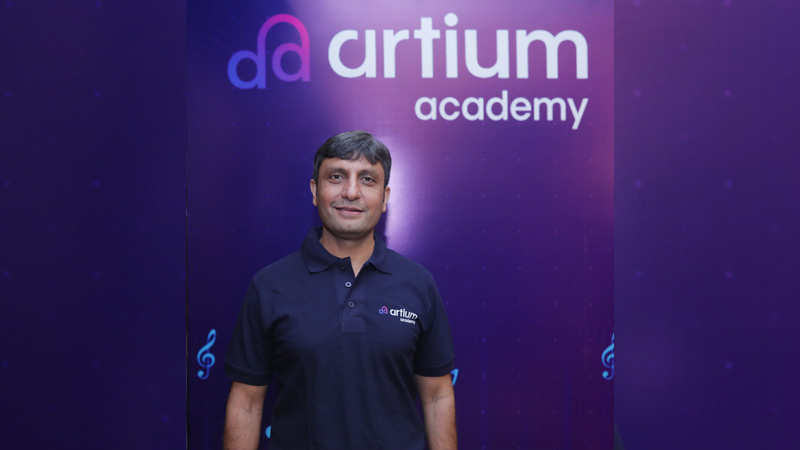
  • I don’t believe that every learner comes to become an artist: Artium Academy’s Ashish Joshi

    I don’t believe that every learner comes to become an artist: Artium Academy’s Ashish Joshi

    Mumbai: As technology and artificial intelligence (AI) continue to reshape music creation, education is also evolving to keep pace with these changes. AI offers musicians advanced tools for creativity and efficiency, while independent music is gaining prominence worldwide.

    Artium Academy steps into this space, offering a forward-thinking approach to music learning. By combining modern pedagogy with AI, they provide a personalised learning experience, nurturing talent from the grassroots level. With guidance from industry legends like Sonu Nigam, Shubha Mudgal, KS Chithra, among others, Artium Academy is transforming the way music education is delivered, helping students evolve from learners to creators.

    Indiantelevision.com’s Arth Chakraborty caught up with Artium Academy founder and CEO Ashish Joshi to discuss the academy’s innovative approach to music education, the role of AI in enhancing learning experiences, the importance of nurturing talent for the independent music scene, and much more…

    Edited Excerpts:

    On the inspiration behind founding Artium Academy, and the evolution of its mission since its inception

    Despite the depth, diversity, and richness of Indian music, which is probably deeper and more diverse than the global music ecosystem, India has never had a music education brand that is truly global. Just imagine the Berklee College of Music, New York and The Juilliard School in the West. That was one of the first thoughts that came to my mind and that’s when we realised that there was also a lack of an outcome-driven education platform globally.

    What I mean is that, once you finish learning, whether on your own or through an institution, you are left to fend for yourself. There is no creative assistance, no creative guidance, or no financial support. Even if you manage to create something of your own, there’s no help with monetisation or distribution. So, the value chain was dysfunctional. Also, the current music education ecosystem in India is rigid and has not evolved. It’s not a globally standardised process like you see in the West or Southeast Asia, where programs are standardised right from school. That’s not the case in India. These were the gaps we saw, which inspired us to start Artium. Today, we are proud to be the largest outcome-driven music education platform.

    On Artium Academy differentiating itself from other music education platforms

    The outcome-led approach I mentioned is one of our key differentiators. There are a few aspects that really stand out. First, we are fortunate to have some of the top maestros in the industry, individuals who have dedicated their life, heart, and soul to music across various genres, such as Sonu Nigam, Shubha Mudgal, K.S. Chithra, Louis Banks and Aruna Sairam. These maestros have come together as part of the academic board at Artium, which is one of our biggest differentiators. The second is that we are the first outcome-driven music education platform. When I say outcomes, they come in two forms: one is a globally certified music education program, and the other is the journey from being a learner to becoming a creator, and eventually an influencer. This comprehensive vertical music play is what sets us apart from other players who are solely focused on music education.

    Additionally, we’ve launched our own music label, where we give opportunity to our talent. Every album we launch includes a collaboration between a superstar from the industry and our talent, giving them a fast track in their growth journey. So, real outcomes are being driven.

    On AI transforming music education and enhancing creativity and efficiency in music production at Artium Academy

    I wouldn’t say that we are using AI to teach learners because I still believe that the learning process is creative, and you can’t depend on AI to start teaching. However we are using AI to enable the post-class practice experience. We’ve built a picture recognition platform as part of our practice studio. So, after the class is over and the learner goes home, they have the content they learned in the class. Through the practice studio, which has an AI-enabled platform, learners can practice and submit their assignments based on the practice they’ve done.

    I feel AI plays a vital role in enabling these self-paced practice sessions when the teacher isn’t available after the live class. That’s one area where AI plays a very important role, and we’re trying to use that as much as possible. We’re also using AI for generating video content. For instance, at Juju Baby Music, all our video content is AI-enabled. This means we don’t have to go outdoors to shoot for any concepts we create around the videos; all the videos are AI-enabled or rather AI-led.

    On the current trend of underdeveloped music styles gaining popularity as compared to the polished styles valued in the past; and this trend affecting young artists’ creative processes

    I believe Lo-Fi is a format of music, but an artist doesn’t have to sing in Lo-Fi. The core process of music learning remains the same, although new genres, such as hip-hop, may be introduced along the way. However, this doesn’t change the approach to vocal training. An artist’s journey typically has two or three key phases: learning, creating (which involves songwriting), and finally, performing. The performance stage is crucial, as it requires the artist to have mastered the fundamentals during their learning phase to excel as a live performer.

    While new formats like Lo-Fi have gained popularity thanks to advancements in technology, they are more about how the music is presented than how it’s learned. Lo-Fi works because most devices can handle stereo sound well, but it’s not a style of singing. The learning process shouldn’t shift based on these evolving formats. More and more artists realise that mastering versatility is essential for them to become multi-genre singers. The nuances of these new formats are tied to production, not to the foundational aspects of learning music.

    On AI tools used in your teaching methods

    Once learners complete their live classes, they have content available on their dashboard for post-class learning. This phase focuses on the practice process, where they can use AI tools to practice with original content and receive feedback on how well they are doing with pitch, sur, and taal. We are efficiently utilising AI here and continue to evolve as we move forward on this journey.

    On Artium Academy supporting aspiring musicians in today’s rapidly evolving industry

    Most music education platforms in the world leave you to fend for yourself once you finish your learning journey. However, at Artium, we have our own music label, Juju Baby Music, where the idea is to take learners journey from being just learners to creators. Once they become creators, we help them through the entire A&R process of grooming them to be the artists of the future. We launch these talents on our own label, and in every album, we feature singles by our creators/artists, along with collaborations between our talent and maestros from the industry. This provides emerging talent with some of the finest exposure they can receive because all they need is a platform for visibility. That’s how we’re progressing with Artium Originals, with Juju Baby being a part of it.

    On Artium Academy defining and measuring success for its students, particularly in terms of their career growth in the music industry

    First, I don’t believe that every learner comes with the intention of becoming an artist; every learner has different reasons for learning. For instance, kids and their parents often want them to acquire cognitive skills, confidence, and the right growth. In that process, they may not focus on performing better.

    For us, the measurement of growth is in three formats. For a group of kids who want to acquire knowledge of music, we offer global certification programs to enable that process. For middle-aged individuals who see music education as a stress buster and seek social equity, we also facilitate their learning journey. For those who come with the intention of becoming creators or influencers of the future, there’s a specific journey we enable. As I mentioned before, these individuals move from being learners to creators.

    We provide them with creative assistance and a platform like Juju Baby Music to create and distribute their music. We also assist them in securing live shows and brand partnerships. So, the whole Juju Baby support system is what we offer to the talents who come to Artium with the intention of becoming the artists of the future.

    On the future of music education evolving and your vision for Artium Academy over the next few years

    I believe music education is growing rapidly for two key reasons. First, there’s a rising narrative among new-age parents that music education is an essential life skill for children. Much like enrolling kids in sports, more young parents are encouraging their children to start learning music as early as five or six years old. Second, India has never had a globally certified music education program, especially for Indian classical music, and I see that now emerging strongly. Moreover, with the government of India’s new education policy (NEP 2020) making music education an elective subject in CBSE and ICSE schools, this will further boost its growth.

    Overall, I see the growth of music education across different age groups and demographics as a healthy and positive trend. I also envision Artium Academy becoming the leading outcome-driven music education platform, starting with global Indians and eventually expanding across all cultures to become a truly global platform. By offering a platform for future creators, I see us as the foundation of talent, uniting creators under one umbrella within the next three to four years. Our goal is to be the largest hub for music creators, and with these creators as part of our ecosystem, we will generate significant independent music intellectual property (IP).

    In this way, we aim to build the largest independent music IP platform. On one side, we’ll be the largest education platform, on the other, the largest hub for music creators, and simultaneously, the biggest platform for producing independent music IP. That’s the future I see for Artium.

  • Finolex Pipes celebrates Navratri with ‘Peedhiyan Badlengi, Parampara Nahi’ campaign

    Finolex Pipes celebrates Navratri with ‘Peedhiyan Badlengi, Parampara Nahi’ campaign

    Mumbai: Finolex Pipes and Fittings, India’s leading pipe brand, has launched its Navratri campaign, continuing the successful ‘Peedhiyan Badlengi, Parampara Nahi’ (Generations Change, Traditions Don’t) series. The campaign explores the rich diversity of Navratri celebrations across India through three captivating videos that bring cultural stories to life with AI-generated visuals.

    The first video of the series is already live, and the second video premieres today, 7 October 2024. The final video is set for release on 9 October 2024. The campaign invites viewers to engage by sharing their personal Navratri stories on Finolex’s social media platforms, fostering a deeper community connection.

    Finolex Pipes & Fittings, vice president of marketing and communications, Sumit Bhatia says, “Navratri embodies resilience, continuity, and unity – values that Finolex champions. Our visually stunning campaign not only honors enduring traditions but also invites audiences to connect with the festival’s essence in a modern and engaging way.”

    Finolex continues to lead with innovation, using AI to highlight how traditions evolve while maintaining their core significance. This campaign builds on the success of Finolex’s Ganesh Chaturthi initiative, reaffirming the brand’s commitment to celebrating timeless traditions.

    https://www.instagram.com/finolexpipesandfittings/

    http://www.finolexpipes.com

    http://www.mmpc.in


  • AI, Hip-Hop, and the Casino Effect: The Future of Music Production

    AI, Hip-Hop, and the Casino Effect: The Future of Music Production

    Artificial Intelligence has emerged as a transformative force in various industries, especially the creative sectors. For instance, movie production has taken a turn for greatness with the advent of CGI, deep fake technology, and AI-driven animation. The music industry is also not left out, with AI enhancing efficiency and automating repetitive tasks. 

    AI is beginning to play a pivotal role in how music is created, distributed, and consumed. For instance, the “casino effect” — how digital platforms and algorithms influence our decisions — has also started reshaping the music production landscape. So, don’t be surprised that AI and the casino effect are pushing the boundaries of what’s possible in hip-hop.

    Areas Where AI and Casino Effect Impact the Music Industry

    Do you remember what takes you to the casino or makes you click the visit website button to access your favourite online casino games? That is probably the thrill of winning, the immersion of getting engaged with your favourite games, the fulfilment of taking a challenge, or all of these and more. 
    The casino uses unpredictability to create immersive games for thrilling and engaging rewards. So, the music industry has taken a cue from this. Various aspects of music production use the casino effect to boost efficiency and dynamism. Some of the parts of music production where AI and the casino effects are making the waves include:

    ● Song composition and writing;
    ● Sound design and audio effects;
    ● Song mixing and mastering;
    ● Music recommendation and recovery;
    ● Music marketing and distribution;
    ● AI-generated music video and visual effects.

    Therefore, AI is involved in every aspect of music production and usage. It plays a huge role in the industry’s emerging trends, especially hip-hop music.

    The Outcome of AI and the Casino Effect on the Music Industry

    AI is increasingly being integrated into the music production process, offering tools that can assist producers, beatmakers, and artists in creating music. 
    While people using AI to produce songs can program it to follow some commands, it can also come up with some randomness, just like in the casino. This creates a thrill and can help artists discover creative breakthroughs that would not have otherwise been possible in the traditional music landscape. Below are some notable outcomes of AI and casino effect on the music industry:

    Personalisation and Adaptive Music

    AI can analyse users’ preferences and make data-driven decisions. As such, it can easily create and suggest music and elements tailored to users’ needs, enabling the producer to make the needed music. With such a level of personalisation, users become more committed, increasing emotional connection and engagement, just like the casino tailoring experiences to its users’ needs. 
    Also, AI has become increasingly adaptive, and it can make real-time changes to songs to suit users’ needs, preferences, moods, and tastes. As such, the music stays fresh in demand.

    Enhanced Emotional Engagement

    The popular belief is that the advent of AI leads to the loss of human touch in many industries and sectors. However, its advancement in understanding and working with people’s emotions can never be denied. 
    Many people now use wearable devices to store data about their moods and emotions, from where AI can pick and store data and eventually make songs for their enjoyment. It can also make music to target various emotional responses and needs, overall personalising the songs for the listener’s greatest needs.

    Optimising Sound Design

    The soundscape has totally transformed from what it used to be. AI can create complex sounds that captivate the users and have all the finer details taken care of. AI can also capture and ensure proper sequences of sound-making elements, including melody, rhythm, and arrangements.

    Data-Driven Hit-Making

    AI helps make games that appeal to emotions and uses available datasets to suggest hit songs and enhance song production to give the best quality. It analyses hit songs for producers, giving them insights into how to make the best songs for their audience. Also, producers can easily predict the songs and elements that are received by the audience. Many casinos have also used the same tactic to know what games to produce or prioritise, making the business soar.

    Interactive and Gamified Music Experiences

    Music is now beyond the game. Producers can create gamified music structures that enable users to get more involved in music selection and production. The casino has a long reputation for being a customer-centric landscape, so the music industry adopting such a casino effect is a major transformation.

    How Will AI and the Casino Effect Drive the Future of Music Production?

    AI and the casino effect are currently storming the music production landscape. However, these two are seemingly going to be around for a while. In fact, the future holds more than we currently see. Not only will these individual factors affect music production on their own, but there are also possible convergences of their effects, leading to bigger revolutions. The table below gives an overview of what to expect.

    Aspect

    The Role of AI

    Casino Effect

    Convergence of AI & Casino Effect

    Music Creation

    Automated composition and production

    Emphasis on shorter, hook-driven tracks and focus on instant gratification

    AI predicting engaging content based on listener data

    Personalisation

    Tailored music experiences based on user data

    Predictive algorithms to keep users engaged

    Custom playlists or songs created to retain users

    Music Consumption

    AI-curated playlists and predictive content delivery

    Gamification of music platforms and reward-based listening systems

    Dynamic recommendations to maximise engagement

    Monetisation

    Enhanced advertising through AI

    Microtransactions and virtual rewards

    New subscription models offering personalised experiences

    Cultural Impact

    Shift in music education focus toward AI tools

    Potential decline in long-form music formats

    New patterns of music discovery and consumption

    Challenges and Considerations of AI and Casino Effect on Music Production

    Undoubtedly, AI and the casino effect have influenced music production positively in many ways. However, stakeholders and other partakers of the music industry have some concerns as regards the challenges AI and the casino effects in the music industry pose. Below are notable challenges and considerations of AI in music production:

    Creative Homogenisation

    AI works with data and usually relies on data analysis and existing datasets to generate new content, including songs. There have been concerns about music sounding repetitive and homogenous because AI relies on the existing data set to produce new ones. Also, AI might remove genuine originality by prioritising trends and patterns over genuine innovation.

    Decreased Motivation for Artists

    While AI and the casino effect can help artists’ innovations, they can also decrease the artist’s innovation to produce. Instead, artists can be driven by instant gratification, preventing them from having the drive to take creative risks.

    Shortened Attention Span

    The casino effect in music is believed to limit attention span. Instead, there is more dopamine-triggered consumption of music. Just like gambling is designed to keep players engaged and immersed, the casino effect in music production focuses on creating catchy and short music. While this is great, it can decrease the listener’s overall attention span and reduce their connection to the lyrical landscape.

    Ethical Concerns

    Ethical concerns have arisen about the use of AI in various fields, and music production is not left out. Many people have questioned the possibility of deep fakes, with AI creating songs with artists’ voices without permission. This is especially possible since they work with available datasets. Not only can this create a tedious ethical brawl, but it can also lead to a messy legal battle.

    Conclusion

    The casino effects are no doubt welcome in various sectors. With the thrill of unpredictability, immersion, and personalisation, everyone wants a taste of what casino lovers get without even going to the casino. Fortunately, music has recreated this thrill with AI as its backbone.

    The casino effect is most especially obvious in the Hip-Hop genre. It enables personalisation, enhanced engagement, optimised sound design, and automated and creative songwriting and composition, among other benefits.

    AI and casino effect will have more to gain in the future, with each functional individually and their convergence even more powerful. While there are concerns, further work and integration will address them quickly.

    Disclaimer: This article does not have journalistic/ editorial involvement of indiantelevision.comindiantelevision.com group or its websites does not endorse/ subscribe to the contents of the article/advertisement and/or views expressed herein.

    The reader is further advised that Online Casino, Betting, Online Gaming , Crypto products, Financial Investments/Engagement , NFTs, Products associated with health, wellness, and food are unregulated and can be highly risky. There may be no regulatory recourse for any loss from such transactions or risk associated with health conditions.

    Indiantelevision.com group shall not in any manner, be responsible and/or liable in any manner whatsoever for all that is stated in the article and/or also with regard to the views, opinions, announcements, declarations, affirmations etc., stated/featured in the same. The decision to read hereinafter is purely a matter of choice and shall be construed as an express undertaking/guarantee in favour of indiantelevision.com (indiantelevision.com group) of being absolved from any/ all potential legal action, or enforceable claims. The content may be for information and awareness purposes and does not constitute financial advice. 

  • TV9 Bangla unveils Durga Puja song

    TV9 Bangla unveils Durga Puja song

    Mumbai: Highlighting the spirit of Durga Puja in a unique style, TV9 Bangla launched a campaign showcasing popular areas in Kolkata frequented by pandal hoppers, including Bagbazar, known for its traditional theme, and Maddox puja, famous for its youthful crowd. It also mentions Bosepukur, which was among the first to introduce theme pujas in Kolkata and features the light and décor of Ekdalia Evergreen. Additionally, the song recalls notable pujas in Naktala and Samaj Sebi, among others.

    The campaign features two protagonists visiting pandals across the city while the TV9 Bangla OB van travels to district hotspots in Bengal, including Hazar Duari, Bandel Church, and Cooch Behar Raj Bari. Highlighting the tagline “Na Dekhleyi Noye,” meaning not complete without seeing, the new campaign song emphasizes that the day’s news from TV9 Bangla is essential, just as seeing Ma Durga during Durga Puja is necessary, with the music capturing the festive spirit.

    The campaign’s visuals combine AI and graphics, with hand-sketched and painted elements animated to match the background score. AI enhances the animation, and VFX is used for special effects after framing each shot.

    The campaign song features contributions from NEO – The Creative Company as the agency, music composed by Ishaan, and vocals by Upal Sengupta.

    On this occasion, TV9 Bangla managing editor and business head Amritanshu Bhattacharya asserted, “TV9 Bangla has been serving ground-breaking and factfinding news across Bengal. With Durga puja approaching, we are proud to present a contemporary puja release campaign that has a realistic touch of news. On deploying AI technology and graphical representation, this song will ring into the mood of festivities.”

  • The role of AI in shaping tomorrow’s workforce

    The role of AI in shaping tomorrow’s workforce

    The rapid advancement of AI technologies, particularly in recent years, has sparked both excitement and concern about their potential to replace human roles across various sectors. Tools like ChatGPT have demonstrated the ability to perform tasks that were once the exclusive domain of humans, such as writing, coding, and even creative endeavours like photography and editing. As AI continues to evolve, it raises a pressing question: Can AI truly take over human jobs, and if so, what does that mean for the future of work?

    The introduction of tools like Chat GPT, Sora, GitHub and others has given us a peek into how AI can change the way we live and work. The tasks that used to take hours or days can now be completed in minutes. And this is just the beginning. As AI evolves, we will enable humans to take over multiple roles across fields. In industries like customer service, technical writing, and content creation, AI is already making inroads by handling routine inquiries, drafting reports, and even brainstorming creative ideas. ChatGPT and its peers are reducing the need for human labour in some areas, demonstrating AI’s potential to take on roles that involve knowledge-based work.

    How well is AI doing our jobs?

    At this very moment, 57 per cent of content on the internet that exists is generated by AI, according to a study by Amazon Web Services. Another report by Forbes stated that 90 pet cent of content on the internet will be generated by AI by 2025. Automation in manufacturing has already replaced many manual jobs with robots capable of performing tasks faster and more efficiently than humans, reducing costs and increasing productivity.

    The field of programming, once seen as an impenetrable domain for AI, is now being influenced by it. Advanced AI tools can write code, assist in debugging, and automate repetitive tasks, making development cycles faster and more efficient. Companies are leveraging AI to handle everything from boilerplate code generation to automating the testing process, reducing reliance on entry-level programmers.

    AI is also making headway into creative areas like photography and editing, once thought to be immune to the impact of AI. In photography, AI-powered tools can automatically edit images, adjust lighting, and enhance photo quality, removing much of the manual labour involved in post-production. Video editing, too, is being streamlined by AI, which can cut and arrange footage based on pre-set preferences. AI is also creating music, providing voice assistance, teaching some of the hardest subjects and many more things across many industries. If we assume AI is going to take over every industry at the same rate, most of the jobs we have today will be taken over by AI sooner than expected.

    The reality of AI taking over our jobs

    While some jobs will inevitably be automated and taken over, AI is more likely to reshape roles rather than eliminate them entirely. The World Economic Forum’s Future of Jobs Report highlights that by 2025, AI could replace 85 million jobs, but it is also expected to create 97 million new ones. This shift shows that the focus will be on changing the types of jobs people do, rather than reducing the number of jobs overall.

    Moreover, no company can run entirely on AI. A recent incident of Microsoft’s “Blue Screen of Death” showed the dangers of over-reliance on technology. A faulty update from CrowdStrike caused a global outage, disrupting hundreds of planes, hospitals, trains, offices, and more. It was a clear reminder of the risks of depending too much on AI or any technology. To truly benefit from AI’s potential, we must combine its strengths with human oversight, ensuring a balanced approach as we move forward. From what we have seen so far, “AI won’t replace human jobs but the people who can use AI could replace them”. With evolving technology and workplaces continuously streamlining operations, we will need to adapt to the technology and upskill ourselves to become more efficient.

    Conclusion: Will AI take over?

    AI is undoubtedly transforming industries and changing the way we work, but a complete takeover of human roles remains unlikely—at least for now. While AI excels in automating tasks and replicating certain aspects of creativity, it cannot fully replace human ingenuity, empathy, and emotional understanding. The future of work will likely see a blend of AI and human collaboration, where AI handles repetitive and technical tasks, and humans focus on creative, strategic, and emotionally driven roles. As AI continues to advance, it’s crucial that employees and companies adapt, ensuring that the benefits of AI are harnessed while preserving the unique qualities that only humans can bring to the table.

    The article has been authored by Mudrex CEO & co-founder Edul Patel.
     

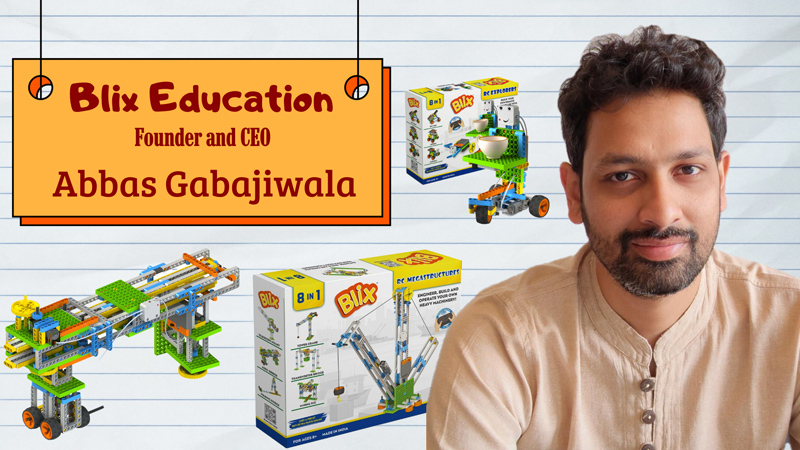
  • We envision toys evolving with tech for each child’s personalised learning: Blix Education’s Abbas Gabajiwala

    We envision toys evolving with tech for each child’s personalised learning: Blix Education’s Abbas Gabajiwala

    Mumbai: As children’s interests and playtime habits evolve, brands like Blix Education are transforming the way they learn, blending creativity and technology to make play more than just fun. Offering a wide range of interactive STEAM-based toys, Blix Education taps into children’s curiosity, allowing them to explore and build through hands-on experiences. The brand doesn’t just focus on entertainment but brings education into the mix in a way that’s both engaging and innovative.

    Founded by Abbas Gabajiwala, Blix Education stands out for its commitment to merging play with learning through its STEAM (Science, Technology, Engineering, Arts, and Mathematics) toys. Known for its versatile and reusable toy sets, Blix Education’s offerings include everything from robotics kits to modular construction sets, as well as comprehensive STEAM lab setups for schools. Blix Education’s products are available on major platforms such as Amazon and Flipkart, and in retail stores like Hamleys. Globally, Blix Education toys are utilized in educational settings from Singapore to Germany, enhancing learning experiences across continents. Gabajiwala, a former CTO and award-winning designer, leverages his expertise to craft toys that nurture creativity and problem-solving skills, making Blix Education a global leader in educational play.

    Indiantelevision.com’s Arth Chakraborty in a chat with Blix Education’s founder and CEO Abbas Gabajiwala to gain deeper insights on how STEAM toys are transforming children’s learning experiences, the challenges of promoting STEM products in non-traditional markets, and more…

    Edited Excerpts:

    On STEM toys being better than traditional toys

    STEM toys offer a distinct advantage over traditional toys by integrating education with play, encouraging children to explore concepts in science, technology, engineering, and mathematics. While traditional toys primarily focus on entertainment, STEM toys stimulate critical thinking, problem-solving, and creativity. They provide a hands-on learning experience, enabling kids to grasp complex ideas in an interactive and engaging manner.

    STEM toys grow alongside a child’s curiosity, encouraging them to build, experiment, and innovate while developing a deeper understanding of how things work. These toys are designed to accommodate various learning styles, offering a wide range of activities that nurture cognitive development and creative problem-solving skills. By engaging with STEM toys, children are constantly challenged to think critically and explore new concepts, making learning a more interactive and enriching experience.

    Ultimately, STEM toys not only entertain but equip children with essential skills for future careers, helping them develop a passion for learning while playing. They bridge the gap between fun and education, making them a more enriching option than traditional toys.

    On the challenges that you faced in promoting STEM toys in non-traditional markets

    Promoting STEM toys in non-traditional markets presents several challenges. One of the main hurdles is a lack of awareness and understanding of the benefits of STEM education. Many parents and educators in these regions may be unfamiliar with the concept, associating toys with entertainment rather than learning. This makes it difficult to convey the value of STEM toys as tools for cognitive and creative development.

    Our most popular product is Blix Queaky which is an experimental toy teaching children about electricity and conductivity. The biggest challenge in promoting this, is lack of understanding of the product or why it functions that way. When we sell these toys, parents expect them to work exactly as shown, and are disappointed when they don’t, they don’t understand that actual learning happens with experimentations.  

    Additionally, there can be cultural resistance to new educational methods, with a preference for more conventional forms of education. Economic factors also play a role, as STEM toys, often perceived as premium products, may be considered too costly for some families.

    On technology-driven toys changing the way kids learn science and engineering

    Technology-driven toys are revolutionising how children learn science and engineering by transforming abstract concepts into hands-on experiences. These toys, like STEM-based robotics kits or coding games, allow kids to experiment and explore in interactive, engaging ways, fostering deeper understanding. Instead of passively absorbing information, children actively apply principles of science, technology, engineering, and mathematics (STEM) while building, programming, or solving real-world problems.

    Technology is all around us. Children as young as aged one and two know how to use the phones, press buttons, watch their favourite youtube videos and play games. However we need to teach them how this technology has been made – they need to be the future creaters of this technology and instead of just playing and using existing technology, we need to teach children how to learn from it and create more.

    Through play, kids develop critical thinking, problem-solving, and creativity, essential skills for the future. Technology-driven toys break down complex ideas into manageable, bite-sized challenges that make learning accessible and fun. For example, building a robot or designing a simple circuit can introduce children to the basics of engineering and electronics without the intimidation often associated with these subjects.

    These toys also encourage independent learning and curiosity, enabling kids to discover how things work while nurturing their interest in STEM fields from an early age.

    On securing funding from Shark Tank India Season 3 impact Blix’s growth trajectory

    Blix received the funding in the season but due to some internal reason they did not accept it later. But Blix has been on an upward growth trajectory since being aired on shark tank. We have come into the limelight and have helped educate people on the importance of STEM based learning in India.

    On the innovations in toy technology that excite you the most right now

    Right now, innovations in toy technology that excite me the most are those that combine artificial intelligence (AI) with hands-on learning experiences. AI-powered educational toys that adapt to a child’s learning pace and preferences can revolutionize how children engage with STEM subjects. These toys personalise the learning experience, making it more interactive and tailored to each child’s strengths, which enhances retention and understanding.

    Our award winning – first time in India DIY remote controlled construction set has taken the Indian toy market by storm. For children to now make RC operated structures opens a whole new world of play and a multifold ways of playing with our kits.

    Another exciting development is the integration of augmented reality (AR) with physical toys, allowing children to explore virtual worlds while building real-life skills. AR enables dynamic storytelling and immersive experiences, making science, technology, engineering, and math concepts more accessible and engaging.

    Finally, modular robotics kits, which allow children to build and program their robots, inspire creativity and problem-solving. These innovations not only make learning fun but also prepare children for future careers in an increasingly tech-driven world, making toy technology an exciting frontier. During Gapanpati puja, Blix used their toys to do aarti. On this Instagram link you can see how even children can make such inspiring toys so easily:


    On early exposure to STEM influencing children’s future career choices

    Early exposure to STEM (Science, Technology, Engineering, and Mathematics) plays a crucial role in shaping children’s future career choices. When children engage with STEM concepts from a young age, they develop problem-solving, critical thinking, and analytical skills that are foundational for many careers in technology, engineering, and science fields.

    STEM activities and toys stimulate curiosity, encourage hands-on learning, and foster a love for discovery, making complex subjects approachable and enjoyable. As children experiment and explore, they become more confident in their abilities to solve real-world problems, which can ignite long-term interest in STEM-related careers.

    This early foundation broadens their understanding of potential career paths, making them more likely to pursue professions in fields like engineering, robotics, programming, or research. Moreover, the ability to adapt and innovate—skills nurtured by early STEM exposure—gives them a competitive edge in a rapidly evolving, tech-centric world.

    On balancing fun and functionality when designing new toys

    Balancing fun and functionality when designing new toys is key to creating engaging and educational experiences for children. At Blix, we prioritise both aspects by focusing on interactive, hands-on learning that naturally incorporates essential STEM (science, technology, engineering, and mathematics) concepts. Our design process begins with understanding how children learn and play, ensuring that every toy captures their attention and curiosity through fun challenges and engaging tasks.

    Functionality comes from embedding educational value within the toy, allowing children to explore problem-solving, critical thinking, and creativity while having fun. We carefully choose designs that encourage kids to build, experiment, and explore while maintaining simplicity and playfulness. By merging entertainment with STEM-based learning, we ensure our toys not only bring joy but also equip children with the tools to understand and apply complex concepts in real-world scenarios.

    This balance keeps children excited about learning and helps parents see the long-term benefits.

    On the evolution of toys in the coming years and Blix contributing to the future of play globally

    In the coming years, toys are expected to evolve significantly, driven by advancements in technology and a growing emphasis on personalised learning. We envision a future where toys integrate more seamlessly with digital platforms, offering interactive experiences that adapt to each child’s learning style and pace. Emerging technologies such as augmented reality (AR), artificial intelligence (AI), and IoT (Internet of Things) will play a crucial role in making playtime more immersive and educational.

    Blix is committed to leading this transformation by continuously innovating and integrating these technologies into our STEM toys. We aim to create products that not only entertain but also provide valuable educational experiences. Our focus will be on developing toys that enhance problem-solving skills, foster creativity, and prepare children for future careers in technology and engineering. By staying at the forefront of educational toy design, Blix will contribute to shaping the future of play globally, making learning an engaging and dynamic journey for children.

    Blix recently launched their RC megastructures set which allows children to develop replicas of transporter and folding bridges, which offers a building challenge and educates on the mechanics of intricate bridge designs. Additionally, to mimic the functionality of heavy operational machinery like mining drills or industrial gantry cranes, this innovative set helps users understand the intricacy of X-Y motion systems commonly used in manufacturing and engineering.