Tag: Ahmed Abdi

  • ‘Civil court disallowed disconnection, made no comment on cable pricing’

    MUMBAI: It appears that the media (including this website) got it wrong on the contents of a ruling delivered by a city civil court on Friday on a petition filed by Ahmed Abdi, president of the Mumbai-based Consumer Action Network
    The president of the Federation of Cable Operator Association (FCAO) Ravi Singh clarified today that city civil judge RS Dalvi in her ruling had made no comment on the pricing of cable channels but had only ordered that the cable operators were disallowed from disconnecting connections of the plaintiffs until further orders.
    This is contrary to the reports that said that Friday’s ruling means that that cable television subscribers in Mumbai’s suburbs will now have to pay only Rs 110 per month as subscription fees for all channels, including pay ones, till the time that CAS takes effect in their area.
    The respondents in the suit filed by Abdi were Seven Star Cable and Cable Video Network, both based in the western Mumbai suburb of Andheri. The fact that both defendents were absent during the hearing is what increased the confusion around this case. The next date of hearing of the case is 17 October. 
    Also Read:
    Civil court: non-CAS areas of Mumbai to pay Rs 110 for all channels

  • Civil court: non-CAS areas of Mumbai to pay Rs 110 for all channels

    Civil court: non-CAS areas of Mumbai to pay Rs 110 for all channels

    MUMBAI: Conditional access may exist in Mumbai only when quoting legalese, but it is taking the legal position in mind that a Mumbai civil court on Friday ruled that cable television subscribers in Mumbais suburbs will now have to pay only Rs 110 per month as subscription fees for all channels, including pay ones, till the time that CAS takes effect in their area.

    City civil judge RS Dalvi, hearing a suit filed by Ahmed Abdi, president of Consumer Action Network, on Friday observed that the Bombay High Court had earlier declined to stay the implementation of CAS. Dalvi therefore held that cable operators could charge only Rs 72 plus taxes (Rs 110 per month) in the entire metropolis, excluding Zone A (from Colaba to Sion covering the entire island city where CAS was supposed to be implemented from 10 September). This will be in effect in the suburbs till CAS is implemented, she has ruled. The ruling also states that cable operators are disallowed from disconnecting connections of the plaintiffs until further orders.

    Abdi argued that since he lives in the western suburb of Andheri, which comes under Zone 2 where CAS is to become effective from 1 October, he should be charged only Rs 110 per month for all the channels available.

    The respondents in the suit filed by Abdi were Seven Star Cable and Cable Video Network, both based in the western Mumbai suburb of Andheri. The fact that both defendents were absent during the hearing could have been another factor that went against them. The next date of hearing of the case is 17 October.

  • Consumer group demands government action on CAS

    Consumer group demands government action on CAS

    The Consumer Action Network (CAN) has censured the central government for failing to implement the recommendations of the task force on the introduction of a Conditional Access System.

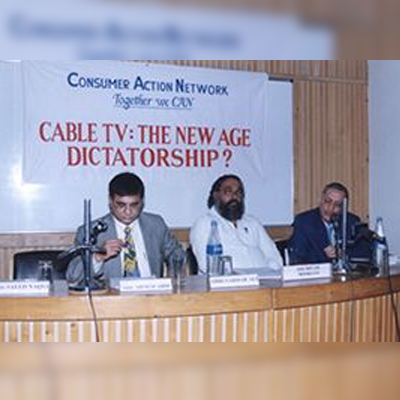
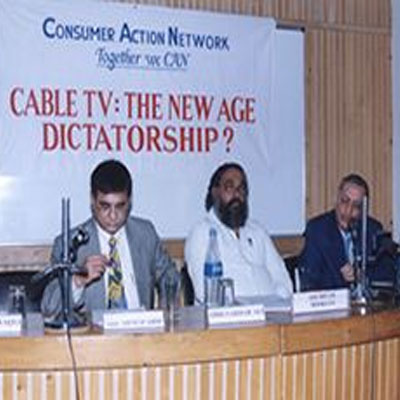
    CAN held a seminar on ‘Cable TV : New Age Dictatorship’ in New Delhi on 16 April, where speakers denounced ever increasing cable rates and subsequent government inaction. An organisation comprising a group of spirited citizens with special concern for consumer welfare, CAN claims the seminar helped raise several related issues faced by cable consumers.

    The purpose of the seminar was to highlight and voice issues currently faced by cable TV viewers in the country. It aimed at being a platform for face – to – face dialogue with cable ops and broadcasters. Speakers included former MRTP acting chairman Sardar Ali, journalist Saeed Naqvi, Hinduja TMT executive vice president Ashok Mansukhani, Delhi high court advocate Shyam Moorjani, and CAN president Ahmed Abdi.

    Some of the issues discussed at the seminar included freedom of choice, arbitrary rate hikes, absence of any regulatory authority in India unlike other countries and lack of initiative on the government’s part.

    Abdi lamented the present state of the consumer who has neither choice in selection of channels nor in deciding the rates. Cable rates have increased by more than 400 per cent in five years, he pointed out. He alleged that suits broadcasters to delay the introduction of Conditional Access as they would no longer be able to bundle their weak channels and sell them forcibly along with the popular channels.

    Naqvi commented that there was a need to create awareness on such issues through forums, debates and seminars. Moorjani stressed on the need for a regulatory authority to be formed that can regulate the broadcasting and cable industry and protect consumers. Cable TV, which has more than 200 million users in India and which is projected to grow into a Rs 5000 billion advertising industry, does not have any regulatory authority, he said.

    Speaking on behalf of the cable industry, Mansukhani supported the consumers’ viewpoint and said that transparency should come in and that the cable industry is sick of allegations of ‘underdeclaration’. He stressed the need for a regulatory authority and conditional access. He also stressed on the need to freeze the rates.

    The recordings of the findings and suggestions of the seminar will be forwarded to the information and broadcasting ministry.

  • Consumer group demands government action on CAS

    Consumer group demands government action on CAS

    Delhi-based citizen’s forum Consumer Action Network (CAN), has censured the Central government for failing to implement the recommendations of the task force on the introduction of conditional access systems.

    CAN held a seminar on ‘Cable TV: New Age Dictatorship’ in New Delhi on 16 April, where speakers denounced ever increasing cable rates and subsequent government inaction. CAN claims the seminar helped raise several related issues faced by cable consumers.

    CAN president Ahmed Abdi, advocate Shyam Moorjani and Hinduja TMT executive VP Ashok Mansukhani at the seminar

    The purpose of the seminar was to highlight and voice issues currently faced by cable TV viewers in the country. It aimed at being a platform for face-to-face dialogue with cable ops and broadcasters. Speakers included former MRTP acting chairman Sardar Ali, journalist Saeed Naqvi, Hinduja TMT executive vice-president Ashok Mansukhani, Delhi high court advocate Shyam Moorjani, and CAN president Ahmed Abdi. 

    Some of the issues discussed at the seminar included freedom of choice, arbitrary rate hikes, absence of any regulatory authority in India unlike other countries and lack of initiative on the government’s part. 

    Abdi lamented the present state of the consumer who has neither choice in selection of channels nor in deciding the rates. Cable rates have increased by more than 400 per cent in five years, he pointed out. He alleged that it suited broadcasters to delay the introduction of conditional access as they would no longer be able to bundle their weak channels and sell them forcibly along with the popular channels. 

    Naqvi commented that there was a need to create awareness on such issues through forums, debates and seminars. Moorjani stressed on the need for a regulatory authority to be formed that can regulate the broadcasting and cable industry and protect consumers. Cable TV, which has more than 200 million users in India and which is projected to grow into a Rs 5000 billion advertising industry, does not have any regulatory authority, he said. 

    Speaking on behalf of the cable industry, Mansukhani said that transparency should come in and that the cable industry was sick of allegations of “underdeclaration”. He stressed the need for a regulatory authority and conditional access. He also stressed on the need to freeze the rates.

    The recordings of the findings and suggestions of the seminar will be forwarded to the information and broadcasting ministry.