Tag: Agrani satellite

  • Chandra plans to revive satellite project

    Chandra plans to revive satellite project

    MUMBAI: Subhash Chandra is planning to revive his satellite project. Essel Group owned Agrani Satellite Services Ltd (ASSL) is in negotiations with three companies including Indian Space Research Organisation (Isro) for a Ku-band satellite.

    “We will be finalising in three months whether we want to acquire or build a satellite. We expect to have the satellite by the third quarter of 2007,” said Zee Telefilms Ltd director Punit Goenka.

    Isro has sent a proposal to make a satellite for ASC Enterprises with 12 Ku-band transponders. “We are examining their proposal. We are also in talks with two other global satellite providers,” said Goenka who is the chief of ASC Enterprises Ltd, the company which holds ASSL, and also the business head of Zee TV.

    ASSL plans to invest $40-80 million, depending on the capacity of the satellite it wants to purchase. “The cost of a satellite would be around $4 million per transponder. When we had earlier planned the Agrani satellite, the cost was working out to $7.5 million per transponder,” Goenka said.

    Agrani Satellite Services Ltd (ASSL) had planned to acquire a geo-stationary satellite from French major Alcatel Space Industries (ASI) for Rs 950 crore. The C and Ku-band satellite was to begin commercial operations by Arianespace. The company, with small stake from Alcatel and Arianespace, would have C and Ku-band transponders to support a broad range of applications ranging from TV broadcasting and DTH to rural and VSAT networks, domestic and international Internet backbone bandwidth as well as direct access and international connectivity.

    “We are now looking at only Ku-band transponders. The demand for C-band is slowing down,” said Goenka.

    The company already has a license for operating Indian satellite systems. Dish TV, the direct-to-home service, will move its channels to the new satellite if Chandra decides to go ahead with the project. Currently, it uses eight Ku-band transponders on the NSS satellite.

    ASC Enterprises has, however, shelved its retail convergent products and services. “We had plans of establishing a nationwide chain of stores for retailing these products. But we are not going ahead with this project,” Goenka said.
     

  • Singh panel report: no speedy impact on DTH

    Singh panel report: no speedy impact on DTH

    NEW DELHI: The recommendations of the NK Singh panel on FDI that the media cap of 20 per cent in a DTH venture should be hiked to 49 per cent is highly unlikely to have any immediate impact on the proposed plans of those players – Rupert Murdoch and Subhash Chandra – interested in entering the KU-band DTH TV service sector in India.

    According to broadcasting industry observers, the reason that such recommendations would not have an immediate is impact because the government will take its own sweet time in accepting the suggestion and subsequently directing the various departments and organizations to act on the suggestions.

    But it has been accepted by the industry that certain sections of the government – NK Singh is with the Planning Commission, which is a government body – have at least acknowledged the fact that mere policies would not attract private players , specially FDI. The case of DTH is an example. The policy was announced late 2000, but till date no player has even firmed up its plans to enter this sector.

    The Planning Commission had earlier also observed that the media cap of 20 per cent in a DTH venture should be relaxed and the policy guidelines relaxed as the whole policy had failed to create any sign if life in this sector. Apart from saying that the ministry was looking into the suggestion, information and broadcasting minister Sushma Swaraj or the government has done precious little in this regard.

    Even if everything is hunky-dory and the government gives all necessary permissions in a jiffy, after having co-opting suggestions on relaxation in FDI caps in a DTH venture, the final okay can come only sometime in the fourth quarter of this calendar year, industry experts have opined.

    Even with relaxed FDI norms, a DTH venture will still need Indian partners who have an appetite for pretty investments in a venture where the gestation period is long.

    Coupled with other things which need to be put in place, even Star, probably, cannot start a DTH venture before the first quarter of 2004. If work is done at a break-neck speed, the DTH venture may get off the ground sometime during the last quarter of 2003.

    A typical DTH venture will need investment between $ 400 – 500 million and various studies undertaken in India have indicated that any company starting a DTH venture in India would be fortunate if it manages to corner a couple of million subscribers with three years. Considering the investment involved and the slow pace of cobbling together a decent subscriber base, a DTH venture will take that much long to even reach the level of operational profits.

    Though Star executives can raise a toast to the positive recommendations of the NK Singh panels, it is Subhash Chandra and his satellite company that has to be watched where DTH is concerned.

    ASC Enterprises Ltd, implementing the Agrani satellite project, is one of the two applicants that have sought permission for a DTH venture from the government. The other is Space TV, an affiliate of Star India Ltd.

    Though sources in ASC Enterprises Ltd today told indiantelevision.com that the Singh panel report does not have any immediate bearing on the company’s plans, Star sources indicated that it is a positive step forward, but lot more needs to be done and clarified.

  • Agrani satellite transponders to be used for DTH platform

    Agrani satellite transponders to be used for DTH platform

    After Star, it is the turn of the Subhash Chandra-controlled Essel Group promoted ASC Enterprises Limited (ASCEL) to apply for a DTH license.

    Agrani Satellite Services Limited (an ASC Enterprise) has signed a turnkey satellite contract for India’s first private sector satellite initiative, thus agreeing to procure a geostationary, C & Ku band satellite from Alcatel Space Industries of France. The deal involves ‘in-orbit delivery’ of the satellite and a ground control station by Alcatel and Arianespace will provide the Launch Services. The project is estimated to cost Rs11 billion.

    According to the information available, seven to 10 transponders on the satellite will be used for the DTH platform, while the remaining will be used for telecom purposes. There is no clear word though when the company proposes to launch the DTH platform. This will depend in large measure.

    The high power KU band spot beam of the proposed Agrani satellite is ideally suited for Direct to Home signals, as well as to provide domestic bandwidth to various Telecom and Internet Service Providers, analysts said. 

    The power of the Ku band transponder(s) on the proposed Agrani satellite is designed to take care of heavy rainfall in costal and hilly areas of the country.

    “The project will save foreign exchange out flow, enable TV channels to be up-linked from Indian soil using Indian Satellite system,” a senior executive of an Indian-controlled broadcasting company opined.

    ASSL is the first Indian private satellite system to be authorised by the Government of India under May 2000 SatCom policy framework. The Government has also approved the equity participation of Alcatel and Arianespace in ASSL.

    Government of India’s Satcom policy announced in May 2000 and operationalised in November 2000 allows private Indian companies to launch, own, operate and maintain private satellite systems as Indian registered satellite.

    The policy also allows preference treatment to the Indian registered satellite (including the INSAT Satellites which have also been allowed to be used by Private Indian Companies); if suitable capacity is available on INSAT or Private Indian Satellite Systems, the service provision of any kind on the Foreign Satellite will not be permitted. Currently India uses more than 80 transponders on different foreign satellites.

    Other than INSAT, ASSL will be the only satellite system to offer C-band capacity on an India-only coverage beam. Other Asian satellites have Asia-coverage beams that result in lower downlink power levels in India.

    ASSL’s Ku-band capacity offering features a high downlink power in India compared to the best available in the region, and a unique India-Europe connectivity that is suitable for Internet backbone access. ASSL also has the ability to offer turnkey bundled solutions and technical consulting services for India-specific requirements.

    The Agrani transponders will support a broad range of applications ranging from TV broadcasting and DTH to rural and remote area communications, providing telecom media diversity along critical long distance routes to improve resilience against natural or man made disasters, private and public VSAT networks, domestic and international Internet backbone bandwidth as well as direct access and international connectivity among others. 

  • Agrani satellite deal closed; launch by 2003-end

    Agrani satellite deal closed; launch by 2003-end

    Media baron Subhash Chandra has a number of firsts to his credit. To that list add another one. India’s first private sector satellite initiative officially went onstream today with the signing of a turnkey contract between Chandra’s Agrani Satellite Services Ltd (ASSL), Alcatel Space Industries and Arianespace (providing the launch vehicle).

    The contract was signed today by Chandra and Pascale Sourisse, chairman and CEO, Alcatel, in the presence of Jean-Marie Luton, president – director-general, Arianespace.

    The geostationary satellite is expected to begin commercial operations from the fourth quarter of 2003 and will be delivered in orbit on an Ariane 5 launch vehicle.

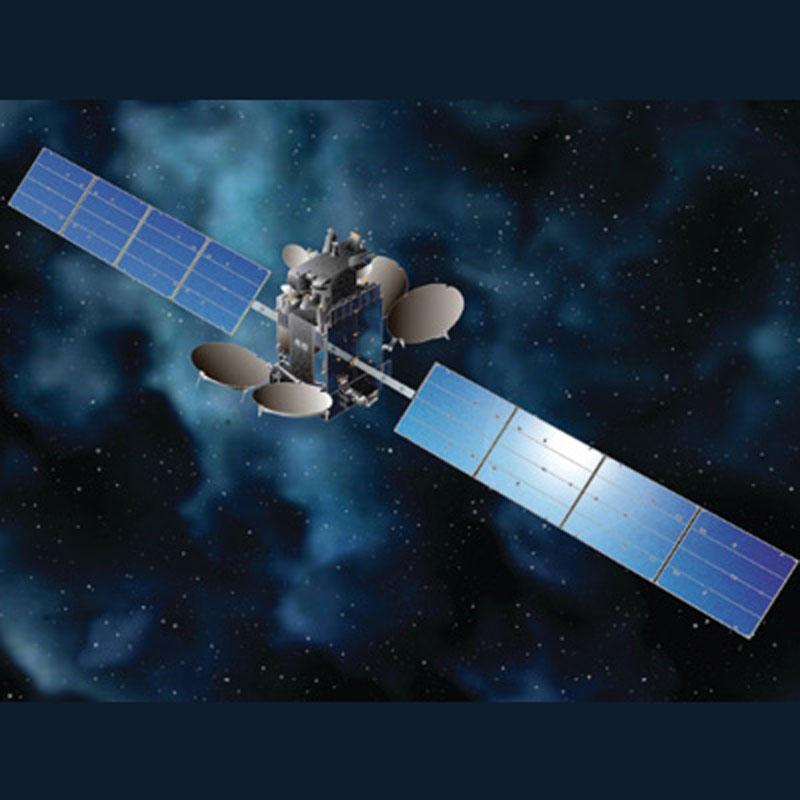
    The deal involves the in-orbit delivery of a 5.4kw satellite with a 14-year lifespan. The long life satellite with 24 C band (12 in the India coverage beam and 12 in the Asia coverage beam) and 14 Ku band transponders are distributed over two beams, one for India coverage and the other steerable over the Middle east, South East Asia or Europe. Of the Ku-band transponders, seven will have a fixed India coverage; three, a steerable coverage over Europe, Middle East and South East Asia; and the remaining transponders will be switchable between fixed and steerable. These transponders have a total bandwidth of 1,404 MHz.

    The satellite is expected to support a broad range of applications ranging from TV broadcasting and DTH to rural and distance routes.

    Queried as to how much of the satellite’s capacity would be used by the Essel/Zee channels, Chandra said 15 per cent of the C Band capacity and a small percentage of the satellite’s Ku Band capacity would be utilised. The remaining bandwidth will serve television broadcasting and distribution companies, Internet service providers and other telecom service providers.

    The ASC Enterprises Ltd (Ascel)-promoted ASSL is the first private satellite system to be authorised by the Indian government under the 1997 Satcom policy framework. The government has also approved the equity participation of Alcatel and Arianespace in ASSL.

    The main reason that the lead time for the satellite to become operational is only 18 months or so is because ASSL is acquiring an existing satellite from Alcatel. The satellite was built in 1997 for use by Shinawatra Satellite, Thailand. It was, however, never used and has been lying in storage for four years.

    The total project cost is Rs 11.5 billion in which the debt funding of Rs 6.9 billion is being arranged by a consortium of Indian banks and financial institutions. Of the equity component of Rs 4.6 billion, Alcatel and Arianespace have taken a stake of 9.75 and 3.25 per cent stake respectively. This will be worth $15 million and $5 million respectively.

  • Zee scales down Agrani, broadband plans

    Zee scales down Agrani, broadband plans

    The third quarter results of media baron Subhash Chandra’s Zee Network are out and they were quite clear on one front. That it was time for Zee to take stock and do a rethink on a number of ambitious projects Chandra had lined up for the group. It appears to be a policy of scaling down and consolidation at the moment.

    As part of this exercise comes the report in the Times of India on Monday that the ambitious Agrani Satellite project has been scaled down by Rs 25.5 billion.

    The reduction comes soon after his rejection of the Industrial Financial Corporation of India’s (IFCI) tough stand that he pledge his stake in Zee Telefilms and Essel Packaging for availing funds for the satellite project. In addition IFCI had also sought a personal guarantee from him.

    The Agrani project as it stands now involves a proposed investment below RS 12 billion. This proposal has been submitted to the Industrial Development Bank (IDBI) for funding but it remains to be seen whether IDBI takes a softer stand on funding than IFCI.

    In a related development, the Zee Network has also scaled down plans for its ambitious RS 37 billion broadband project by deciding to implement the project in three phases, the Financial Express reported. The company will now be investing only RS 3 billion in the first phase. The rest of the project will depend on Zee Network finding suitable strategic and financial partners.

    Zee hopes to invest RS 23 billion in the second phase. Till such time as the company gets a financial partner in the project, the broadband rollout will be restricted to the laying of ducts in four cities within the financial resources available to Zee Telefilms’ wholly-owned subsidiary, Siticable Network.