Tag: advertising

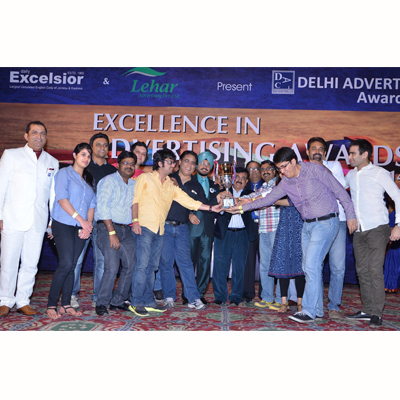
  • Delhi Advertising Club announces Excellence in Advertising Awards 2014

    Delhi Advertising Club announces Excellence in Advertising Awards 2014

    MUMBAI: In the recent past, many have acknowledged the fact that Delhi has established itself as a major advertising hub.


    And to celebrate the most outstanding media initiatives of the year gone by were recognised and awarded at the Delhi Advertising Club – Excellence in Advertising Awards 2014.


    17 agencies received 40 DAC Excellence in Advertising Awards. The Agency of the Year Award was bagged by Innocean Worldwide India, whereas Campaign of the Year Award went to McCann, New Delhi.


    Delhi Advertising Club president HS Paul said, “Delhi is gradually emerging as the Advertising Capital of India with major companies being headquartered in Delhi & NCR besides the government advertising body like DAVP. According to industry estimates, if advertisers spend around Rs 30,000 crore in India, alone Delhi/NCR contributes to roughly 40 per cent, with release orders to the tune of around Rs 12,000 crore being signed out of Delhi.”


    He further added that, “Delhi Advertising Club’s Excellence in Advertising Awards” since its inception in 1991 is an endeavor to recognise the efforts and accomplishments of teams and individuals from the advertising  fraternity here. These awards are not only a matter of honour for creative excellence, but have received tremendous support from media marketers and advertisers as well. I am very much pleased with the support received from the industry and would like to thank all partners, sponsors of trophies, Jury members, board members and ordinary members of Delhi Advertising Club for making the DAC Awards a great success.”


    More than 500 executives from advertising world attended the ceremony and awards for 20 categories were presented to the winners selected by the jury out of 228 entries received from various advertising agencies of Delhi and NCR. Award winning Ad-Agencies are: Airads, Adsyndicate, Adman, Bubna, Crayons, Catalyst, Cytomed (Alkem), Graphisads, Havas, Interads, Infinity, Innocean, Linen (Lintas), McCann, Mode, Niyati & Span.


    At the ceremony , Delhi Advertising Club founder and past president  Late Dr.Vishwanath was given Lifetime Achievement award which was collected by his son Interads Advertising  MD Anil Sharma from DAC chief Patron VK Chopra.

  • Election tracker: Battling it, out-of-home

    Election tracker: Battling it, out-of-home

    MUMBAI: This general election may be the first among many, where media has been so extensively (and blatantly) used by political parties and their prime ministerial hopefuls.


    Far from fighting shy of marketing themselves, the main players – Congress and BJP – have spent nearly Rs 400 to Rs 500 crore each on publicity campaigns. An additional Rs 500 to Rs 1,000 crore will be spent on related activities such as banners, hoardings, organization of public meetings and transportation of key campaigners, among others. Not surprisingly, media agencies estimate around 2 to 2.5 per cent of overall advertisement spends this year to come from elections.


    One can switch a channel, turn a page or surf away, but hoardings are hard to ignore or even miss. And this is the reason why of the whole advertising budget, parties are spending approximately 10-15 per cent of the total budget i.e. close to Rs300-400 crore on OOH, if not less, as per industry sources.


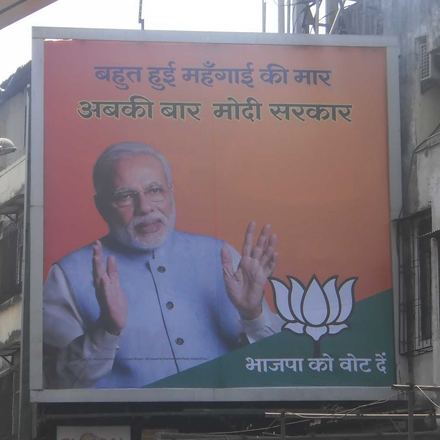
    Possibly, with advertising rates on general entertainment channels (GECs) on television being prohibitive and posters having been banned in several cities of the country, outdoor remains the only viable option for election propaganda as it is cost-effective and has high reach as well. So you have hoardings of calling for a ‘Modi Sarkar’ or boating of ‘Bharat Nirman’ with NamO and RaGa staring down at you from the most non-descript locations in the country. What’s more, they have illumination for better visibility at night.


    With elections just round the corner, outdoor advertising has picked up significantly, mostly fuelled by political parties, which is quite unlike the usual scenario where outdoor advertising is more prominent during the second half of the year.


    Speaking of the growing appeal of OOH, Madison OOH Media Group CEO Arminio Ribeiro, says: “Given the flexibility of this medium in terms of narrow- and broad- casting and its localization and rapid awareness build-up benefits, outdoor has appealed to political parties to get their message across to the electorate through its multiple formats.”


    In order to get the best quality hoarding, tapping the most crowded route through buses or railway has certainly increased the competition. Everyone is trying to avail the benefit of this golden opportunity and those who have the diverse range of inventories are the main gainers.


    Sanjeev Gupta, managing director of Global Advertisers, which has been roped in for outdoor by both Congress and BJP, says, “With changing trends, political parties have also changed their approach and have become more professional. Therefore, our media plan included a mix of outdoor inventories to expand the reach of these campaigns and we expect to see more demand for outdoor in the coming months.”


    While Postercope Asia Pacific regional director, Haresh Nayak, says: “Tier II and Tier III markets have been the focus for the last year, continuing to grow this year as well, showing deep penetration in rural areas to create brand awareness.”


     Indeed, the FICCI-KPMG 2014 report finds that the OOH industry has grown by 5.5 per cent from CAGR (2007 to 2013), what with clients from real estate, telecom, media, auto, and now politics, driving it forward.

  • JWT acquires majority stake in Social Wavelength

    JWT acquires majority stake in Social Wavelength

    MUMBAI: WPP Group’s JWT has acquired a majority stake in Social Wavelength.


    JWT’s acquisition of Social Wavelength is a logical confluence of social media and mainline expertise, coming together to create integrated communication for brands. The rich experience of five years that we have, in this young industry of Social and Digital Media, will find the next leap of growth, through this partnership. A socially connected world is going to create new challenges and opportunities for brands, and we will create solutions to help brands navigate those challenges,” said Social Wavelength joint CEOs Haresh Tibrewala and Sanjay Mehta.  


    The social media agency was founded in 2009, and headquartered in Mumbai, with offices in Delhi and Chennai. The agency now has over 170 professionals who offer social media communication services, social media listening services using Radian6,  influencer outreach program, application development, video and rich media content creation and media buying to over 50 leading brands.


    The acquisition marks a further step in WPP’s strategy of developing its networks in fast-growth markets and sectors. In India, WPP companies (including associates) generate revenues of nearly $500 million and employ almost 13,000 people.


    “We want to be a critical resource partner across the many solutions we provide to our clients. As we continue to relentlessly transform our offerings, Social Wavelength adds a huge dimension to our existing clients and the brands we steward. Across the marcom value chain and across various digital touch points the skills and capabilities of Social Wavelength will be that edge,” said JWT South Asia CEO Colvyn Harris.


    Social Wavelength’s revenues for the year ended 31 March 2013 were Rs 9.15 crore, with gross assets at the same date of Rs 5.92 crore. Social Wavelength marks WPP’s fifth acquisition in India in the last four years.


    JWT Asia Pacific has invested heavily in expanding its digital footprint over the last two years.  In addition to the acquisition of Hungama, in India, JWT acquired Post Visual in South Korea in 2013, and took a stake in Converge, in Pakistan, in 2012.  XM Asia, a digital agency owned by JWT, also acquired Designercity, in Hong Kong, and Thomas Idea, in Thailand, in 2013, and XM Gravity in 2012.

  • Why bigger agencies net smaller fish?

    Why bigger agencies net smaller fish?

    MUMBAI: Passion drives creative minds to set up independent agencies. In a majority of cases however, after the initial burst, resources become a constraint and growth avenues out of reach.


    While being able to do what you want, pitch to the client of your choice or leverage the tools of your choice continue to be the perks of going solo, at some point, the smaller independent agency is forced to reflect on how long it can continue to stand alone successfully.


    This is probably when selling out to a larger entity seems like the best option. In the past couple of years, there have been several instances of big networks snapping up smaller, independent agencies; the most recent being DDB Mudra’s acquisition of Bangalore-based 22feet. Indiantelevision.com spoke to a cross-section of the advertising industry in a bid to understand what really drives network agencies to invest in independents or conversely, independents to sell out or as in some cases, hold on to their freedom.


    Vineet Gupta of 22feet, who will soon take charge as MD of the new entity, 22feet Tribal Worldwide, says mergers and acquisitions (M&A) aren’t necessarily about losing independence. “We have always wanted to outperform and be ahead in the market. And in Tribal, we found a partner which had the same vision like us and hence, we went ahead by joining hands,” he explains.


    Praveen Kenneth of Law & Kenneth – at the time Law & Kenneth was integrated with Saatchi & Saatchi – had famously said that Law & Kenneth was born out of passion and had always focussed on adding value to client brands and to the lives of the people it touched every day. The story of Law & Kenneth was an example of the Saatchi & Saatchi spirit of ‘Nothing is Impossible’, and the combination of Law & Kenneth’s stability, proven success and experience in India’s dynamic market place and Saatchi & Saatchi’s iconic status and mystique had resulted in a creative powerhouse called L&K Saatchi & Saatchi.


    WebChutney, a digital agency founded in 1999, became part of Dentsu India Group when the network agency acquired 80 per cent stake in it in 2013. How has it benefitted the independent agency? Says, the agency’s co-founder Sidharth Rao, “Our unique chutney culture is the same but yes, being part of a global network has helped in terms of new alliances & smarter processes. One of the best parts is that we have access to global learnings which we think will be a big advantage going forward in our journey.”


    For Naresh Gupta, CSO and managing partner of Bang in the Middle, the iYogi in-house creative agency that went independent in 2012, the best marriage is when creative and cultural freedom isn’t taken away and bigger agencies only provide support through finance and sources to scale up. “There has to be a cultural match before any formal arrangement is made because a group which has invested too much money in acquiring one doesn’t want it to fall. It will only want it to grow as it wants back the money it had invested in it,” says he.


    Publicis’ South Asia CEO Nakul Chopra believes that while cultural and operational differences between the two agencies would never cease to exist, it depends on how well they make the marriage work. “If the home-work has been done well before the acquisition is made and the two are culturally close at the core, there are not many difficulties between them. We at Publicis have a well-oiled and tested process that allows us to achieve that goal,” he says, adding that the acquisition is also about ‘strategic fit’. “Ideally and normally, we would want to acquire an agency when it fulfils multiples of strategic goals. In parallel, we also look closely at the culture of that agency and how well it fits into the culture of our network. Only after this, do we decide on acquiring any agency.” Chopra insists that acquisitions are not like buying a shirt and either the agency is in talks with someone or someone approaches the agency. What matters is how transparent and deeply connected the two agencies feel before shaking hands.


    Dentsu India group executive chairman Rohit Ohri echoes similar sentiments. “Network agencies are always on the lookout for a holistic view. There are some or the other gaps which need to be filled-up so network agencies look for agencies which can do so. The fundamental law of any acquisition is that the two parties work closely in the pre-acquisition period to get to know each other’s culture and get a sense of partnership. There has to be a chemistry match otherwise it can lead to a fallout past acquisition or the smaller agency can collapse. There has to be a meeting of minds,” he explains.


    On the bigger agency trying to impose its culture on the smaller one, he gives the example of Dentsu’s Taproot acquisition close to two years ago. “The merger has worked well for both of us. Dentsu has been able to work on major accounts (Congress being the latest client) that were won after the merger. Taproot has been a leading light in the creative field and has a strong reputation. So we follow what they set out to achieve. It is the other way round for us. We at Dentsu are trying to assimilate that,” he says.


    And not all mergers end on a good note. Remember what happened to Enterprise Nexus? The agency was created in 1996 when Enterprise (born out of the partnership between Mohammad Khan and Rajiv Agarwal in 1983) and Nexus (founded two years later when Agarwal left the agency to launch his own along with Arun Kale) joined hands.


    However, what started off great, fizzed out soon when Agarwal and Kale, gave up their shares to Khan, making him the majority shareholder in Enterprise Nexus. The agency was later acquired by WPP and merged with Bates India.

    With a few mergers ending on a bitter note, it hasn’t stopped the majority of firms from acquiring others or launching new ones. So does the buck stop at M&A?


    According to Anil Kakar, founder of Gasoline, a lean agency structure based on a collaborative model where both like-minded creative talent and projects have been cherry-picked to ensure faster and more cost-effective solutions, “A lean agency structure ensures a greater investment of time and thought into a campaign, a greater control over the creative output, customised solutions, faster turnaround times and access to some of the best brains in the business.”


    “Obviously it helps in terms of getting access to a larger client base as well as in leveraging the media strengths of the network. The network consists of a unique bunch of agencies each with their own particular strength which is very useful when pitching to global brands,” adds Rao.


    Gupta offers a different perspective altogether. “Acquisitions work both way; most independent agencies don’t want to remain small and want to add muscle and that can be only added either by becoming a network agency or becoming a part of a network agency. Also, it is very difficult for an independent Indian guy to go international and become a network,” he says. 


    However, agencies that are “okay with what they have” may choose to remain independent. Otherwise, the question “Can I make the business grow?” is bound to crop up from time to time. “Our country is a very competitive one and it is a price-sensitive market. Clients don’t pay agencies for the amount of work they do for them,” he adds.


    In sum, you need to tread on M&A with caution: while it is necessary for further consolidation and growth, it can’t be achieved at the altar of the agencies’ DNA.

  • Rana Barua promoted as the CEO of Contract Advertising

    Rana Barua promoted as the CEO of Contract Advertising

    Mumbai: Rana Barua has been elevated as the CEO of Contract India.


    Rana who is currently travelling will take charge with immediate effect.


    His elevation as the CEO is in recognition of the stability and growth that Contract has had in the last one year.  He has been able to successfully build a team of some of the finest talent in the industry, along with winning several new businesses for the agency and enhancing existing client relations.


    Announcing the development, JWT South Asia CEO Colvyn Harris said, “In Rana, we have a leader who has very ably carried the mantle of leading Contract to a renewed position of power that has made the agency a destination of choice for brands and talent.”


    Over the last twelve months, Rana has driven Contract’s diversification across mainstream, digital, design and other platforms of engagement marketing to ensure the best value proposition for clients.

  • RK Swamy BBDO wins creative mandate for Magicbricks.com

    RK Swamy BBDO wins creative mandate for Magicbricks.com

    MUMBAI: After a two-month long multi-agency pitch, RK Swamy BBDO has won the creative mandate for Magicbricks.com, the property portal from The Times Group.


    On winning to account, RK SWAMY BBDO senior partner Sunil Kuketri said, “This is an interesting category with a huge canvas available for creativity. We will make the most of this opportunity by creating interesting clutter-breaking work for Magicbricks.”


    Magicbricks.com is a property portal with a host of specially developed features and tools to aid the users in taking the right decision; making it the most comprehensive platform in the category.


    RK Swamy BBDO, part of RK Swamy Hansa, serves over 250 companies in India and the USA. With around 1200+ professionals, the Group offers Creative and Media services, Market Research, Direct/CRM & Advanced Analytics, Events and Activation, Healthcare Communication, PR, Social & Rural Communication and more.

  • Award Nominees for 2nd Edition of IAA Leadership Awards Announced

    Award Nominees for 2nd Edition of IAA Leadership Awards Announced

    MUMBAI: The International Advertising Association’s (IAA) India chapter today revealed nominations for the first 12 categories of the much-awaited second edition of the IAA Leadership Awards. Taking into account the outstanding marketing and related initiatives that have been undertaken in the year gone by, the nominees have been shortlisted from the fields of Marketing of various products and services categories.

    The IAA Leadership Awards is a unique initiative which celebrates leaders in the fields of Marketing, Advertising and Media. The 2nd edition of the IAA Awards will witness honoring 21 individuals in as many categories who will be handpicked through a 2-stage selection process.

    The following are the list of nominees revealed today who will compete to win the 2nd Edition of the IAA Leadership Awards:

    Speaking on the nominees, Srinivasan Swamy, President IAA India and VP-Development, IAA Asia Pacific, and Chairman, R K SWAMY BBDO said, “Following the success of the first edition of the IAA Leadership Awards, we continue to honour and recognize the contributions of individuals across various verticals who have made a positive difference for the brands they represent. The nominees can be happy with the fact that they are the chosen few from the field of Marketing, shortlisted via a scientific thought process and detailed research. By celebrating their achievements, we hope to motivate them to raise the bar year-on-year.”

    The annual Awards this year is scheduled to take place on 1st March 2014 at Grand Hyatt Mumbai. Honourable Union Minister of State for Information and Broadcasting, Sri Manish Tewari will grace the occasion as the Chief Guest. The who’s who of the marketing, advertising and media industry are expected to be present at the awards night.

  • Pitch Madison projects 2014 to be a good year for media ad spends

    Pitch Madison projects 2014 to be a good year for media ad spends

    MUMBAI: The year 2014 is expected to be one of the best years of recent times for media advertising, including for television.


    Pitch Madison Media’s advertising outlook for 2014 estimates media advertising spends in 2014 to grow 16.8 per cent to  Rs 37,216 crore from Rs 31,877 crore in 2013, with the biggest contribution of Rs 5,000 crore to this growth coming from elections to the Lok Sabha and to assemblies of four major states including Maharashtra.


    Advertising spends on television are expected to grow well because of increased penetration of digitisation, as ad rates increase because of restricted supply with the enforcement of the 12 minute per hour cap on advertisements and with many new channel launches once the licences are issues after the Lok Sabha elections.


    The advertising spends on television in 2014 are expected to grow by a robust 15 per cent in 2014 to Rs 14,282 crore from Rs 12,419 crore in 2013. The growth in advertising spend on television was 8.2 per cent against the projected 6 per cent.


    The advertising spend outlook for 2014 contrasts that of 2013, when the watchword was caution. The prediction for growth of media advertising in 2013 was 7.4 per cent but the actual growth turned out to be higher at 11.1 per cent.


    On television, the completion of digitisation in the top 42 cities in 2013 led to increased spending on niche channels, SD and HD channels and also local advertising options due to split runs across channels.


    According to the Pitch Madison advertising outlook, the proliferation of channels from existing bouquets will increase inventory availability at higher rates.


    Television’s share in the total ad spend in 2014 is projected to fall to 38.4 per cent from 39 per cent in 2013. Television’s share in the advertising pie was 42.1 per cent in 2011 and 40 per cent in 2012.


    Though the growth in advertising spends on television seems to be healthy enough for the TV industry, increasing popularity of the internet is likely to cut down the share of television in total advertising spends.


    In 2013, out of 15 categories of advertisers, advertising spends by seven of them showed a dip implying that advertisers are losing interest in television-based advertisements.


    Media, retail, alcoholic beverages and corporate have registered a negative growth of advertising spends on television in 2013 and only fast moving consumer goods emerged as the driver of growth for advertising on television.


    Print has shown immense promise and in 2014, regional dailies are expected to continue their onward march and grow at a faster rate at the expense of English dailies. In 2014, advertising in print is expected to grow by 17 per cent to Rs 15,405 crore. In 2013, print advertising spend had grown by 10 per cent and in 2012 by only 4.0 per cent.


    Radio is expected to grow by another 15 per cent. Consolidation within radio will take place due to the expected phase III auction rollout. Digital will continue to grow stronger at 29.5 per cent, outdoor medium is set to grow  by 8.2 per cent and cinema by 7.2 per cent.


    The outlook said it was time for the medium to reinvent itself for the advertiser.


    The digital medium will pull in a total of Rs 3,950 crore in 2014, which is Rs 900 crore more than Rs 3,050 crore in 2013. The growth in advertising spends on the digitial medium has however subsided from around 50 per cent from 2009 till 2012. In 2013, the growth on digital dropped to 32.4 per cent.


    The digital medium’s share in the total advertising pie will rise to 10.6 per cent from 9.6 per cent in 2013, 8 per cent in 2012 and 5.6 per cent in 2011.


    Due to the economic slowdown, marketers have scrutinised each and every penny spent and internet being a return on investment medium, it is becoming the preferred choice for them. The growth in online advertising is expected from FMCG, automobile and banking sectors.


    For radio, the growth in advertising spends in 2013 was 17.96 per cent against the projected 4 per cent. Looking at the growing faith of advertisers in this medium, the outlook projects 15.04 per cent growth in advertising on radio in 2014, with the total advertising spends adding up to Rs 1,262 crore against Rs 1,097 crore in 2013.

  • News Nation readies second channel launch as it celebrates first anniversary

    News Nation readies second channel launch as it celebrates first anniversary

    MUMBAI: As the country heads into general elections, there’s a regional Hindi news channel being added.


    As it celebrates its first anniversary today, News Nation, a national Hindi news channel, has geared up to enter the regional news channel space with the launch of a channel for the states of Uttar Pradesh and Uttarakhand.


    News Nation’s news channel for Uttar Pradesh and Uttarakhand is all set to be launched on 19 February. The new channel already has 200 employees on board. The dry runs of the news channel are on but the name of the channel has not yet been disclosed.


    The Uttar Pradesh/Uttarakhand channel will operate from two main offices in Lucknow and Dehradun and have bureaus in 10 other cities, including in Varanasi, Jhansi, Meerut and Agra.


    News Nation’s Senior Editor Ranjeet Kumar will be the editorial head of the Uttar Pradesh/Uttarakhand channel.


    The channel on the launch day will be available to all cable TV viewers in the two states as well as to subscribers of DTH television service provider Freedish.


    News Nation has invested almost Rs 50 crore in its second news channel. A marketing campaign for the new channel, like in the case of News Nation, will follow a month after the launch.


    The new channel will initially be free of advertisements. “We have a rule that we let the people sample the content we have, get the ratings and then reach out to advertisers,” says News Nation CEO and Editor-in-Chief, Shailesh Kumar.


    The programming of the channel will be youth focussed. The vibrant colours of the two states will reflect in the logo as compared to the neutral logo of the national channel.


    The Uttar Pradesh/Uttarakhand news channel will not have the usual programming focussed on entertainment, crime and astrology. The channel will have hard news but minus any sensationalism. “You can compare News Nation to any international channel,” says Kumar buoyantly.


    The network has ambitious plans to expand its presence in the country. “We are currently studying markets to identify areas that are lacking good quality news channels and after that we will choose our locations,” says Kumar. He also added that there is no restriction on staying just in the Hindi Speaking Market (HSM).


    According to TAM data provided by the channel, News Nation has garnered an average of 68 TVTs between weeks 3 and 6 for CS 15+ age group in the HSM.


    News Nation is looking at signing annual advertisement deals with various clients before the election season sets in. Currently, it only has four to five minutes of advertising per hour.


    After having built a credible space for itself within a year, News Nation is optimistic that its first regional channel will also achieve similar success.


    “The road for us was not easy as this is an extremely cluttered genre. We clearly understood that there was a need for a Hindi news channel which was aggressive yet relevant, a channel based on pure news content yet blooming with new ideas and therefore, we came up with News Nation and within months of its launch it crossed over its competitors in terms of ratings,” says Kumar.