Tag: advertising

  • The year of hiccups for marketers

    The year of hiccups for marketers

    MUMBAI: The year 2017 was when brands were unwillingly thrown into a roller-coaster ride only to emerge dizzy and faint. The highs weren’t enough to ride out the lows.

    2017 will be seen as a year of turmoil for brands. Just when the effects of last year’s demonetisation were ebbing away, the government threw another spanner in the works in the form of the goods and services tax (GST).

    Much before its implementation, marketers and consumers cheered on the GST to be a saviour for the industry, touted to solve multiple tax complications. But its launch timing, months after demonetisation, crippled the Indian economy even further primarily due to faulty implementation.

    The year began with the economy regaining its composure after the ban on bills of Rs 500 and Rs 1000, which led to troubled times for businesses across the country, especially in the cash-dependent sectors. No one was spared from the effects, be it kirana stores, big FMCG players or media and advertising agencies. As physical money became dear, online payment apps were the saving grace. Paytm, Mobikwik, Zappr and the likes became a must-have app for a majority of Indians and their profits grew four fold by March 2017. 

    In the months after GST was passed, sales crashed, margins dropped and marketers became extra cautious before investing in new products and advertisements. Brands steered away from marketing and advertising post August, which otherwise is considered as the ideal period for creating new campaigns as the festive season in India commences from September and goes up all the way till the new year.  

    The crashing economy brought down infrastructure, including real estate, to its knees and crushed consumer demand with the implementation of the new Real Estate Regulation and Development Act (RERA) in May. Slow implementation of the new real estate regulation across the country as well as uncertainty over the impact of GST on home prices pulled down consumer sentiment this year. According to a report by the Centre for Monitoring Indian Economy (CMIE), home loan growth in April-October fell by 32.7 per cent from a year ago, one of the biggest declines in the last five years.

    It was not only the FMCG and real estate sectors that had a nightmarish 2017. The USD35 billion liquor industry was subjected to one of the worst hangovers not only because of GST but also because of a Supreme Court ban on all alcohol sales within 500 meters of highways across India from 1 April 2017. Although the ban was implemented to curb drunken driving on highways, it dried up the hospitality industry, state government and liquor companies who ended up losing Rs 50,000 – Rs 70,000 crore. The market fell nearly 30 per cent in the immediate quarter after the highway ban and at least 1,500 retail outlets closed down.

    After all the bad news, 2017 also saw some strong revenue figures and new entrants in the market. Patanjali recently became India’s most trusted FMCG brand as per The Brand Trust Report India Study 2017. Valued at over Rs 30 billion, Patanjali estimated its annual turnover of the year 2016-17 to be Rs 10,216 crore. In November this year, the company also signed a memorandum of understanding (MoU) of Rs 10,000 crore with the Government of India at the World Food India 2017. To buck up against the Baba Ramdev-led ayurvedic company, top FMCG players went the whole nine yards in their bids to recapture the markets they lost. While Hindustan Unilever Limited (HUL) launched its version of ayurvedic products under brand Ayush, homegrown FMCG major Dabur is in the process of modernising its ayurveda portfolio and introducing new products. The multimillion-dollar company also launched a traditional ayurvedic product Dashmularishta and menstrual pain relief tonic Ashokarishta. 

    Lever Ayush, in its first campaign, took a potshot at Patanjali by pointing out the naive ways in which we categorise ayurvedic products like skincare creams, soaps and toothpaste. It went on to say that not every product with green packaging or leaves on the cover essentially fit ayurvedic ingredients. The company has managed to create its dominance in the southern market by aggressive marketing and advertising. 

    According to a Nielsen Report, herbal segment in India accounts for 41 per cent of the Rs 45,000 crore personal care market. Hence, sectoral leader HUL has come out all guns blazing in a field so far ruled by Patanjali, while Colgate-Palmolive has placed its own natural products to take back its market in the toothpaste segment and Dabur India now has a major share in the honey segment as opposed to Patanjali. 

    Television remained the strongest sector for advertisers this year despite depressed economic conditions while digital continued to ride on a high growth trajectory. Advancement in infrastructure, evolving audience measurement technology leading to better content and lowering data costs induced viewers to greater digital consumption. Television advertising is expected to grow at over 10.3 per cent with free to air channels gaining significance, localised content and high-definition experience boosting regional channels’ viewership and sporting leagues outside of cricket becoming increasingly popular.

    public://Untitled-2_18_0.jpg

    public://Untitled-3_22_0.jpg
    Source: Group M

    Print media continued to witness a slowdown in 2017 where while English newspapers remained under pressure, regional language papers demonstrated strong growth.

    The out of home (OOH) industry registered a slowdown in growth rate at seven per cent majorly due to adverse impact of demonetisation and GST but is projected to grow at a CAGR of 11.8 per cent primarily driven by development of regional airports, privatisation of railway stations, growth in smart cities, setting up of business and industrial centres, and growing focus on digital OOH.

    The year also saw a rise in influencer marketing and brands sent out messaging by using ‘internet celebrities’ to put in a good word for the product on social media. According to Business Insider Affiliate Marketing Report, approximately 15 per cent of the digital media industry’s revenue is achieved through affiliate (influencer) marketing. A recent report suggested that 40 per cent consumers are sold on a product or idea if an influencer they followed were to recommend it. 

    The turmoil in the Indian telecom industry can be attributed to several things. Smartphone penetration in the country increased this year by three folds and today India has over 300 million smartphone users which is projected to grow by more than 50 per cent in the next few years. According to Counterpoint research, 300 million people out of 650 million phone users own a smartphone, making India a big market for brands and telcos. Indian tycoon Mukesh Ambani sparked a price war in 2016 with the launch of Reliance Jio with other telecom giants scattering to acquire market share. Vodafone and Airtel lured customers with data at cheap prices and unlimited calls. But Reliance Jio clearly won that war. Within the first month of commercial operations, Jio announced that it had acquired 16 million subscribers. This was the fastest ramp-up by any mobile network operator anywhere in the world. Jio crossed the 50 million subscriber mark in 83 days since its launch subsequently crossing 100 million subscribers on 22 February 2017. By October 2017 it had about 130 million subscribers. 

    On 21 July 2017, Jio introduced its first affordable 4G feature phone, powered by KaiOS, named as JioPhone. The price announced for it was Rs 0 with a security deposit of Rs 1500 which could be withdrawn back by the user by returning the JioPhone only after 3 years. This phone was released for beta users on 15 August 2017 and pre-booking for regular users started on 24 August 2017. 

    In order to strengthen its presence in the ongoing battle of the telecom sector, Sunil Bharti Mittal-led Bharti Airtel launched Android powered 4G smartphones in partnership with Indian mobile company, Karbonn Mobiles. Airtel will partner with multiple mobile handset manufacturers to create an ‘open ecosystem’ of affordable 4G smartphones and bring them to market for virtually the price of a feature phone. It is also in talks with Intex mobiles for similar offerings. Domestic handset maker Micromax and Vodafone came together to offer a smartphone, effectively at a price of Rs 999 if the buyer retains the device for three years.

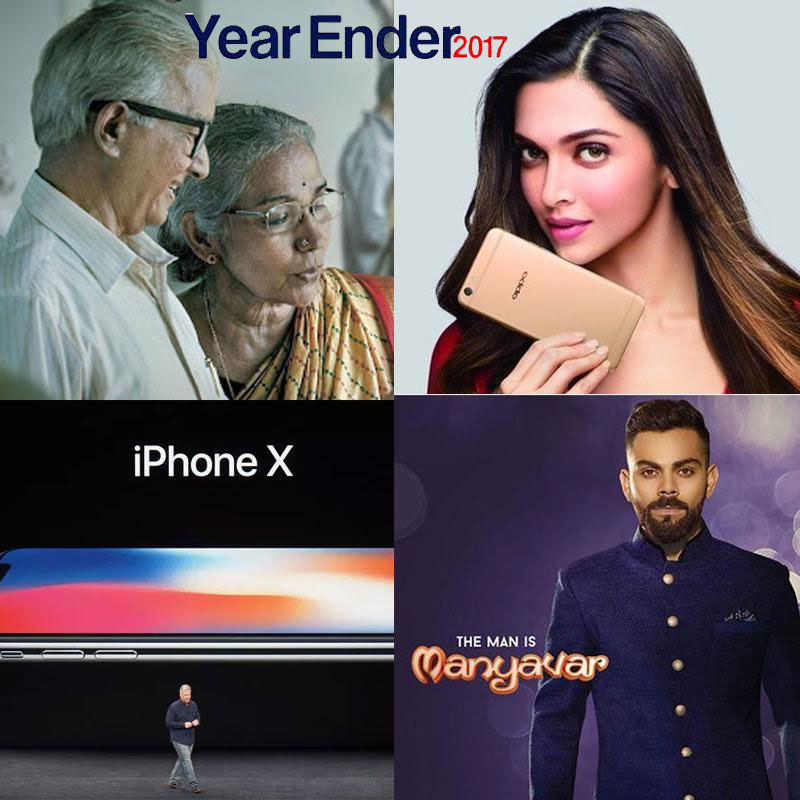
    With data becoming much cheaper this year and mobile manufacturers selling handsets at throwaway prices, mobile handsets became much affordable and smartphone penetration increased three folds. A lot of this has to be credited to Chinese players who took the Indian smartphone market by storm. While Vivo and Oppo were aggressive in marketing their products, both invested heavily in OOH advertising in 2017. We saw a lot of hoardings and static banners with Deepika Padukone (Oppo), Ranveer Singh (Vivo) and Virat Kohli (Gionee) promoting their respective brands (as brand ambassadors). While Vivo came on board as the title sponsor for India’s premier cricketing league IPL, rival Oppo became team India’s official jersey sponsor for all its matches for five years. 

    According to various reports, today Chinese brands such as Lenovo, Oppo, Vivo, Gionee and Xiaomi have captured over 50 per cent share of India’s smartphone market even as Apple and Samsung fought a tough battle to hold on to their reigns.

    Amidst all this, the biggest highlight of the year in the space was the launch of Apple 8 and Apple X. The company launched its flagship phones in much fanfare in September this year on its 10th anniversary.

    Still recouping from the setbacks of 2017, marketers are pinning hopes on 2018 that improved market sentiment will bring them back to a steady growth path. The prospects of good economic growth, coupled with a revival in demand and consumption, will help them overcome the hit they took in volumes and profits in 2017.
  • Religare aims to change the youth mindset to health insurance

    Religare aims to change the youth mindset to health insurance

    MUMBAI: In its endeavour to emphasise and bring to attention how widespread serious illnesses are and how expensive it is to treat them, Religare Health Insurance has gone live with its first ever YouTube mast-head video. The message is that lack of proper financial planning and absence of adequate health coverage spiral into financial distress.

    In order to highlight these underlying issues, the company has created a thought-provoking video that has received over 8 million views in a single day.

    With the campaign, Religare Health Insurance apprises its audiences that some critical health issues such as cancer or coronary heart ailments have become far more common than we think.

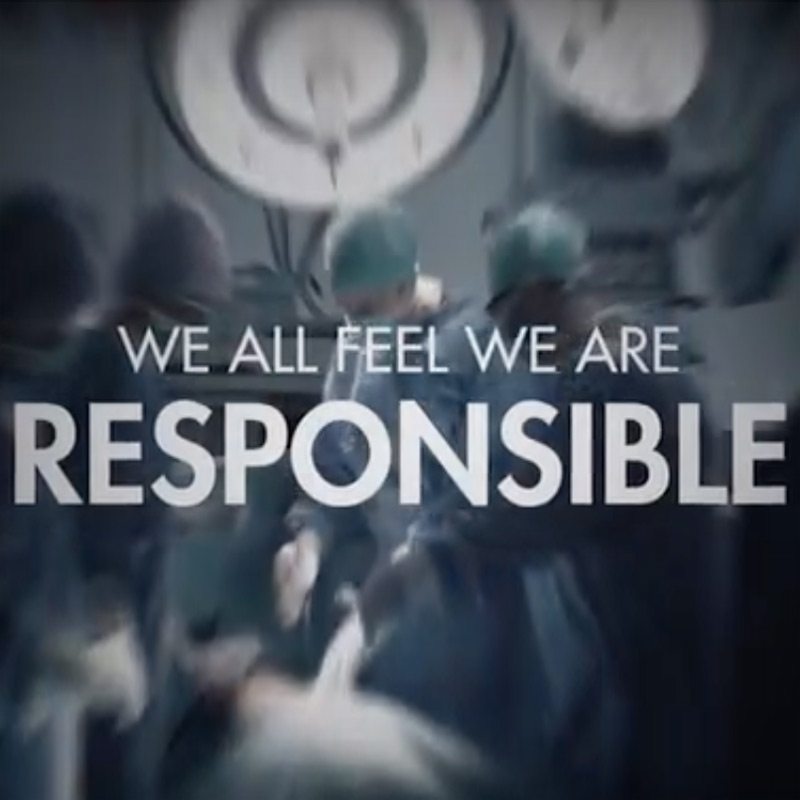
    Titled ‘Be Responsible’, the campaign urges people to be more responsible towards their loved ones by insuring their health; thus making them financially independent to manage any health-related misfortune.

    Religare Health Insurance business head of digital and business development Sachin Maheshwari says, “We have observed that even first time buyers of health insurance are usually of relatively progressed age. This is because customers believed that they would not encounter any serious medical condition in their younger years. This campaign is part of our sustained efforts to apprise customers with facts that would enable them to secure themselves with a health insurance as early in their lives as possible.”

    Religare Health Insurance wishes to bring a change in this behaviour and resolves to educate the younger audience which is why this day-long campaign was executed on the YouTube platform. It’s the first time a health insurance brand has taken a stance like this.

  • Prataap Snacks enters sweet market with Yum Pie

    Prataap Snacks enters sweet market with Yum Pie

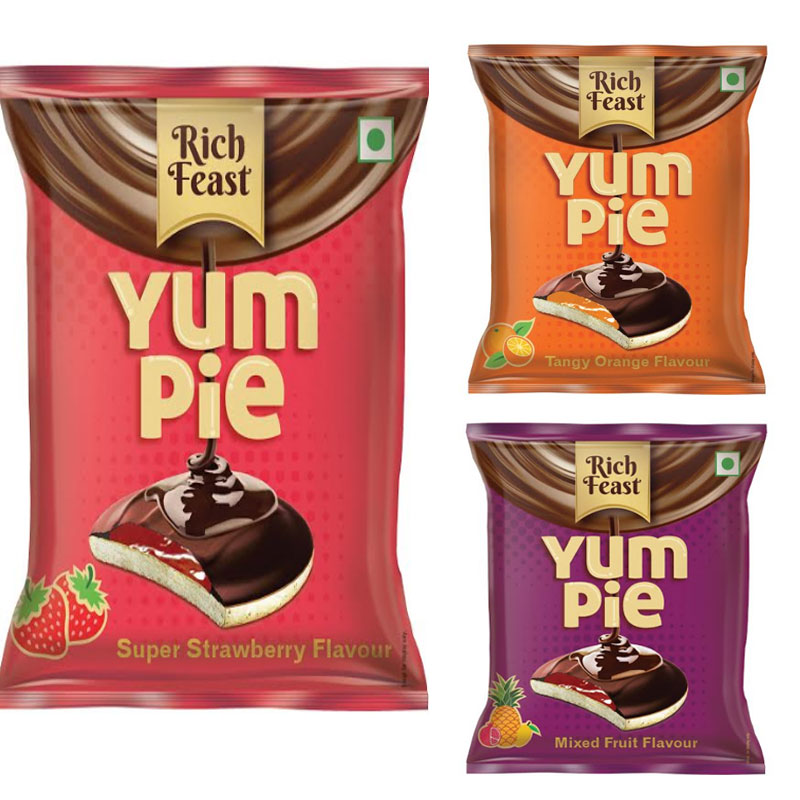
    MUMBAI: Prataap Snacks, the parent company of leading Indian snack foods company Yellow Diamond, has entered the sweet snacks market with the launch of its new brand Rich Feast. The first product under the new brand is Yum Pie, a three layered treat that comes with sponge cake, flavored jam and chocolate.  

    The brand has also come-up with a TVC to mark the launch of the new product, Yum Pie, targeted towards kids. Standing true to the brand’s philosophy of giving maximum value to its customers, the ad highlights Yum Pie as a sweet snack with a fruity twist for kids to savour. The TVC begins with a kid who is reluctant to make friends in his new surroundings and is approached by another kid for friendship who is seen using Yum Pie to break the ice. The two kids eventually connect and bond and the TVC ends with the line – ‘Itna yum, share karna toh banta hai’.

    The company has set up a fully automated manufacturing plant under its wholly owned subsidiary Pure n Sure Food Bites in Indore to manage the production of Yum Pie.

    The product is 100 per cent vegetarian and priced at Rs 5. The products have been designed and targeted towards kids in the age group of 4-14. Yum Pie is available in orange, strawberry and mixed fruit flavours.

    Prataap Snacks MD and CEO Amit Kumat says, “Our new brand ‘Rich Feast’ marks our entry into sweet snacks category where we see a lot of untapped growth opportunity. With this, we will now get into a bigger macro-snack category from only being a salty snacks player. We intend to grow the Rich Feast brand further with new launches in the coming time.”
     

  • 55% marketers make better decisions with machine learning: iProspect report

    55% marketers make better decisions with machine learning: iProspect report

    MUMBAI: Digital agency iProspect has released its third annual Future Focus whitepaper geared to examine how machines and technology are impacting marketing and advertising in the year ahead. The paper takes a look at how brands can make the most of machines in 2018, from facilitating seamless consumer experiences to delivering greater efficiencies.

    iProspect interviewed 250 of its global clients, including FTSE 100 and Fortune 500 companies, and used real-time feedback to outline key insights and priorities necessary for businesses to thrive in our fast-moving, high expectation digital economy.

    Feedback shows that the transformative impact of voice, artificial intelligence (AI) and machine learning (ML) is being felt across the entire business landscape with 55 per cent of marketers surveyed agreeing that ML will allow them to make better decisions in 2018. 56 per cent of the marketers surveyed highlighted effective management of large data sets to deliver personalisation and relevant one-to-one experience as their main priority in 2018.

    The 2018 Future Focus whitepaper discusses some new machine rules. Brands enhanced customer experience by closing the gap between consumer expectation and brand reality. While 2017 was about understanding how best to connect data to understand consumers better, 2018 will be the year where marketers put consumers firmly at the centre of communications.

    The concept of ‘consumer moments’ will become widespread in 2018, encouraging marketers to seek out data signals that help them understand not just who their customers really are, but what are the moments that matter most as those consumers interact with brands at different stages of the purchase journey.

    Digital assistants have become the new gatekeepers and are set to fundamentally change the relationship between brands and consumers. According to market intelligence company Tractica, more than 700 million people use some form of digital assistant today, be it Siri on their mobile phone, or Amazon’s Alexa via a home device. With word error rate now at parity with humans, digital assistants can understand us better than ever, and usage of assistants is expected to soar to almost two billion by 2021. Within the next five years, most of the developed world will be using a digital assistant in one form or another to automate and manage many aspects of their daily lives.

    And it’s not just millennials who are early adopters of this technology. Forrester estimates that while 66 per cent of 18-24 year olds are using digital assistants, almost 40 per cent of the 70+ age group are also engaged. For marketers, this represents a new challenge in 2018 and beyond on learning how to market not to the consumer, but to the machine.

    AI & ML have transformed marketing and it is time for brands to get ahead of the intelligence curve. Simply put, AI aims to emulate human cognitive capabilities through artificial systems. One of the specialities of AI is machine learning, which enables computers to solve a problem by themselves, learning through examples, rather than being programmed especially to solve a distinct problem. If AI and ML capabilities are sought-after by tech companies, it’s because those companies understand the benefits for customer experience (eg., personalised recommendations on Netflix), security (eg., fraud detection on Paypal transactions), or product development (eg., autonomous cars for Uber).

    In 2018, we can expect mainstream brands to truly start testing the potential of AI and ML in advertising, taking marketing efforts to the next level. ML has the power to improve efficiency, help scale personalisation, and predict consumer behaviour with greater accuracy. As a result, 2018 will bring greater investment and experimentation in this area.

    VR will take commerce to new horizons and the distance between inspiration and conversion is now smaller than ever. Global e-commerce sales reached nearly $1.9 trillion in 2016, and are forecasted to grow to $3.9 trillion in 2020. As consumers expect to be able to buy everything, everywhere and at any time, this staggering growth will be increasingly supported by ecosystems which weren’t designed to be transaction first, but are now developing commerce features.

    There will be a rise of Amazon, the ‘everything store’. There can be little doubt that 2017 was a significant year for Amazon, as its seemingly irresistible expansion broke new ground across some of the biggest categories in the world. Amazon’s enormous capital power and evident knack for winning in any division it turns its attention to means it truly is becoming the oft-quoted ‘everything store’, apparently achieving the impossible — major, simultaneous expansion without sacrifice of either product or profit.

    Yet the company remains highly secretive, rarely announcing its intent or offering strategic insight. This means that as Amazon claims not only more net shoppers, but also creates new shopper behaviours, the onus is on today’s marketers to be proactive, rather than reactive, in developing their understanding of it. The good news is that there’s no more opportune time to learn than now. As Amazon finally turns its attention to the long dormant opportunity in ads by outlining plans for it to become a major income stream, marketers should seize the opportunity to get in at ground zero and start including it on media plans today.

    iProspect global chief strategy officer Shenda Loughnane says, “Advances in ML will allow for greater effectiveness and efficiency in marketing communications, freeing both marketers and agencies to focus on adding strategic value. Brands will need to understand how to balance the human versus machine elements of their business in order to leverage the full value of both.”

    iProspect India CEO Rubeena Singh adds, “In an increasingly complex digital economy, ML is set to play a pivotal role in our ecosystem. In India, we are already feeling these forces of change are driving better data understanding, enabling personalised conversation at scale and delivering greater efficiencies. We are at an inflection point where brands need to learn how to marry human capital and machines in order to succeed in the transformation that lies ahead.”

    Advances in ML will allow for greater effectiveness and efficiency in marketing communications, allowing both marketers and agencies to focus on adding strategic value, whilst allowing machines to take on more of the more complex administrative tasks associated with digital optimisation.

  • QuikrEasy shows you how things are done easy

    QuikrEasy shows you how things are done easy

    MUMBAI: Mullen Lintas Bangalore has conceptualised a three-film campaign for QuikrEasy, the services vertical of Quikr. The platform provides a way to find hyper-local services such as professional movers and packers, pest control, interior designers/architects as well as day to day services. Along with this, there is a special focus on its beauty services called AtHomeDiva.

    Mullen Lintas was tasked with this campaign to establish QuikrEasy as a one-stop platform for getting service providers for all home-related services with greater convenience, wider choice and peace of mind.

    Quikr CMO Vineet Sehgal says, “We often find the task of identifying, evaluating and then engaging with service providers cumbersome and end up delaying the task that can make life better. QuikrEasy symbolises the simplest and convenient way to manage small or big tasks in the easiest possible way.”

    The brand’s services find appeal with urban households who are pressed for time and are seeking assistance to smoothly manage their everyday household and lifestyle-related chores. Small or big but important tasks remain unfinished and are often postponed on account of other priorities.

    The first two films show the act of procrastination is amplified, be it fixing shelves or calling the pest control services, all postponed due to pre-occupation. The third film highlights the solution to the challenges urban females face while juggling between work, home and social responsibilities. This film shows the ease of indulging in the comfort of home for a wide variety of high-quality beauty services.

    Mullen Lintas national creative director Shriram Iyer adds, “Most of the times it’s the simplest of jobs that overwhelm us. Be it doing repairs, getting the house painted, or for women even getting a simple wax. It was this insight of what happens when the smallest chores hold us down and how with QuirkEasy’s convenience and speed everything can get resolved in a jiffy that informed our campaign.”

  • Vertoz shares gain in opening trade

    Vertoz shares gain in opening trade

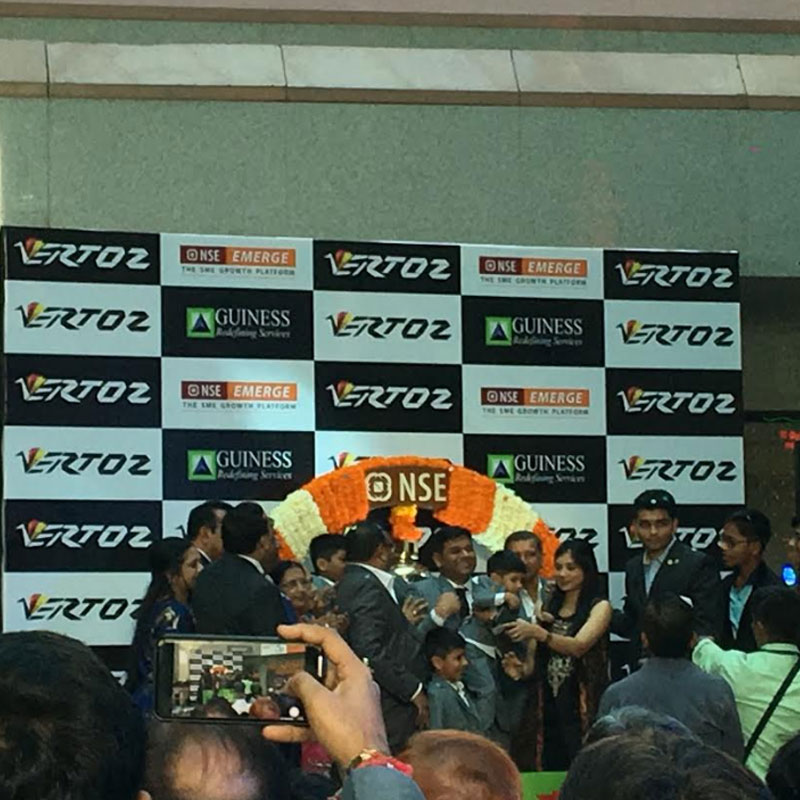
    MUMBAI: It was a rare sight to witness at the bourse today when Vertoz Advertising became the first programmatic advertising company to be listed on National Stock Exchange this morning. The price for the public issue of 15.84 lakh equity shares was fixed at Rs 108 per share. Within the first 3 hours, the stock skyrocketed 21.6 per cent trading at Rs 129.6 after opening at Rs 116.

    Founded in 2012, Vertoz has offices worldwide with its global headquarter in New York, USA. It offers engaging and innovative advertising and monetisation solutions to clients as a better option to the traditional methods of media buying and selling. The company’s technology, advanced capabilities and programmatic platform makes for a highly scalable software platform that powers and optimises the marketplace for real-time trading of digital advertising inventory between advertisers and publishers.

    Indiantelevision.com got talking to the  company’s founders and CEO Ashish Shah and founders and chairman Hiren Shah where they spoke about the company’s growth, division of funds raised from the IPO, programmatic advertising in India and much more. Excerpts: 

    Why did Vertoz take the IPO route when most agencies prefer private investments or acquisitions?

    Ashish: We believe in doing different things rather than doing things differently. A lot of companies in our sector have gone through a private equity round and we did too had the same option but we chose to have an IPO as it helps in distributing the wealth in a better way. There are a lot of people in the company, investors, M&A, and all of that requires cash. Private equity wouldn’t have helped in solving that problem.

    What was the revenue of the company last year and how much has it grown? What is your projection for next year?

    Hiren: Our net revenue stood at Rs 20 crore in 2016 and at Rs 9 crore in Q1 2017. We are expecting revenue of Rs 30-40 crore in 2018. The way India is growing and with people moving to digital, we are expecting a huge growth in the segment. 

    Will you be looking at acquisitions going forward?

    Hiren: Yes, but we will be looking at acquiring companies and not getting acquired. We have a subsidiary in the US and other European countries for acquiring digital businesses. We will be using the funds raised from this IPO to acquire those businesses. 

    When can we expect that to happen?

    Hiren: Soon! It should happen in the second half of 2018. 

    When will you be listed on NSE completely?

    Hiren: It is mandatory for small and medium-sized enterprises to be listed on NSE Emerge for at least two years or four annual general meetings. Once we are able to comply with that, we will be listed on NSE, maybe in late 2019 or early 2020. 

    How do you intend to use the funds raised for the IPO?

    Hiren: We would be using around 70 per cent of the funds in inorganic growth and acquisition of businesses and the rest 30 per cent at a macro level on working capital of our business.

    Do you think the Indian media industry has understood programmatic advertising and are leveraging it to the best use as opposed to other markets? 

    Hiren: It is a long way to go for India as people here are still not aware about programmatic advertising. They still follow traditional methods of advertising and it was the case with the US as well but they have evolved in programmatic to a greater extent. India on the other hand, still needs to understand the core of it but with prime minister’s Digital India movement, programmatic will see better days. 

    How do you think will programmatic advertising shape up Indian media over the next few years, say by 2020?

    Ashish: India is a growing economy and is rapidly adopting various policies and changes for a future ready industry. We would be able to achieve what western countries have achieved in a quicker time. 

    How much do advertisers spend on programmatic now? How much is it in the west?

    Hiren: Advertisers shell out less than 5 per cent of the advertising spends and a major chunk still goes into traditional media. In western countries, this number is close to 60 per cent.

    When do you think will we be able to use programmatic advertising in radio?

    Hiren: Although programmatic advertising is already happening in radio and television in other counties, it would start in India very soon, maybe by 2019. Some radio players are using programmatic in jingles but that is only limited to online radio. 

    How will programmatic adverting shape up in India going forward?

    Ashish: programmatic is the need of hour and has huge potential in the ad world. Advertisers can take quick decisions on what they should do or change in their marketing communications. Although programmatic advertising will evolve in India, it will also change its form with various technologies coming in place.

    In western countries, in-house teams are created for this. Is it a challenge for agencies to sustain? 

    Ashish: I don’t see it as a challenge for agencies as it is just about economies of scale.Everybody has a room for everything.

  • DAVP ads: Audio-visual medium gets lion’s share

    NEW DELHI: A sum of Rs 12.8577 billion was spent in 2016-17 in advertisements on various media by the Directorate of Advertising and Visual Publicity, the Parliament has been told.

    As against this, the total expenditure in 2014-15 was Rs 9.9834 billion, and Rs 11.888.5 billion in 2015-16, the minister of state for information and broadcasting Rajyavardhan Rathore said.

    Of this, the expenditure in the audio-visual medium was the largest: Rs 6.0914 billion in 2016-17, Rs 5.316 billion in 2015-16 and Rs 4.7367 billion in 2014-15.

    DAVP is the nodal advertising agency of the government for releasing advertisements only on behalf of various ministries/ departments to disseminate information in respect of government policies, schemes, programmes and other projects and events of the government.

    AlsO Read :

    Give more funds to DAVP for empowering people: Parliamentary Committee

    DD invites short films on Govt schemes, ‘DAVP producers’ preferred

  • Audo-visual, electronic media greatest beneficiary of Govt ads in 2016-17

    NEW DELHI: A sum of Rs 5.0983 billion was spent on government advertisements through the audio video and electronic media.

    Giving figures of 2016-17 until 17 March 2017, Parliament was told today by Minister of State for Information and Broadcasting Rajyavardhan Rathore that in comparison, a sum of Rs 4.2377 billion was spent on the print media.

    A total of Rs 1.3291 billion was spent on Advertisement Boards / Outdoor Publicity.

    Advertisements are given out through agencies accredited with the Directorate of Advertising and Visual Publicity.

    Advertisements were given out to the electronic media on behalf of 65 departments or programmes of the government, with the largest being spent on Department of Drinking Water Supply – just over Rs 1.336 billion.

    In comparison, 415 different government ads were given to print media, and 35 ads went to outdoor publicity.

  • Star Sports bags two golds at Digixx Awards 2017

    MUMBAI: Star Sports has bagged two golds at the recently held annual Digixx Awards. The awards aim to recognize and celebrate excellence in digital marketing and advertising that creates an exceptional user experience that is deeply engaging and interactive.

    The Awards categories were broadly divided into three major groups – Industry Sector Awards, Discipline Awards for Campaign and Special Awards.

    Star Sports has won in the two categories at the prestigious awards – Digital Marketing Excellence In Media for their overall digital initiatives and campaigns in 2016 and an individual award Young Guns of The Year to Janessa Fernandes from Star Sports for Kabaddi – an individual award given to the best young digital marketeer.

    “It’s a recognition to the consistent and dedicated efforts put by our Digital Marketing team throughout the year. It’s a great beginning to 2017 and awards like this continue to inspire us in our endeavor of achieving excellence in the digital space. Star Sports would like to convey its best wishes to the other winners as well who have been doing exceptional work”, said a Star India spokesperson on winning the awards.

  • Only one-third of govt ads went to electronic media

    NEW DELHI: A sum of Rs 340,52,61,236 was spent on advertisements in the electronic media by the Directorate of Advertising and Visual Publicity on behalf of various Ministries/Departments of the Government for advertisements during the current year.

    Of a total of Rs 992,46,45,257 spent so far, the major share of Rs 545,60,50,506 has gone to the print media. The Parliament was told that Rs 92,51,00,816 was spent on outdoor publicity (hoardings etc).

    Printed Publicity material cost totaled Rs 9,48,28,635 and Rs 4,34,04,064 went into exhibitions.

    The Ministry/Department-wise break-up of expenditure in respect of the advertisements released through the above Media Vehicles is available on DAVP’s website under head ‘Newspaper’ and sub-head ‘Reply to Rajya Sabha Question -› Annexure of Question No.- 880’.

    The DAVP has seven empanelled impact assessment agencies which can be used by the client ministries according to their requirement.

    Also read:   Over Rs 149 million spent on govt ads post-DeMo

    No proposal to bring news portals under PRB or PCI Acts