Tag: advertising

  • ‘Get Well Soon India’ says Youva Stationery in new campaign

    ‘Get Well Soon India’ says Youva Stationery in new campaign

    Mumbai: As the country recovers from the second wave of the pandemic, it is necessary for people to take precautions and hope for the recovery of the ones who are suffering. To educate children about the effects of the pandemic and how it impacts us, Youva, the domestic stationery brand from the house of Navneet has launched a heart-warming campaign “Get Well Soon India” where kids are seen creating a greeting card for the country.

    The campaign designed and produced by ANTS Digital brings out the innovation in children and at the same time spreads a positive social message targeted at generating health awareness.

    The campaign delivers a powerful message that defeating the novel coronavirus is a collective responsibility as a society and urges people to help India get well soon. It stresses the importance of wearing a face mask and washing hands as frequently as possible. It also urges people to participate in the nationwide vaccination drive against Covid-19.

    Youva, chief strategy officer and spokesperson, Abhijit Sanyal said, “Youva, as a brand, was conceptualised keeping children and the youth in mind. Our brand philosophy is creation, this campaign creates hope for our fellow citizens who are suffering, stressed, and are losing self-belief in these testing times. As a brand, if we can create positivity and confidence through our communication then we will be able to say that we made some contribution in these trying times. We earnestly hope our message is as well received as our products!”

    ANTS Digital Pvt Ltd, CEO, Sanjay Arora said, “We created this film for our client to send a strong message to the public that to fight tough situations like the ongoing pandemic we need to be disciplined all the time. Social distancing, vaccination and wearing a mask is not only important but mandatory. The Youva of this country is wishing the very best to all and encouraging them to do the right thing. We wanted to highlight the heroes of the future, our greatest asset, our children. We hope our key message of maintaining safety protocols reaches people at large.”

  • Bisleri forays into hygiene segment with new TVC

    Bisleri forays into hygiene segment with new TVC

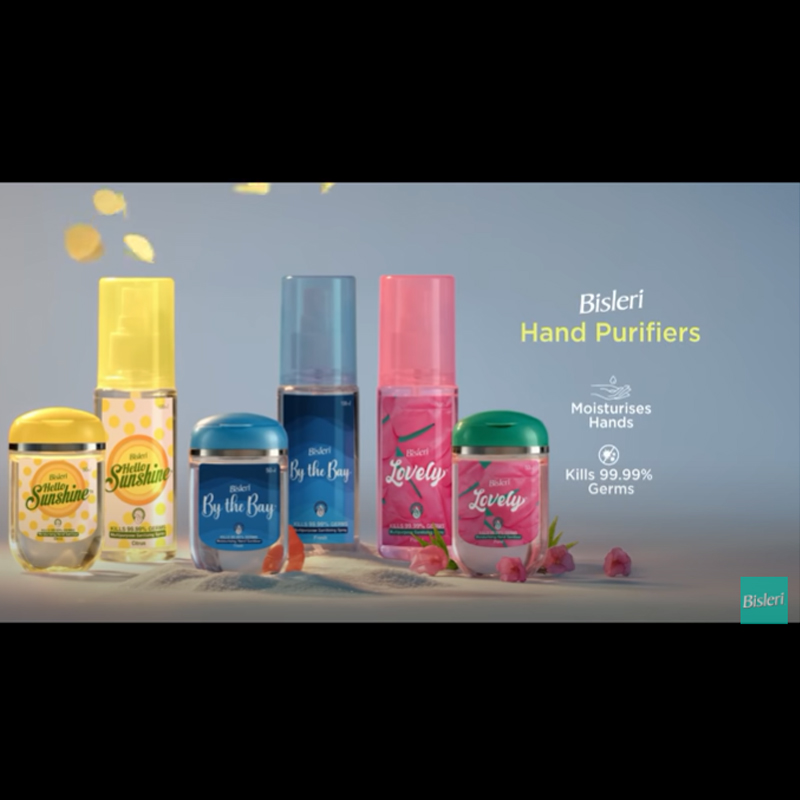
    Mumbai: Bottled drinking water brand Bisleri has announced its foray into the personal hygiene segment. The company launched a new TVC for its new range of hand purifiers, with the tagline – ‘For the love of hands’, and became the latest entrant in the hand sanitisers market, a segment which has witnessed an upsurge in demand since the onset of the pandemic.

    With the frequent use of regular sanitisers, consumers experience adverse effects on the skin, like coarseness and dryness. The TVC aims to portray how Bisleri’s new range of hand purifiers that are enriched with aloe vera, glycerol, and vitamin E, can keep the skin moisturised and nourished while ensuring protection from germs.

    The film’s visuals effectively drive across the message in a simple yet engaging manner that Bisleri Hand Purifiers not only provide safety to the hands but also keeps them soft, fragrant, and refreshing. In addition to the TVC, the company also has plans to roll out digital campaigns on social media and OTT platforms for the new product range.

    Bisleri chief executive officer Angelo George said, “There has been exciting growth in the personal hygiene segment triggered by increasing health and hygiene concerns. We developed Bisleri hand purifiers with these enhanced features in premium packaging, to provide a superior experience. With our distribution reach across the country, the exciting range of Bisleri hand purifiers is available at leading general trade stores, pharmacies, and modern trade outlets as well as e-commerce platforms.”

    The skin-nourishing formulation, packaging design, and fragrances were developed under the guidance of Bisleri vice-chairperson Jayanti Chauhan. Bisleri’s range of hand purifiers is available in three refreshing fragrances- citrus, fresh & floral in both gel and spray formats, the company said.

  • TOI Bangalore makes way for good times with an 80-page issue

    TOI Bangalore makes way for good times with an 80-page issue

    Mumbai: One of the most palpable ways to tell if things are coming back to normal is to begin the day with a newspaper whose mere heft bears a piece of positive news.

    In the wake of a devastating second wave and amidst concerns about a third one, it’s how businesses strive to make the present worthwhile that inspires and injects new hope in all of the economy. It’s an effective stimulant on the consumer side too. When readers see a thicker paper filled with brand advertisements, they are more motivated to come out of the inertia of consumption and begin to feel a sense of comfort with the status quo.

    A bearer of this sweet news was Saturday’s Times of India Bangalore 80-page edition filled with ads from consumer-facing brands who want to usher in a wave of normalcy without waiting for the situation to fix itself.

    According to TOI, the edition featured as many as 125 advertisers. The paper drew brands from across the categories of consumer durables, retail, luxury, real estate, BFSI, apparel, digital, automobile, and more signaling that they are ready as ever to make the ‘New Normal’ not just a survival story, but a story of growth.

    “This uplifting edition could not have been accomplished without the combined efforts of the Times of India Bangalore team whose unwavering belief in change translated into this bumper issue,” the organisation said in a statement.

  • Global ad market to top $700 bn in 2022: WARC Data

    Global ad market to top $700 bn in 2022: WARC Data

    New Delhi: Global advertising spend is expected to rise 12.6 per cent during 2021 as a whole to reach $665bn, according to WARC Data’s report tracking global ad-spends. This is a sharp increase from the 6.7 per cent initially forecast, and would result in all of 2020’s losses being recouped, contrary to previous expectations.

    The new report signals renewed optimism in the situation getting better for the overall market as it recovers from the severe impacts of the pandemic. According to WARC Data, a further growth of 8.2 percent is predicted for next year, with the global advertising market to be worth more than $700 billion. While it took six years to move from $500bn to $600bn, it has now taken just four years to reach $700bn. This is in no small part due to rapid investment in online formats, which has doubled in the last five years, it stated.

    India, too, will see strong growth in advertising spend over the next two years, but 2021 investment will not fully recover 2020’s losses, said WARC Data in its latest report, tracking 100 markets worldwide. According to the report, India’s growth is up 16.1 percent to $8.2 billion in 2021.

    Regional advertising investment in the Asia Pacific is forecast to increase by 12.8 percent this year to top $200 billion for the first time. This will be driven by the Chinese ad market, which is expected to grow by 16.3 percent to exceed $100 billion for the first time.

    WARC’s quarterly research also finds that advertising spend in the second quarter rose 23.6 percent to $157.6 billion, marking a new high for a Q2 period and the strongest rise in over a decade. This growth was mainly driven by online formats, which collectively saw spend rise 31.2 per cent versus the previous year. eCommerce was the star performer with growth of 59.5 per cent, though offline media – most notably linear TV saw 11.5 per cent growth – also fared well.

    Linear TV to grow 7.1 per cent in 2021

    For linear TV, spend is projected to grow 7.1 percent to $168.1 billion this year, equal to a quarter (25.3 percent) of the global ad market. Investment is expected to rise by a further 2.7 percent in 2022, though this means just 60 percent of 2020’s losses will be recovered by 2022.

    “The 2020 downturn was felt disproportionately among legacy media owners. While online ad investment rose 9.4 per cent last year, mostly to the benefit of a few pure players, brand spend on legacy media such as print, TV, radio, outdoor and cinema fell by $63bn. Data show that this loss was on a par with the Great Recession,” as per WARC.

    The forecast suggests, legacy media will see two consecutive years of growth in 2021 (8.8 per cent) and 2022 (3.1 per cent) for the first time in a decade, but budgets will continue to move online. More than 60 per cent of spend is expected to be on digital media in 2022, an increase in share from 50 per cent before the pandemic in 2019.

    “New quarterly research, collated from 100 markets worldwide, shows for the first time the true extent of the digital shift in response to the coronavirus outbreak last year. Growth in online adspend has typically tracked some 20 percentage points ahead of offline media, but in the final quarter of 2020, this leaped to a remarkable 41 points—an absolute difference of $41 billion,” WARC Data, managing editor and author of the report, James McDonald.

    “Investment in offline media fell by $63 billion worldwide in 2020, marking the worst year in living memory for the majority of media owners. All media are forecast to record growth this year, with most sustaining this into 2022. Yet, as has been seen before, it is the online platforms that are set to benefit most from the ad market’s recovery.”

    All consumer-facing product sectors are expected to increase advertising spend this year. The travel sector, however, will take more than two years to lift spend back to pre- pandemic levels, it added.

  • Throwback Thursday: How Burger King broke the mould with its ‘Mouldy Whopper’ ad

    Throwback Thursday: How Burger King broke the mould with its ‘Mouldy Whopper’ ad

    Mumbai: In this week’s Throwback Thursday segment, we present an ad that isn’t so much of a relic considering it was launched just over a year back. However, the product showcased in the ad – a rotting, aging whopper from Burger King – might qualify as one! It is one of those game-changing ads that make one sit up and rub their eyes in disbelief and ask oneself- Is this for real? But that’s not the only reason this ad features here.

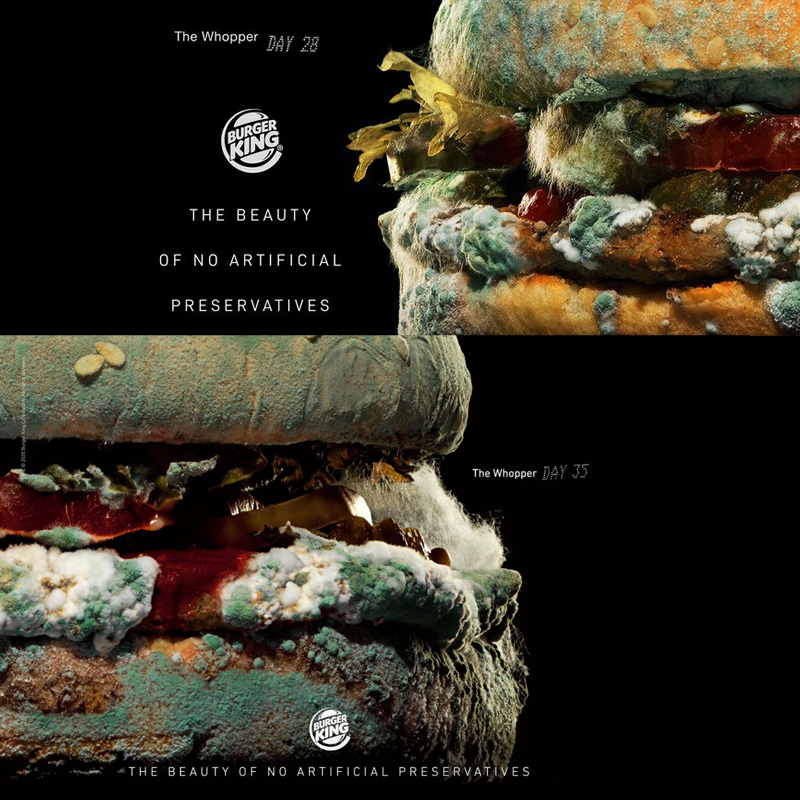
    Burger King unveiled a global ad campaign ‘Mouldy Whopper’ in February 2020, aimed at highlighting its commitment to dropping all artificial preservatives from its food products. The ad features a Whopper- one of the signature burgers from the brand- and proceeds to coat it with, believe it or not, mould- layers of it! To say that the Burger King’s ad was a departure from usual food ads would be a gross (in more ways than one) understatement.

    Instead of showcasing its food with the classic flawless and often unrealistic, picture-perfect finish- which is the standard norm in fast food advertising, they decided to show the honest, albeit gross reality of natural, ‘free-of-artificial-preservative’ food.

    The ad displays a Whopper that looks fresh to start with, and whose components progressively decompose and get engulfed in fungus over a period of time. It depicts this gradual degradation of the burger through a time-lapse video, alongside a date stamp letting you know how long the burger has been exposed to the elements- beginning from day one and concluding at day 34.

    The speeded-up action shows the burger deteriorating before our eyes over the course of 30 seconds with intriguingly high-resolution photography. First, the lettuce wilts, then white, fuzzy fungi ravage the meat patty. The burger bun flattens out as the mould spreads all over, and the viewer finds out that the action took place over 34 days. The tagline flashes across the screen: “The beauty of no artificial preservatives”, as it then hits the viewer why the whopper wilts in a matter of hours, going on to rot, decay, and develop grey-green mould in over a month’s span.

    The campaign was created through a partnership between three agencies: INGO STHLM, Ogilvy-owned David, and Publicis. It was a far cry from typical food advertising, in which the items are carefully crafted to look as appetising as possible. The idea, of course, was to call attention to the company’s shift away from artificial preservatives and towards a healthier product, even if it came with the tag of ‘junk food’.

    The Mouldy Whopper spot accumulated more than 1.7 million YouTube hits within days of its debut. While it left most marketing experts divided, media outlets could not stop breaking the ad down. There were visceral responses on whether the marketing guys at Burger King had lost their minds.

    But luckily for the brand, it worked in a counter-intuitive way. It became a talking point, demanded attention, and the central message was also hammered in— that the Whopper grew mouldy because it had no artificial preservatives. The fast-food industry has a reputation of being too processed and full of additives, and this was a welcome departure.

    Many of the consumers lauded the brand for its bold but honest and realistic portrayal.

    By doing so, the fast-food brand broke all food advertising conventions by marketing its best-selling product in an unappetising, downright disgusting manner. At the same time, such an ad was a huge risk. It could gross loyalists of the brand and turn them off from it.

    The work promotes the brand’s pledge to drop all artificial preservatives, which it has accomplished across much of Europe and 400 locations in the US. Plans to have it removed from Whoppers in all the US locations are next on the cards for the brand.

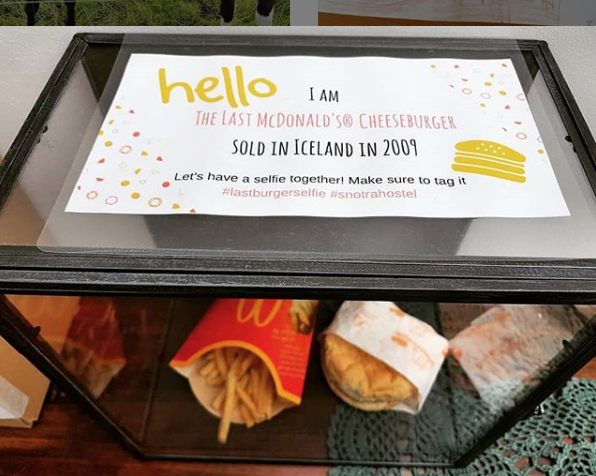
    The campaign also seemed to take a cheeky dig at its chief rival, despite never mentioning McDonald’s in the campaign. McDonald’s has come under fire several times in the past for how its food doesn’t appear to decompose as one would expect.

    Whether the ad and the shift away from artificial preservatives will work to accomplish Burger King’s ultimate goal—selling more Whoppers—remains to be seen.

    Burger King’s CMO Fernando Machado has this to say: “No one in our office was expecting consumers to jump in the car and drive desperately to Burger King to buy a Whopper just because we removed artificial preservatives. The main objective of the Mouldy Whopper campaign was not to drive short-term sales.”

    “It is the right thing to do and we don’t see a future where fast food brands will have artificial preservatives. So, by getting there first, we are making our brand future-proof. And, hopefully, in the long run, this will not only help with sales but mostly avoid the brand becoming irrelevant,” he added.

    So, was the chain’s controversial mouldy whopper ad a winner? Well, if this year’s Cannes fest is any indicator then it’s a whopping YES for the whopper. The campaign premiered at the recently concluded Cannes Lions International Festival Of Creativity achieving no less than three Grand Prix in the Outdoor category, Retail subcategory. Three posters of the campaign won Grand Prix each, in addition to their correspondent Golden Lion.

    But, of course, all that would be a moot point if the communication would have been lost to the ones who matter most – the consumers. Yes, one needs to push hard at the boundaries sometimes, even tear it down to be noticed and become relevant. As a wise guy once said, “If no one notices your advertising, everything else is academic”

    CREDITS

    CLIENT: Burger King

    AGENCY: Ingo, David Miami, Publicis

    Executive Creative Director: Björn Ståhl               

    PRODUCTION

    COLONY (Production company)

    Producer: Lena von der urg

    MUSIC: “What A Difference A Day Makes” by Aretha Franklin

  • FreshToHome has grown 4x since 2019: CEO Shan Kadavil

    FreshToHome has grown 4x since 2019: CEO Shan Kadavil

    Shan Kadavil’s bio on a networking platform reads ‘Farmer, Fisherman & Entrepreneur’.  In his own words, his journey to co-founding FreshToHome stemmed simply from a desire to find safe, hygienic fish to consume. That desire turned into passion, which in turn set him off on a mission to source seafood which is free of chemicals & antibiotic residue. To do so, Kadavil and team had to disrupt the traditional ways in which sourcing and distribution of seafood & meat happens in India and re-invent the food supply chain from scratch, by disengaging with the middle men and providing value to the farmers and fishermen.

    Thus, was born FreshToHome- an AI-based online marketplace that directly connects consumers with the fishermen and farmers. Today the platform has transformed into arguably the world’s largest vertically integrated e-commerce company in the fish and meat space, delivering to nearly two million customers in ten cities in India and all of UAE. The brand is now making forays into other fresh food categories such as fruits, vegetables and dairy.

    An entrepreneur who jump-started many technology companies and start-ups in India and the US, Kadavil has been named twice in the Exhibit magazine’s “100 Top Tech Indians” list, and won the Economic Times “Most Promising Entrepreneur of 2019” award, among others. Founder, chairman of tech startup, Dbaux Technologies, Kadavil holds a number of patents in the areas of Big Data & Cloud Computing.

    Kadavil is also credited with having built the first and largest Studio outside the US for Zynga- a leader in social gaming and maker of popular games such as Farmville, CityVille & Mafia Wars- in his previous role as the country manager & India founder of the company.

    As he himself jokingly once said, Kadavil literally went from making virtual tomatoes and potatoes on Farmville to actually farming fresh vegetables, poultry and fishes from fishermen.

    IndianTelevision’s Anupama Sajeet caught up with the multi-functional leader for a freewheeling conversation on being one of the early movers in the online seafood & meat delivery space in India, the challenges it entailed and on the road ahead for the e-tailer…

    Edited excerpts:

    On the brand’s claim of ‘zero chemicals & antibiotic-residue free’ on its fish & meat products

    The key to success in the fish and meat category is quality products and the fastest time from source to end consumer. A typical fish supply chain in India has over three middlemen which takes at least three to four days to reach the end-user. FreshToHome’s AI & IoT-tech-enabled platform ensures that the sellers are able to source without middlemen and the product reaches the end consumer within 24 to 36 hours.

    Additionally, the platform guarantees that an around-the-clock cold chain keeps the products within a range of zero to four degrees. The prompt delivery to the customer’s doorstep is possible through our state-of-the-art facilities and hubs in all regions and our convoy of vehicles that deliver around 23,000 tons of fish and meat per year.

    Apart from this, we have numerous checks during the process, including for standard chemicals, antibiotics, and preservatives. FreshToHome has reputed third-party lab certification that we provide on our website and app, which our customers are free to download. With this, we are able to validate that the products our customers are purchasing have been tested for over 120 antibiotics and other chemicals.

    On the marketing strategy behind the recent TVC campaign & revamped logo

    With our first campaign titled “Apne aap se, ya app se” we reference the wet market and nudge consumers to move online and buy from the FreshToHome app for a better experience. The film aims to highlight the predicament faced by ‘non-app’ users. There are three films created, which show the comparison with the wet market in a split screen treatment, depicting our three product categories- chicken, fish & meat- with super-quick delivery, cleaned, cut, and ready-to-cook. Most importantly, it shows how the consumer can save time and effort spent in the conventional ways of buying and thereafter cleaning, cooking it. We have also revamped our brand imagery (logo, look and feel) to be more youthful and fresh, bringing to life its core of fresh, chemical free food.

    On the brand’s media mix for advertising

    Being a digitally native brand, our media will be primarily digital. Post pandemic, coinciding with our campaign launch, our media mix has included TV, OTT, outdoor and print in a big way, as we want to deliver a larger thematic message by creating awareness of the benefits of shifting to buying meat and seafood online.

    On ‘the pandemic effect’ and the difference in numbers- pre & post Covid

    The growth of the platform has been rapid during the pandemic- the number of orders and registered users have gone up. While, in the first wave we witnessed a growth of 1.5 times, we have registered a growth of 2.5 times now.

    During the first wave, we were less prepared and there were a lot of issues in settling down operationally. We spent a lot of energy figuring out how to amplify human capital. The lack of resources was a problem but we have now hired 40 per cent extra manpower. In the last three to four months, we have employed 3000-4000 people. This rapid growth has happened on our platform directly or indirectly. And that kind of growth prepared us for the second wave. Earlier where we had one factory in each city, we now have two to three factories. We have grown four times from 2019 to the present. Currently, we are getting 2.2 to 2.3 million orders per month.

    On the shift in consumer behaviour towards online & company’s plan post-pandemic

    Online space is going to become much more competitive and saturated with every passing day. Companies like us will not be able to ignore the importance of this medium if they want to stand out among the competition and provide value to their consumers. Businesses with agility and creativity should work together to ensure the collective survival of this ecosystem.

    The industry has continued to reach out to micro-influencers for awareness about safety and hygiene among their potential consumers. It is imperative to adopt marketing strategies directed towards building a direct bond with their customers by focusing on digital methods.

    Talking particularly about FreshToHome and FTH Daily, COVID-19 transformed the fish and meat purchasing behaviour of consumers dramatically. Due to safety concerns, consumers made the habit-forming shift to e-commerce and we saw online demand for our products going up manifolds last year, thanks to the safety guarantee of “100 per cent Fresh and zero per cent chemicals”.

    On features, that sets FreshToHome apart from other established e-tailers

    The key differentiator of FreshToHome is our direct sourcing approach. For a competitor, who buys from vendors in the city, this is a hard task to do. Our ‘Farm to Fork’ feature and our AI-backed US patent called “Virtual Commodities exchange” is primarily what helps us stand apart. So, we get the info on consumer demand and then we match this with supply information from farmers. With the help of this, the time delay between taking the product and reaching the consumer is reduced.

    Secondly, there are no chances of wastage. The wastage in the supply chain of fish is about 15 per cent. The time cut-off in the supply chain, which is a minimum of 0 to 24 hours, makes us extremely competitive. Then there’s our sourcing strength. Most players may go to five to six harbours, but we go to nearly 500 fishermen and 125 harbours. This has the advantage of being marginalized in cost and not overpriced.

    Also, we use external labs to get certifications like ‘Free of ammonia’ and ‘No preservatives and antibiotic residue’. We are an honest brand and we are vocal about it.

    On ensuring quality, while expanding the products portfolio beyond meat

    When Mathew Joseph (co-founder) and I met, he had a company called ‘SeaToHome’. The reason behind starting ‘FreshToHome’ was to expand our categories to everything “fresh”- that was the vision. Since then, we realised that fish itself has been a complex challenge of hygiene but we are slowly and steadily building against that. It took us four years before we got our commodity on the exchange platform correctly. Then, to build the cold chain and supply chain- the whole process took us five to six years to develop.

    Now that the infrastructure has been developed, we are expanding our categories to fruits, vegetables and dairy. We have already expanded our daily delivery service- FTH Daily in 2019, which specialises in delivering milk, groceries, fruits, vegetables, and daily essentials, in Bangalore, Hyderabad, and Pune.

    On challenges faced while expanding regionally

    The challenge has always been to change an inherent consumer behaviour to shift their purchase of meat and seafood through our app, instead of going out and buying it themselves. This is a gradual shift where we are continuing to educate consumers about the benefits of buying meat and seafood from FreshToHome.

    On plans for international expansion

    We are already one of the largest players in the UAE and now plan to expand to all GCC (Gulf Cooperation Council) countries, specifically in Saudi Arabia, Oman and Qatar.

  • Digital & TV steer ad industry’s recovery to pre-pandemic levels in 2021: dentsu

    Digital & TV steer ad industry’s recovery to pre-pandemic levels in 2021: dentsu

    MUMBAI: India has emerged as one of the top five markets with high year-on-year growth rate in advertising spends, said dentsu in its latest Global Ad Spend Forecast June 2021. After suffering a steep 12.9 per cent decline in 2020, the ad spend is expected to bounce back with 10.8 per cent growth in 2021, according to the report.

    The forecast suggests the overall ad spend will reach $ nine billion this year, and expand further by 12.4 per cent in 2022. The growth will largely be led by Television and Digital, as Print, Cinema, OOH and Radio are expected to take a longer time to recover.

    According to the data, Television continues to remain the most popular and resilient media in India, retaining a 40.9 per cent share in ad spend despite the pandemic. The medium also showed a 7.7 per cent spike in growth, as compared to the 2020 spend. Digital’s share of spend has grown rapidly, from 20.0 per cent in 2019 to 29.4 per cent in 2021, and is expected to reach 32.7 per cent by the end of 2022

    India in top 5 mkts-denstu

    The bi-annual report based on data from 59 markets, anticipates a full recovery for the global ad market in 2021, with spends exceeding pre-pandemic levels sooner than was previously forecast. 

    While 2020 remains the weakest performing year since the global financial crisis, the decline in growth during 2020 has improved since the January 2021 forecast from -8.8 per cent to -7.2 per cent. The pandemic-induced decline in global advertising spend during 2020 has also proved less severe than anticipated, it states. The overall ad market outlook for 2021 shows recovery with 10.4 per cent growth and a spend of $634 billion, which represents an improvement of 4.6 percentage points over January 2021 prediction.

    Ad-spend in APAC

    Overall, the ad spend in APAC is expected to grow by eight per cent, with Australia and India showing higher growth rates in 2021 compared to other countries. In APAC, the 6.2 per cent rise in digital spend last year is likely to grow by 12.8 per cent in 2021 to reach $124.5 billion, representing a 54 per cent share of total ad spend. 

    Regional live events such Tokyo Olympics and Paralympics Games will remain significant drivers of growth in Linear TV ad spend in APAC (3.9 per cent increase in 2021 to reach $59.2 billion). The report also indicates a shift towards CTV (Connected TV) and OTT (Over The Top). With audiences moving more towards digital media consumption, Linear TV spend will remain below pre-pandemic levels until beyond 2021.

    With gradual lifting of restrictions on social activities, OOH will bounce back post impact of the pandemic, rising 7.5 per cent in 2021 in the region. Cinema has a slightly longer recovery, with a further decline in 2021 (-5.0 per cent) but expected to bounce back in 2022. Radio will also see growth (4.3 per cent) in 2021.

    While most channels will return to growth in 2021 (Cinema in 2022), Print is seeing a slight decline in 2021 (–2.7 per cent) and expected to continue declining in 2022, as it evolves towards new modes of digital delivery.

    Meanwhile, government spending remained a key growth area, supporting the Covid vaccine rollout and other related initiatives. In APAC’s key markets, the travel and transport sectors, will still be affected by the uncertainty of the past year and see a muted increase in demand (4.9 per cent), while Media & Entertainment is forecast to see growth (9.7 per cent).

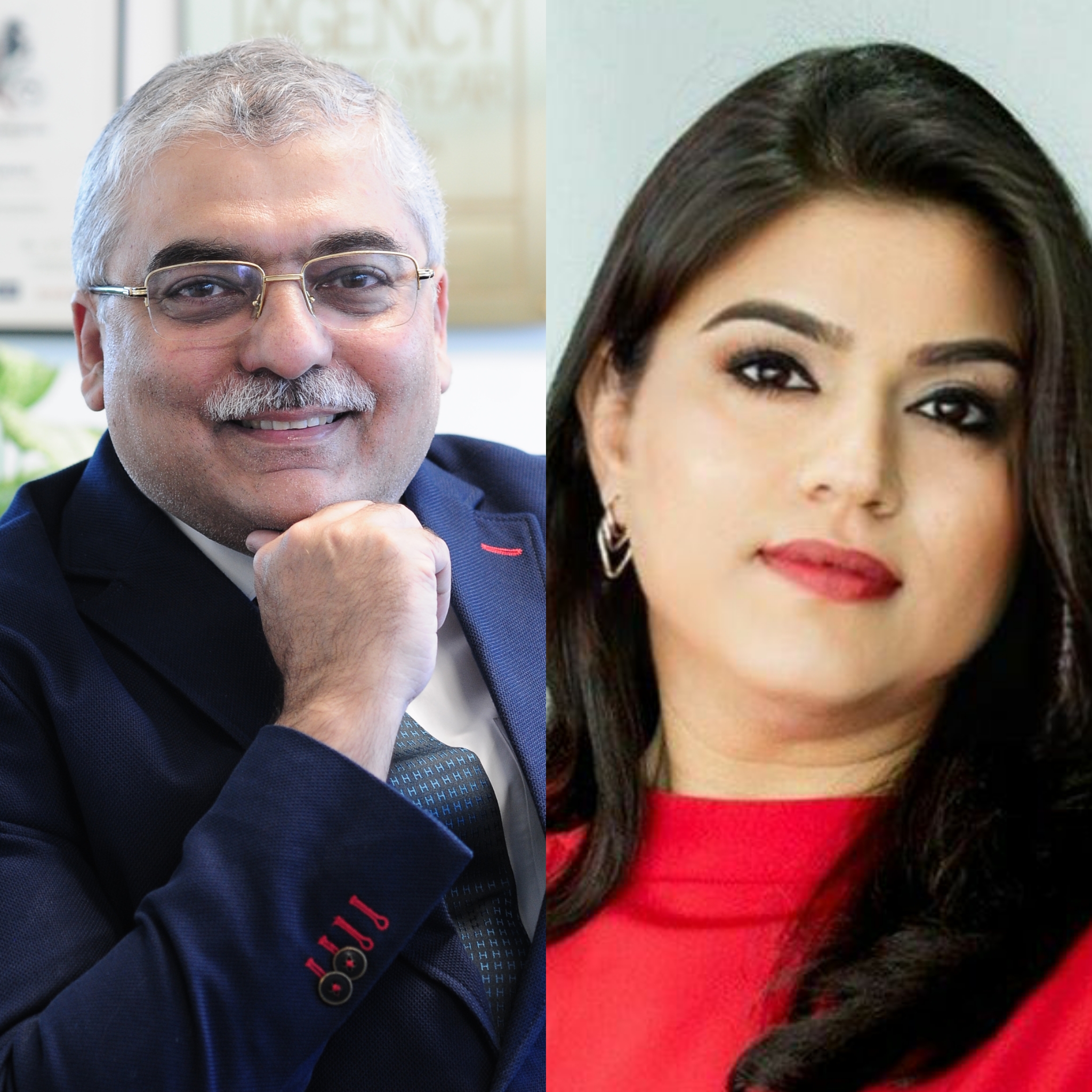
    dentsu International APAC CEO Ashish Bhasin said, “It is promising to see a return to growth in the APAC region with two of our markets in the top five contributors of ad spend growth; China and Japan. While China continues to see strong levels of growth driven by Digital and OOH, Japan’s growth will be buoyed by events like the 2020 Olympic & Paralympic Games, and the House of Representative elections and the advertising spend associated with it, particularly in TV.

    By market, the top five contributors to the $ 59.7 billion of growth in incremental ad spend during 2021 will be the US, China, UK, Japan and Australia. The US share of ad spend remains significantly above all other markets in 2021. The highest growth rates in 2021 are forecast to come from spend in India, Canada, the US, Australia and the UK.

    Media APAC CEO & Media Singapore MD Prerna Mehrotra said, “We are optimistic that the region will bounce back to positive growth in ad spend, with some channels likely boosted higher than pre-pandemic levels. The main drivers behind the growth is economic recovery, with the APAC GDP set to increase by 7.3 per cent, and a stronger-than-ever push to digital marketing.”

  • Thums Up’s Olympics 2020 campaign celebrates hope and resilience

    Thums Up’s Olympics 2020 campaign celebrates hope and resilience

    New Delhi: As India enters its 100th year of participation at the Olympic Games this July, Thums Up has set out to celebrate the historic feat and salute the real heroes – the athletes who overcame tremendous odds to reach where they are today. The home-grown brand on Wednesday announced its worldwide partnership with the international event which is set to begin in Tokyo Games to be held in Tokyo on 23 July.

    As part of the partnership, Thums Up has launched its new campaign – Toofan wahi jo sab palat de, that tries to capture the mood of not just the athletes representing India at the Olympic Games, but the entire nation. “The upside down Thums Up bottle is a visual symbol that celebrates determination, strength, and the fierce challenger spirit,” said the company on Wednesday. “Every bottle in the hand of every consumer is now also their voice to ‘Palat De‘ all the naysayers who say they can’t or shouldn’t do it.”

    Ogilvy India, chief creative officer, Sukesh Nayak said, “Completely turning the conversation upside down, it’s a game changer that takes the brand a notch higher. We believe it very well captures the emotion of the nation, when it comes to the Olympic athletes, our real heroes.”  

    According to the company, the task at hand was to create a brand shift, without taking away anything from it and to make the campaign relatable and emotional, without disturbing the DNA of the brand. The first film was launched on Tuesday, which was directed by Shashanka Chaturvedi in association with the production house- Good Morning Films. The uplifting tone of the campaign perfectly complements Thums Up’s repositioned brand message of resilience and real heroism of everyday people.

    Ogilvy India (north), chief creative officer, Ritu Sharda said, “All of us have faced these naysayers, telling us what we can and can’t do. The emotion is real and relatable. And that’s why we think the idea is going to cut through the masses and turn into a cheer-storm for our athletes. Of course, the idea lives beyond a campaign and is a personal statement for anyone to say ‘Palat De’ to any challenge”

    Coca-Cola India and Southwest Asia, vice president and head of marketing, Arnab Roy said, “Consumers are at the heart of Coca-Cola’s beverage portfolio. The company is acutely attuned to their preferences and continuously looks at innovative ways to connect people with our brands. Our partnership is a statement of empowerment, and our intent is to instill the ‘thunder’ of hope and strength amongst our consumers. The new upside down Thums Up bottle is a visual symbol of resilience that people showcase in their daily lives, against all odds.”