Tag: advertising

  • FCB Cogito elevates Vidyadhar Wabgaonkar as CEO

    FCB Cogito elevates Vidyadhar Wabgaonkar as CEO

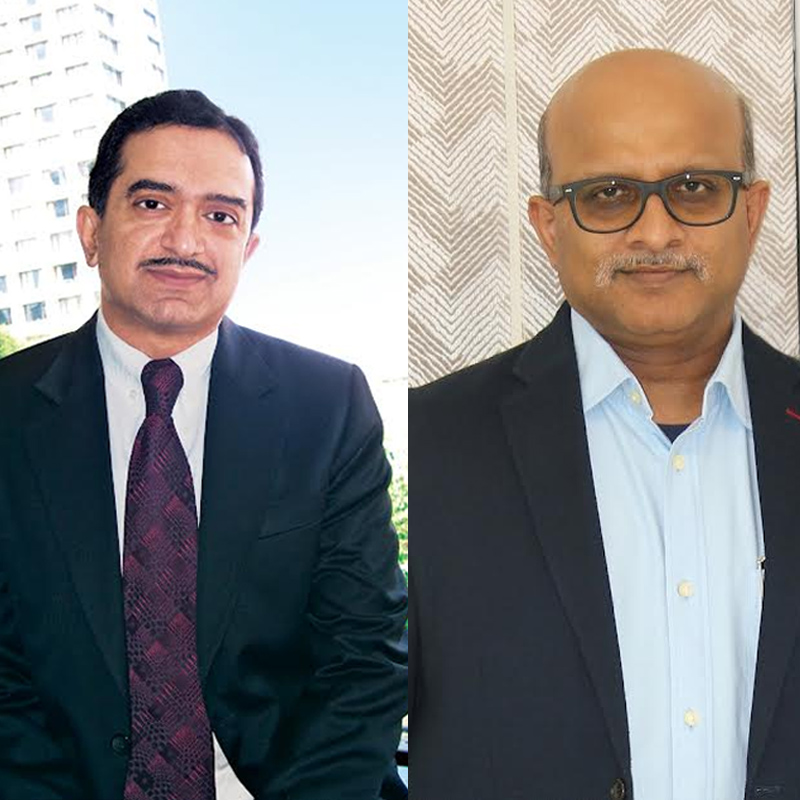
    Mumbai: FCB Group India has announced the elevation of Vidyadhar Wabgaonkar as the CEO of FCB Cogito, the independent consulting arm of the Group in India. The announcement comes as part of the Group’s recent restructuring of operations in a three-agency structure of FCB Ulka, FCB Interface, and FCB India.

    Vidyadhar Wabgaonkar, popularly known as Wabs, has been leading FCB Cogito for over four years now. An engineering gold medalist and a rank holding MBA from IIM Kolkata, Wabgaonkar comes with a rich marketing background that includes stints in P&G India and MARICO Industries. According to the Group, his expertise lies in the seamless combination of qualitative and quantitative aspects and the application of tenets of Neuro-Linguistic Programming (NLP) to marketing and business management. He is also a certified life coach and a Master Practitioner of NLP.

    Under Wabs’s aegis, FCB Cogito Consulting has come to be known for its strong proprietary products like ‘Chess’ for getting clients ready for competition and future and ‘Brand Hormone’ for rejuvenating brands, it said in a statement.

    The Group is celebrating its 60th anniversary this year, and this elevation comes in at a very crucial time when the agency is looking forward to the next 60 years in India, it added.

    Speaking on Wabgaonkar’s elevation, FCB Ulka vice-chairman Karkare, said, “FCB Cogito has been the secret weapon in our armory. It represents our capability to solve higher-order problems for our clients with data and insight-driven solutions. It is our intellectual capital, and a means to provide strategic partnership to our clients.  Wabs always brings a fresh perspective, and in today’s times, his unique skills are going to be invaluable to brands as they navigate uncharted terrains.”

    Speaking on his new role, Wabgaonkar said, “ FCB Cogito believes that most clients have the resources required to be successful. It is the paradigm that connects the resources that often need evolution. ‘Why buy me’ is the most important question that each brand needs to answer, and the answer frequently lies well beyond the tangible aspects of the brand. A good answer and a consensus around it, together multiply the force of selling and marketing manifold.”

  • Media and Disability: How inclusive are our TV ads?

    Media and Disability: How inclusive are our TV ads?

    Mumbai: In yet another reminder of why we need to look beyond the label of ‘differently abled’, Indian athletes created history, by hauling 19 medals- their best ever- including five gold, eight silver and six bronze at the recently concluded Tokyo Paralympics. In a remarkable display of bravado, the Indian Paralympic athletes contingent even surpassed their Olympian counterparts, who also had their best outing this year.

    Perhaps this is the cue we need, to stop slotting people into the ‘disabled’ box, conveniently forgetting there’s a person behind the label. While this is true for all spheres of our lives, there is no dismissing the fact that mass media, such as advertising, wields the power to shift narratives around disability at a much wider and deeper level than other tools of communication. However, advertising featuring people with disabilities lags far behind, found a recently conducted study by the US-based data measurement firm, Nielson. An analysis of the firm’s Ad Intel data, that looked at nearly 4.5 lakh primetime ads on broadcast and cable TV in February 2021 found that only one per cent ads included representation of disability-related themes, visuals, or topics.

    Just three per cent of ad spend went to ads featuring disabled people or that were inclusive of disability themes in the creative, the study further noted. Most of the time, disability is absent from advertising, except when it’s focused on products that treat disabilities. Rarely do ads show disabled people in everyday life, such as working, parenting, household chores or enjoying activities, said the August 2021 report titled ‘Visibility of Disability: Portrayals Of Disability In Advertising’.  Pharmaceuticals, health care treatments, devices and similar categories made up nearly 50 per cent of the total dollars spent in disability-inclusive ads, the study found.

    While they study is primarly based in the US, the scenario would not be very different in the Indian advertising landscape. Today, as the world takes baby steps towards a more inclusive, diverse and woke representation everywhere, advertisers have the opportunity to showcase people with disabilities in everyday life, engaging with the products and services brands offer. And it can do this simply by better reflecting the real lived experience of people with disabilities.

    Some brands have managed to strike the right chord of empathy, without over-dramatising or trying to emotionally manipulate the audience. Google Photos had come out with a heartwarming real-life narrative of a visually disabled young man in 2016, who was about to undergo a corneal transplant and regain his vision after almost 15 years. The five minute film, created by Lowe Lintas, chronicled the journey of Amit Tiwari, a resident of Jhansi, who suffered from severe corneal dystrophy in both eyes, which left him almost completely blind when he was in high school. The film showed how with a little help from Google Photos’ image search and organisation features, Amit was able to rediscover all those memories he had been a part of, but missed out on seeing.

    Inclusivity, however, does not mean just an increase in representation in pharmaceuticals ads but across the category spectrum. While treatment and managing care are important aspects of living with a disability, an overabundance of these types of representations can reinforce stereotypes of people with disabilities. Hence, it’s important that life with a disability is portrayed as more than just prescriptions in creatives, by showing it as more relatable, while being realistic.

    The 2016 ad by KFC for the fast food company’s ‘Friendship Bucket’ managed to tick all the right boxes on this count. The ad for its Friendship Bucket, featuring a differently disabled person shows two friends sitting in a KFC restaurant communicating in sign language. The ad celebrates all ‘unique friendships’ in an adorably regular manner without much ado and with all the cheeky warmth of a true buddy, ending with a voice-over saying ‘Dost jitney alag hote hain, Friendship utni kamal ki hoti hai!

    Nestle too came up with an endearing ad for Nescafe coffee featuring a stand-up comedian who stammers in 2015, while an ad for Birla Sun Life had woven a story around a father and his autistic son. These are people who had, till almost a few years ago, seen no representation in mainstream advertising.

    When brands from a broader range of industries are more inclusive of disabilities in their creative, they help balance the narrative and normalise living with a disability. And when the ad gets it right with its intent and execution, it has an impact on all audiences, not just those living with a disability.  

    In recent times, JK Cement’s digital social media campaign titled ‘Yeh Yaarana Pucca Hai‘ comes to mind. The six-minute-long film takes an emotional route to deliver a strong message on the need to create an inclusive infrastructure for differently-enabled students and access quality education to all children by providing them with equal opportunities. Through this campaign, the cement brand makes an effective pitch to society that every child has the right to education and how each one of us, as responsible citizens, can ensure the same.

    The campaign was launched as part of a bigger initiative ‘Banaye Har Raah Aasaan’, where JK Cement built 251 ramps in one single day in schools across Jaipur, Rajasthan on 5 August.

    Hopefully, the next few years will see a much more varied and diverse representation of people belonging to all sections and from different walks of lives, so that these ads will no longer be seen as niche or exclusive, but as a part of life. However, for any communication to connect with its audience, it should either be relatable, tug at our heartstrings, jolt us from our cocooned lives, or at the least hit a chord somewhere within us. If not, it could come across as contrived or worse, as an attempt at commercialisation of a social cause.

  • Digital boom spells out recovery for the industry during festive season

    Digital boom spells out recovery for the industry during festive season

    MUMBAI: As the world adapts to the post-pandemic world, there’s been a significant shift in the way people shop, eat and look for entertainment among other things. With the festive season around the corner, there are massive expectations riding on digital media as brands experiment and figure out ways to reach their consumers effectively within the online space.

    The rapid expansion of the digital advertising space in India has opened up a promising avenue for businesses and brands amid the pandemic. According to Dentsu’s Ad Spend Report from June 2021, the digital ad spend in India has grown from 20 per cent in 2019 to 29.4 per cent in 2021. And while television remains the most popular medium for advertising, its growth was just 7.7 per cent, which goes to show that the digital advertising ad spend is fast catching up with TV.

    Advertising Standards Council of India (ASCI’s) ‘Trust in Advertising’ report interestingly revealed that it is not just the metro cities that are viewing ads online. The viewership of digital ads in rural centers, too, was found to be at par with the metros.

    “The consumer today is looking out for convenience, everything at the press of a button,” says Madison Media Ultra COO Jolene Fernandes Solanki. “Digital advertising is expected to be the driver for growth across businesses during festivals. With online being the only medium that has grown during Pandemic, digital ad-ex will gain momentum and further grow during this festival. With this significant growth, digital will maintain its second position and contribute a share of 32 to 35 per cent.”

    The online market is also seeing an upsurge in Direct-to-consumer players. D2C brands have seen a nearly 200 per cent growth in categories such as beauty, personal care, nutrition, and small electronics, as per industry experts.  Brands such as Mamaearth, MyGlamm, SUGAR Cosmetics, Lenskart, Licious, Zivame, Epigamia, BoAt, Wow Skin Science, Country Delight, among others are establishing a strong presence in the D2C arena, fulfilling customer demands despite the challenges thrown in by the Covid-19 pandemic.

    With the digital revolution that is connecting customers and businesses across the country, the rise of the usage of social media, apps, and instant messaging platforms has been witnessed. According to Admitad Affiliate India, head, eCommerce vertical Abhijit Banerjee, a lot of brands will be experimenting with digital platforms, which will not just be limited to promotion but will also be the preferred point of purchase. “Each year, brands are leveling up with different marketing strategies and choosing ROI driven marketing channels, coupon codes, deals, and discounts for their consumers,” he says.

    The spending skew in digital is growing steadily this time around since it is getting increasingly cluttered on traditional media to get consumer attention, feel industry executives. Apart from that, brands agree that it is much more efficient to tap into new geographies with digital rather than TV. Even as major players already dominate the online space, now smaller, regional players are realising the importance of the medium. Brand advocacy on digital has become quite important; brands are not hesitating to opt for the influencer marketing route like last year as their brand advocates in their campaigns.

    The gap between ad spends on TV and digital is narrowing every year. Digital at 35 per cent market share has overtaken print at 16 per cent and is closing the gap with television which stands today at 45 per cent, as per estimates by media agency GroupM. 

    According to Voiro founder and CEO Kavita Shenoy, online spending is on a steady upward trajectory and digital-first businesses are leaning on this trend to encourage customer consumption. This will see advertisers explore new ways of addressing target segments, across media inclusive of music apps, gaming, contextual commerce, and of course live events.

    “Marketing spends will be performance focussed and largely be focussed online as the world is still in lockdown and consumers are still wary of stepping out of home, but prefer to transact online, for everything from groceries to luxuries,” Shenoy says, adding, “The spends indicate that the addressable advertising audience is far more engaged online and that it is easier for brands to measure effectiveness and see ROI in real-time.”

    With e-commerce driving consumption, online advertising spends are likely to see a significant uptick this festive season. According to e-retailer Myntra, the adoption of digital channels for shopping continues to accelerate, and there is a continuous increase in the number of categories a customer purchases. The festive sales season which started last week will go on till Diwali and later Christmas and New Year’s, driven by purchases from tier 3 and 4 cities. 

     As per a recent study conducted by the HI + AI research division, ‘Gipsi’, eCommerce/ Online shopping now has become a habit and will continue to see a rise in spends during the festive season. Even the digitally-hesitant audiences who used to prefer digital shopping only during offers and sales are now shopping online as a convenient option, says Tonic Worldwide’s Unmisha Bhatt.

    While digital spends have been consistently rising for the past many years, the pandemic accelerated it to another level. Coupled with the issues with deliveries of newspapers during the extended lockdown, the percentage share of digital spends has spurted in the last year and a half, with digital spends now second only to TV.

     “This year, we are slowly seeing things going back to normal but changes in the marketing landscape might stay, ” says DViO Digital founder and CEO Sowmya Iyer.  “Brands see a good return on ROI with digital marketing and with the advanced technologies we have at our disposal today, it opens up a wide range of possibilities right from gamification to user-generated content. A lot of brands were seen collaborating with the OTT and gaming platforms for integrating their products and advertising purpose. Here, the targeting is very specific and we see more and more brands wanting to allocate their marketing budgets for OTT collaborations,” she adds. 

    Pandemic has indeed turned out to be a catalyst for digital transformation. “The non-adaptors of digital media (laggards and e-payment skeptics) were also forced to bite the bullet since physical shopping/ consumption was practically impossible during the lockdown. Digital has already taken a larger share in the media ad spend pie overtaking Print. It can now, in fact, be termed ‘mainstream,” says Havas Media India managing partner Saurabh Jain.

  • Brands eye stronger recovery in ad spends this festive season

    Brands eye stronger recovery in ad spends this festive season

    MUMBAI:  The year 2020 was a game-changer on many counts for the world in general. Many brands that relied heavily on offline marketing and in-store shopping had no other option but to join the digital marketing bandwagon to engage with their consumers. Now with the festive season almost upon us, how are brands looking to attract eyeballs and consumer footfalls with persisting outdoor restrictions in many parts of the country?

    According to the latest survey – ‘The Festive Season Pulse 2021’ conducted by global technology company, The Trade Desk, nearly 82 per cent of respondents said they shop online at least once a month with nearly one in four making online purchases several times a week.

    “Digital consumption is at an all-time high,” highlights TVS Srichakra head, brand marketing Kavitha Ganesan citing the success of their recent integrated marketing campaign ‘Tyres for a Country full of Turns’. “However, for mass reach, the brand still relies on TV as the main medium. For a category like ours, it is critical to activate marketing campaigns with an integrated 360-degree approach. Hence BTL consumer and trade activations become important. We expect the category to place more and more impetus on the digital front and possibly lower the spends on print.”

    Post-pandemic, the total time spent by Indians on media channels has gone up significantly. According to Havas Media India, managing partner- South, Saurabh Jain, Digital is now mainstream in level with Print, given its multifarious applications and measurable ROI.

    “The growth in advertising would be led by Digital followed by TV, Print, OOH & Radio, yet TV will remain the biggest & most preferred medium for mass & incremental reach,” says Jain, highlighting how Big-ticket properties, especially cricket, have demonstrated the effectiveness of TV in brand building and scaling up reach in a cricket-frenzy nation.

    According to industry estimates, advertisers are expected to invest Rs 4000-5000 crore on sporting properties on TV and Digital in the current scenario where the ad demand is higher than supply. “Print also seems to be much stronger in Unlock 2.0 as compared to the previous unlock,” adds Jain.

    However, brand concur that there is a need to target the customer across multiple touchpoints to ensure they remain ‘top of the mind’ for consumers.

    Fashion and lifestyle e-tailer Myntra expects a similar play between digital and mainline, and is implementing a 360-degree campaign approach, leveraging TV, Digital and social media platforms to cut across diverse markets and build a deeper brand salience with its customers across the country.

    No doubt, industry experts expect high clutter across mediums, mainly TV and digital, this season. The emergent challenge for brands will be to drive more visibility amid this clutter, by looking for opportunities in print, OOH, and cinema.

    “Brands will invest in high-impact properties to break the clutter and achieve high reach during campaigns. The Star group has managed to retain their sponsors for IPL and also roped in many more for the T20 world cup. Other key properties like KBC have already attracted multiple new sponsors,” says Madison Media Ultra COO Jolene Fernandes Solanki.

    Apart from FMCG which leads the ad spends, advertising growth will also be seen across other categories like automobile, consumer durables, e-commerce, OTT, Ed-tech, mobile gaming, retail, tourism, and digital wallet payments. “We are observing a huge rise in new categories and advertisers through a whole bunch of start-ups emerging. They are likely to get active during this festive,” adds Solanki.

    The rise of regional media is another trend that is set to capture the brands’ interest this season, according to agencies. The popularity of regional content and increasing internet penetration in Tier 2 and Tier 3 markets will lead to content-driven marketing solutions at a regional level.

    “Print could also see some recovery during this festive season,” opines iProspect’s Kaushik Chakraborty. “The second half of 2021 is witnessing a resurgence in print advertising with brands returning to the medium in a big way. Large-format ads/Jackets have witnessed an increase in recent weeks.”

    However, OOH still has a tough road ahead, with most brands still cautious about investing in outdoor advertising amid apprehension of a third wave coming. However, both OOH and radio are likely to do better than 2020, say experts.

    TV and Digital have witnessed a steady increase. In terms of ad spends, Television will continue to have the highest share – over 40 per cent – of overall ad spends at the back of IPL and T20 WC, followed closely by Digital with 34 per cent share.  The overall ad market is forecast to grow by a further 12.4 per cent in 2022, recovering to pre-pandemic levels suggest reports.

    Furthermore, brands are expected to invest in impact shows such as Amitabh Bachchan hosted KBC, Salman Khan hosted Big Boss and the soon-to-be-launched Big Picture hosted by Ranveer Singh.

    “Brands have understood the importance of a split spending budget in order to obtain better results,” says Admitad Affiliate India, head – ecommerce vertical, Abhijit Banerjee. “To reconfigure their marketing strategy they are investing in partnerships and collaborations with an array of channels to keep the festive spirit intact. Not only that, with each year brands allocate a lot of budgets for inventories like cashback and coupons for lucrative deals and offers.”

    The three festive months of October, November, and December constitute an important decisive phase for brands and affiliate channels as they expect to reap the benefits of these increased ad spends. With regards to expenditures, high-impact properties, integrations, and video platforms are the focus areas for brands apart from their usual channels which are scaling up.

    “Everyone wants to tell a brand story that brings festive cheer and brands are trying to do this with the help of such platforms. The entire ecosystem is now very enthusiastic about this new growth and is passionately driving the adoption of various new products and service offerings which is clearly visible to us,” says Logicserve Digital founder and CEO Prasad Shejale.

    According to Grapes Digital founder and CEO Himanshu Arya, brands like Automobile, FMCG, and E-commerce players could spend around 25 to 30 per cent on digital, which can increase further during the festive period from Dussehra to Diwali. For specific categories like electronics, consumer durables, and jewellery, the festive period is the most crucial time as the maximum sale is derived during this season.

    There is also a lot of advancement in the Connected TV ecosystem and this space is expected to grow multifold, believe industry executives. The media options are limited at the moment and thus there is definitely a lot of din and chaos in the available media mix and brands would need to put extra effort to stand out from the crowd this season.

    “There is no surprise that the media planning is lopsided towards digital. Having said that, Activation is back in the game and we have delivered fantastic results to brands from activations conducted in a safe environment. So, apart from digital, anything that breaks clutter and delivers ROI for brands will definitely find a place in the media mix,” says CupShup co-founder Sidharth Singh.

    Marketing strategies are now pandemic-ready. Earlier marketing calendars would be lopsided towards offline and ATL with less than 10 per cent of budgets assigned to digital marketing and most companies didn’t have basics in place on digital distribution, logistics, and spending metric on digital.

    “Today marketers have evolved and have digitised their businesses. They are present where their consumer is. There is a healthy ratio of spends across platforms. Marketers are more agile and flexible. Communication calendars are being prepared with Plan A’s and Plan B’s. The mood out there is to win over with all the possible preparations and see an upside,” says Tonic Worldwide chief strategy officer and director, India and MENA Region, Unmisha Bhatt.

    Wunderman Thompson, South Asia chairman and Group CEO, Tarun Rai sums up, “India is not one India but ‘many Indias’ with different media consumption habits. As a result, there is a role for both traditional and non-traditional media in the country. We have seen how newspaper advertising has bounced back in the last few months. In fact, many digital-only brands are now using newspapers as a medium and spending huge sums on wrap-around front-page ads.” So, while digital will continue to grow at a fast clip and may even overtake TV in a couple of years, he believes both traditional and digital media are here to stay for, at least, the next decade.

  • BARC Week 33 : HUL remains top advertiser

    BARC Week 33 : HUL remains top advertiser

    Mumbai: The top-ten advertiser list for Barc Week 33 was led by FMCG giant Hindustan Unilever with ad volumes of 4393.11 (‘000 secs). The second position was secured by Reckitt Benckiser India which registered total ad volume of 4143.51.

    Cadburys India was at the third spot, though at 838.96 (‘000 secs) its ad volumes were significantly lower than that of RB. Godrej Consumer Products, and Brooke Bond Lipton India stood fourth and fifth respectively. UNSP-GEN-PERSONAL Greetings/Announcement was the new entrant at number six. It was followed by Procter & Gamble, Asian Paints (I), Colgate Palmolive India and ITC.

    Among the brands, RB’s Brand Dettol dominated with four products including Dettol Toilet Soap at the first position (643.18), Dettol at the second, Dettol Antisepctic Liquid at fourth and Dettol Liquid Soap at the sixth spot. Independence Day Greetings and Asian Paints Royale Glitz broke the monotony of the FMCG dominated list at number three and seven, respectively.
    Horlicks, Lizol, Harpic Power Plus 10X Max Clean and Clinic Plus Shampoo were also among the top-ten most advertised brands.

  • Sebamed launches new campaign for its baby care portfolio

    Sebamed launches new campaign for its baby care portfolio

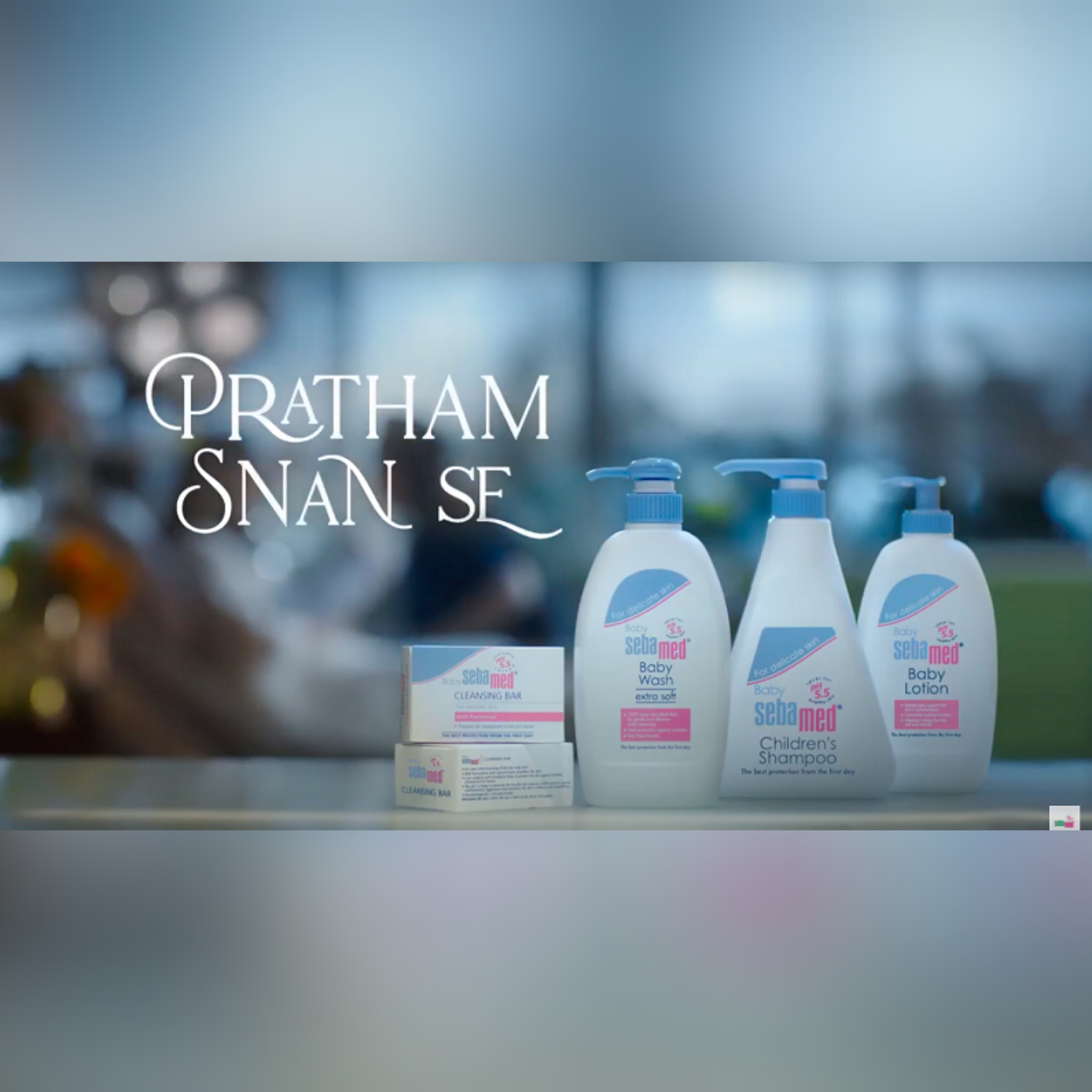
    Mumbai: German personal care brand Sebamed has launched its all-new baby care campaign urging moms and to-be-moms to use Sebamed products with pH 5.5 benefits right from first bath.

    In line with its previous bathing bar and shampoo campaigns, the brand has once again based the campaign on its ‘new knowledge’ about skin’s pH at the time of birth and highlights the importance of using Sebamed products with pH 5.5 right from day one.

    The campaign ‘Prathm Snan Se’ uses situational humour to drive home the point that the new age moms will reaffirm and choose nothing but the best products for their babies. The film features a young mom in labour, asking frantic questions about the skin pH of newborn and showing her utmost trust on brand Sebamed by sharply reminding the surprised medical staff to use the brand’s products for her newborn’s first bath. With the message – ‘maa ka dil hai, sawaa to pucchega hi’ it encourages all moms and to-be-moms to stay curious and reaffirm their choices based on ‘proven scientific facts’.

    Rooted in curiosity-centered consumer strategy, it’s the fourth campaign launched by the brand in last one year in the skin, hair and baby care space, which also included ‘Film Stars ki nahi, science kee suno’, Sirf science ki suno and recent digital campaign inspiring India to get #BackToNormal.

    Sebadmed, country head, Shashi Ranjan said, “We strive to create a new narrative in every category we operate and our products are proven safe and scientifically superior. Baby care portfolio is one of the key growth drivers for us and through this campaign; we are celebrating the unwavering trust of mothers on brand Sebamed and relevance of pH 5.5 products for new born right from day one. The campaign delivers this message in a unique way and we are sure it will establish a strong connection with our audience.”

    The Womb, creative partner and co-founder, Navin Talreja said, “Sebamed pH 5.5 baby care range is scientifically proven safe for new-born’s right from day one. Our campaign seamlessly delivers this message, and we remain confident that it will resonate with mothers and fathers. Across Indian culture, occasions like Godh Bharai, Annaprashan etc are highly celebrated, but there’s nothing for the first bath. So we created ‘Pratham Snan’, to protect the baby’s skin from the first bath itself.”

    http://rb.gy/oc5ruw

  • ManipalCigna Health Insurance invokes spirit of togetherness in new ad

    ManipalCigna Health Insurance invokes spirit of togetherness in new ad

    Mumbai: The COVID-19 pandemic has transformed people’s lives in unprecedented ways. There are people who continue to experience social isolation and loneliness, and find it challenging to reach out for help. Echoing these concerns, ManipalCigna Health Insurance Company has launched a new digital campaign ‘Saath Dijeye- Fark Padta Hai’ urging people to support each other during the pandemic. The campaign highlights how simple acts of kindness can make a big difference in someone’s life. 

    “The second wave of COVID-19 was difficult for everyone. But we got through this together. If there’s one thing we’ve learnt in these difficult times, it’s that we’re stronger than we think. And the only thing that makes us even more undefeatable is being there for one another, despite the distance or time of day,” said ManipalCigna Health Insurance, head of marketing and online sales, Sapna Desai. “As we enter a time for healing and getting better, it is important that we don’t forget the lessons that we learnt along the way. Inspired by all the selfless acts and generosity that we saw, we have put together this message to celebrate the spirit of togetherness and how it makes a difference.”

    Besides the new digital film, the company has also rolled out advertisements on digital and social media along with influencer outreach programs to drive awareness about this new campaign. “#SaathDijiye has reached 6.08 million users and generated 17.42 million impressions, and there have been 4500+ posts on Twitter,” said the company in a media statement.

  • Gulf Oil lauds truck drivers in new Raksha Bandhan ad film

    Gulf Oil lauds truck drivers in new Raksha Bandhan ad film

    Mumbai: Gulf Oil India has launched a digital film as a part of its on-going Gulf  ‘Superfleet Suraksha Bandhan’ campaign to appreciate the truck drivers who have been behind the wheels to ensure an uninterrupted supply of essentials and medical supplies.

    This digital film themed around the festival of Raksha Bandhan, depicts how sometimes even loved ones need to change their outlook. The film shows how the emotional bond shared by a trucker brother and his sister comes alive when she realises the hard work he has been putting in all through the pandemic.

    Truck drivers have been engaged in delivering medical supplies including oxygen tanks, cylinders, and medical aid even during the most challenging times of this pandemic, sometimes compromising their own health. When this realisation dawns on her, the truck driver’s sister ensures his safety and well-being by getting him inoculated against Covid-19 at a vaccination camp organised by Gulf Oil.

    Gulf Oil India, under the SurakshaBandhan campaign, has successfully vaccinated more than 10,000 truck drivers across the country, said the brand in a media statement.

    “Throughout the pandemic, our trucking community has been on the roads, risking their lives, to address the demand, supply, facilitating the efficient movement of goods, essentials and medicines,” said Gulf Oil Lubricants India, MD and CEO, Ravi Chawla. “Gulf Oil recognises the challenging job undertaken by the community, involving long hours of functioning and limited family time, to support the economy and country. With this vaccination drive, we were able to educate, inoculate a part of the trucking community and ensure safeguarding them against the novel coronavirus. We would like to thank our trucker brothers for coming out in numbers and using this opportunity to get vaccinated.”

  • GUEST COLUMN: FMCG companies took to apps, bet big on direct-to-consumer reach

    GUEST COLUMN: FMCG companies took to apps, bet big on direct-to-consumer reach

    Mumbai: The eruption of COVID-19 has left millions and millions of businesses scurrying for survival. Although somewhat less affected than some categories, the FMCG companies also faced headwinds for some time. And to counter these headwinds, technology has been the single most important intervention that they have employed during these trying times. And of the technologies, applications enabling a direct route to the consumer as well as other businesses in the value chain have been most prominent.

    While placing their faith in these applications, FMCG companies have also recast their value chains weeding out unnecessary elements at various levels allowing themselves greater leverage vis-à-vis their vendor partners and establishing a more direct connect with their end-consumers. And among FMCG firms, food companies, or those with prominent food product portfolios have been particularly noteworthy for taking the app route.  A step ahead of general trade, modern trade, or even traditional e-commerce channels, these apps have been popular yet necessary go-to modes for these companies.

    The big B2C advantage

    How does B2C prove to be advantageous for FMCG companies? Until now, customer-relationship building and acquiring customer insights were largely the preserve of the retailer community. However, what B2C apps do is that they facilitate a direct and one-on-one company-to-consumer relationship, with the former no more having to make efforts to establish bonding with a faceless consumer. On top of allowing deeper end-consumer insights for companies and brands, they can catalyse more relevant and individualised product and service propositions by the brand to the consumer thus leading to a more enriching customer experience which in turn would drive increased customer acquisition, conversion, and retention for the brand. And needless to say, the power balance between the brand and the retailer is further shifted in favour of the brand and away from the retailer.

    B2B applications not too far away

    However, this taking to applications has not been limited to B2C channels. FMCG companies have also incorporated apps in their business processes directly targeting retailers and kirana stores who offload their products and serve as a last-mile seller/supplier to end-consumers. Identifying and prioritising retailers who delivered top volume businesses, the companies made sure that the retailers continued to place orders for their products, and even more efficiently using these applications than they did before. In fact, thanks to Covid, the earlier forecasts projecting a contribution of around 10 per cent digital channels in the total FMCG market in the next ten years in the country has been advanced to next three to four years now. And at the same time, cutting out or minimising the role of distributors especially in terms of selection of retail outlets, the brands have reclaimed their power vis-à-vis the latter while effecting greater streamlining and consolidation of their distribution systems.

    Proliferation of new products

    While pivoting to digital technologies, B2C and B2B apps, the FMCG companies have also realigned their product portfolios in a major way capitalising on the shifting consumer preferences and behavior in times of the pandemic. And as part of this realignment, there has been a proliferation of new and innovative products which have been introduced to the market in the last few months. With health and hygiene being a predominant consumer focus, as many as 3,000 products in the health and hygiene category have been estimated to be launched in the September quarter alone last year. Earlier, in the April-September quarter, as many as 9,700 new products were launched by FMCG companies. Mindful of and in response to the country-wide lockdowns in place and customers being confined to their homes, 125 products were introduced in-home cooking segment alone during March-August 2020 in categories including ketchup, jams, cheese, and milk powders.

    Exploring alternative channels of distribution too

    Even as D2C apps gain traction, the FMCG companies are also exploring tie-ups with new-age delivery startups, food-tech service players, food aggregators, hyper-local apps, and courier firms to have their products delivered to the doorsteps of the end-consumer. In fact, some FMCG companies are also making product-specific tie-ups with delivery platforms and micro delivery platforms.

    Digitisation not limited to distribution: Influencer marketing gets a boost

    Rising uptake in apps and the broader digitisation has not only been confined to retail and distribution but also advertising and marketing. And riding on the increasingly entrenched position of social media and its consumption, influencer marketing has become a big part of FMCG’s digital marketing strategy in recent years. According to a report, globally, nearly a fifth (19 per cent) of FMCG companies have raised their influencer spending significantly as compared to pre-COVID-19 levels. And within India, during the festive season campaign alone, influencer marketing saw a 20 per cent jump in campaigns. A digital marketing agency has estimated India’s influencer market at $75-150 million a year, as compared to the global market of $1.75 billion, which is only set to get bigger in the coming months and years.

    Other technologies that could aid the B2C momentum

    At the same time, apart from apps, there are several related B2C technologies and platforms that could add teeth to the ongoing B2C drive. They could range from customer data platforms to data management platforms to marketing automation tools to business intelligence and data visualization tools to social listening tools, among others.

    So, in the future, there is no doubt that the B2C apps as part of an FMCG company’s digitisation program will acquire a more permanent dimension. Notwithstanding a resurgence of Covid in certain states, now with vaccination underway and revival of consumer sentiment in urban India, FMCG businesses including food companies are set to see greater activity and growth.  

    (Manish Aggarwal is director, Bikano, Bikanervala Foods Pvt Ltd. The views expressed in the column are personal and Indiantelevision.com may not subscribe to them.)

  • HUL most prolific advertiser in week 32: BARC

    HUL most prolific advertiser in week 32: BARC

    Mumbai: The top-ten advertisers list for BARC week 32 (7 August to 13 August) was led by Hindustan Unilever Ltd (HUL) with ad volume of 4445.94 (‘000 secs). The FMCG giant’s last week’s score was 5487.39 (‘000 secs).

    Reckitt Benckiser (India) Ltd maintained its hold at the second position. The consumer goods company, unlike HUL, saw an increased ad volume of 3939.47 in week 32 compared to 3213.56 in week 31.

    Rest of the list was dominated by other FMCG players, namely, Cadburys India Ltd, Reliance Retail Ltd, Brooke Bond Lipton India Ltd, Godrej Consumer Products Ltd, Procter & Gamble, ITC Ltd, and Colgate Palmolive India Ltd, in that order, with the only exception being Asian Paints Ltd – at the seventh place.
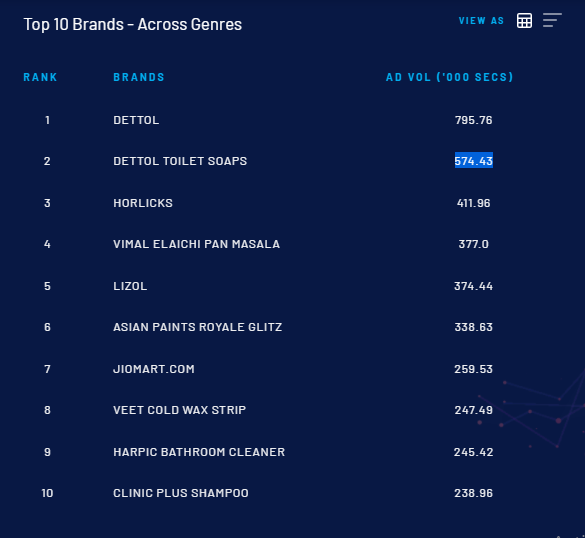
    Leading the top ten brands tally across genres were RB’s Dettol and Dettol toilet soaps with ad volume of 795.76 and 574.43 respectively.

    Horlicks, Vimal Elaichi Pan Masala, Lizol, Asian Paints Royale Glitz, Jiomart, Veet Cold Wax Strip, Harpic Bathroom Cleaner, and Clinic Plus Shampoo followed.