Tag: Advertising Standards Council of India

  • “Need of the hour”- industry hails ASCI’s new guidelines

    “Need of the hour”- industry hails ASCI’s new guidelines

    MUMBAI: Is the party over for influencer marketing in India? Or does it get bigger hereon? These are some of the questions playing in the minds of industry players and consumers as the Advertising regulatory body (ASCI) unveiled its long-overdue guidelines for influencer advertising, here on Thursday. The new rules come into effect on 14 June.

    The Influencer advertising market in India is booming across social media platforms and is estimated to be worth $75-100 million, as per digital marketing agency AdLift. And, it’s only getting bigger. With people unable to indulge in retail therapy and check products & services in person, watching an influencer talk about the product or following the social media talk seems like the next best option for many.

    Brands too have recognised its burgeoning potential and allocated a significant share of their digital ad spend on the segment. Needless to say, Influencer marketing does help a brand in multiple ways. Apart from product trials and reflections, it helps them bring out their brand’s story organically and establish trust with their target audience. In fact, as per Forbes 54 per cent of people have visited a website to purchase after seeing a product or service mentioned on Instagram.

    However, there was no way for consumers to make a distinction between promotional content for a brand and genuine user-generated content- unless the influencer chose to make the disclosure. Well, all that is going to change now.

    The new ASCI guidelines make it mandatory for social media influencers to label the promotional content they post: “All advertisements published by them on their accounts must carry a disclosure label that clearly identifies it as an advertisement.” And it is not limited to “monetary compensation”, but “anything of value given to mention or talk about the Advertiser’s product or service, like free or discounted products or service or other perks.”

    So what does the industry have to say about these regulations in what was so far a free-for-all market?

    “It is a step forward in the right direction,” says branded content marketplace Do Your Thng founder Ankit Agarwal. “The blurring of the line between ads and simple user-generated content needed to be corrected. Users not only have the right to know the difference between the two, but it was also their demand. Besides helping bolster the trust audiences were increasingly haemorrhaging in content creators, the guidelines will hold brands and marketers more accountable. I am gratified ASCI has moved the needle in organizing a niche where entropy was just about beginning to reign supreme.”

    According to ClanConnect co-founder & COO Kunal Kishore Sinha, the guidelines will shape the future of sponsored posts and influencer-brand collaborations in India. “Going forth, consumers can expect much more transparency as they navigate through the social media universe. On our part, we are geared up to guide influencers through the intricacies of the newly-launched guidelines, helping them meet all the requirements so they can focus on what they do best – create impactful content,” he says.

    Whoppl managing partner Jennifer Mulchandani says agencies now need to make sure brands & influencers still stand out by staying relevant and engaging their audience through content that resonates with them. “It’s important to pick the right influencer mix that caters to the specific TG that would benefit from the product in question, and not just result in a sale for the brand but also greatly positively impact the consumer, thereby using their power of influencer responsibly,” she adds.

    According to SoCheers director Rajni Daswani, many brands are still averse to the whole #Ad & #Sponsored and may now start drawing parallel compared to paid media, which might see the investment in influencer marketing take a slight hit, after the phenomenal growth year that it had in last few years. “The guidelines could be like a double-edged sword for creators as influencers/creators who are doing a lot of branded content might see a hit in their engagement & reach numbers, but quality content will continue to win nonetheless,” adds Daswani.

    Terming it as the need of the hour, OpraahFx founder Pranav Panpalia says it will also help elevate creators’ reputation and help brands to connect to their exact audience set while aiding consumers to make informed decisions. “Giving a disclaimer of a brand being promoted (prior to the content), helps viewers make an upfront choice about whether they want to continue to consume the said promotional content. Continuing to consume such content simply implies that s/he indeed is interested to listen to the brand’s promotional pitch,” he says.

    However, industry experts also believe that there may be some teething issues during the initial days and the content creator also has to know in detail what they are marketing to their audience and exercise a sense of responsibility, says Divo founder and director Shahir Muneer.

    Influencers, on their part, have also welcomed the move, albeit a tad cautiously. According to some influencers, the guidelines put more onus on the creator than on the brand and could lead to a disengagement of a section of their audience, once they realise its paid content. Some voiced their concern on social media, that even when they organically endorse a product or service, it could be misconstrued by their followers as a mere sponsored promotion.

    Some like Nikunj Lotia, popularly known as BeYouNick told a publication that brands are often involved in specific parts of the content, instead of the entire, and labelling it may confuse the audience.

    Allaying fears that it might restrict creativity, Grapes Digital founder & CEO Himanshu Arya says, consumers are smart enough to make a distinction between a material connection and an organic post. “It is the first step towards making transparency and trust the ethos of influencer marketing,” says Arya.
  • ASCI unveils final guidelines for influencer advertising on digital media

    ASCI unveils final guidelines for influencer advertising on digital media

    Mumbai: Advertisers now have a clear set of guidelines on which they can base their influencer driven ads/commercials. Industry watchdog – the Advertising Standards Council of India (Asci)  –  unveiled the final guidelines for influencer advertising on digital media today. The ombudsman had initially released some draft guidelines  in February and sought feedback from all stakeholders – advertisers, agencies, influencers and consumers. Asci then incorporated the responses before drawing up the final framework.    To ensure a collaborative process and expert inputs, ASCI tied up with Big Bang Social, a leading marketplace for social storytelling, to get India’s leading digital influencers’ views on board.

    The new rules will become applicable to commercial messages or advertisements published on or after 14 June 2021. The guidelines clearly lay out the definitions for the terms influencer, virtual influencer, material connection and digital media. Asci has introduced  Asci.social platform- a digital platform that will house information about the rules applicable to the  community of influencers, marketers, agencies and consumers. Additionally, all promotional content in which they feature will have to mandatory  be labelled as such by the influencers. Asci has roped in Reech, a French technology provider to monitor potential violations of the guidelines.

    GUIDELINES:

    Disclosure: All advertisements published by social media influencers or their representatives, on such influencers’ accounts must carry a disclosure label that clearly identifies it as an advertisement.

    Criteria for disclosure :

    a. Disclosure is required if there is any material connection between the advertiser and the influencer.

    b. Material connection isn’t limited to monetary compensation. And includes anything of value given to mention or talk about the Advertiser’s product or service, like free or discounted products or service or other perks

    c. a disclosure is needed even if they weren’t specifically asked to talk about that product or service.

    d. Disclosures are required even if the evaluations are unbiased or fully originated by Influencer, so long as there is a material connection between Advertiser and Influencer.

    e. If there is no material connection and the influencer is telling people about a product or service they bought and happen to like, that is not considered to be an advertisement and no disclosure is required on such posts.

    · Disclosure must be upfront and prominent so that it is not missed by an average consumer

    · Any one or more disclosure labels can be used: advertisement, ad, sponsored, collaboration, partnership, employee, free gift

    · If the advertisement is only a picture or video post without accompanying text (such as Instagram stories or Snapchat), the disclosure label needs to be superimposed over the picture/video

    I. For videos that last 15 seconds or less, the disclosure label must stay for a minimum of 3 seconds.

    II. For videos which are 2 minutes or longer, the disclosure label must stay for the entire duration of the section in which the promoted brand is mentioned.

    · In live streams, the disclosure label should be announced at the beginning and the end of the broadcast.

    · In the case of audio media, the disclosure must be clearly announced at the beginning and at the end of the audio, and before and after every break that is taken in between.

    · The disclosure should be in English OR in the language as the advertisement itself in a way that is easy for an average consumer to understand.

    Responsibility of disclosure of material connection and also of the content of advertisement is upon the advertiser for whose product or service the advertisement is, and also upon the Influencer.

  • ASCI investigates surrogate ads in liquor category appearing during IPL

    ASCI investigates surrogate ads in liquor category appearing during IPL

    MUMBAI: The Advertising Standards Council of India (Asci) has, for the past few weeks, intensely monitoring possible surrogate advertising during the ongoing Indian Premier League (IPL). Asci has put in place daily updates on the monitoring of alcohol brand extension advertising, instead of its regular weekly feeds, for immediate processing of complaints. Complaints against eight such advertisements, which are in potential violation of the Asci code,  have been registered over the past one month.  These include whisky, beer and white liquor brands. In all these cases, Asci has written to the advertisers within 24-48 hours of airing of the commercials, seeking a response.

    The advertisements picked up range from those selling music CDs to packaged water, non-alcoholic beverages, and merchandising. The key to Asci's investigation is determining what are surrogates for liquor and what constitutes genuine brand extensions.

    Asci’s codes and guidelines are clear about what qualifies as a genuine brand extension:

    ·   For a brand extension of a product (liquor, tobacco, etc) to be considered genuine, it must be registered with an appropriate government authority such as the Food and Drug Administration and the Food Safety and Standards Authority of India etc.

    ·   In-store availability must be at least 10% of that of the leading brand in the category that the product competes, or sales turnover must exceed Rs 5 crore per annum or Rs 1 crore per annum in each state it is distributed in

    ·   It must have a valid certificate from an independent organisation for such turnover and distribution data

    Advertising for such brand extensions cannot feature what is prohibited by law or banned products. Neither can the advertising allude to or hint at products that cannot be advertised. 

    As per the law, advertisements for liquor brand extensions can run on TV if they have a CBFC certificate. The IPL broadcaster for TV has confirmed to Asci that all advertisements are checked for CBFC clearance so that they are not in violation of the Cable TV and Network Act. Keeping that in mind, Asci has processed complaints on advertisements appearing in OTT, digital and print media.

    Asci secretary general Manisha Kapoor said: “We are being extra vigilant because the IPL is one of the biggest marketing platforms in India. We are looking at advertising across media – print, OTT, digital. When we spot potential violations, we ask advertisers to substantiate their claims of their product or service being a genuine brand extension within seven days. This includes sales, distribution and market share data that must be certified by an independent body. Only if they fulfil the criteria for a genuine extension, is the advertisement allowed to continue.  If the advertiser fails to respond within the allotted time, the complaint is taken up ex-parte by Asci’s independent consumer complaints council.”

    Asci is the self-regulatory body of the advertising industry that has as its members, agencies, advertisers, media houses and other stakeholders. Its mission is to increase consumer trust in advertising by ensuring honesty and adherence to ethics in all marketing claims. 

  • ASCI announces Covid-2019 advertising advisory

    ASCI announces Covid-2019 advertising advisory

    MUMBAI: The Advertising Standards Council of India (ASCI) has directed brands to ensure that their adverts do not proliferate unsubstantiated claims related to Covid2019 that mislead and misinform the people.

    The self-regulatory industry body has issued a new set of guidelines on Covid2019-related ads that advertisers must adhere to, in a move to shield consumers from false and/or misleading information and products in the midst of the pandemic.

    As per the advisory: "Advertisers should be able to substantiate (direct or indirect) claims of immunity against or treatment for Covid2019 supported by either technical support recognised or approved by health authorities such as WHO, ICMR, Health Ministry, Ayush Ministry, DCGI, CDC (USA), or health organisations of similar stature or by well-recognised medical/technical literature or by regulatory-approved clinical research conducted by a recognised medical institute/laboratory."

    It further warned advertisers not to distort facts or mislead consumers by means of implications and omissions, abuse their trust or otherwise exploit their lack of experience and knowledge.

    ASCI also issued a firm reminder to manufacturers of Ayurvedic, Unani and Homeopathic products to abide by the guidelines set in place by the Ministry of Ayush regarding Covid2019 advertisements.

    The advisory is in line with Chapter 1 of ASCI’s code related to truthfulness and honesty of representation and, thus, the creation of consumer confidence in advertising.

    ASCI general secretary Manisha Kapoor said the pandemic is a difficult time for people and brands alike, but it cannot be a pretext to mislead consumers.

    “We want advertisers to be more mindful in creating advertisements and making claims related to Covid-19. Given the pandemic and the extended lockdowns, people are obviously concerned. Manufacturers and brands have also responded to consumer needs arising out of the pandemic. However, we want these products and advertisements to stick to claims and promises that are well backed by adequate substantiation. The advisory to advertisers is meant to safeguard consumers as well as to ensure the highest standards for advertising,” she said.

  • ASCI appoints Manisha Kapoor as its new secretary-general

    ASCI appoints Manisha Kapoor as its new secretary-general

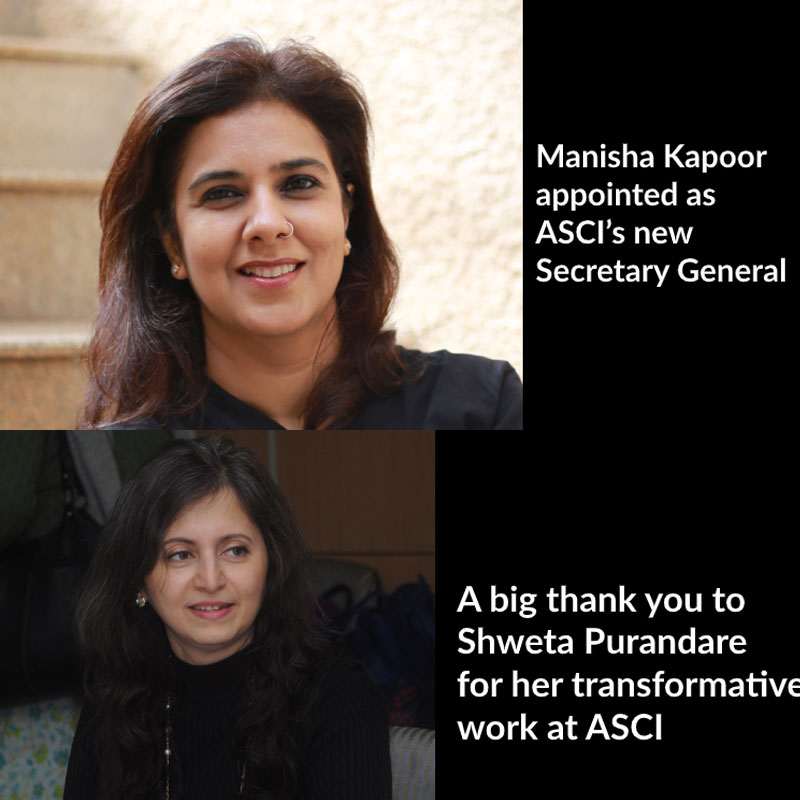
    MUMBAI: The Advertising Standards Council of India (ASCI) has named Manisha Kapoor as its new Secretary-General. From September 1, Kapoor will take over ASCI’s secretariat responsibilities, including the consumer complaints redressal process as well as the marketing, public relations, and social media initiatives.

    Kapoor has been part of ASCI’s consumer complaints council for the past five years and is, therefore, closely associated with the advertising industry’s self-regulatory body. She will take over from Shweta Purandare.

    Purandare joined ASCI eight years ago as chief complaints officer and took over in 2014 as the Secretary-General.  During her tenure, ASCI became bigger and better. It launched its WhatsApp number and set up new complaint redressal and review processes. She also was instrumental in increasing ASCI’s vibrant presence on social media. Over the years, she became the public face of ASCI with various stakeholders and represented it with distinction in various fora.

    ASCI chairman Rohit Gupta said: “We thank Purandare for her work in achieving our vision and her belief in our goals and motto. She was instrumental in enabling ASCI’s closer engagement with the regulators resulting in ASCI signing MoUs with the Department of Consumer Affairs, the Food Safety and Standards Authority of India, and the Ministry of AYUSH. As she embarks on the next phase of her career, we wish her the very best. We are delighted that Kapoor will take on the role now. We look forward to her valuable inputs and leadership.”

    Purandare said: “It has been an extremely enriching experience professionally through which I could contribute to ASCI’s transformation in terms of capacity, capabilities, and stature. As I move on to undertake a new journey, I wish Kapoor the very best.”

    Kapoor has more than 25 years of experience in building brands and businesses. Having worked with companies like Hindustan Unilever and J&J India, she has also consulted with corporations on brand development and strategy for the past 15 years – first with MarketGate Consulting and more recently with Futurebrands Consulting. She has also worked with several non-profits and the government on development sector projects.

  • D. Shivakumar elected new chairman of ASCI

    D. Shivakumar elected new chairman of ASCI

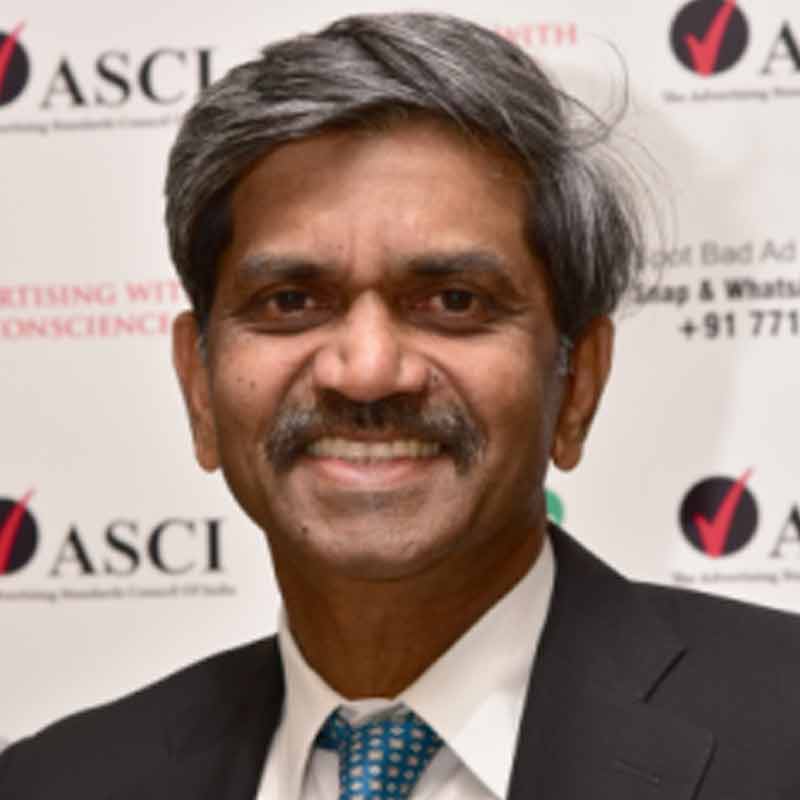
    MUMBAI: The Advertising Standards Council of India (ASCI) has appointed D. Shivakumar as the new chairman of the board for ASCI. 

    Shivakumar is the group executive president of corporate strategy at Aditya Birla Group.

    As the member of the board of governors for three years, supporting self-regulation, Shivakumar is an accomplished business leader having spent over 19 years in sales, marketing and general management positions across consumer products and the luxury industry.

    Sony Pictures Networks India President of network sales and international business Rohit Gupta has been elected as the vice-chairman while Media Brands CEO Shashidhar Sinha has been re-appointed as the honorary treasurer.

    Members of the Board of Governors include Harish Bhat (director, Tata Global Beverages.), Subhash Kamath (Managing Partner, BBH Communications India), Sandeep Kohli (executive director and vice president for personal care Hindustan Unilever Ltd), Prof S.K. Palekar (adjunct professor and advisor – Executive Education Institute of Management Technology), .S.  Rajan (managing director, Ketchum Sampark), K.V. Sridhar (founder and chief creative officer Hyper Collective Creative Technologies), Abanti Sankaranarayanan (former vice chairperson, CIABC), Girish Agarwal (director, Dainik Bhaskar Group), Madhusudan Gopalan (CEO, Procter & Gamble Hygiene and Health Care), Prasun Basu (president – South Asia Nielsen India), Sivakumar Sundaram (president- revenue Bennett, Coleman & Co), Vikas Agnihotri (director sales, Google India) and Umesh Shrikhande (CEO, Taproot India).

    The outgoing chairman of ASCI Abanti Sankaranarayanan said, “2017-18 has been another strong year for ASCI as we have made significant advancements towards building our organizational muscle, external credibility and strong collaborations. Our stringent guidelines, seamless processes and the dedication and hardwork of our Consumer Complaints Council have contributed to restricting the use of misleading advertisements and enhance self regulation. ASCI’s momentous achievements for the year include successful completion of three year-long collaboration with Department of Consumer Affairs, renewal of Memorandum of Understanding (MoU) with Food Safety Standards Authority of India, introduction of “Guidelines for Celebrities in Advertising” and inclusion in AYUSH’s Empowered Committee to control misleading ads of AYUSH drugs. As the Chairman for ASCI for the year 2017-18,I am extremely proud to be a part of this journey and I am confident that under Shivakumar’s Chairmanship ASCI will continue to grow swiftly and steadily.”

    The incoming chairman, D. Shivakumar said, “I want to thank Abanti for her stewardship. We live in changing times with respect to information, media and trust of society. ASCI has been built on the foundation of self-regulation and the wisdom of the previous chairmen and the board. It’s my privilege to do the role now”.

    The Consumer Complaints Council (CCC) established by ASCI is an independent body (majority of its members drawn from civil society members like consumer activists, lawyers, doctors, educationists), the CCC met 47 times during the year and deliberated on complaints against 2641 advertisements. Complaints against 1177 advertisements were upheld, while for 483 they were not upheld. The significant increase in the number of complaints as compared to 2016-17 numbers (2300) is largely due to ASCI’s Suo Moto Monitoring project viz. National Advertisement Monitoring Services (NAMS). The Independent Review Process (IRP) received a very favourable response and 30 IRPs were conducted during this year.

  • ASCI part of AYUSH committee to control misleading ads

    ASCI part of AYUSH committee to control misleading ads

    MUMBAI: In a pre-emptive step, the Ayurveda, yoga and naturopathy, Unani, siddha and homoeopathy (AYUSH) ministry has constituted a committee to control misleading advertisements and exaggerated claims of AYUSH drugs. 

    The Advertising Standards Council of India (ASCI) is the only non-government member in the empowered committee of seven members comprising the AYUSH ministry, health and family welfare and the department of consumer affairs representatives. 

    The constituted committee will be empowered to review and monitor the implementation of the provisions of The Drugs and Magic Remedies (Objectionable Advertisement) Act, 1954 and rules thereunder for curbing misleading advertisements of AYUSH drugs. 

    The committee will be authorised to make recommendations for regulatory action against misleading advertisements and advise the central government for issuing any specific direction or advisory and for taking the necessary steps. The committee will also be responsible for reviewing the actions taken by the states and the pharmaceutical vigilance centres for surveillance and control of misleading advertisements of AYUH drugs.

    ASCI chairman Abanti Sankaranarayanan said, “ASCI has been closely working with the ministry to ensure that Indian consumers are not exposed to false information and have access to safe drugs. We are confident that the new committee will act as a catalyst to the process of self-regulation in advertising, thus safeguarding consumers from deceptive advertisements that can negatively impact them.”

    The meeting of the constituted committee will be convened every six months or as and when required to review progress and make recommendations to accomplish its objective of controlling misleading advertisements.

    Established in 1985, ASCI seeks to ensure that advertisements conform to its code for self-regulation, which requires advertisements to be legal, decent, honest and truthful and not hazardous or harmful while observing fairness in competition. The council looks into complaints across all media, including print, TV, radio and hoardings.

  • MIB recants, says only explicit condom ads banned during the day

    MIB recants, says only explicit condom ads banned during the day

    MUMBAI: After stirring the hornet’s nest on the contentious issue of restricting condom ads to only water-shedding hours, the Ministry of Information and Broadcasting (MIB) has clarified that such ads can be aired on TV during daytime. 

    In an advisory earlier this month, the MIB had asked all TV channels to air condom advertisements only between 10pm to 6am to avoid exposure of such material to children.

    But in a clarification dated 21 December 2017, the ministry said the ban on condom advertisements during daytime applies only to commercials that have sexually explicit content.

    In a release, the ministry quoted that “advertisements that do not sexually objectify women and are aimed at informing citizens regarding devices/products/medical interventions to ensure safe sex are not covered under the said advisory.”

    The ministry had earlier stated that it had taken note of objections regarding condom ads that are “targeted at a particular age group” being aired on some channels that are considered as ‘indecent especially for children.’ It used Rule 7 (7) and Rule 7 (8) of the Cable TV Networks Rules, 1994 to tell broadcasters to refrain from telecasting ads of condoms that could be considered inappropriate/indecent for viewing by children. 

    The relaxation on the issue came after the Rajasthan high court issued a notice to the Centre challenging an advisory of the MIB barring TV channels from showing condom ads during prime time.

    The petition underlined the fact that condom ads don’t violate Rule 7 of the Cable Television Network Rules, 1994 which apply to anything which endangers the safety of children or create in them any interest in unhealthy practices or shows them begging or in an undignified or indecent manner. 

    The Advertising Standards Council of India (ASCI) had approached the ministry earlier this month for guidance after several people complained regarding the inappropriate nature of the condom ads being telecast during primetime viewing on most channels. 

    Also Read:

    I&B tightens up on condom ads on TV

    ‘Sanskari’ India wants condom ads off primetime

    MIB categorises all non-Hindi and non-Eng TV channels as regional

  • Jio takes Airtel to ASCI over network speed ad

    NEW DELHI: The telecom war between Reliance Jio and other telecom service providers took a new turn when a complaint was lodged with the Advertising Standards Council of India (ASCI) against broadband tester Ookla’s network speed test that said Bharti Airtel has the fastest network speed.

    A letter sent by Reliance Jio to the self-regulatory advertising body ASCI said: “The claim of Airtel that it is India’s fastest network is false, misleading and incorrect. The claim is being made by Airtel acting in a mala fide manner in collusion with Ookla LLC, who profess to be experts in the domain space of testing mobile internet speed.”

    Reliance Jio, which is the latest entrant in the field but has over 100 million subscribers, has also separately served a legal notice to Ookla for what it has termed as its “flawed” test, according to an IANS report.

    Claiming that Ookla does not have any accreditation from the Indian government, Jio said It also stated that Ookla is not a “not-for-profit” organisation. “It charges money for its services used by telecom companies for their internal consumption, and charges additional consideration” for awarding certificates “that may be used by such companies for external consumption, marketing and publicity”.

    “Without prejudice to the above, in any event, the way the award is being projected misleads the public into believing that Airtel has the fastest network today, that is when the advertisements are being aired/published,” the letter said.

    “Even in the past, Airtel has been guilty of making attempts to use such titles and proclamations,” the letter states.

    In its reaction, an Airtel spokesperson reiterated that “Airtel has been rated as India’s fastest mobile network by Ookla — the global leader in broadband testing and web-based network diagnostic applications.”