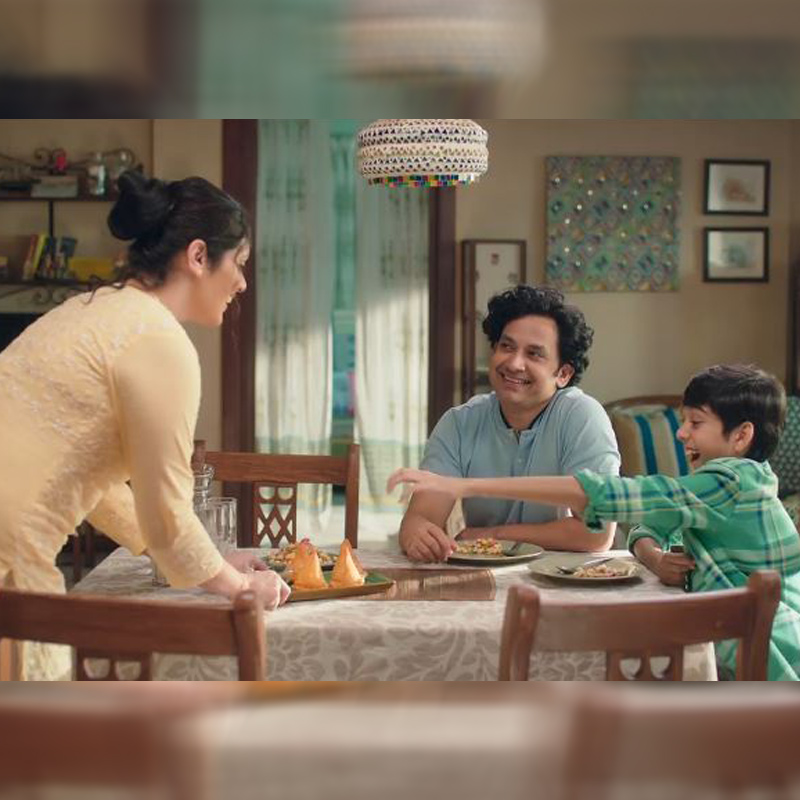
NEW DELHI: Do you remember TV commercials that featured fans at crowded football games, or that focused around cities choked with people, or with celebrities doing every possible thing to woo their audience? You may call them the “before coronavirus” commercials/ads that no longer work in today’s scenario. With the onset of the pandemic, everything changed in a matter of hours, and TV commercials of various brands were no exception. As the Covid-imposed lockdown continues, Indian advertisers are completely relying on media-led brand building to reap long term benefits.
The rise of ad flexibility
As major live events, where TVCs played a pivotal role, were cancelled keeping in mind to curb the spread of the Coronavirus, advertisers had to regulate themselves according to their new programming slate. This has also been changing according to the scenario outside, making the ads more compassionate and caring towards their customers. Since the airing of many programs was also cancelled due to the pandemic, the TVCs mostly aired during the news broadcast or in the news channel.
Advertising in digital content
With the remote working and stay at home guidelines, the viewership of TV and OTT platforms is seeing an explosive growth. Though the advertising demand during this phase is being subdued due to the current situation, advertisement in certain categories like essentials, health and hygiene worked like never before. Brands across industries have responded to this situation quite promptly and started investing in TVC and campaigns for essentials and health and hygiene products across media. Whereas, non-essential categories didn’t fall behind and rather started their communications in digital medium by tagging alongside essential categories. Few companies have shifted to the basics and once again emphasised on brand building by highlighting their efforts towards combating the situation through their advertisements.
Brand building is the new focus
With a stepped-up viewership of TV and OTT platforms, lessened advertiser clutter and potentially lower rates due to lower demand, brands have realised that this is the perfect time to invest in brand building by emphasising more on the brand’s core values. Brands have once again started earmarking for BTL so that it can be redirected to deploy on media and have put consumer promos, offers among others on a backseat. They executed brand building by exploring higher ACDs (average commercial durations) and consumer-relatable storytelling.
New industries, new advertisers
As we have entered a much dreaded second phase of the Covid2019 pandemic, there is no clear timeline by when we will emerge out of the unprecedented situation. Therefore, brands need to engage in rigorous scenario-based planning, where they have to make an imaginary timeline of recovery, changes in consumer behaviour and upgraded budgets. The digital-first approach should be the first line of advertising for a brand in this ‘new normal’ situation. Brand’s media plans also need to be aligned with business strategy so that a balance can be made between opportunity and reality. One needs to keep in mind that whenever there is an extended lockdown, there is a downward pressure on consumer purchasing power and planned purchases will be on the lower side.
(The author is director, Bonn Group of Industries. The views expressed in this column are his own and Indiantelevision.com may not subscribe to them.)
NEW DELHI: Dabur India has roped in Bollywood actor Parineeti Chopra as the new brand ambassador for Dabur Pudin Hara. The brand has also unveiled a new TVC with Chopra.
The TVC is a slice-of-life relatable story of a young couple where the husband has a mild stomach problem after having a heavy meal. He thinks that an ambulance or doctor might have to be called during the night and he would not be able to sleep. That is when Chopra, his wife, offers him Pudin Hara Pearls which relieves his distress.
Dabur India marketing head- OTC healthcare Ajay Singh Parihar shared that the new campaign aims to highlight the importance of Pudin Hara during different stomach problems, in an endearing manner. “We are excited to have Parineeti Chopra as the new face of Dabur Pudin Hara. She fits well with the brand persona of being modern, trustworthy, and progressive apart from connecting well with different sets of consumers. A new TVC featuring Parineeti Chopra has also been unveiled with an interesting consumer insight Isse Pehle Ki Baat Badh Jaaye, Lein Pudin Hara,” he added.
“I always believe in natural ways of taking care of oneself and the new campaign of Dabur Pudin hara is exactly that. Hence, I would want to communicate to the consumers that they can take care of their stomach with 100 per cent natural and safe Pudin Hara, which also has a strong heritage and is the most trusted brand of Dabur,” said Chopra.
MUMBAI: If there was one thing that bowled over netizens this weekend, it was Rahul Dravid’s dramatic turn as ‘Indiranagar ka gunda’ in a Cred advertisement. Otherwise known for his cool persona, a commercial managed to do what the fiercest bowlers and toughest competition couldn’t — get Dravid to lose his cool.
To acknowledge and pay tribute to his the cricket legend’s extraordinary performance, coworking space provider 315Work Avenue has come up with witty responses to the new campaign. The company expressed how safe their working space is from ‘gundas’, especially in Indiranagar, where it’s office is located.
It emphasised that, “Our wall is strong enough to keep you safe from Indiranagar Gunda: book your space now,” playing on ‘The Wall’ moniker of the cricketer. The other riposte talked about safety: “Safest Work Place in Indiranagar: Could protect from angry Gunda too.”
315Work Avenue founder Manas Mehrotra said: “The always affable Dravid shouting, smashing rear-view mirrors and throwing coffee, is a brilliant play on his persona. The less than 15 menacing seconds on-screen ad transforms the public image of the former captain of the Indian national cricket team. We could not have imagined that India’s wall would one day be an Indiranagar gunda. As a cricket lover and a fan of Rahul Dravid, we are in awe of the most unexpected character. We came with our response as we wanted to pay an ode to this fantastic campaign and we made sure that we played with words to match the tempo.”
Several other brands like Zomato, Oyo and Parle-G also hitched onto the bandwagon and created some wonderful spinoffs of the Cred ad. Along with the ex-cricketer’s colleagues, including Indian skipper Kohli, top marketing professionals, movie makers and actors also lauded Dravid for his unexpectedly marvellous ‘off-field’ performance. Meanwhile, social media has been in a frenzy since the ad hit the internet, churning out bountiful memes revolving around the rarely-ruffled Rahul Dravid.
MUMBAI: How many times have you seen the Indian cricket team’s former captain Rahul Dravid lose his cool and holler at an opponent? Chances are nil. Known for his calm and gentlemanly temperament, both on and off-the-field, ‘The Wall’, as he’s been dubbed for his rock solid Test match innings, has seldom been known to crumble even under the most intense, nail-biting match situations. So, it’s not surprising that a new ad for credit card payment app Cred, which shows him in a never-before-seen angry avatar, has been breaking the internet! Fans just cannot have enough of this spanking-new side of the cricketer.
So much so that, even current Team India skipper Virat Kohli could not believe his eyes and took to Twitter to share his disbelief saying, “Never seen this side of Rahul bhai,” with a shocked emoji.
The ad plays precisely on this sense of disbelief to promote Cred’s cashback and reward schemes, saying that the offer may sound as unbelievable and ridiculous as saying “Rahul Dravid has anger issues!” And then goes on to show the rarely-flustered cricketer losing his cool while stuck in Bengaluru’s infamous traffic jam. Dravid aces his road rage acting display, even going on to stand up through his SUV’s sunroof with a cricket bat in hand to holler, “Indiranagar ka gunda hun main!’ (I am the don of Indiranagar- a well-known locality in the metro).”
The ad, released ahead of the opening match of the 2021 edition of the Indian Premier League between Royal Challengers Bangalore and Mumbai Indians, went viral in no time and has garnered two million views already.
It even sparked a meme fest online, with some netizens listing it among Dravis’s best ‘performances’ and some blaming the cricketer’s new-found aggression on the Bengaluru traffic, saying it can do this to the best of us.
KOLKATA: Amid concerns over misleading advertisements on online gaming and fantasy sports, the ministry of information and broadcasting (MIB) has issued advisory to TV channels to follow guidelines issued by the Advertising Standards Council of India (ASCI) on 24 November.
“All broadcasters are advised that the guidelines issued by ASCI are complied with and advertisements broadcast on television adhere to the guidelines of the ASCI. It may also be ensured that advertisements do not promote any activity which is prohibited by statute or law,” MIB stated.
A large number of commercials on online gaming, fantasy sports etc have been appearing on television, MIB noted in the advisory. But those ads appear to be misleading, do not correctly convey to the consumers the financial and other risks associated thereof.
Hence, MIB, along with the ministry of consumer affairs and the ministry of electronics and information technology, convened a stakeholders consultative meeting on 11 November with ASCI, News Broadcasters Association, Indian Broadcasting Foundation, All India Gaming Federation, Federation of Indian Fantasy Sports and the Online Rummy Federation.
After discussions, it was agreed that ASCI would issue appropriate guidelines for the benefit of the advertisers and broadcasters to ensure that the ads are transparent and protect consumers.
According to the recent ASCI guidelines issued on the same, no gaming advertisement may depict any person under the age of 18 years engaged in playing an online game for real money winnings, or suggest that such persons can play these games.
NEW DELHI: 2020 has been a difficult and challenging year on many fronts on account of the Covid2019 pandemic. Alongside, it has taught us to value life and treasure every moment spent with our near and dear ones – and Diwali is the perfect time to do so. With the festival of lights and joy upon us, digital platforms across categories have come up with fun and innovative ways to celebrate the occasion with everyone.
Here's a look at some of the campaigns by digital platforms that advocate following precautions and overcoming adversities through togetherness this Diwali:-
Mitron
Mitron is spreading festive cheer with the launch of its Diwali campaign #mitronkidiwali. Users are invited to share their Diwali celebrations on the short video sharing app, by participating in an exciting contest.
Adding to the festivities, Mitron has also launched catchy in-app music. Titled ‘Happy Diwali Mitron’, the toe-tapping song urges users to enjoy the festivities with family and friends.
For the contest, users are invited to upload Diwali celebration videos with festive elements like rangoli, firecrackers, playing cards, Diwali cleaning, sweets, and festive attire. There are six categories for participants to choose from, which will then serve as the theme of the video. These include Miss Phuljadi #diwalidiva (best dressed female), Mr Bomb #diwalihunk (best dressed male), Super Lit Diwali #litdiwali (best Diwali decoration), Jashn-e-Diwali (best Diwali celebration with family/friends) and Mitron ki Diwali (best Diwali video on the app). Content creators can participate in all the categories and create as many videos as they like. Six lucky winners will get to win some amazing prizes.
Eros Now
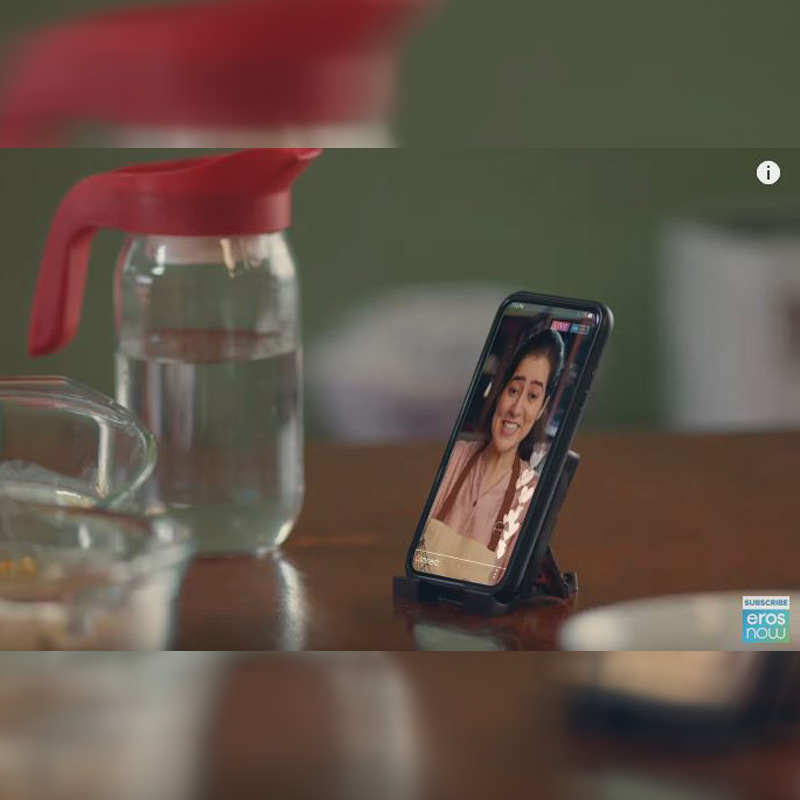
Eros Now, through its #UnlockDilwaliDiwali campaign, is encouraging users to celebrate the festivities with loved ones. While it is important to be mindful of the current circumstances which restrict certain activities, what matters in the end is quality content at affordable prices. Eros Now’s #UnlockDilwaliDiwali campaign is based on the simple premise that people can remain safe and have fun at the same time by spending this special occasion indoors together, binge watching their favourite movies with a helping of their favourite mithai on the side.
9stacks
9stacks, the poker platform, has dealt out the Yeh Diwali Poker Wali campaign, wherein players can simply stay home and connect with their close ones over the voice enabled private table feature on the platform. Through the private table option, users can reserve tables to play with their friends and family anytime during this festive season.
With the much-awaited festival of Diwali just around the corner, most families are looking forward to spending time with each other in-house as going out and celebrating would not be possible amidst the pandemic. Hence, in such a scenario, the concept of private tables will help users bond with their loved ones as well as break the monotony brought in by the lockdown over the last few months. 9stacks invites everyone to host Poker nights this festive time by gathering around with their loved ones and enjoying a riveting game that is sure to keep them hooked.
Facebook
Facebook has shared a short film underscoring the power of connections, and its brand belief that people can do ‘More Together’ than alone.
The film's plot is centered around the spirit of resilience of 28-year-old Pooja and how she helps sustain as many households as possible through the hardships of the pandemic via her dairy venture. The decision to hire more personnel, even when business is slow, comes at a great personal cost. However, the way the plot unfolds showcases the limitless possibilities when people come together.
Paytm
The online wallet brand has launched a film to celebrate the festive spirit. It showcases a strong emotional bond between the family members even if they are separated by distance. It is an extension of the company’s ongoing TV campaign highlighting the seamlessness of Instant Bank to Bank Transfers through the Paytm app.
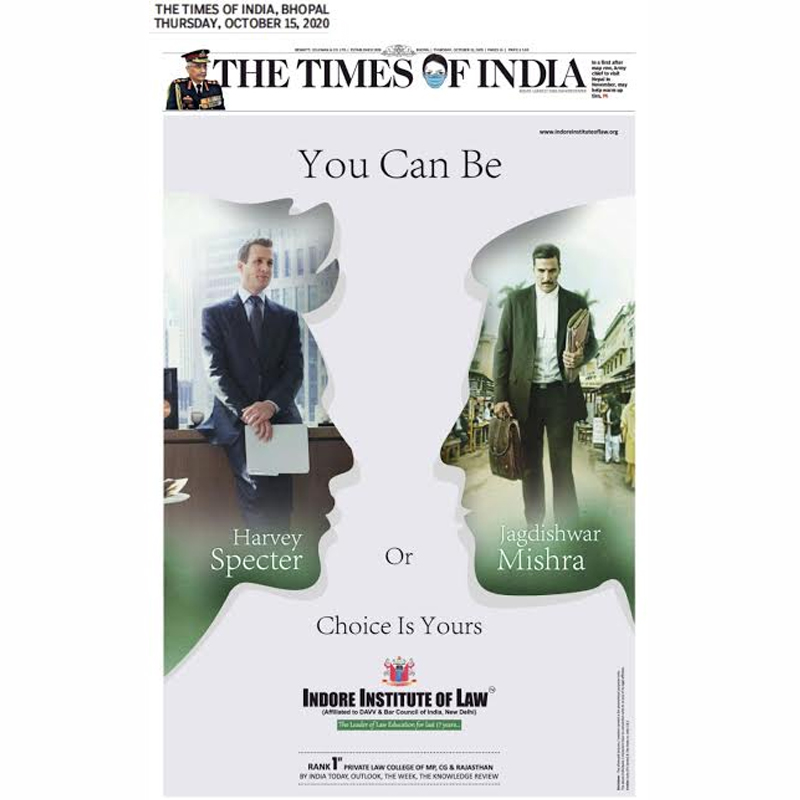
NEW DELHI: Last week, readers came across a curious ad on the front page of The Times of India’s Bhopal edition. The print advert by Indore Institute of Law drew a comparison between two fictional characters Harvey Specter from American TV series Suits and Akshay Kumar from Jolly LLB. It bore the caption that an aspiring lawyer could be either – “Choice is yours.”
The picture started doing the rounds on social media platforms and netizens were quick to slam the college’s perceived elitist stance behind the ad. Others accused the institute of denigrating the “dignity of Indian lawyers.” Social media pundits also questioned whether the college had obtained permission from the original creators before running the campaign. A fair few wondered why the institute chose fictional characters instead of its own alumni or famous practitioners of law in the real world.
The overall impression in certain sections of social media was that the ad was in poor taste and problematic; and not the inspired idea that the advertisers imagined it to be.
Facing flak, the law college later issued an apology saying, “We assure everyone that it was absolutely not our intention to offend anyone or defame any section of the legal profession.”
But the damage was already done and the ad-makers were brutally trolled for their creative sense.
Please find our clarification regarding our advertisement published on 15/10/2020. We would like to make clear the…
Being a Law Institute, the college should have known better than to draw such a superfluous comparison, besides flagrantly violating the Intellectual Property and Trademark code on top of that. As per rules, no agency or brand can use any celebrity or work of any other firm without their approval, and if it has done so then the company has to pay the penalty under the Copyright Act. However, if the ad is published on social media, not many will raise the question of ethics.
Using others’ IP in an advertisement is not uncommon, but this case has come into the limelight because the brand chose the ATL medium. Had the flyer had been limited to social media, it probably wouldn't have caused such a ruckus.
ASCI secretary-general Manisha Kapoor shared that the council has not received any complaint in this regard as of now.
Explaining the due process of dealing with violations, Kapoor said: “The advertiser will be asked to furnish the required permissions and an independent consumer complaints council will duly examine the objections and the advertiser’s response, and ascertain if the ASCI code has been violated. The advertiser will be asked to modify or withdraw the advertisement in question if it is found violating the ASCI code.”
ASCI seeks to ensure that advertisements conform to its code for self-regulation, which requires advertisements to be legal, decent, honest, and truthful and not hazardous or harmful while observing fairness in competition. The code also describes that the ad should not be derogatory to competition without any plagiarism. It should not use indiscriminately for the promotion of products, hazardous or harmful to society or to individuals.
NEW DELHI: Last week, #BabaKaDhaba went viral and showed the positive impact social media can have when used constructively. However, this week the internet was once again caught in a digital storm, divided on an ad posted by Titan Group’s Tanishq. The popular jewellery brand recently launched a new ad titled Ekatvamto celebrate “unity in oneness.”
The 45-second Tanishqspot, released ahead of the festive season, showed a baby shower being thrown by a Muslim family for their daughter-in-law, who is a Hindu. In the video, the young woman, realising that the ceremony has been organised conforming with Hindu traditions, anxiously asks her mother-in-law: "Par yeh rasam toh aapke ghar mein nahi hoti hai na? (But this ceremony is not observed at your place, is it not so?)," to which the latter replies, "Bitiya ko khush karne ki rasam toh har ghar mein hoti hai na? (The ceremony to make the daughter happy is held in every house, isit not so?)"
The description of the Tanishq commercial is as follows: “She is married into a family that loves her like their own child. Only for her, they go out of their way to celebrate an occasion that they usually don’t. A beautiful confluence of two different religions, traditions, and cultures.”
No sooner was the ad posted than it met with vicious trolling and expletives by a section of social media users who alleged that it promoted ‘love jihad’ and began trending the hashtag #BoycottTanishq.
However, another section of users on Twitter also supported India’s most trusted jewellery brand, lauding its effort to highlight that interfaith marriages can work and upholding the idea of a secular India.
Taken aback by the controversy, Tanishq pulled down the spot, tweeting, “One as a Nation. One as Humanity.’ That is what Ekatvam stands for,” to reiterate the message of communal harmony in the film.
Tanishq has officially withdrawn their ad after being trolled viciously. Here's why this is a very sad state of affairs, and context from other such ads that were trolled (and some, withdrawn) https://t.co/Nb0cSiTPHXpic.twitter.com/sn3IMBqdmC
Yesterday, it once again gave a lengthier explanation on Twitter why it took the extreme step: “The idea behind the Ekatvam campaign is to celebrate the coming together of people from different walks of life, local communities and families during these challenging times and celebrate the beauty of oneness. This film has stimulated divergent and severe reactions, contrary to its very objective. We are deeply saddened by this inadvertent stirring of emotions and withdraw this film, keeping in mind the hurt sentiments and well-being of our employees, partners and store staff.”
Which once again got the trollers annoyed, who stated the boycott Tanishq campaign would continue as the brand had insinuated that the trollers would resort to strong arm tactics, showing “Hindus” in poor light.
Various brands in India have faced a similar situation where they had to buckle to the collective pressure on social media. But should brands bow down to these attacks?
Brand expert N. Chandramouli says that brands that have attempted to take a brave moral stance should anticipate recoil from those on social media. "The portents are not good if a brand takes a step back, as it shows a lack of courage, conviction, and spine."
He further says that a brand may do away with an ad under various circumstances, and not all of them are due to boycott calls. “Sometimes there are certain calls that may get made that pressurise the management. Sometimes, of course, the boycott calls are so vociferous, that the brand does so on its own. However, in both cases, the brand’s image gets tarnished due to the pull-back.”
Brand-nomics MD Viren Razdan has a different take on the issue, when he asks: "If the ad has been pulled down, did Tanishq not foresee any such issues? Or were they okay with the controversy it would kick up? If it’s the latter then it’s really a new brand direction for them.”
Nevertheless, this is not for the first time that a creative product has been brutally trolled for portraying Hindus and Muslims doing things out of the ordinary with each other. In 2019, just before the festival of Holi, Surf Excel had released an wherein a Hindu girl respects a young Muslim boy dressed all in white (going for his prayers) and prevents her friends from spraying him with coloured water. She then rides him to the mosque on her cycle, giving him a shield of protection all the way. Apparently, the film evoked a severe reaction on social media for promoting love jihad and for describing the colours of Holi as daag (stain).
Around the same time, Brooke Bond too got called out on Twitter for “portraying Kumbh Mela in a bad light” and “hurting the sentiments of Hindu pilgrims.”
Boycott karne se pehle dekh lena khareedne ki aukaat hai bhi ya nahi! #tanishq
— Ritu (सत्यसाधक) #EqualRightsForHindus (@RituRathaur) October 12, 2020
Even after producing brilliant creatives and thought-provoking ads, the question that arises in light of the Tanishq episode is: whether advertisers have any space for experimenting or going bold or touching grey areas while expressing oneselfcreatively?
Chandramouli says that owing to the current state of affairs in the country, social media has become highly polarised. Trolls who have seen their actions yield ‘results’ resort to the tactics of provocation and outrage to drive negative sentiment against whatever challenges their biased views. “It must be remembered that when a big brand pulls back, it further encourages the trolls, and sets an incorrect impediment for other brands attempting to venture to do something bold.”
Mirum India director of brand strategy and client services Mohit Ahuja also agrees that Tanishq’s fearful reaction has set a wrong precedent. "It not only bows to the pressure tactics of trolls who get braver by actions like these but also encourages similar action by other brands. It will make communication as a whole poorer. If advertising does not foster love and inclusivity, what will? Is communication like this not the main reason that most of us remain in advertising?"
Using religion and politics in advertising is a ticking time bomb, as it requires a nuanced understanding of how the people of India, beyond one's Facebook friends, think.
Scarecrow M&C Saatchi founder Raghu Bhatt opines that an ad is supposed to create goodwill and sales, not rancour and a product boycott.“If an ad is offending people, every brand will be sensible about it, apologise, and withdraw. The people who are criticising Tanishq for its action have nothing to lose. Unlike brand creators, brands can't have egos. Tanishq is sending a message that it doesn't want to hurt anyone's feelings,” he asserts.
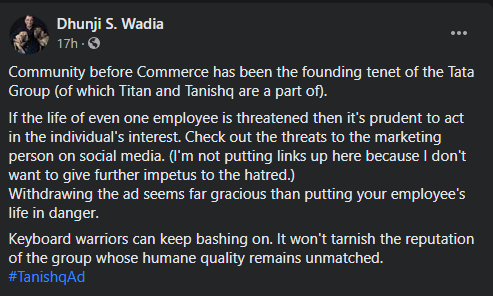
Rediffusion Y&R former president Dhunji S. Wadia wrote on his Facebook page: “Community before commerce has been the founding tenet of the Tata group (of which Titan and Tanishq are a part). If the life of even one employee is threatened then it's prudent to act in the individual's interest. Check out the threats to the marketing person on social media. Withdrawing the ad seems far gracious than putting your employee's life in danger. Keyboard warriors can keep bashing on. It won't tarnish the reputation of the group whose humane quality remains unmatched, #TanishqAd".
Taproot Dentsu chief creative officer and co-founder Santosh Paddy declares that it’s high time that the industry stood together on issues such as these. “Why is our industry being targeted every single time? Creativity is the core of our business and we cannot be pushed in the corner every single time. We are the soft targets as brands are involved. It’s high time we give a hard push back, to theauthorities for this biased behaviour. It’s creative freedom for some and beating for some?”
It's really sad to watch what kind of country we are turning into. An ad uniting two religions has to be taken down in the country which used to be called secular since forever.#tanishqpic.twitter.com/8E7UDl7PeH
indiantelevision.com has compiled a list of ads which have faced criticism in the recent past: –
Anouk Myntra
The ad with the tagline 'Bold is Beautiful' by Anouk fashion brand under Myntra was applauded as well as criticised for taking on the sensitive topic of homosexuality. The ad featured a lesbian couple preparing to break the news to one set of parents.
Kalyan Jewellers
In 2018, Kalyan Jewellers withdrew an ad featuring Amitabh Bachchan and his daughter after it came under attack for creating 'distrust' in the banking system. People threatened to sue the brand for accusing it of "casting aspersion and hurting the sentiments of millions of personnel" through the advertisement.
Amazon
The e-commerce company found itself in the midst of a controversy for allegedly selling products like slippers, doormats, and toilet seat covers with the pictures of Hindu gods and goddesses. The pictures were widely circulated on social media and Amazon was roundly criticised for hurting the sentiments of Hindus. People expressed their displeasure on social media and raised calls to boycott the e-tailer.
Gillette
The brand launched a commercial asking men to be better versions of themselves, which sparked a debate about whether companies should simply stick to promoting their products or sell social causes.
Ola
Ride-hailing app, Ola rolled out an ad a few years back to promote the affordability proposition for its Micro service. The ad featured a young couple out shopping on the streets. The boyfriend, who is paying for his better half, eventually says: “My girlfriend costs Rs 525 per Km but Ola Micro costs just Rs 6 per km". The underlying message was that using an Ola Micro is cheaper than dating a woman. The campaign was attacked on social media for being sexist and was withdrawn by the company.
MUMBAI: Down south, leading Indian TV network, Zee Entertainment Enterprises Ltd (Zeel) is penning a new script in its run-up to the festive season. When the Indian government announced the lockdown, it slammed the doors tight on the inflow of revenues for the whole economy – with the exception of a few sectors. Television channels, which are reliant on ad revenues from companies mesmerising consumers to go out and buy products through TVCs, in particular, felt the pain immediately. Even as bound-at-home India watched more and more television, advertisers turned off the advertising tap. Result: for nearly four months, and more, anywhere between 50-80 per cent of broadcast revenues disappeared poof into thin air.
Broadcast executives have been working day and night – since the gradual lifting of the lockdown two months back – to get advertisers to spend more and pay more the advertising spots. Most of them are banking on the upcoming festival season to get them out of the hole they are in currently. Yes, they are expecting a spike but they are wise enough to know that it is going to lag behind the massive festive ad bumps they had in 2018 and 2019.
Zeel, which was a very close number two in the viewership sweepstakes nationally (with its share of 21 per cent just behind Star’s 22 per cent) in the four weeks between week 32 and 35, has a very robust southern language business cutting across general entertainment and movie channels in Kannada, Telugu and Tamil. Like other networks, Zeel’s southern cluster too saw its revenues getting bashed, and has recently redone the programming for some of its channels and is planning to keep doing it even more in the forthcoming months.
“Consumer connect is at the heart of our business and every channel did their own understanding of consumers and picked up on viewership trends and emerging habits,” says ZEEL south business EVP & cluster head Siju Prabhakaran. “We used these learnings as insights during our return in each of the markets. Our channels therefore have made a strong comeback in each of our markets `backed with great content.”
While southern viewers gorge on their local heroes and stories in each of their languages, they have also been open to consuming series from other languages and regions as long as they are dubbed. Prabhakaran, therefore, cross dubbed content from the different language networks and put the shows on air. And it worked: cross –pollination of good content with the language being the main facilitator has helped the network to retain its viewers.
Zee Kannada and Keralam were amongst the first ones to start airing fresh episodes and fresh shows in June thanks to the fact that the governments of those states permitted TV productions to commence. With no new movies being released or produced, the new episodes came as a breath of fresh air for Zee Kannada, pole-vaulted it to leadership during prime time and in the non-fiction and fiction categories.
Prabhakaran is looking at further strengthening Zee Kannada’s line up. Says he: “During the upcoming festive season, we have great offerings for our viewers, with our marquee property Zee Kudumba Awards and this weekend we are also launching comedy Kiladigalu. In addition, we launched a new season of SaReGaMaPa on Zee Kannada recently with 9.8 TVR. Zee Kannada has around 36 – 37 per cent market share.”
Assessing the Andhra Pradesh and Telangana market, he points out that Zee Telugu, which was on a recovery path, has emerged stronger during this time. Zee Telugu is the number one channel in Andhra Pradesh market within the GEC space. The channel launched 14 fiction shows in one single day. To announce its comeback, it launched a brand campaign called “Vinodaniki Aahvanam” meaning “Welcoming back the entertainment” with brand ambassadors from its prime time shows.
Zee Telugu is itching to launch its marquee property Zee Kutumba awards and bring on the world television premiere of Saaho and two new fiction shows during the upcoming festive season.
Zee Tamil returned with fresh shows during the latter half of June. “In Tamil Nadu, the market was most affected in initial phases. However, post comeback we are a strong number two gaining slot leadership, two shows amongst the top five, and four shows amongst the top 10. It is also the number one channel in the prime-time slot and a leader in the fiction genre,” avers Prabhakaran.
Zee Tamil has an interesting line-up for the festival season with Zee Kutumba awards, world television premieres of interesting movies like Ennai Nooki Payum Thotta, Saaho. It is also launching two new fiction shows- Suryavamsam and Dr. Ambedkar – in the third week of September.
The less than two-year-old Zee Keralam is also gaining ground, says Prabhakaran, with its 13 per cent share of Kerala market and new non-fiction show are on the production floors, awaiting a flag off on the channel.
Its movie channels Zee Thirai in Tamil and Zee Picchar in Kannada were launched prior to lockdown and today occupy the number three (20 per cent share in Chennai; 17 per cent in urban markets) and number two slots. The Telugu movie channel Zee Cinemalu grew organically with the growth in movie watching during the lockdown leading to its market share increasing to 27 per cent from 22 per cent earlier.
Shares Prabhakaran: “Across southern markets, we have a great cluster story, as a network. Zee has 21 per cent share of the all India viewership and 1/3 of the viewership comes from the south cluster. The south region itself gained prominence. In times to come with the content line-up these would be a strong set of channels. Therefore, in terms of our festive plans- during October and November, all channels are doing three to five launches of their own in their own markets in fiction and non-fiction.”
Prabhakaran expects all this action to translate into a rise of ad revenues. Says he; “We see September with the festival buoyancy push ad revenues up to November. With businesses coming back and retail outlets opening up, it presents a conducive environment for people to go out and shop given the general opinion that we can co-exist with the pandemic in the current situation till a vaccine is found. Therefore, we see the comeback of advertising as a positive sign.”
He asserts that July onwards ad-rates have been coming back on track and will only improve further in the coming months and possibly reach pre-Covid2019 levels. Post-Diwali he is expecting a steady increase in revenue.
“When Onam came we did not know how it would turn out, but surprisingly in the last week of Onam things did pretty well. I wouldn’t compare it with the previous years, but it did reasonably well. For the past couple of years, Kerala has gone through a lot, but this year at least people could go out and shop,” he shares.
Onam is the starting point of the festive season followed by Ganesh Chaturthi, Diwali, Dussehra, Christmas, and New Year. “Our content pipeline is testimony to the fact that we are looking at a very strong festive season,” he points out. “Also, there are a lot of categories, which did not advertise in Q1 and Q2. These have now postponed their media investments to Q3 and Q4. I think the festival is going to be the bigger recovery because if something gets to a point of inertia it needs a bigger push to bounce back.”
Brands, which would have opted for print advertising or OOH, are now looking at television as a medium, he believes, because it's the fastest and best way to target the masses who are still bogged down at home. Automobile, telecom, e-commerce, real estate, edutech, and retail are the sectors, which are likely to go ballistic in the coming few months, giving a lift to economic activity. And in the process, hopefully, Zeel’s southern cluster.
MUMBAI: If there’s one group of production professionals who believe that the ministry of information and broadcasting could have done better with its recently released standard operating procedures (SOPs) for filming again, it is the TV commercial film makers.
According to the Association of Advertising Producers (ASAP), the ministry could have been more granular or detailed in the SOPs.
ASAP honorary general secretary and Corcoise Films executive producer Cyrus Pagdiwala points out that the I&B ministry’s guidelines are very loosely drafted, risk factors have not been considered nor has it offered any comprehensive solutions. He believes ASAP’s Covid209 measures are far more encompassing and detailed in terms of safety measures, than the I&B’s SOPs.
TV commercial film makers have already been on the floors, filming commercials for more than a month now, adhering strictly to the ASAP protocols, which mandate risk assessment and plans, leave of absence if anyone on the production shows symptoms of illness, influenza or a simple cough, safe transport for employees and so on.
“We are not completely satisfied by the government’s directive. There is no specific detail about how many people can be present on the set. The criteria of 33 percent cast and crew members on the set is extremely vague. A larger production unit can still manage to have more people on the set. I believe in a place like India it is not possible to put a number on how many people can be there on the set. Some errant producers can lie about the number of professionals on the site, if one were to look at the I&B SOPs. In some countries the government has specified that you cannot have more than 45 people on the set so something like that can be done in India,” adds Pagdiwala.
Cutting Edge Production executive producer and ASAP member Billoo Sandhu agrees that the I&B guidelines are basic. He recently shot an ad film in Chandigarh and believes with the opening up of filming across India, film makers can now start planning big budget commercials which were hitherto a no-no, courtesy the lockdowns and restrictions.
Says he: “Now shooting is not limited to just Mumbai and nearby places, now we will start looking at other studios. But I think shooting in containment zones will still not be allowed as it is not safe. However, the states which are not film friendly will now allow us based on these guidelines.”
Pagdiwala is pleased that film makers can now travel and shoot in other locations but says the central government’s announcement has come much too late. “Because, Maharashtra government has allowed shooting two months back. So, this directive laid by the central government sounds weak and too dated,” he further states.
Cutawayy Films executive producer Gaurrav Dhar opines that the centre’s directive to have a Covid2019 coordinator on every shoot is welcome, though he would like to see a specialist or professional appointee being given that responsibility. According to him the I&B’s guidelines have helped remove the stigma that has come to be associated with Covid2019. “While shooting if there are similar protocols and guidelines across, shooting becomes easier and everybody is in sync,” he adds.
Ogilvy Group 82.5 Communications chairman and chief creative officer Sumanto Chattopadhyay said that while shooting the team is strictly adhering to all the safety measures. Chattopadhyay has been handling shoots in Mumbai, Bangalore, Kerala and several other places remotely through Zoom calls.
Ad-filmmakers highlight that with the IPL being flagged of in September, the requirement for TVCs is going to skyrocket. “We hope that October onwards, business will be back on track,” says Pagdiwala.



 indiantelevision.com has compiled a list of ads which have faced criticism in the recent past: –