Tag: adtech

  • CAMM Summit ’22: Adtech is a gamechanger for publishing industry, say experts

    CAMM Summit ’22: Adtech is a gamechanger for publishing industry, say experts

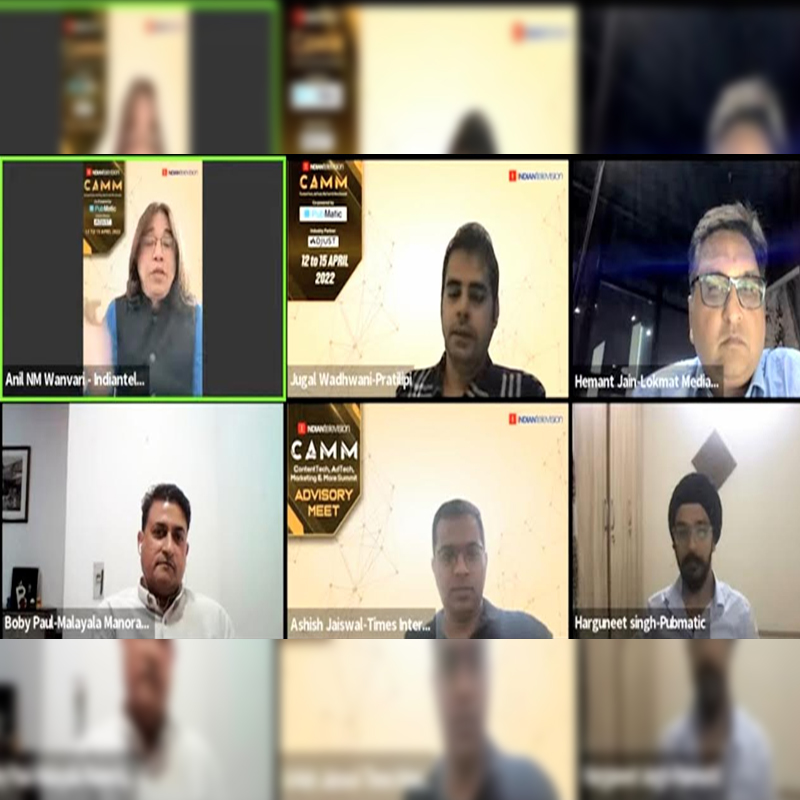
    Mumbai: Advertising and technology have undoubtedly made great strides over the last few years. And to discuss the various cutting-edge innovations in this dynamic space, IndianTelevision.com has organised ContentTech, Adtech, Martech and More (CAMM) Summit and Exhibition 2022. The virtual event took off on Tuesday with a panel discussion on ‘Adtech Landscape: A Gamechanger for Publishing Industry,’ which put the spotlight on how adtech is emerging as a niche that helps publishers efficiently maximise the value of their content or ad inventory.

    Moderated by IndianTelevision.com founder, CEO and editor-in-chief Anil Wanvari, the guests on the panel were Times Internet chief technology officer Ashish Jaiswal, Pratilipi business and content head Jugal Wadhwani, Malayala Manorama general manager – marketing Boby Paul, Lokmat Media senior executive vice president and head of digital business Hemant Jain, and PubMatic director Harguneet Singh.

    The CAMM Summit saw a conversation that is perhaps the most crucial in the age of changing advertising technologies.

    Challenges ahead of publishing industry and the possible ways to overcome

    Opening the discussion, Wanvari highlighted the increasing fragmentation of audiences between the own platforms of publishers as well as the third-party platforms is becoming a common phenomenon.

    “In terms of trying to drive advertising revenue, what are the challenges that publishers are facing?” he asked the panel.

    Agreeing with his thoughts, Times Internet’s Jaiswal said fragmentation is clearly happening and the same content being available across platforms is a major challenge for publishers. But being a publisher, he also shared how they are overcoming the challenge. 

    “What we are doing on our side to overcome these challenges is to stay connected with our audiences across all the platforms. We do not just publish and leave, we ensure that there’s a clear connection between us and our audiences across all platforms,” stated Jaiswal.

    Taking ahead the conversation, Lokmat Media’s Jain said, “What demonetisation couldn’t do to digital payments, Covid-19 did to digital media.”

    With this statement, he hinted at the enormous growth in terms of audience engagement that publishers have witnessed. Coming to the challenges, Jain said optimising content for small screens is another major challenge. 

    “It is quite difficult to give the right reading or viewing experience to customers while giving enough space to advertisers also,” Jain noted. “The struggle doesn’t end here. Lack of a large inventory, audience fragmentation and ensuring that the consumer ends up on your platform at the end are also making it difficult for publishers to maintain their growth.”

    However, Jain feels that while there are so many challenges, it also keeps you pushing to develop and looking for newer opportunities.

    Coming to the opportunities, he suggested that today focusing on one platform is not enough, publishers need to have an open mind and need to create a holistic approach to the business. “At the same time, it is important to have a highly optimised platform that meets users’ and advertisers’ expectations,” he remarked.

    He feels that publishers have to accept the fact that the audience who is consuming content on Facebook doesn’t necessarily come to your website too because the content we put on Facebook is already customised in a way that people would love to watch it on that platform only. “If you work hard, each of these platforms will help you revenues apart from your direct sales from the website.”

    However, Malayala Manorama’s Boby Paul feels audience fragmentation is a choice. “It happens because you want to put your content out to more and more people. So all you need to do is to keep a close eye on the aggregator platforms and understand which platform is providing you benefits and strategise accordingly,” Paul said. “When you have an audience coming to your aggregator platforms, you should design strategy in a way so that you can entice them to come to your own platform.” 

    Taking note of the challenges and the possible solutions suggested by the experts, Wanvari asked Paul to highlight the challenges of technology as far as marketing is concerned.

    Speaking about the marketing and monetisation part, Paul said that digital publishing platforms are facing major challenges because most of the digital platforms are free to air. “There’s no set framework. But as adtech is evolving, there seems a hope,” he asserted.


    Adtech and programmatic: The way forward for publishers


    While all the publishers highlighted the challenges and opportunities, PubMatic provides a solution to all these concerns. Harguneet Singh acknowledged the challenges highlighted by the panel and explained how adtech platform like PubMatic comes into the picture and helps the publishers.

    “While the challenges are quite evident, adtech platforms like PubMatic come in the picture as a savior to the publishers,” he affirmed.

    Suggesting some adtech based solutions, he said that publishers have provided a lot of control to the users in the name of free content which they need to take back immediately. He feels that adtech and programmatic are the key tools for this.

    “While adtech platforms enable advertisers, ad publishers, and advertising agencies to create, run, and optimize ad campaigns with minimal human involvement, programmatic advertising uses artificial intelligence and real-time bidding to automate and streamline the ad buying process,” Singh said, adding that, “With the right use of adtech and programmatic, publishers can significantly grow their business and increase CPMs.”

    What do users want?

    Amid the emergence of adtech and programmatic, it is crucial to understand what users want? Pratilipi’s business and content head Jugal Wadhwani, who closely works with individual publishers, explained that initially all people wanted was social recognition, the concept of revenue was not there really. “But presently, generating revenue is equally important for individual publishers too,” he added.

    However, Wadhwani feels that once the publishing platform becomes a hit, distribution is not that big of a challenge, it is the discovery that they are actually looking for and platforms like Pratilipi come into the picture to help individual publishers.

    On being asked how things are working on the audio side, Wadhwani said that audio advertising is very low right now in India. “The numbers are rising, but there is no significant development on the audio front so far.”

    Coming to the subscription models and how paywalls work, Wanvari asked how conventional news publishers ensure that users buy their subscription instead of just reading the free version. 

    Lokmat’s Jain explained that India is a ‘sachet-driven country,’ so they need to come up with small offerings. “If publishers really need to sell high valued subscriptions, they need to build high-quality unique content rather than a generic piece,” he remarked.

    “Over the last 10-years, journalism in India has evolved and produced unique content which helped the subscription model to become common. One of the most successful players in this field is The Hindu, which has built a very robust subscriber base,” noted Jain.

    How will the removal of cookies impact the publishers?

    Google announced it will not build alternate tracking identifiers with similar cross-site tracking abilities after phasing out third-party cookies. This change will be made by Google in late 2023. While this announcement may not have come as a surprise, many advertisers find themselves confused about how to manage the situation.

    “How will publishers collect user data without cookies which is crucial for audience profiling?” Wanvari asked.

    Jain thinks that with the removal of cookies, profiling or identifying customers, which is extremely important for running a digital publishing business, would become difficult. “With this, targeting customers offsite will become impossible.”

    Suggesting a way for publishers after the removal of cookies, Jain said that in such a situation, targeting users on-site seems one possible solution. “To target them on-site, publishers really need to come up with relevant content.”

    Times Internet’s Jaiswal thinks that in a cookie-less world, trust-building will become crucial. “Publishers will have to ask users to fill out forms to manually provide their data, maybe we can call this idea a ‘profiling paywall.’ But to ensure that they really fill out the form, provide their email address and mobile number, publishers need to work a lot on trust-building.”

    Jaiswal suggested that publishers can win trust with unique content.

    Adding to the conversation, PubMatic’s Singh said adtech will play a really important role here. “Right technology and the right technology partner who has good sense will have great opportunities to work with publishers,” he averred.

    Concluding the discussion, all panelists agreed that adtech provides tools for both publishers of content and advertisers to efficiently navigate the appropriate price points and trading techniques to connect inventory with digital ad buyers.

  • CAMM Summit 2022 all set to discuss latest cutting edge innovations

    CAMM Summit 2022 all set to discuss latest cutting edge innovations

    Mumbai: ‘Content is king’ has become too common of a phenomenon. But there has never been a never-ending hunger for content as is being witnessed today. Estimates are that close to $120 billion is expected to be spent on producing content every year. To discuss the latest cutting-edge innovations in the technology space, IndianTelevision.com has come up with ContentTech, Adtech, Martech, and More (CAMM) Summit and Exhibition 2022. The four-day-long event will be co-powered by PubMatic.

    The virtual summit will commence on 12 April at 02:45 p.m and conclude on 15 April. The key themes for the summit will include planning for connected TV, changing Adtech landscape, AI & data, content infrastructure, technology trends for the year 2022, user experience and retention etc.

    With the help of industry stalwarts, CAMM Summit and Exhibition will showcase the latest cutting edge innovations in cinema production, distribution, consumption, streaming and TV show creation and distribution – whether via satellite or through the Internet.

    The idea is to create a tech-ready corporate and studio culture so that India’s much hyped-up creative industry can live up to its total potential.

    The CAMM Summit will be carried out with the help of an esteemed advisory board comprising senior professionals from the industry including Tata Elxsi global practice head for media and new media Ajay Kumar Meher, CeleverTap senior vice president marketing Jayant Kshirsagar, Zee Technology & Innovation Centre chief technology officer Kishor AK, India Today group chief technology officer Piyush Gupta, PubMatic regional vice president OTT & CTV Vijay Anand Kunduri, Network18 Media & Investments Ltd group chief technology officer Rajat Nigam, Google India head of large partner solutions, online partnerships group Sweta Jhunjhunwala and many more prominent names.

    The event will have speakers from ContentTech, AdTech and marketing sectors who will share their experiences, insights and predictions for the future. The speaker list will include Timex Group head of marketing and e-commerce Ajay Dhyani, Pratilipi business and content head Jugal Wadhwani, Lenskart media head Anupam Tripathi, Times Internet chief technology officer Ashish Jaiswal, TV9 Network chief technology officer S Badari Prasad, Kinnect senior vice president – marketing science and customer experience Bharatesh Salian, PubMatic director Harguneet Singh Madison World vice president Kosal Malladi, Lokmat Media senior executive VP and head of digital business Hemant Jain and so on. The speakers will share their thoughts on their respective panels.

    The summit is an ideal hotspot for startups, short video professionals, MarTech professionals, Broadcasters, AdTech professionals, Venture Capitalists and everyone with a keen interest in technology.

    CAMM Summit and Exhibition is one of its kind of initiatives that will gather the technology professionals under one rooftop. It will give you an opportunity to hear from top industry leaders from ContentTech, AdTech and Marketing sectors who will help you understand how the AdTech landscape is forging stronger brand and publishing relationships. The summit will also give you an opportunity to learn from the experts by listening to their journey, experiences and how they overcome the challenges. There will also be successful branding and marketing stories from the brands. This is the biggest platform to gather knowledge on the current trends in the marketplace. 

  • The Trade Desk partners with Lifesight to help brands optimise digital campaigns

    The Trade Desk partners with Lifesight to help brands optimise digital campaigns

    MUMBAI: Global advertising technology firm The Trade Desk has partnered with Lifesight, a customer intelligence company that specialises in location-based measurement. The association will enable the tech firm to provide insights to marketers in India regarding the impact of their online advertising campaigns on store visits and the ability to optimise campaigns.

    Through the platform, marketers would also be able to effectively measure how their digital campaign is driving in-store visits to complement other online campaign metrics such as views or clicks, said the company. “By leveraging in-flight location data insights, marketers can optimise campaigns on the go and use those campaign insights to inform spend allocation and shape media strategies that drive better business outcomes,” said the tech firm.

    “In the last 18 months, measurement has become a top priority as marketers are under pressure to prove ROI of every advertising dollar. As we step into the festive season and economic activity picks back up in India, brands can apply learnings from the pandemic to change the way they market to consumers that is more effective and efficient,” The Trade Desk India- general manager, Tejinder Gill said.

    As more people go shopping for India’s festivities, brands are experiencing huge traction on digital channels and in their physical stores. This retail resurgence both on and offline have marketers re-assessing their measurement approach in an increasingly complex consumer journey.

    The announcement comes at a time when Indian marketers are increasingly embracing the value of data-driven and cross-channel advertising campaigns. Through The Trade Desk, brands can measure and compare their campaigns’ performance with other channels on the open internet such as connected TV (CTV), over-the-top (OTT), audio streaming, web and mobile apps.

    Lifesight CEO Tobin Thomas said, “This partnership marks the first time that Lifesight’s footfall measurement solution has directly integrated within a programmatic buying platform in India. This is a much-needed innovation that can help brands get the most out of their programmatic spend. Together with The Trade Desk, we are advancing the measurement capabilities for marketers in India.”

  • Channel Factory onboards Alex Littlejohn as MD, APAC

    Channel Factory onboards Alex Littlejohn as MD, APAC

    Mumbai: Channel Factory, the global brand suitability and YouTube measurement programme partner, has brought on board Alex Littlejohn as managing director (MD) to spearhead its growth in the APAC region.

    In his new role, Littlejohn will be responsible for growing the brand’s existing operations in Singapore and will be tasked with launching the business into the broader APAC region with local offices across SEA and Australia slated for launch in Q4 2021, said the press statement.

    Littlejohn has extensive experience in scaling adtech businesses having held the position of president international for Adconion Media Group for eight years where he was responsible for growing the team from a standing start to over 250 employees across eight European and four APAC markets. Following Adconion’s acquisition by Singtel (SGX), he served at Amobee as senior vice president for APAC.

    “Alex clearly brings years of incredibly valuable experience to Channel Factory and we could not be more excited to welcome him to the team,” said Channel Factory founder & CEO, Tony Chen. “His impressive record and successful wins speak for themselves and we have full confidence in him to lead our business growth across the APAC region in each local market as we increase our global footprint and push the ad industry to be more conscious while we approach a new decade of recovery and regeneration.”

    Littlejohn has been recognised in the 40 most influential people under 40 years in the media and marketing twice, on two continents, and has been awarded multiple times in multiple markets for his contributions to the industry.

    “I am excited to be joining Channel Factory at such a pivotal time for the business,” said Littlejohn. “Our Mission is to build a better Video ecosystem that connects creators, brands, and consumers, and as one of only seven accredited YouTube measurement partners globally, I am excited to further develop the existing Channel Factory operations in the region.”

  • Throwback2020: Not in moolah but digital marketing grew in virtue

    Throwback2020: Not in moolah but digital marketing grew in virtue

    NEW DELHI: It has been quite a few years that the digital marketing industry is enjoying a fabulous run rate in India. It is a no-brainer that growing internet penetration, cheap data rates, and just the sheer availability of digital entertainment and logistical options have contributed to its stellar rise. While the traditional modes of advertising have been struggling to keep the  cash registers ringing, partly because of the continuing dip in the economy and partly due to the Covid2019 lockdown’s impact on businesses across the spectrum, digital marketing enjoyed quite a positive stay in an otherwise positively uncomfortable 2020. 

    The year was a mixed bag of challenges and opportunities for the digital marketing industry, though the latter were overpowering. Despite a slump in growth numbers, the industry seems to be staring at a rather bright future. Tech advancements, positive sentiments within the industry, and the sheer scope of growth ahead makes the ride an interesting prospect for the future too. 

    The spike in digital adoption

    For nearly two-months, starting March, the whole country was forced to stay indoors following strict lockdown rules, courtesy the global viral pandemic Covid2019. It forced people to work online, connect online, shop online, teach online, consult online and do what have you online. This led to a crazy uptake in digital adoption. 

    Logicserve Digital founder & CEO Prasad Shejale said: “The pandemic has definitely caused a huge shift in the industry. While the country’s economy and GDP took a massive hit, the digital industry has been rapidly growing with regards to its consumption, penetration as well as engagement. The global e-commerce sales growth and number of digital adopters accelerated in the initial three months; in the normal course that would have taken three years.”

    According to a Kantar report released in May this year, India’s monthly active internet user base is estimated to reach 639 million by the end of 2020, from the currently estimated 574 million. The country had clocked 734.82 million wired and wireless broadband subscribers up to 31 October 2020 according to Telecom Regulatory Authority of Indian monthly telecom data reports.

    Mobile became the preferred choice of internet consumption and the average time spent on smartphones in a day grew with average usage growing 11 per cent to 5.5 hours in March 2020 (pre-Covid) from about 4.9 hours on average in 2019. This further grew by another 25 per cent to 6.9 hours April onwards (post-COVID), a report by Vivo and CMR highlighted. 

    India also saw the biggest jump in video consumption, of 40 per cent to over 2.9 billion hours during the week starting 22 March as compared to the last week of December 2019, when it was 2.1 billion hours, as stated by an Internet & Mobile Association of India (IAMAI) and Nielsen report. 

    Naturally, this sharp spike in digital consumption had a positive impact on digital marketing and advertising too. 

    Digital marketing growth story 2020

    At the beginning of the year, a DAN report had predicted that the digital advertising industry would grow 27 per cent in 2020. However, that might not turn out to be the case entirely. 

    The sector, much like every other business, took a hit in Q1 FY21, because of the market uncertainties and lockdown. Ad rates went down as much as by 15-20 per cent according to an industry insider. 

    A panel discussing the widening scope of digital marketing with Indiantelevision.com founder, CEO, and editor-in-chief Anil Wanvari in June stressed that the growth digital marketing has clocked in the year will not be immediately visible in the CAGR, but will be a defining factor in how the advertising pies of individual marketers changed. It insisted that after six months of struggle in 2020, the industry will have a very prosperous six years ahead. 

    iProspect India AVP-strategic solutions Nihal Nambiar had said: “Digital, in 2020, will definitely not have a similar CAGR of 27 to 30 per cent as it has been recording for the past few years.” But he mentioned that he is looking forward to some positive quarters ahead in terms of brands moving to digital platforms.

    Shejale pointed out: “Various reports suggest that in spite of the slowing economy, the digital segment has seen a growth of around 20-27 per cent by November 2020. The numbers might vary in different research articles. However, this is the broad range within which the growth is seen, and it’s very promising.” 

    However, GenY Medium co-founder & CEO Yashwant Kumar is more hopeful and is expecting that the industry will grow by 35-40 per cent in 2020-21. 

    He noted: “Digital advertising has gained tremendously during the pandemic and has become the preferred medium with a huge surge in e-commerce across categories together with consumers spending a lot more time with their families at home on their connected TVs and mobiles. Digital has been consistently growing at 27 per cent CAGR over the past few years ahead of television, print and outdoor. We are seeing a significant movement towards digital in Q2 and Q3 this year after a slow Q1. My expectation is that digital advertising will grow by 35 to 40 per cent for the year 2020-21.” 

    While the industry has contrasting views towards the growth numbers, KPMG’s ‘A Year Off Script’ report released in September indicated that online advertising is expected to result in a 12 per cent growth overtaking traditional media like television which will contract by 17 per cent this year. 

    The report added, “At ₹22,300 crore, total digital advertising revenue will beat the ₹21,700 crore revenue of TV over FY21.”  

    Trends that defined the industry in 2020

    The biggest trend that strengthened the roots of the digital marketing industry in 2020 was the sheer influx of rural users in the internet world. As per a report by the Internet and Mobile Association of India (IAMAI) and Nielsen, rural India had 227 million active internet users, 10 per cent more than urban India’s about 205 million, as of November 2019. A Kantar report further suggested that this number will increase to 304 million by 2020. “Local language content and video drive the internet boom in rural India, with a 2.5 times increase in penetration among the population in the last four years,” it added. 

    This, added with digital retailers going deep into the heartland India, led to a great jump in the need for “hyperlocal” content by brands. This kept the digital agencies busy through the year. 

    Additionally, giants like Facebook, Swiggy, and Instagram entering the local market with thier own shopping platforms, growth of edtech companies like WhiteHat Jr, Vedantu, and Instagram releasing a new content section called Reels, were some new found opportunities for the digital industry to explore. 

    Wavemaker India chief client officer and head-west Shekhar Banerjee had mentioned in an earlier conversation with Indiantelevision.com that brands went heavy on performance marketing in 2020. “Apart from the usual search, social, and e-commerce mix, one platform that has become the biggest gainer during the period is the e-groceries section, taking a huge part of the digital pie. Going ahead, hyperlocal platforms, with their changing business models will be more conducive to advertising.”

    Another interesting opportunity for the digital marketing industry came in the form of online events. Almost 95 per cent of the physical events moved to online platforms giving digital agencies great opportunities to work with brands. It included marquee events like IPL, which was hosted without a live audience and saw viewers engaging with it either through TV or digital platforms. 

    OTT platforms also saw a remarkable rise in viewership during 2020. Kumar highlighted, “According to one industry report (Velocity MR Study), Amazon and Netflix saw +60 per cent growth in their subscriber base in the AMJ '20 quarter. Similar numbers have been reported for other platforms like Hotstar, YouTube and others. This massive shift towards the OTT platforms becoming the go to destination for entertainment, sports and news is driven by increased consumption of video content by consumers across all the age groups and demographic segments. Daytime video usage by the working professionals has become the new norm as they have started watching TV or streamed video content during their work breaks or while actively working.” 

    Additionally, what moved the industry significantly was FMCG brands getting more serious about digital platforms. As per industry experts, FMCG brands increased their expenditure on digital platforms to 12 per cent, compared to around 7 per cent in 2019. 

    This also paved the way for a significant hike in influencer marketing activities. 

    Mompresso co-founder & COO Prashant Sinha said, “Digital marketing has seen transitional growth in the year 2020. The majority of advertising and marketing spends by brands this year has been towards digital channels and with no doubt, this will continue to grow further in 2021. We can also expect to see big portions of these budgets to go towards influencer marketing and macro and micro-influencer led campaigns. The overall digital marketing industry has seen a boost this year, where creators, brands, and marketers have learned to work together. Brands have revaluated the metrics and shifted focus to prioritize channels where they receive the most engagement. While video content has dominated the space, more diversification is expected. Live streaming and user-generated content will continue to be popular among influencers and marketers.” 

    The growth in the e-gaming industry resulted in increased ad spends by players and also the development of a whole new media option for the brands. While most of the marketers still sat on the fence about exploiting the medium, it is expected that it will flourish in the coming quarters. 

    The year was a mixed bag of challenges and opportunities for the digital marketing industry, though the latter were overpowering. Despite a slump in growth numbers, the industry seems to be staring at a rather bright future. Tech advancements, positive sentiments within the industry, and the sheer scope of growth ahead makes the ride an interesting prospect for the future too. 

  • TikTok launches its Innovative Digital Advertising Solutions at Ad:Tech

    TikTok launches its Innovative Digital Advertising Solutions at Ad:Tech

    MUMBAI: Short-form mobile video platform TikTok announced the launch of its Innovative Digital Advertising Solutions in India at the ongoing ad:tech conference. It also launched the ‘Hashtag Challenge’ for the brands to seek insights into the digital community, trigger more high-quality content, and find out the most engaging way for branding.

    Apart from these, TikTok also launched Brand Takeover and In-feed Native Video to further enhance the ad impact, and to address various needs of the digital advertisers.

    TikTok Ads director of global monetisation strategy Wang Tong said, “We have seen a huge fervour that TikTok has raised around the world, and of course we see that same fervour here in India as well. While we are excited about the passionate, creative and self-expressive elements that have been triggered by TikTok, we never stop exploring the manner in which we could be valuable for the business too, and to make TikTok bring in a paradigm shift in the traditional ad expression."

    TikTok Ads director of global partnership Huang Linjing added, "As a marketer, it is vital to make sure that your brand is effectively connected to your audience. At TikTok, we not only provide an interactive platform for advertisers to reach out to users, but we can also make the users actually participate in our ad campaigns.”

  • Media, marketing & technology experts to gather for ad:tech

    Media, marketing & technology experts to gather for ad:tech

    MUMBAI: Ad:tech global digital marketing & advertising conference and exhibition, having 14 shows worldwide, will host its fifth edition of the New Delhi Show on 19 – 20 March, 2015. The event will be held at the Leela Ambience Hotel and Residences, Gurgaon where more than 4000 thousand marketing, technology and media communications professionals are expected to attend.


    dmg :: events EMEA & India digital marketing head James Drake-Brockman said, “The fifth edition of the ad:tech promises to be a testament to this ever expanding digital market in India. This year the show will have 110 plus speakers and more than 70 exhibitors and sponsors for the event. We have witnessed overwhelming success since ad:tech’s inception and we are confident that this year, the legacy will be continued. At ad:tech New Delhi 2015, you can experience two action-packed days with keynotes, education led by digital marketing’s best and brightest, hundreds of leading-edge suppliers – from established players to the newest startups – nonstop networking and much, much more.”


    This year the keynote speakers include: Unilever Asia, Africa, Middle East, Turkey and Russia vice president Rahul Welde, GroupM chief digital officer Rob Norman, Myntra CEO and Flipkart head of fashion Mukesh Bansal and BBC news and current affairs director of digital development James Montogomery. 


    Among the big themes this year will be: M-Commerce, the future of E-Commerce, data fuelled marketing, analytics, fresh insights on programmatic advertising, digital content, media measurement in the digital era and multi-screen world, evolution of native advertising, digital’s impact on entertainment, music & news, experiential e-commerce, performance marketing, the role of data and automation in future media planning, 


    This year’s event will be attended by some of the biggest brand from India and the world like Airtel, Oberoi Group, Axis Bank, Kotak Mahindra Bank, Thomas Cook, Yes Bank, Olx, HDFC Life, American Express, Indus Ind Bank, Max Life Insurance, Tata Capital, Tata AIG, Amazon, Johnson & Johnson, ITC, Star India Pvt Ltd, ITC, FlipKart, GSK, HDFC Life, Mahindra & Mahindra, Wipro, HCL, Madison Communications, GroupM, Lintas and Cheil Worldwide amongst others.