Tag: ADS

  • Digital ads share low; CII-KPMG hopes for 33.5pc CAGR

    Digital ads share low; CII-KPMG hopes for 33.5pc CAGR

    MUMBAI: Confederation of Indian Industry (CII) and KPMG in India unveiled today a report titled ‘Digital – The New Normal of Marketing’, at CII National Marketing Summit, which brings out valuable information on Indian digitization and the shift from traditional to digital marketing.

    The report estimates that, India is one of the fastest growing advertising markets globally with an estimated growth of 15.5 per cent in 2016, driven by a large consumer base and a burgeoning e-commerce industry. Although the share of digital advertising spend remains low at 12.7 per cent in 2016, it is one of the fastest growing mediums at an expected CAGR of 33.5 per cent (2015-2020) to cross INR 255 billion in 2020.

    Of the total digital advertisement spends, ‘search and display’ commands the largest share even though it is a relatively maturing segment.

    “The post-demonetisation days have clearly showed how the country is set to leapfrog a few stages to embrace the power of digital. Mobile is being rapidly adopted and marketers have an incredible opportunity to enhance the game of digital communication and deliver great customer experiences at each point of the journey,” said CII National Committee on marketing chairman and Aditya Birla Group CEO – textile business Thomas Varghese.

    As per the report, connected devices, smarter devices and ‘hyper relevant rich content’ will drive consumption for the consumer. Marketers will be well served if they are able to ride the data wave and use technology to build in analytical models. The Digital marketer will be responsible to deliver a distinctive consumer experience using various channels – thus making the role a key contributor to the overall omni channel experience. The report also gives insights into nascent technologies like emotions analytics and predictive marketing.

    ‘There have been silent and not so silent changes around us that are changing the way marketing will be done. With the internet becoming all pervasive, it has become so integral to our lives that it has literally disappeared. Singularity, connected systems, Cognitive and AI will create a world where the marketer will be marketing not only to humans but the ‘self-thinking’ machines,’ says KPMG India partner and head – digital consulting Rachna Nath.

    “Digital marketing is more about big data and technology innovation rather than conventional marketing. Digital marketer today will have to look at the consumer as a living sensor which creates data. Insights on consumer behavior will drive the next big innovation on the campaign. Success will depend upon how the digital marketer is able to drive differentiated strategies for each digital channel and eventually converging on consumer experience” says Aditya Rath, Partner and Lead for Digital Customer.

    Other key findings and suggestions presented in the report are:

    Video is new data format

    The digital consumer’s attention span has now come down to 8 seconds, down from 12 seconds in 2007. Marketers are expected to direct their content strategists to curate short videos that create a greater impact on the consumer’s mind while holding their attention till the end. Live streaming videos are interactive, immersive and cost-effective.

    Omni-channel experiences and touch points are essential in the digitally charged marketplace Healthcare, automotive, insurance, retail and manufacturing companies are experimenting on various IoT use cases to enhance the consumer experience.

    Wearables provide a new dimension from a data perspective Through the galvanic skin sensors and gyroscopes that are in-built in these devices, marketers can continuously monitor the customer’s physiological and behavioural data.

    Authenticity, relevance, and value are increasingly important parameters for content creation and distribution Customers trust user-generated content and give more weightage to peer recommendations and reviews than to professionally curated content.

    Native ads are being used increasingly to combat mobile and desktop ad blocking They blend in and appear as content that would normally and deliver value and relevance to the consumer and do not hinder user experience of the website even while monetizing.

  • This wedding season, Manyavar celebrates with Virat Kohli

    This wedding season, Manyavar celebrates with Virat Kohli

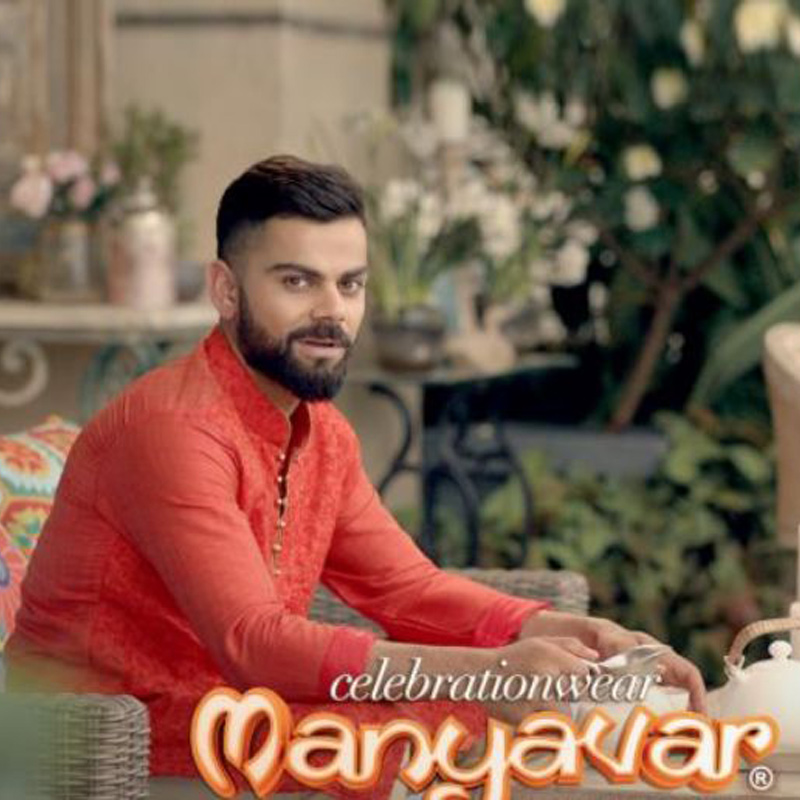
    MUMBAI: As the wedding season dawns on the nation, Manyavar is all geared up to make the most of it. Its recent campaign ‘New Beginnings’ with Virat Kohli, the brand ambassador for Manyavar is in line with the same thought and inspires to celebrate life.

    The campaign has been conceptualised by Shreyansh Innovations with its honcho, Shreyansh Baid helping the creative work. Elements is the production house.

    Through this campaign, Manyavar aims to bring back the charm of good old days when every new occasion brimmed with excitement, little moments left us speechless. The brand attempts to keep tradition alive and re-stablish connect with Indian culture by initiating the concept of a new beginning in a kurta.

    Looking dashing in a red kurta, Virat talks about wearing a kurta to make his moments special, like making a cup of tea for the first time. Though the first tea may not be up to the mark, wearing a kurta definitely makes the occasion memorable.

    Targeted at youth, the campaign brings about a feeling of positivity and celebration – a kurta will make you look good, feel great and the moment special! Kohli is the most relatable figure for the audience that Manyavar is targeting.

    Manyavar is one of the best retail brands when it comes to celebrations, the ethnic way. They have evolved as per the fashion trends and offer customers ethnic wear for every occasion in their lives.

  • This wedding season, Manyavar celebrates with Virat Kohli

    This wedding season, Manyavar celebrates with Virat Kohli

    MUMBAI: As the wedding season dawns on the nation, Manyavar is all geared up to make the most of it. Its recent campaign ‘New Beginnings’ with Virat Kohli, the brand ambassador for Manyavar is in line with the same thought and inspires to celebrate life.

    The campaign has been conceptualised by Shreyansh Innovations with its honcho, Shreyansh Baid helping the creative work. Elements is the production house.

    Through this campaign, Manyavar aims to bring back the charm of good old days when every new occasion brimmed with excitement, little moments left us speechless. The brand attempts to keep tradition alive and re-stablish connect with Indian culture by initiating the concept of a new beginning in a kurta.

    Looking dashing in a red kurta, Virat talks about wearing a kurta to make his moments special, like making a cup of tea for the first time. Though the first tea may not be up to the mark, wearing a kurta definitely makes the occasion memorable.

    Targeted at youth, the campaign brings about a feeling of positivity and celebration – a kurta will make you look good, feel great and the moment special! Kohli is the most relatable figure for the audience that Manyavar is targeting.

    Manyavar is one of the best retail brands when it comes to celebrations, the ethnic way. They have evolved as per the fashion trends and offer customers ethnic wear for every occasion in their lives.

  • Tourism New Zealand endorses Tourism 2025

    Tourism New Zealand endorses Tourism 2025

    MUMBAI: Tourism New Zealand says the industry has turned a corner with the release of ‘Tourism 2025 – Growing Value Together/Whakatipu Uara Ngatahi’ and its aspirational goal to reach $41b value by 2025.


    Chief Executive Kevin Bowler says Tourism 2025 has brought the industry together and has forged a shared vision for where we want to get to and how with a collective focus, we can get there.


    “Tourism New Zealand has agreed to align its business plan with the overall direction set out in Tourism 2025,” he says. “It is appropriate that this is a framework for alignment, rather than just a list of operational tactics, as there aren’t many silver bullets when it comes  to achieving the growth we’re aspiring to achieve.”


    “Instead, this framework is about helping the whole industry to all move in the same direction, targeting the areas with investment in time, energy and money that will deliver the greatest economic returns for the industry and of course the country.”


    Kevin says that Tourism New Zealand’s work under its current three-year marketing strategy fits closely with the 2025 framework and the organisation is using its additional funding provided by the Government to drive actions across Tourism 2025’s five central themes.


    “The Tourism 2025 theme ‘targeting for value’ is perfectly aligned with Tourism New Zealand’s objective to increase the value of international visitors to New Zealand,” he says.


    “To help achieve this, we have increased our investment in international business events, premium visitor segments, and special interest travel sectors recognising these visitors typically spend more than the average holiday visitor.”


    “We are working closely with airlines and airports to encourage growth in airline services to ‘grow sustainable air connectivity’, and have a number of joint venture partnerships in place, most significantly a $20 million per annum joint marketing agreement with Air New Zealand. Our involvement with the i-SITE network, Qualmark and the China market through the ADS and PKP programmes are our key contributions to the Tourism 2025 theme “drive value through outstanding visitor experience”.


    “By identifying and attracting visitor segments that visit New Zealand in the shoulder and off seasons, particularly through our new focus on emerging markets like India and Indonesia, we are assisting the industry improve its performance under the theme “productivity for profit”.


    “Finally, Tourism New Zealand has an entire team dedicated to providing research analysis and “insight” that is distributed to the industry on the tourismnewzealand.com website.”


    Tourism New Zealand was a key contributor in the development of Tourism 2025 and supports the ambitious goal of raising the combined value of international and domestic tourism to $41 billion by 2025.

  • Over Rs 330 crore spent on ads in first ten months of this year

    Over Rs 330 crore spent on ads in first ten months of this year

    NEW DELHI: The Government spent around Rs 332.24 crore on advertising in the period between 1 January and 31 October this year.

    A sum of approximately Rs 288.67 crore was spent in the first ten months of this year on issuing display print media advertisements which usually carry the photographs of present and past political leaders/ministers/other dignitaries.

    In addition, approximately Rs 41.11 crore was spent on electronic media advertisements and about Rs 11.46 crore on outdoor publicity respectively on advertisements which carried the photographs of political leaders; Information and Broadcasting Minister Manish Tewari informed the Parliament.

    The Directorate of Advertising and Visual Publicity (DAVP) is the nodal agency of the Government of India for advertising by various Ministries and Organisations of Government of India including Public Sector Undertakings and Autonomous Bodies.

  • Ads piggyback kids

    Ads piggyback kids

    MUMBAI: The latest advertisement to hit television screens is testimony to the fact that advertisers can’t seem to get enough of children when it comes to publicising brands. And this includes brands which don’t target kids; not even remotely.

    The ad in question is for IDBI Bank and rolls with a little girl sitting beside her friend, saying she loves to eat ganna (sugarcane) but can’t until she gets a new set of teeth which is why her pal is busy peeling it for her. The commercial ends with a voiceover: ‘Bank aisa, dost jaisa’. Two other ads are part of the campaign conceptualised by Ogilvy & Mather (O&M) and have children speaking of their friends in different scenarios.

    O&M NCD Abhijit Avasthi exults: “When we started work on the new campaign of IDBI Bank, we were very clear that we are changing the campaign and not the values that the bank stands for. The idea we came up with does exactly this. In an innocent and charming way, we are telling people ‘What if a bank would do what a friend would do’. When you say something like this, you really don’t need to say much more.”

    Indeed, the ad has charmed its way into people’s hearts, especially on social media. But that doesn’t stop one from wondering what kids can possibly have in common with a bank!

    Again, this isn’t the first instance where children have been used to sell products and services which they have nothing to do with; be it detergents, power inverters, cars, insurance policies or e-commerce websites. So what is it about kids that advertisers find so attractive? Ad veteran Alyque Padamsee reasons that people notice kids more than they do adults. “It is heart warming to see kids on screen. And who does not love them?” says he.

    Padamsee gives the example of Vodafone’s earlier campaign. “Vodafone used a little boy and her dog for its ‘everywhere you go, our network follows’ campaign, and it worked for them. Everyone remembers the commercial and it beautifully conveys the message the telecom company wants to tell people.”

    “Anything in life can be told through the eyes of a child. It’s not difficult,” says BBDO’s chairman and chief creative officer Josy Paul who elaborates on the point by giving the example of the agency David (founded in 2000 by BBDO) and adds, “When you joined the agency you got a resignation letter, not an appointment letter. You had to resign from adulthood to join David. The whole philosophy was to think like a child.”

    The other factor is that kids today play an important role in family decisions, say buying a car. Remember the ad with the Sardar kid whose car doesn’t run out of petrol ever – that’s how Maruti Suzuki tried to convince people about the car’s performance.

    Ernst & Young consultant (media) Mihir Date goes to the extent of calling present-day children decision makers. “What they watch on television is what they want. For example, my nephew only watches Cartoon Network but wants everything shown on the channel, be it a kiddie product or not,” he says.

    Peer pressure too plays an important part where kids want what their friends have; points out Date, adding, “And marketers have been smart enough to understand the GenY. It is working in their favour to use kids in advertisements wherein both kids and parents get targeted.”

    There are enough and more examples where brands and their creative agencies have used situations or scenarios where kids fit in beautifully, and the overall image is always happy and colourful. Say Nerolac paints, now being promoted by Shah Rukh Khan, which earlier had the jingle ‘Jab Ghar Ki Raunak Badhani Ho’ with happy scenes of children prancing around while the walls of their homes are being painted in bright colours.


    However, there’s a flip side as well to using kids in commercials.

    Says ad film director Prahlad Kakar, “If the brand value or what they stand for is not woven well into the story, then the message will be lost.”

    Padamsee agrees: “Amitabh Bachchan and Shah Rukh Khan are all over the place. They endorse so many brands; do we remember which commercial stands for which brand? Hardly… Similarly, one might notice and love the kids in an advertisement but that doesn’t mean that people will remember the brand. Many a times, the ad gets noticed but the brand isn’t.”

    While this is an open debate, it’s true that putting children in the ad is a sure way of getting viewers to like it, most of the times at least…

  • Azva launches campaign on seven vows

    Azva launches campaign on seven vows

    MUMBAI: Azva, the bridal jewellery collection from World Gold Council, has launched its latest campaign on the idea of seven vows / saat pheras of a wedding ritual.


    The insight for the campaign is that Indian marriages and gold go hand-in-hand. The last decade or so has witnessed a sea-change in the way marriages are solemnised in India. When the location, attire, mandap, sangeet and even décor have seen dramatic influences from other cultures and countries, the modern Indian couple was seen as moving forward. But gold bridal jewellery remained stuck in tradition and in the traditional idea of marriage.


    The challenge was to bring gold back into modern marriage conversation. The brief given to BBH India was to contemporise gold in the modern marriage context. The campaign aims to contemporise the modern seven vows and in turn builds relate-ability with the modern day couple. The creative idea “every relationship has the magic of seven” is translated in the creatives.


    The nationwide roll-out across 46 cities comprises of TVC as the lead medium supported by OOH and ads in leading magazines. There is a strong digital plan engaging the audience on social networking site and promoting the brand across leading online portals.  


    The TVC is directed by Prakash Varma of Nirvana Films. Media buying is handled by Maxus


  • Facebook introduces an easier way to create ads and measure their impact

    Facebook introduces an easier way to create ads and measure their impact

    NEW DELHI: Facebook has redesigned its ad buying and reporting tools based on responses from businesses.

    The ad buying process will start with a simple question – what’s your advertising objective? – and the Facebook tools will recommend an appropriate ad based on that objective, and then help determine how the ads performed against the objective.

    The updates, which we call objective-based ad buying and reporting, are part of ongoing efforts to make advertising on Facebook as simple as possible. In June, Facebook announced efforts to streamline Facebook ad types and provide consistency across formats. In July, ad products were streamlined, removing online offers, sponsored results and question ads. In August and September, it became possible for marketers to upload one image size that would work for all types of ads on Facebook, and the social site started offering a preview of how they would appear across Facebook.


    Feedback received from businesses was that when creating an ad, they did not want to choose an ad unit – they wanted to meet an objective. Facebook then spoke with marketers of all types and sizes to uncover the objectives that matter most to them. They are: Clicks to Website, Website, Conversions, Page Post Engagement, Page Likes, App Installs, App Engagement, In-store Offer claims, Event Responses.

    In turn, these objectives have become the new starting point for buying ads on Facebook. Based on the objective a business chooses, Facebook will recommend an appropriate ad-type (i.e., a Page post link ad to drive clicks to a website).

  • MediaMath acquires Akamai’s ad platform

    MediaMath acquires Akamai’s ad platform

    MUMBAI: MediaMath, the leading global digital media-buying platform, has acquired Akamai Technologies Advertising Decision Solutions (ADS) which will augment MediaMath‘s industry-leading data management platform (DMP).

    Financial terms of the transaction were not disclosed.

    The companies have also signed a multi-year relationship whereby MediaMath will have exclusive rights to leverage Akamai‘s pixel-free technology for use within digital advertising and marketing applications.

    As part of the agreement, MediaMath will acquire substantially all of the assets associated with Akamai‘s ADS business, and will integrate the Akamai ADS team into its workforce.

    "MediaMath‘s exclusive use of Akamai‘s pixel-free technology will enable clients to scale their business more effectively, and help us make that happen quickly," said MediaMath CEO Joe Zawadzki. "We‘re thrilled to welcome such a talented group of technologists, data scientists and online advertising professionals from Akamai‘s ADS team. The technology and talent, along with the data co-op, will further improve our platform‘s capabilities, and further improve our clients‘ business results."

    "We‘re excited to partner with MediaMath," said Akamai‘s Senior Vice President & General Manager of the Web Experience Division Mike Afergan. "Together, we‘ll be able to provide our joint customers with an even more effective set of tools to manage their data, understand their audience, and help enhance the quality of online marketing campaigns."

    As a result of the pixel-free technology partnership, MediaMath‘s clients will gain access to more data for audience segmentation, retargeting, and optimization, with quick and easy activation. Advertisers currently on the Akamai Platform will not have to integrate other pixels for audience and media performance tracking when using TerminalOne, removing significant workflow and technology hurdles facing media buyers and other technology platforms.

    Pixel-free also provides advertisers the ability to capture audience and transaction intelligence from 100 percent of their online pages. This is a major increase compared to the 30 percent of traffic capture achieved by pixel-based systems. The pixel-free approach is consistent with privacy best practices, offering consumers a simple opt out choice.

    MediaMath‘s acquisition of the Akamai allows advertisers to improve the effectiveness and sophistication of audience analysis while using predictive insights to drive greater marketing performance across digital channels.

    Advertisers will also be able to build and leverage their own bespoke data co-ops. The co-op platform will continue to enable advertisers to control exactly how their data is used, bringing a level of efficiency and transparency not available through existing co-ops or opaque networks.

  • Parliamentary committee wants action against ads of prescription drugs

    Parliamentary committee wants action against ads of prescription drugs

    NEW DELHI: A Parliamentary Committee has recommended appropriate action against companies that advertise prescription drugs in news and the lay press.

    The Parliamentary Standing Committee on Health and Family Welfare, in its report on the Functioning of the Central Drugs Standard Control Organisation, has recommended that a provision should also be incorporated in the Drugs and Cosmetics Rules to ban such practices and penalise offenders. The Committee would like to be informed of the action taken to implement these recommendations.

    The Committee said that this can lead to self-medication by the patients which can turn out to be hazardous. Recent cases of lay press advertisements are those of Anti-depressant Deanxit (Lundbeck); Anti-epileptic agents Desval ER (Ranbaxy), Lametec DT (Cipla), CToin (USV); and Cholesterol lowering Coltro (USV)..

    However, the Committee said advertisements should be issued whenever any drug is found to be sub-standard and referred to some states which had set up websites to impart this information.

    Meanwhile, it suggested that the Ministry should use the technology used by the Registrar of Newspapers to prevent drugs with similar brand names.