Tag: ADS

  • Manuj Arora appointed director, ads at Myntra

    Manuj Arora appointed director, ads at Myntra

    MUMBAI: Manuj Arora has taken on the role of director at Myntra. He moves into this position after nearly seven years with the online fashion retailer, where he previously held the titles of deputy director from April 2020 and associate director for three years starting in April 2022. During his time as associate director, his responsibilities included leading the gift card and strategic alliances businesses, as well as overseeing approximately 50 per cent of Myntra’s advertising business across various product categories.

    Prior to joining Myntra, Arora served as a manager at Sony Pictures Networks India (SPN) for two years. His experience also includes a role as associate group head at Reliance Broadcast Network, where he focused on business development through advertising sales and integrated marketing solutions. Earlier in his career, he held positions at Zee Media Corp Ltd (DNA) as an assistant manager in sales and at Colgate Palmolive in customer development.

    In his new role as director at Myntra, Arora will be responsible for Myntra ads, brand partnerships, strategic alliances, and gift cards.

  • Instagram introduces new ways to verify age in India & Brazil

    Instagram introduces new ways to verify age in India & Brazil

    Mumbai: Meta-owned Instagram has announced that it has expanded the test of new options for people to verify their age to additional countries, including India and Brazil. The company further stated that it plans to expand to the UK and EU before the end of the year.

    The company has brought its new test for users to verify their age via an original ID or video selfie to India. It says that kids today are using fake dates of birth to create profiles on social media platforms.

    It requires people to be at least 13 years old to sign up for the service. In some countries, the minimum age is higher. Uners who are teens (13–17) will be offered age-appropriate experiences like defaulting them into private accounts, preventing unwanted contact from adults they don’t know and limiting the options advertisers have to reach them with ads.

    If someone attempts to edit their date of birth on Instagram under the age of 18 to 18, or over, in India, they will be required to verify their age using one of three options: upload their ID, record a video selfie, or ask mutual friends to verify their age. The company also expressed that they’re testing this to make sure teens and adults are getting the right experience for their age group.

    Instagram further added that it is removing “Social Vouching” as an option to verify age from the test to make some improvements.

    The Social Vouching option allows users to ask mutual followers to confirm how old they are. The person vouching must be at least 18 years old, must not be doing it for anyone else at that time, and will need to meet other safeguards that are in place. The three people selected to vouch for the user will receive a request to confirm the user’s age and will need to respond within three days.

    Further, Instagram also stated that it is partnering with Yoti, a company that specialises in privacy-preserving ways to verify age. Yoti is verified by the Age Check Certification Scheme and is an age verification provider for several industries around the world, including social media, gaming, and age-restricted e-commerce. Yoti has received public support for its approach and knowledge of responsible artificial intelligence from authorities and governmental organisations in the fields of youth and privacy, including the German regulator KJM.

    Yoti notes that it trains its dataset on anonymous images of diverse people from around the world who have transparently allowed the company to use their data and who can ask them to delete their data at any time. For people under the age of 13, Yoti collected data using specific data collection exercises where parents or guardians had given explicit consent.

  • FIFS welcomes MIB’s advisories against illegal offshore betting platforms ads

    FIFS welcomes MIB’s advisories against illegal offshore betting platforms ads

    Mumbai: The Federation of Indian Fantasy Sports (FIFS), the industry’s self-regulatory body, has welcomed the ministry of information and broadcasting (MIB) decision not to allow private television channels, digital news publishers, and OTT platforms to broadcast/show advertisements for online betting sites and surrogate ads. The federation lauds the ministry for the move that reiterates FIFS’ stand against this menace. FIFS said that it has previously emphasised the need for identification and prohibition of offshore business activities to ensure consumer interest safeguards.

    FIFS DG Joy Bhattacharjya said, “We thank the ministry of information and broadcasting for this important step. As FIFS, we have been creating awareness about the need for demarcation between the legitimate and illegitimate players in the online gaming ecosystem to ensure unwarranted elements like offshore betting and gambling don’t see a rise and adversely impact consumer interests. This move from the ministry will ensure that Indian citizens are educated about the risks on these platforms and do not get lured or trapped by the same. We are hopeful that this initiative will lead to further stringent action on these players by other arms of the government as well.”

    As a big and positive step towards consumer interest protection, on 3 October 2022, MIB issued an advisory to private television channels, digital news publishers, and OTT platforms to refrain from showing advertisements for online betting sites and surrogate advertisements for such sites.

    In the advisories issued by the government, a clear stand has been taken by MIB against direct and surrogate advertisements of offshore betting platforms, saying that it may also invite penal action for the broadcasters. The advisories also stated that since betting and gambling are illegal in most parts of the country, advertisements for these betting platforms as well as their surrogates are also illegal and should not be shown to Indian consumers.

    The ministry, in its advisory, clearly highlighted that such offshore betting websites use news as a surrogate product to advertise their betting platforms, especially in the digital medium. The advisories mentioned that in these cases, there is a striking resemblance between the logo of the news platform and the betting website. The advisories also clarified that since betting and gambling are illegal in most parts of India, so are their advertisements, direct or surrogate. MIB mentioned the Consumer Protection Act 2019, Cable TV Network Regulation Act 1995 and the IT Rules 2021 to issue the advisories.

    FIFS added that it takes consumer interest protection very seriously and recently revised and strengthened its charter in order to promote innovation with responsible growth for the fantasy sports industry. The new charter emphasises the role of the Fantasy Sports Regulatory Authority (FSRA), an independent self-regulatory body committed to promoting standardised best practises in fantasy sports.

  • Amazon miniTV kicks off its brand campaign ‘Young Janta Ko Yahi Mangta!’

    Amazon miniTV kicks off its brand campaign ‘Young Janta Ko Yahi Mangta!’

    Mumbai: Amazon miniTV has launched its brand campaign “Young Janta Ko Yahi Mangta.” The two quirky advertisements, which feature an astronaut and a ghost, emphasise that the youth of India prefer to watch relatable and entertaining stories-hatke or atrangi.

    The integrated campaign, which was conceptualised by Fatmen, takes a jab at tired tropes like hopeless romantic comedies and dull horror movies, which are no longer appreciated by today’s viewers when it comes to their entertainment preferences.

    Amazon advertising head Girish Prabhu said, “Over the last year, we have seen tremendous growth for Amazon miniTV—our free AVoD (advertising-supported video-on-demand) service. Our user base has grown by almost five times since January, and we are committed to bringing premium, exclusive, and free content to our audiences. We are building on this momentum with an increasing slate of inventive and exclusive content across web series, comedy shows, and unscripted series.”

    He further added, “We are focused on delivering high-quality ad-enabled content to our customers, complemented by the ad technology to help brands showcase their stories with the most digitally savvy customer base in the country.”

    Both advertisements conclude with a message from a helpful Amazon delivery representative alerting viewers about the fresh, fun, and cost-free programming on miniTV that is easily accessible on the Amazon shopping app.

    Ghost –

    Astronaut –

  • 61% consumers watch online video content like YouTube/OTT on their mobile/home TV: Axis My India Sep CSI Survey

    61% consumers watch online video content like YouTube/OTT on their mobile/home TV: Axis My India Sep CSI Survey

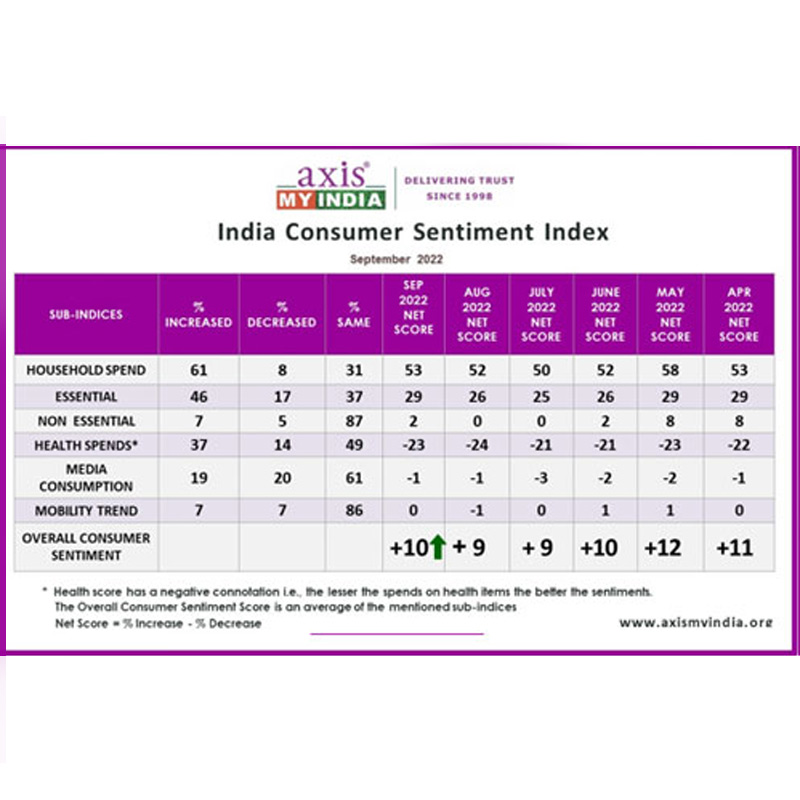
    Mumbai: Axis My India, a leading consumer data intelligence company, released its latest findings of the India Consumer Sentiment Index (CSI), a monthly analysis of consumer perception on a wide range of issues.

    According to reports, 20 per cent of consumers are planning to shop more this festive season. On media consumption, 61 per cent mentioned that they watch online video content either on their mobiles or connected TV. 32 per cent mentioned that they notice advertising on TV, followed by digital (26 per cent). An interesting observation was on app usage. On average, nine apps are used by a smartphone user.

    The net CSI score for September, calculated by percentage increase minus percentage decrease in sentiment, is at +10, from +9 last month, reflecting an increase of one point. The sentiment analysis delves into five relevant sub-indices: overall household spending; spending on essential and non-essential items; spending on healthcare; media consumption habits; and mobility trends.

    Key Findings:

    •     Overall, household spending has increased for 61 per cent of families, which is the same as in August. The net score, which was +52 last month, has increased by +1 to +53 in September.
    •     Consumption of media remains the same as the previous month, i.e., 19 per cent. The overall net score, which is -1 in September, also remains the same.
    •     Mobility has increased for seven per cent of families, representing a one per cent increase over the previous month.
    •     Spending on essentials like personal care and household items has increased for 46 per cent of the families, which is an increase of one per cent from last month. The net score, which was at +26 this month, has increased by +3 to +29.
    •     Spending on non-essential and discretionary products like air conditioners, cars, and refrigerators has increased for seven per cent of families, which reflects an increase of one per cent from last month. The net score, which was at nil last month, has improved to +2 this month. This could reflect the spirit of the festive season approaching.
    •      Consumption of health-related items has increased for 37 per cent of the families, which reflects a decrease of one per cent from last month. The health score, which has a negative connotation i.e., the less spent on health items, the better the sentiments, has a net score value of -23 for September, as compared to -24 last month.

    On topics of current national interest:

    •      In an attempt to understand consumers’ engagement with mobile apps, the survey discovered that, on average, consumers have nine apps on their smartphones. 16 per cent use a minimum of 4–8 apps on their smartphone, and 22 per cent have more than eight apps. A significant 24 per cent mentioned that they use a feature phone.
    •     In order to determine which medium advertisements are more likely to be noticed, the survey discovered that a majority of 32 per cent notice ads on TV, while 26 per cent notice them on online media. It was also discovered that only 17 per cent notice ads on social media platforms, 15 per cent in print, six per cent in outdoor and two per cent on radio.
    •      The survey further revealed that a majority of 61 per cent watch online video content like YouTube or OTT on their mobile/home TV.
    •     Digging deeper into the festive spirit, the survey shows that 20 per cent plan to shop more this festive season compared to last year. However, 32 per cent plan to shop the same as last year.
    •     According to the Axis My India Consumer Sentiment Index Survey, 48 per cent of consumers shop/purchase more products during the festive season as compared to the rest of the year.
    •      Exploring farmers’ sentiments towards new tractors, the survey found out that 10 per cent are planning to purchase new tractors in the coming year, while three per cent and two per cent plan to do so within six months and three months, respectively. For reasons like smaller land size, renting, or affordability, a significant 86 per cent of farmers don’t own a tractor.

    The survey was carried out via computer-aided telephonic interviews with a sample size of 10014 people across 32 states and UTs. 68 per cent belonged to rural India, while 32 per cent belonged to urban India. In terms of regional spread, 23 per cent belong to the northern parts while 24 per cent belong to the eastern parts of India. Moreover, 29 per cent and 23 per cent belonged to the western and southern parts of India, respectively. 59 per cent of the respondents were male, while 41 per cent were female. In terms of the two majority sample groups, 32 per cent reflect the age group of 36-year olds to 50-year olds, while 31 per cent reflect the age group of 26-year olds to 35-year olds.

    Axis My India chairman and MD Pradeep Gupta said, “After compromising the past two festive seasons because of the pandemic and its related constraints, this year consumers are expected to shop more during festivities. One can already witness a slight increase in expenses across essential and discretionary products. Further improvement in mobility sentiments highlights the fact that more and more people are enjoying the stores’ and malls’ experiences of discovering, shopping, and gifting.”

    He further added, “This sentiment is also extended among the Indian farmers, wherein a significant percentage of 15 per cent intend to buy a brand new tractor in the next one year. This is thus a crucial time for the Indian advertising business as spending is expected to bring a lot more returns than usual. As more and more people (61 per cent) are watching online video content (YouTube/OTT) on their mobile/home TV and thereby noticing ads across TV, online and social media platforms, it is of utmost importance for the media industry to tap the right medium for addressing differentiated consumer needs.”

  • Brands are allocating nearly 25-30% of their budgets to influencer marketing: GroupM’s Ashwin Padmanabhan

    Brands are allocating nearly 25-30% of their budgets to influencer marketing: GroupM’s Ashwin Padmanabhan

    The advertising & media landscape in the country is evolving every day, especially with the exponential growth of all things digital during the pandemic. According to market research firm Statista, the influencer marketing industry in India- a relatively new-age advertising segment- has grown robustly and is worth Rs 9 billion, as of 2021. It is projected to grow at a compound annual growth rate (CAGR) of 25 per cent over the next five years to reach Rs 22 billion by 2025. There has also been a perceptible paradigm shift from banking on celebrity endorsers to engaging influencers for product placements in recent years.

    On the sidelines of its flagship content summit Brew, IndianTelevision.com had an in-depth conversation with GroupM’s president of partnerships and trading Ashwin Padmanabhan, to find out whether influencer marketing has finally come of age in India.

    Padmanabhan also weighs in on the importance of responsible advertising, while sharing insights on the marketing & advertising strategies brands and OTT platforms are adopting to improve the bottom lines in today’s uncertain inflationary times, with consumers tightening their purses.

    Edited Excerpts:

    On has influencer marketing reached a stage in India where brands are now keeping aside a substantial part of its annual adspend towards it

    Absolutely. If we look at our clients in the GroupM universe, currently, close to 150 odd brands actively use influencer marketing as a strategy to reach their consumers. Importantly, they are using it in more than one area. One is to drive consideration because the nature of influencer marketing is such that influencers create content which their followers are highly engaged with. That’s one of the reasons that influencers are becoming very relevant in a brand’s marketing mix: to drive engagement.

    We are also seeing some brands now moving from driving consideration to engagement to actual action, as the tech infrastructure becomes increasingly better, to enable a call-to-action where the consumer can directly click on a link to buy a service or product. So we are seeing that shift too with brands in a mid-to-lower funnel.

    In fact, during the lockdown, nobody could go out & shoot content or create TVCs, etc. That’s when we started working with a lot of brands as an alternative to traditional television commercials or traditional web commercials, and influencers became very relevant in that environment. But as brands started working with them, they realised that they can start working with influencers on a standalone basis- as an integral part of their marketing strategy, and not just because they can’t do something else. And that’s the shift that has happened in the last two years.

    On how much percentage of a brand’s annual marketing/ ad spends is allocated today to influencer marketing

    The way we look at brands right now we see three buckets of clients: There are brands which have become native to influencer marketing who allocate close to 25-30 per cent of their budgets to influencer marketing. It’s a very integral part of their marketing strategy. D2C brands make up a large mix within this, but we are seeing even FMCG and especially, personal care brands allocating more than 15-20 percent of their budgets on influencer marketing. They may not be in the top four or five, but they are surely in the mid to lower funnel range. These brands have realised that it’s a great way to create ‘Share of Voice’ (SOV). They can’t fight the ‘big boys’ in the media space, especially in the CPG (consumer packaged goods) category, SOV is very critical. And influencer marketing becomes a great tool to drive SOV. And hence these brands are over-indexed in influencer marketing than their peers, which are the larger organisations.

    Loreal- one of our clients- although a big name, in specific categories like personal care and especially in cosmetics range like Maybelline, they are highly over-indexed in influencer marketing. They had an ‘always-on’ influencer marketing strategy throughout the year. And that’s the other shift we are seeing from stand-alone campaigns. It also allows you to have a threshold level of visibility, engagement, and driving action from the consumer through the year- that’s the beauty of influencer marketing.

    Also, there’s the middle bucket of the brands which have become mature, that would have anywhere from 10 to 25 per cent of its ad spend allocation. These are brands which have tried using influencer marketing and continue using it but it’s not part of their ‘always on’ strategy for them. They look at it very tactically, a lot of their influencer marketing is around events that they do. And then the set of influencers they work with amplifies the work they do. So, they use it differently as a strategic mix. But even here we see anywhere from five to ten per cent spending allocation.

    And then there’s still a very large bucket of clients who are curious and they are wondering how to work with influencer marketing. They are trying to gauge and test the waters & see what’s in it for them, and what kind of metrics they can work with. So they have a lot of questions in their mind on how they quantify their investment, how they define ROI in this case, is there some kind of measurement that’s credible. And that is where we come in with INCA. With the tech that we have built, today we can analyse anywhere close to 45,000 influencers in India & have a very detailed understanding of not only what space they create content in. We also have a detailed understanding of their audiences, their demographic, and what part of geography they come from. Stuff like this has not been organised in many years as it’s an evolving space,  which is also why we took out the INCA influencer marketing report- the first edition of which came out last year.

    Our estimate about the industry last year was close to Rs 900 crore, and this is not the money being spent on media or the money being spent on boosting the content being created. This is money being spent specifically and directly on influencers, which is a significant number. And it’s only growing 25-30 per cent YoY.

    And not just data, but also a lot of qualitative research as well that’s going into it, to quantify the ROI or shift that’s happening when we work with an influencer or celebrity influencers. And the more we do it, the more we see brands getting warmed up to it. It’s suddenly moving out of a space they didn’t understand to a space they can make sense of their investment.

    On ASCI stricture of ‘paid sponsorship’ tag affecting the influencer marketing revenue

    Not really because the way we advise our clients to work with influences is not to force the influencer to post your content. The idea is to create content that’s organic to the influencer and has a brand message embedded. As long as brands do that, there’s content for their followers to consume that’s in line with their expectations. The moment you stray from that and you start using the influencer purely as a reach medium then I think we are moving away from the basic principles of influencer marketing. So it’s not really about the guidelines, which are only making it clear that whatever content you are consuming is sponsored by someone. It’s a disclaimer or statement we are making upfront so it’s transparent. That’s a good thing, and as long as the content remains true to what the influencer makes regularly there’s no difference. On the other hand, even without that paid content tag if you stray away from this principle you’ll not get the required reach.

    On how GroupM ensures it stays in the realm of “responsible advertising”

    Creativity doesn’t mean a licence to abuse or licence to harm someone. Creativity is about connecting with people in ways that surprise them positively, not negatively. And for us “responsible investment” is a very huge part of what we do at GroupM. We have something called the Responsible Investment (RI) framework that we started applying to the content that we produce.

    One is the content that we produce with influencers around INCA. Then there is the long-form content we produce in the motion content group, such as web series, films as well as TV shows where we are bringing RI.

    From this perspective we have defined four goals or areas for us: The first is around sustainability, second is DEI (Diversity, equity and inclusion) with a magnifying glass into gender equality. The third is around primary education, because in India about 40 percent of kids drop out of school after fifth grade, and there are a lot of companies which are trying to do something to change this. The fourth is around financial inclusion. So these are the four pillars that we have defined.

    So the question we are asking is how can we bring any of these themes into the shows we are doing. And we believe that if we need to truly make a difference in the world then habits have to change. And I think “content” is the most powerful way to do that. Content creates cultures, passion and habits, even the way we behave with each other. And one of the routes to driving RI is how we create this content. We believe as an organisation we have to be the catalyst for the world to come around these four principles. 

    Creators and platforms are forever chasing a formula that they think works. Today, there’s a conflict in the creative space when it comes to content. Where at one level we are probably becoming more regressive because we have seen that certain regressive content has worked, and everybody wants to do the same kind of thing. On the other side, we see a lot of independent creators who want to create content which makes a positive difference. That’s why we are committed to them and putting our money behind them. These productions are investments done by GroupM, as we believe as such an important player in the media space in India if we don’t do it then we can’t expect others to do it.

    On how Netflix introducing ad-supported plans impacts OTT viewership

    The fact is that there’s some great content being produced today, but the access to that content is limited today because of the sheer investment a subscriber/ audience has to make to watch that content.

    On OTTs, unlike on TV, if somebody wants to watch content across different platforms and different languages, then they need to be in the top one per cent in the country, otherwise, nobody can afford it. So clearly, from an economic perspective while it does make sense for the channels as they will be able to get more viewership. But from the audience’s perspective, it makes the content more democratic. So I think it’s great if more platforms open up to that and understand that.

    On getting brands to achieve cost efficient & strategic ad spends during these times of rising inflation, and the impact on AdEx

    We don’t anticipate it to impact AdEx as much, it’s more about how those spends can stretch longer or do more for me. What it is potentially doing is, forcing organisations to go back to the question of efficiency. So, you start moving towards value communication at such times. But the value in the equation is being driven by questions such as how can we make it reach more people, are there different ways to reach them, and can I engage with them more and drive more actions?

    One big trend I’m seeing is that it’s forcing organisations to look inwards. And ask what are those systems and processes that they can build more efficiency to save cost, so as to reduce impact on the consumer. Be it in the way they are packaging their products, or the way they are distributing them physically. So, they are trying to build more efficiencies into their own processes to be able to cut costs, so they don’t need to pass on the burden of inflationary pressure they are facing onto the consumers.

    The other question is, how do they help the consumer get to their product in different ways which are not necessarily the way in which they have been used to buying the product. So new distribution channels, whether its D2C or e-marketplaces or whether its small kiosks or QSRs that have been set up to create a physical space as well. So there’s a lot of innovation happening at the ‘point of sale’ and how the consumer accesses the product.

    Yes, there is some part of the pressure which gets passed onto the consumer but that’s being done in different ways. Like, probably reducing the size of the product while keeping the price same as before, so it won’t pinch your monthly budget as much. The reality is that outside of the one per cent of the country’s population, these pressures that we are going through mean a lot to everybody else. If you are not sensitive to what consumers are going through, it’s not good business as well. And honestly, we are seeing this sensitivity very clearly across our clients. These are some of the biggest CPGs (consumer packaged goods) that we manage. And CPG is where one feels the pinch the most because these are staple, everyday items which you need to run your home. These organisations are being extremely realistic about the fact that they need to start at home before they start putting pressure on the consumer.

  • CNN-News18 wraps up the year with a special programming lineup

    CNN-News18 wraps up the year with a special programming lineup

    NEW DELHI:  CNN-News18, one of the leading national English news channel has kept the engagement and entertainment quotient high throughout 2020 with the best of shows in the most interesting and unique format. As India prepares to bid adieu to the year that 2020 was, CNN-News18 plans to usher in the New Year with a series of specials that will wrap up the year gone by.

    Keeping viewers at the core of its content strategy, CNN-News18 is back with another edition of ‘The Bollywood Roundtables’ – an award-winning year-end series that features India’s finest actors, actresses, and directors. Hosted by Shilpa Rathnam, this year’s entertainment series will witness candid and eye-opening conversations with guests who delivered the best performances in 2020. The Actors’ Roundtable will feature Divyenndu (Mirzapur 2), Ritwik Bhowmik (Bandish Bandits), Jaideep Ahlawat (Paatal Lok), Ishaan Khatter (A Suitable Boy), and Pratik Gandhi (Scam 1992: The Harshad Mehta Story) who will discuss how their life changed post each of their successful OTT debuts and how 2020 was a game-changer for the entertainment industry. CNN-News18 will also showcase ‘The Year That Wasn’t’, a year-end episode of the weekly show that will effectively encapsulate the year 2020 by bringing its viewers the best from all facets of the society.

    Apart from this, ‘The Bollywood Roundtable – The Actresses’ witnessed Konkona Sensharma (Dolly Kitty Aur Woh Chamakte Sitare), Sumukhi Suresh (Pushpavalli), Shweta Tripathi  (Mirzapur 2), Tillotama Shome (Sir), Maanvi Gagroo (Four More Shots Please! Season 2), Aparna Balamurali (Soorarai Pottru), Shreya Dhanwanthary (Scam 1992: The Harshad Mehta Story), and Rasika Dugal (Mirzapur 2). The artists opened up about their year in the Bollywood and their work, what changed in the film industry post the #Metoo movement, the lack of women directors in the film industry, and pay parity. The channel also showcased a Christmas special of their popular show ‘The Week That Wasn’t’. Anchored by Cyrus Broacha, the programming featured a special Christmas song and a satirical showcase on how people are celebrating a pandemic-era festive season.

  • Advertising in newspapers most trusted by consumers: ASCI-ISA report

    Advertising in newspapers most trusted by consumers: ASCI-ISA report

    MUMBAI: Advertising seen on traditional media continues to enjoy high trust amongst consumers, with newspapers (86 per cent) emerging as the most trusted, a report by the Advertising Standards Council of India (ASCI) and the Indian Society of Advertisers (ISA) stated.

    The Trust in Advertising study, carried out by Nielsen, puts forth that while a section might say that people are no longer willing to trust advertising, a larger chunk of society still believes in brand advertising and their messages. They still make their purchases and preferences on the basis of this.

    The study was conducted with people across age groups in 20 centres in India, including metros, smaller towns and rural areas. The study found that eight out of 10 people trusted advertising messages across media.

    TV (94 per cent) was the most common medium for consumption of advertising, followed by digital (82 per cent), print (77 per cent) and radio (29 per cent). Viewership of TV ads is driven by non-metro markets.  Interestingly, viewership of ads on digital is the same in rural (82 per cent) as it is in metros (83 per cent).

    According to Nielsen global head – strategic alliances and new verticals Prasun Basu, this demonstrates the growing importance and centrality of this medium in the hinterland. ASCI spotted early that the growing consumption of digital content and advertising pointed to a permanent change in consumer behaviour and marketing. Accordingly, it set up robust monitoring mechanisms for digital platforms alongside its monitoring of print and TV advertising. It now scans more than 3,000 digital platforms for misleading messages.

    While newspapers are the most trusted medium of ads with 86 per cent consumers reposing faith in them, TV (83 per cent) and radio (83 per cent) are not far behind. Text/SMS ads were the least trusted at 52 per cent.

    About 70 per cent of the respondents said they trust advertisements which are endorsed by celebrities.  

    In terms of shifts, consumers put greater trust in advertisements consumed on TV, print, radio, social media, outdoor and search engines as compared to what they did in a similar survey conducted by Nielsen in 2015. However, there is a fall in the percentage of consumers trusting text messages over this period (58 per cent vs. 52 per cent).

    Among sectors, audiences displayed a very high level of trust for advertisements of educational institutions at 82 per cent. This is possibly because culturally, Indians have a strong belief in education as a means to secure their future. Ironically, ASCI finds that a significant portion of misleading ads come from the education sector. It therefore has a high focus on education sector advertising.

    “ASCI’s job of monitoring the education sector is even more crucial, given these findings. In India, the poorest of people prioritise education spends over other necessities. Most educational institutions promise job guarantees or make false claims of being the number one or guaranteeing 100 per cent placement without any objective data or evidence. We are doing our best to make sure that such false advertising is removed from the market,” said ASCI secretary general Manisha Kapoor.

    Home care products such as detergents, mosquito repellents etc as a sector also enjoys relatively higher trust levels. However, real estate advertisements were amongst the least trusted by consumers.

    When it comes to taking action when they see a misleading or offensive advertisement, about a third of consumers are likely to discuss this with their family/friends, another third take some action by posting it on social media, or reporting the same. However, almost 30 per cent of consumers do not take any action. This, too, is a major focus area of ASCI. It has used every tool available to make it easy for consumers to point out misleading claims in advertisements. Consumers can lodge complaints on its website (www.ascionline.org), or via email (contact@ascionline.org). Consumers can also send their complaints via WhatsApp (7710012345).

    According to ISA chairman Sunil Kataria said, “Brands are built on the back of long term communication with consumers and audiences. It is in the advertisers’ own self-interest to make sure that all communication is honest and truthful, so consumers can trust advertising messages, and thereby, brands. This study helps advertisers, agencies, media owners and planners understand what works well and introspect on what needs improvement.”

    Below is the report.

    A DETAILED STUDY ON ‘TRUST IN ADVERTISING’ (ascionline.org)

  • Madras HC issues interim injunction against sexually explicit ads

    Madras HC issues interim injunction against sexually explicit ads

    KOLKATA: The Madurai bench of the Madras high court has issued an interim injunction against programmes or advertisements on TV channels displaying obscenity. In addition to that, the judges sought response from MIB on censorship of programmes telecast on channels.

    “Some advertisements though look like promotion 'Aphrodisiac' popularly known as 'Love Drugs', it looks like a porno film. Nudity is exhibited in those advertisements, which is punishable under Section 16 of the Cable Television Network (Regulation) Act, 1995,” the order stated.

    It also mentioned that the programmes/advertisements, which are aired on television in the name of selling condoms, aphrodisiacs, and inner wear are violating rules under Cable TV act. 

    Acting on a plea by KS Sagadevaraja who had petitioned the court to curb the telecast of sexually explicit ads, the court noted that there are numerous TV channels that telecast such programmes round the clock and that the same are likely to affect the minds of young audiences.

    "Nudity is available in the name of doctor's advice as well as advertisements and it is freely available and is being viewed by all including the children. It will definitely affect the minds of youngsters and children. Interest of justice requires to issue a direction as prayed for and also to safeguard the children and women," it pronounced.

    The matter has been adjourned to 1 December.

  • Screentime of sports celebrities grew in IPL 13 ads, says BARC

    Screentime of sports celebrities grew in IPL 13 ads, says BARC

    MUMBAI: IPL 13 was the much-needed break that enlivened Indian audiences from the Covid2019 pandemic-induced gloom. While the tournament was played in the UAE, it saw scores of brands advertising during the game to reach out to their audiences. This year, the league clocked over 400 billion viewing minutes and had an extremely high viewership. For the record, the IPL 13 opener saw a viewership of over 200 million-plus. Multiple brands roped in endorsers from films, sports and other categories in a bid to stand out from the clutter.   

    As per Broadcast Audience Research Council (BARC) data, the share of ads featuring a sports celebrity went up from 14 per cent during IPL 2019 to 17 per cent during IPL 2020. The data also revealed that the IPL 13 witnessed a 3 per cent growth in the ads featuring sports stars versus Bollywood celebrities.

    Aamir Khan topped the list of top ten celebrities who were featured in ads during IPL 2020. Khan registered 89,000 ad seconds, followed by MS Dhoni with 73,000 seconds and Shah Rukh Khan with 59,000 seconds.

    Other celebrities who made the top ten list were Virat Kohli on the fourth spot with 45,000 seconds, trailed by Akshay Kumar with 34000 seconds. BCCI head honcho Sourav Ganguly came in sixth with 33,000 seconds, while Ranveer-Deepika ranked seventh with 27,000 seconds. Aayushmann Khurrana bagged the eighth spot with 26,000 seconds. Rishabh Pant and the Aamir Khan-Alia Bhatt pairing rounded out the top 10 with 26,000 and 25,000 seconds of ad volumes respectively.