Tag: AdEx

  • Indian TV advertising takes a beating as FMCG brands tighten purse strings

    Indian TV advertising takes a beating as FMCG brands tighten purse strings

    MUMBAI: India’s television advertising market has hit the skids. The Economic Times reported that ad volumes plummeted 10 per cent year-on-year in the first nine months of 2025, according to TAM AdEx data, as fast-moving consumer goods companies—the industry’s biggest spenders—slashed budgets in response to anaemic consumer demand. Of course, the ban on real money gaming platforms in end-August added to the shrinkage in ad spends too . 
    The carnage shows up in broadcaster balance sheets. Zee Entertainment’s advertising income tumbled 11 per cent to Rs 3,591 crore. Sony Pictures Networks India posted a nine per cent drop to Rs 2,606 crore. Sun TV Network’s advertising and broadcast slot sales fell four per cent to Rs 1,440 crore. Star India, now merged with the erstwhile Viacom18, kept mum on the split between advertising and subscription revenue.
    The culprit is clear: viewers are ditching appointment viewing for on-demand convenience, leaving linear television scrambling for relevance.
    Food and beverages dominated advertising between January and September, claiming 21 per cent of total ad volume. Personal care, services, household products and retail rounded out the top categories. The top ten sectors hoovered up 88 per cent of all TV advertising—proof that consumer brands still see television as the mass-reach medium par excellence.
    TAM Media chief executive LV Krishnan explained that the “drop is largely led by softening of market conditions, whereby consumption had dipped, resulting in a cut in ad budgets. This is a pre-GST reduction period.
    Among individual advertisers, Hindustan Unilever remained the heavyweight champion, followed by Reckitt Benckiser India and Godrej Consumer Products. The top ten advertisers accounted for 42 per cent of total ad volume.
    General entertainment channels and news outlets continued to attract the lion’s share of advertising, together accounting for 57 per cent of total volume. News, movies and music saw a marginal drop compared with 2024, whilst general entertainment gained slightly—a sign that high-reach programming still packs a punch.

    Krishnan reckons the final quarter of 2025 will see year-on-year growth, thanks to GST rate cuts that kicked in on 22 September. He estimates the reforms will spur consumption and inject Rs 5,400 crore into overall advertising during the festive season, on top of organic festive growth. 

    If the green shoots turn into a proper recovery, television may yet claw back some swagger. For now, though, it’s licking its wounds.

  • TV Ad volumes of real estate sector rose by 68% in January-May’22: TAM AdEx report

    TV Ad volumes of real estate sector rose by 68% in January-May’22: TAM AdEx report

    Mumbai: Ad volumes of real estate category on television rose by 68 per cent during January-May’22 over January-May’20, while the growth was 42 per cent more than the corresponding period last year. According to a TAM AdEx cross media report on the real estates sector, advertising volumes for the category saw an increase of 2.8 times on radio during the period as compared to the same period in 2020, even as advertising space in print medium grew by two times during the same period. Ad insertions of the category on digital medium during the January-May’22 saw a rise of 5.5 times.  

    On television the top 10 advertisers accounted for over 40 per cent share of ad volumes during the half-yearly period in 2022 with the advertiser Subha Gruha Projects (India) having the greatest ad volumes in the category, with 9 per cent, as per the report. 300 exclusive brands advertised under the category as compared to 2021. 20-40 seconds and greater than 20 seconds ads together added 83 per cent share of the category’s ad volumes, the data indicated.

    News genre was the most preferred for the sector in the TV medium, with the genre alone hogging 82 per cent of the category’s ad volumes share followed by general entertainment category (GEC) in the second position. The best three channels got 97 per cent of advertisement volumes’ share for category in January-May ’22.

    News Bulletin was the foremost well-known program to advanced properties-real estate category brands on TV, with the top two program genres i.e. news bulletin and interviews/portraits/discussion together adding 66 per cent of the category’s ad volumes.

    In the print medium, Kedia Real Estate was the best promoter within the categories with two per cent share of ad space during January-May ’22. The top ten advertisers accounted for 15 per cent share of ad space. Over 6,000 brands were present in print during January-May’22 among which the top 10 brands had 9 per cent share of ad space. During the period, over 4,500 exclusive brands appeared under the properties-real estates category compared to Jan-May’ 21. English dialect was on top with 37 per cent share of ad space with Hindi following close behind with a 31 per cent share.

    Meanwhile, Kedia Real Estate was the top advertiser in radio too. The top ten promoters added 25 per cent share of ad volumes amid Jan-May ’22. The top ten brands added 18 per cent to the overall advertising space of the category on radio. Over 590 brands advertised exclusively during January-May’22 over January-May’21.

    In digital, the top ten advertisers had 42 per cent share of ad insertions during January-May’22 with Skandhanshi Infra Projects India being on top of the list adding 19 per cent share. Display Ads had more than 98 per cent share of category ad insertions during January-May’22.  Also, among the digital platforms, desktop display topped with 57 per cent share of ad insertions followed by mobile display with 39 per cent share, as per the report.

  • India fastest-growing market globally at 14.6%: dentsu Global Ad Spend Forecast report

    India fastest-growing market globally at 14.6%: dentsu Global Ad Spend Forecast report

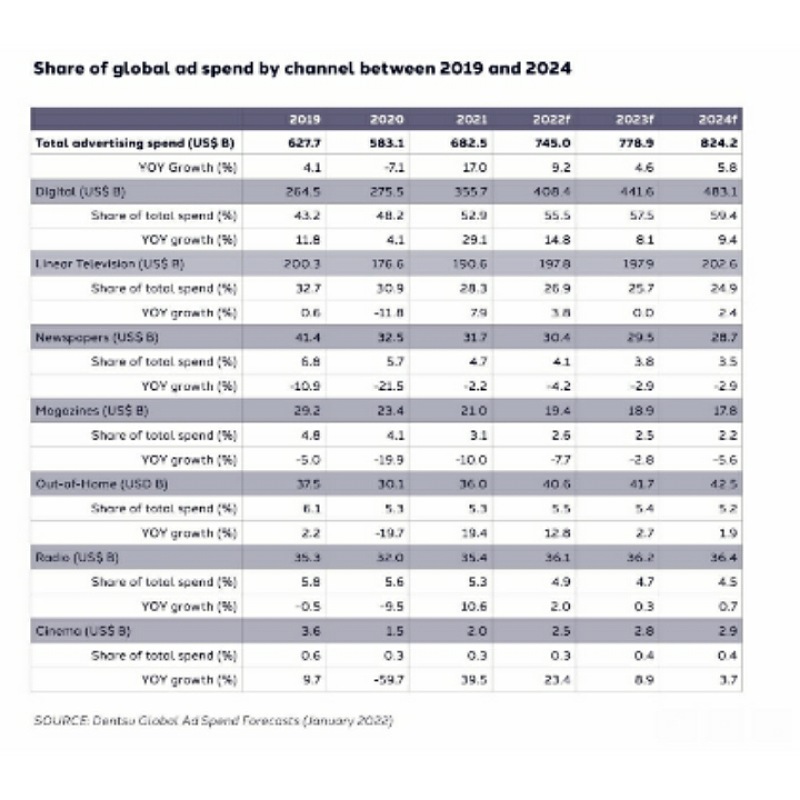
    Mumbai: Advertising expenditure in the Asia Pacific is expected to grow by 5.9 per cent, with India being the fastest-growing market globally at 14.6 per cent, followed by the US, Russia and Canada, according to dentsu’s Global Ad Spend Forecast report. Digital forecast is expected to increase 9.6 per cent to a share of 61.1 per cent of total APAC advertising spend, even as advertising investment overall is forecast to grow by 9.2 per cent globally in 2022, as per the report.

    In APAC, overall ad spend growth is boosted by key sporting events such as the Indian Premier League, FIFA World Cup, Winter Olympics, and country elections in Australia and India.

    Moving towards a second consecutive year of growth following the five per cent market dip in 2020, 2022 is projected to build on a stronger than expected recovery in 2021 which itself saw a record-high 14.4 per cent growth in APAC, totalling $241 billion. The twice-yearly report which combines data from over 50 markets globally, anticipates $745 billion will be spent globally. 

    Digital and television continue to be the two powerhouses driving global and APAC ad spend, yet with opposite dynamics. Following a 24.8 per cent increase in 2021 (vs 29.1 per cent globally), dentsu forecast digital investment to grow by 9.6 per cent (vs 14.8 per cent globally) in 2022, fuelled by Social and Programmatic in APAC. This will result in the digital share of spend increasing to 61.1 per cent ($150 billion) of the total ad spend in APAC, over twice as big as the television share of spend (24.5 per cent) in 2022.

    Linear TV ad spend increased by 5.1 per cent in 2021, the highest rate since 2013. In 2022, dentsu forecast linear TV ad spend to grow by 1.4 per cent to reach $60 billion in APAC. Unlike digital and despite staying in high demand, dentsu is seeing linear TV share of spend on the decline – both globally and in the region – as connected TV and video on demand (VOD) grow.

    Out-of-home (OOH) and cinema will both see encouraging growth in 2022, respectively 12.8 per cent and 23.4 per cent globally (vs 2.8 per cent and 30.0 per cent in APAC). Radio too is forecast to grow, yet at a slower pace of 1.5 per cent in APAC (vs 2.0 per cent globally). As with previous predictions, ad spend in newspapers and magazines will continue to decline globally and in APAC. 

    Globally, the industries that will see growth in ad spend this year will include the beleaguered travel industry which is forecast to see a 10.3 per cent rise. There is also confidence the automotive advertising spend will grow by 7.6 per cent in 2022. Growth follows an 11.5 per cent increase in 2021 and steep declines in 2020 of -15.9 per cent. With pent-up demand and a trend towards personal vehicles in how people want to travel post-pandemic, there is confidence in the recovery of the automotive industry.

    Looking further ahead, APAC ad spend is predicted to grow by 5.6 per cent (vs 4.6 per cent globally) in 2023 and 4.9 per cent (vs 5.8 per cent globally) in 2024 – exceeding growth before the pandemic (4.1 per cent in 2019). Digital is forecast to increase its share of spend domination to 64.6 per cent in APAC (vs 59.4 per cent globally) in 2024. Of course, many factors contributing to the uncertain economic outlook could influence the predictions, from the evolution of the pandemic to supply chain issues, and dentsu recommends the industry keep a close eye on key economic indicators.

    “APAC region is expected to post robust growth in ad spend in 2022. India, Hong Kong and Vietnam will drive double-digit growth with the rest of the region showing strong growth,” said dentsu International CEO Media APAC Prerna Mehrotra. ” The share of digital spends in APAC is set to increase to 61.1 per cent up from 50.1 per cent in 2019 (pre-covid), driven by Greater China and ANZ. TV as a platform will continue to play a key role especially in Southeast Asia and South Asia.”

    “Marketers will need to be nimble, leaning on technology and maximizing opportunities in video, social, connected TV and e-commerce. The use of data to drive business outcomes without compromising privacy or security will continue and we expect data collaboration to be a big focus for 2022. In light of the ongoing global turbulence and recovery, we will continue to work with brands to accelerate efforts to engage consumers and drive attentive reach,” she further added.

    When compared to previous global financial and advertising crises, notably the financial crash of 2008, this rebound is almost three times greater, said the report. In 2022 the growth forecast at 9.2 per cent is nearly three times the 3.4 per cent growth in 2011 – the second-year post-global financial crisis. In 2022 the global ad market exceeded the 2019 pre-pandemic level of spend by 18.7 per cent, whereas in 2011 the global ad market continued to be one per cent lower than in 2008.

    “The bounce back from the early pandemic impact continues to be strong, especially in digital,” remarked dentsu International Global CEO media and global clients Peter Huijboom. “As we spend more time consuming digital media, brands have the opportunity to tap into the increased flexibility in which consumers engage through multiple touchpoints. Businesses who truly understand these developed human behaviours have the best opportunity to build lasting relationships with them.”

    “It also comes as no surprise of the increased popularity in gaming. Dentsu launched its global gaming proposition in 2021. Along with the burgeoning Metaverse, there has never been a more exciting time for brands to experiment, innovate and engage with their customers – as all forms of media are increasingly more central to daily life and routine,” he further said. 

  • AdEx zoomed 37% in 2021 despite Covid second wave: Pitch Madison Report 2022

    AdEx zoomed 37% in 2021 despite Covid second wave: Pitch Madison Report 2022

    Mumbai: The total advertising expenditure (AdEx) in 2021 grew at an unprecedented 37 per cent to Rs 74,231 crore, despite the treacherous second Covid-19 wave, which crippled the economy and AdEx for almost three months of May, June and July for the second year running. This is according to the latest flash figures of AdEx estimates released by Pitch Madison Advertising Report.

    In a departure from the convention, the Pitch Madison Advertising Report 2022 released flash figures of AdEx estimates only for 2021. Contrary to its own forecast of 26 per cent growth in February 2021, which meant AdEx in 2021 would not even reach 2019 levels, AdEx has comfortably surpassed 2019 figures by 10 per cent, the flash report estimates. An exhaustive report giving medium-wise figures, forecast for 2022 and commentary will be released three weeks later, the agency said.

    AdEx has not registered a 37 per cent increase in the last two decades for which figures are available. The closest it has registered was a growth rate of 22.9 per cent in 2007. For context, in 2020 AdEx had de-grown 20 per cent over 2019.

    “The two Covid years of 2020 and 2021 have altered the structure of AdEx, but Indian AdEx has shown that it is resilient and contrary to expectation surpassed 2019 AdEx level,” says Madison World chairman Sam Balsara. “Whilst Covid Wave I had a disastrous impact on AdEx, India Inc has taken the more deadly Covid Wave II in its stride and despite a setback of four months has not only recovered during the year itself but also comfortably surpassed 2019 levels.”

    Detailed medium analysis of AdEx in 2021 with a commentary along with forecast for 2022 will be released on 16 February in Mumbai at the hands of the newly appointed Godrej Consumer Products Ltd CEO Sudhir Sitapati, who will also deliver a talk on the “The New Marketing Playbook,” said the agency in a statement.

  • Tele-wise Marathi: Discussing Media Planning and Buying for the Marathi viewer

    Tele-wise Marathi: Discussing Media Planning and Buying for the Marathi viewer

    Mumbai: With 12 per cent of total TV homes, Maharashtra is the biggest market in India in terms of the market share. Even though the number of marketers and brands as well as the exclusive viewership and advertising have registered the healthiest growth since 2019, the Marathi AdEx doesn’t seem to be adding up, pointed out experts at the recently concluded ‘Tele-wise Marathi: The Power of Television’, a virtual summit organised by Indiantelevision.com to demystify the Marathi television landscape. The event was presented by COLORS Marathi.

    During the session on ‘Media Planning and Buying for the Marathi Viewer,’ Mindshare COO – Amin Lakhani, Zenith CEO – Jai Lala, and Dentsu X India, managing partner (trading) – Vaibhav Jadon, tried to the address the fundamental question as to why despite its massive potential, the Marathi television market is still valued between Rs 1200 and 1400 cr as opposed to the over Rs 2000 cr South markets, and what needs to be done to accelerate growth in this direction.

    The discussion outlining the challenges of communicating to the affluent yet discerning Marathi viewer who is not limited to any one media or language was moderated by Indiantelevsion.com founder, CEO and editor-in-chief, Anil Wanvari.

    Beginning with the contention that the comparison between Marathi and South markets is untenable, Zenith’s Jai Lala said, “Unlike the South markets which were already regionalised probably two decades ago, Maharashtra is still growing, and the biggest challenge with it is that the audience speaks and understands Hindi in addition to the local language. This leads to a huge spill over. From a strictly numbers standpoint, brands can reach Maharashtra with national GECs and other channels. However, Marathi channels start making a lot more sense when the aim is to establish an authentic connect with the Marathi audience.”

    Lakhani and Jadon joined Lala in defining the Marathi viewer as being “spoiled for choice” and “exposed to a lot more distractions than an average TV audience elsewhere.”

    To put things in perspective, with 12 per cent of total TV homes, Maharashtra is the biggest market in India in terms of market share. It also has the highest share among the HSM. The state’s contribution to the overall TV viewership is 13 per cent, of which 5 per cent comes from the 25 local Marathi channels. There has been a 44 per cent swell in ad volumes over 2019 in Marathi channels alone, as compared to the total TV ad volume increase of 14 per cent. Even though the number of marketers and brands as well as the exclusive viewership and advertising have registered the healthiest growth since 2019, the Marathi AdEx doesn’t seem to be adding up.

    Expressing confidence in the positive trends witnessed over the last 18 months, Lakhani said, “While Marathi AdEx, GRPs and other metrics are on the rise, and it will continue to be so, the money spent on Hindi channels within Maharashtra needs to be factored in because eventually it is also on the back of Marathi audiences.”

    Defending the advertisers and planners on whether they are doing enough to catch up with the trends, he stressed upon the fact that the onus of growing a particular market/genre lies more with the broadcasters and content creators.

    “The flow of advertising monies into any genre has always been commensurate with the eyeballs it generates, and not the other way around. Even though the Marathi market will always be faced with the challenge of national brands wanting to deliver at an overall level, with clients going increasingly granular in approach, regional is surely assuming greater relevance but only when backed by numbers. Maharashtra is an important market; not a choice anymore. All we need is great stickiness, great viewership, great time spent and great brand solutions.”

    Lala agreed with Lakhani on the sequence of AdEx following GRPs being inviolable. “Content owners need to invest in getting eyeballs. Maharashtra did not exist as a media market ten years ago. It’s because of the networks investing in it that today we are in this space,” he remarked.

    The five new Marathi channel launches last year notwithstanding, Jadon also believes that there’s huge scope for more channels, and hence more content which specifically communicates with the Marathi audience in their own language.

    Discussing the role of media planning in furthering growth in Maharashtra, Lala shared that while planners have traditionally been taught to use a national first approach, Zenith has recently been experimenting with reverse planning which builds on a regional base instead. Elaborating on the complexities of the methodology, he noted, “Depending on the priority markets and budgets we have initiated this plan for select clients, one of them being Nestle. The approach is better suited if the priority markets are leaning towards Maharashtra and West Bengal, and not as much for a market like Delhi. It is also a little expensive, though the returns need to be evaluated in relation to the objective. If an advertiser wants numbers in terms of reach, frequency, GRPs etc. then this is not the solution he is looking for, but when it comes to building a connect with the audience, this could be the best approach.”

    However, both Lala and Lakahni cautioned that these are simply two different schools of thought, and there’s as yet no data to ascertain or establish which one works better. Jadon too shared his experience of having used the regional first approach successfully for a big FMCG client. “Gone are the days when you would just need Marathi as a top up; it is an integral part of the media plan, but in what way, that is something we as planners, buyers and marketers must decide. Buying GRPs in Maharashtra alone is not economical. Due to the basic consolidation that has happened there are no quality reach drivers or GRPs that we can buy at lower values,” he pointed out.

    On the buying side of the equation, Lala suggested having a different pricing strategy for the top-down and bottoms-up approaches in a manner which incentivises advertisers opting for the latter, as one of the ways of attracting more AdEx. Ruing the complacency that has already set in on the broadcaster front despite Maharashtra being a young and growing market, Lakhani opined, “even if a broadcaster is the market leader, it will have to be mindful of how its property is priced in relation to someone who can deliver the same kind of numbers through a national channel, failing which, it will never be able to catch the buyers’ attention.”

    Jadon emphasised on the need for augmenting supply to encourage healthy competition among players, which will eventually lead to market expansion. Summarising the discussion, he said, “Maharashtra which used to be a single-channel market until a few years back, has now become a two-horse race with both of them charging similar prices because of which the advertiser ends up paying twice or thrice the price for the same GRPs. If I were to optimise my plan, I would instead buy more Hindi GRPs to reach the exact same viewer who is watching me on Marathi as well as Hindi channels. So, while there is enough demand from clients, my belief is that the market needs to expand, there needs to be a lot more channels and a lot more GRPs to be bought. That’s the only way Marathi AdEx can grow.”

  • Covid2019 might push traditional advertising towards negative growth

    Covid2019 might push traditional advertising towards negative growth

    NEW DELHI: The world economy has been brought to its knees by a medical crisis called COVID-19. The pandemic has battered the situation for even the most developed nations, and India, which was already dealing with a bruised economy for the past few quarters has found itself in a bigger soup. The ongoing lockdown has desisted liquidity across industries translating into a tough time for the media and advertising world, which has slowed down the business greatly mid-March onwards.

    DAN India CEO Anand Bhadkamkar tells Indiantelevision.com, “The pandemic has impacted the entire economy and the effects of it are being felt across all businesses. Manufacturing and other core businesses have been affected the most. People have stopped interacting in physical spaces. They are not moving out of their homes. Consequently, the entire economic activity has slowed down considerably. Advertising and communications tend to fuel the growth of commerce massively, thereby, accelerating its growth forward. Now, given that commerce has been badly hit, advertising is suffering equally.”

    DDB Mudra Group CEO and MD Aditya Kanthy shares that advertising reflects and shapes the economy and there has been a slump in the work opportunities because of the situation. “The demand side problems are obvious. Even in categories where there is demand, there are huge supply-side/ supply chain and distribution issues. Liquidity and credit is a challenge. Advertising is dependent on all of these factors. The industry depends on marketers who have the appetite and the means to invest. That is compromised in the current market scenario. It cannot operate in isolation.”

    While there has been a great surge in media consumption, both on digital and television, it is not resulting in ad monies for the platforms, given the market uncertainty. As per BARC-Nielsen data, weekly viewing minutes in week 15 of 2020, starting 11 April, grew by 40 per cent to reach 1,239 billion, as compared to 887 billion during the time period between 11 and 31 January, however, the number of advertisers dropped to 1,021, as compared to 1,378.

    If Madison Media and OOH group CEO Vikram Sakhuja is to be believed, the advertising growth, which was pinned by his firm at around 10 per cent at the beginning of the year,  will take a big hit in this calendar year. “We were expecting around a six per cent growth for traditional and around 28-30 per cent for digital media. However, looking at the current scenario, traditional media might observe a negative growth, while digital will also shrink considerably. We will be lucky if we can see a 1-2 per cent growth this year.”

    He elaborates, “The January-March quarter was already difficult for TV because of the NTO-2.0 and the second quarter is hit by COVID impact. Third-quarter might see a rise if we have a good Diwali season but it will depend largely on the market sentiments then.”

    Bhadkamkar notes, “We were hoping that advertising spends would grow by 10-10.5 per cent in 2020 as per industry estimates. Now, however, this growth is expected to be half of that. And, if the impact continues, the ill-effects would be much larger on the calendar year.”

    “The first quarter has been severely impacted, and recovery might start after h2. Q3 should return with recovery but again, that is only an assumption at the current stage and depends on how COVID 19 situation improves. Certain economists are predicting that the GDP growth (that was estimated at about 4.5 per cent) by May dip up to 1.5-1.9 per cent. If that happens, we will be slipping down by more than half almost. We just have to wait and watch how things pan out. For now, everything seems very tricky. However, from a long term perspective, the outlook for India is definitely positive, once the country starts getting out of COVID 19 downturn.”

    The industry insiders are hoping for some relief and support from the Indian government to pad the losses advertising industry is facing. Recently, AAAI chairman Ashish Bhasin had written to union minister of information & broadcasting Prakash Javadekar detailing a set of recommendations to support the industry.

    Bhadkamkar supports the decision as he says, “The government intervention is necessary for the current situation because the pandemic has affected the advertising industry severely. The letter stresses on how the Government can help in providing the stimulus to the advertising industry and not for any add-on benefits or expecting any specific fiscal measures. At present, the liquidity is getting tighter and there is a lot of slackness in the market. Hence, we need to protect the businesses by providing more liquidity as well.”

    He adds, “Right now, what is needed, is to protect the entire ecosystem because as an industry, advertising generates a lot of employment and more importantly acts as a catalyst for the growth of businesses. In my view, the letter is trying to address this and seek action towards this more so in this immediate period. Once, this lock-down ends and hopefully, we get ahead of the COVID-19 challenge at the earliest, things will come back to normal. But till then, the industry would need that additional support.”

    Kanthy also believes that the government will have to extend support to the whole ecosystem. “The government’s intervention in all parts of the economy is necessary at this time, whether it is on the stimulus or on the tax side. There is a need to put some extra cash in the hands of consumers as well to stimulate some demand. From an industry perspective, it will help us in access to liquidity and credit.”

    Sakhuja adds, “Government support will be really helpful right now so that brands treat advertising as an investment. Also, the government owes a lot of money to media and advertising companies. They need to pay that back as well.”

  • Media maven Uday Shankar to speak at AAAI’s Subhas Ghosal Memorial Lecture 2019

    Media maven Uday Shankar to speak at AAAI’s Subhas Ghosal Memorial Lecture 2019

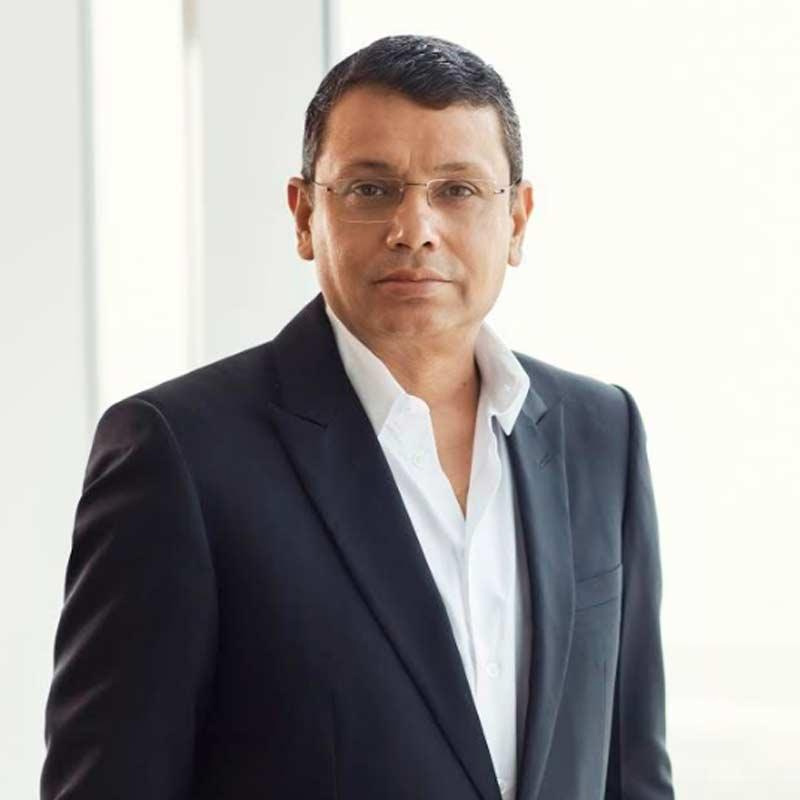
    MUMBAI: The Advertising Agencies Association of India (AAAI) and Subhas Ghosal Foundation (SGF) are pleased to announce the Subhas Ghosal Memorial Lecture which will see The Walt Disney Company Asia Pacific president, and Star and Disney India chairman Uday Shankar on Monday, 11 November 2019 at 7 pm at The Great Room, Four Seasons, Worli, Mumbai.

    Shankar will speak on “Why have I been in media for 30 years” and walk us through his journey in the media and entertainment industry over the past three decades.

    AAAI president Ashish Bhasin says, “We are very happy that Uday Shankar will be delivering the AAAI Subhas Ghosal Memorial Lecture 2019. As a captain of the industry, Uday perhaps has the best visibility to all the facets of the broadcast and OTT industry and we look forward to hearing his views. I must also compliment Sam Balsara on behalf of the AAAI for driving this initiative with great gusto”.

    Says Sam Balsara, on behalf of SGF, “In a rapidly changing advertising world, TV continues to dominate ADEX and grow at a double-digit rate. It will be interesting to hear Uday Shankar’s views on how the TV Industry has carved out a dominant share for itself in the advertising market and plays a very major role in the lives of the majority of Indians, through the absorbing stories, that it puts out every day, 24 X 7.”

    All members of advertising, marketing, media and digital community are welcome. However, entry is only by invitation. Please send an email to Sudesh Kapoor at AAAI on his email id aaai@aaai.in to receive an invitation.

  • Automotive fuel, fitness and sports outlets saw aggressive TV ad volume growth in Q1-19: TAM

    Automotive fuel, fitness and sports outlets saw aggressive TV ad volume growth in Q1-19: TAM

    MUMBAI:  Services and personal healthcare saw a dip in TV ad volumes in the first quarter of 2019 as compared to Q1 2018. While they maintained their positions in the top five super categories, their ad volumes decreased with an indexed figure of 12 per cent and 6 per cent respectively.

    The topmost super category was food & beverages, with 19 per cent share in ad volumes. It climbed up a spot from the previous consecutive quarter with a 7 per cent indexed growth. It was followed by personal care & hygiene (19 per cent), services (11 per cent), household products (7 per cent), and personal healthcare (6 per cent).

    The report also highlighted the top categories under these super categories based on their ad volumes on TV.

    Consumer durables sector

    In consumer durables, wires and cables became one of the topmost advertisers, showing 3.8 times growth in ad volumes as compared to Q1’18. Lighting products also showed an indexed growth of 38 per cent.


    Rank

    Top five Categories – Q1'19

    Top five Categories – Q1'18

    Indexed Growth in Q1'19


    1

    Lighting Products

    Fans

    138


    2

    Fans

    Inverters

    49


    3

    Wires & Cables

    Water Purifiers/Filters

    378 (3.8 times)


    4

    Water Purifiers/Filters

    Lighting Products

    57


    5

    Thermowares

    Air Conditioners

    168


    The top five advertisers in the category were Polycab Wires, Microtek International, Philips Electronics India, V Guard Industries, and Orient Electric. The top five brands were V-Guard Wires, Orient Aeroslim, Livfast Inverters and Batteries, Microtek Jumbo Ups, and Usha Goodbye Dust Fan.

    Auto Sector

    In the auto sector, corporate auto recorded an 11 times growth, automotive fuel showed a staggering growth of 5568 times in Q1’19 from the same quarter in the previous year.

    Rank

    Top five Categories – Q1'19

    Top five Categories – Q1'18

    Indexed Growth in Q1'19

    1

    Cars

    Two Wheelers

    117

    2

    Two Wheelers

    Cars

    40

    3

    Corporate-Auto

    Tyres

    1095 (11 Times)

    4

    Tyres

    Commercial Vehicles

    92

    5

    Automotive Fuel

    Tractors

    556738 (5568 Times)


    The top five advertisers were Maruti Suzuki India, TVS Motor Company, Bajaj Auto, Mahindra & Mahindra, and Kia Motors Corporation while top brands were Mahindra XUV 300, Bajaj Auto, Nissan Kicks, Kia, and Jeep Compass.

    Retail sector

    Retail outlets-fitness/sports noted a whopping growth of 267 times in terms of ad volumes in Q1’19 as compared to Q1’18.

    Rank

    Top five Categories – Q1'19

    Top five Categories – Q1'18

    Indexed Growth in Q1'19

    1

    Retail Outlets-Clothing/Textiles/Fashion

    Retail Outlets-Clothing/Textiles/Fashion

    89

    2

    Retail Outlets-Electronics/Durables

    Retail Outlets-Departmental Stores

    142

    3

    Retail Outlets-Departmental Stores

    Retail Outlets-Electronics/Durables

    60

    4

    Retail Outlets-Fitness/Sports

    Retail Outlets-Home/Interiors/Furniture

    26655 (267 Times)

    5

    Retail Outlets-Home/Interiors/Furniture

    Retail Outlets-Medical/Pharmacy Stores

    120


    The top five advertisers were Reliance Retail, The Chennai Silks Group, Vasanth & Co, Saravana Stores, and Mission Sports & Fitness, and the top five brands were Reliance Digital, Vasanth & Co, Reliance Trends, The Chennai Silks Goddess Collections, and The Chennai Silks.

  • TRAI tariff order’s impact on advertising expenditure on regional channels

    TRAI tariff order’s impact on advertising expenditure on regional channels

    MUMBAI: While TV still remains the primary avenue for major brands to break their bank on advertising expenditure (adex), digital is slowly but surely capturing a bigger slice of that pie. According to the FICCI KPMG 2018 report, adex on Hindi GECs saw a decline of nine per cent in FY18 while regional channels witnessed an increase of 5.4 per cent. The new tariff order is likely to ensure that trend continues in FY19 as well, industry experts feel.

    Carat India SVP Mayank Bhatnagar said that new tariff regime will not impact the adex on an immediate basis but depending on the viewership patterns, advertising deals or strategy would be recalibrated by brand managers. Likewise, Enterr10 Fakt Marathi MD Shirish Pattanshetty was of the opinion that overall advertising spends are likely to grow this year with general elections, IPL and the cricket World Cup. He stated that the regional language market is likely to grow in double digits.

    As per industry reports, ad spends grew 17-18 per cent on FTA channels in 2018 as compared to 10 per cent in 2017, the lowest in five years. TV is expected to be the lead medium as far as reach is concerned for the next three years, with the FMCG category being the highest contributor when it comes to TV ad spends.

    Dishum Broadcasting COO Partha Dey believes that the consumption pattern of genres won’t change but the new regulatory framework could compel some viewers to opt for free or cheaper channels.

    Stratagem Media founder director Sundeep Nagpal, however, contradicted Dey by stating that this trend had nothing to do with the new tariff order. 

    “The new tariff order would, in a way, be less detrimental for regional channels than for national channels,” he explained. 

    HBC founder Harish Bijoor felt that the decline in the adex will be greater for regional channels post the implementation of the new tariff norms.

    Now that over the top (OTT) platforms have already entered the race, the industry predicts that both TV and OTT will work together in the long run. Ad spends on TV and digital stand at 45 per cent and 15 per cent respectively and the latter is expected to take bigger strides in the near future. Total ad pie for TV and OTT will rise from the current 60 per cent to 80 per cent in the next three to four years.

    The CEO of a major production house pointed out that ad spends on digital media have been growing upwards of 30 per cent in the last five years and that trend is set to continue.

    “Having said so, the traditional media including TV will also continue to grow making India the most distinct big market in the world,” he said.

    “I have been hearing the regional content conversation for the last eight years. There is every proof that the regional market is critical, fast-growing and is getting more and more localised.  The power of regional will only go up,” he highlighted. 

    According to him, this is not a new trend as it is opening up dramatically in the OTT space as well. 

    “Each language will gain maturity from the point of view of revenue catchment because along with creating value, you also need a strategy to capture value,” he added.

    With DPOs trying hard to migrate subscribers to the new system, TRAI has given customers time till 31 March 2019 to make their new channel selections. 

    Even the BARC ratings have not been released to the public till there is some stability in viewership. 

    While the industry remains divided on the impact of the tariff order on adex, a clearer picture will emerge once the dust settles.

  • TAM adex data shows Samsung was top telecom advertiser

    TAM adex data shows Samsung was top telecom advertiser

    MUMBAI: Recently released TAM Media Research AdEx data reveals that Samsung India Electronics was the top advertiser in the telecom products category on print, radio, and digital platforms for the period between January 2018 and September 2018. The brand stood third in the TV section, preceded by Xiaomi Technology India and Vivo Mobile India. Jio Phone was the top new brand on TV and radio.

    Cellular phones – smartphones category dominated telecom products with more than 80 per cent share in all media.

    The report also revealed that ad volumes for telecom products rose by 8 per cent on radio while declined significantly by 19 per cent and 53 per cent on television and print, respectively as compared to ad volumes in the same period of 2017.

    Television remained the top choice of telecom products advertisers to place ads on as the medium had 62 per cent of the total insertions followed by radio (36 per cent share). The media received highest ad insertions during Feb '18. Digital had the highest monthly ad insertions in Aug '18.

    The report also revealed that the telecom products providers preferred to place their ads more during feature films (30 per cent insertions), followed by news bulletin (14 per cent) and film songs (10 per cent).

    In terms of content, sales promotions dominated 84 per cent share of ad space with discount promotions leading the roost and claiming 84 per cent share of sector ad space followed by multiple promotion (15 per cent).