Tag: ad

  • Fastrack compelled to withdraw its latest ad

    Fastrack compelled to withdraw its latest ad

    MUMBAI: Long ago, in 1995, when models Milind Soman and Madhu Sapre went bold to show their seductive side while endorsing a shoe brand, they created a furor. While the advertising fraternity claimed it to be a coming of age ad, almost all the “socially responsible” groups came together to raise their voice against the ad that put everyone associated with it in a sticky situation.


    Even after almost two decades the situation doesn’t seem to have changed much. This time the youth brand, Fastrack, which has become popular for its daring stance on youth issues, is at the receiving end. A latest Out-of-Home (OOH) campaign by the fashion and lifestyle brand from the house of Tata’s shows youngsters draped in tape that has “sale” written on it.


    The campaign conceptualised by Lowe Lintas was launched in the middle of this month and will be on till mid-February. Ironically, the brand, which till now has been appreciated for its unprecedented take on the social causes, had to take a step back in this case.


    Sources from the industry reveal that the campaign has been at the receiving end from certain sections of the society since the time it was launched, some even claiming the ad to be objectifying women. Thus, the brand was compelled to take off the ad.


    Lowe Lintas’ NCD Arun Iyer confirmed the news with indiantelevison.com and said that it was a mutual decision taken by both the teams (brand and creative) to take off the advertisement. However, a new campaign will replace it within 24 hours, he informs.


    The brand has over eight million likes on Facebook.

  • ZenithOptimedia predicts global ad spend to grow by 5.3 per cent in 2014

    ZenithOptimedia predicts global ad spend to grow by 5.3 per cent in 2014

    MUMBAI: Global advertising expenditure is expected to grow by 5.3 per cent to $ 532bn, according to a report from media agency ZenithOptimedia.

    The agency has increased its forecast for 2014 by 0.2 percentage points since September, after recent signs of stronger growth from markets like the US, the UK, Germany, Hungary, Poland, Australia and Mexico, together with evidence that Spain’s steep downturn is finally bottoming out.

    Interestingly, this is the second time that the agency upgraded its expectations for 2014 this year, the first was in June (from 5.0 per cent to 5.1 per cent). In fact, for the year 2015, it expects the global ad market to accelerate to 5.8 per cent, followed by another year of 5.8 per cent growth in 2016.

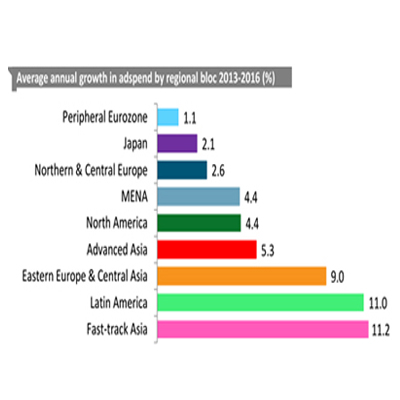
    As part of its global analysis, the agency has also included Ireland in the so-called Peripheral Eurozone category. It assumes that the growth for these countries will be somewhat more muted.

    The agency says that in Europe, it has separated the ‘PIIGS’ markets (Portugal, Ireland, Italy, Greece and Spain), which have faced the full brunt of the Eurozone crisis, into the Peripheral Eurozone. “Their ad  markets have fallen even more sharply than their economies, as local advertisers cut back to reduce losses and preserve cash, and multinationals withdraw budgets to redeploy in more economically healthy regions. We estimate that ad expenditure in Peripheral Eurozone fell by 11.1% in 2013. 2014 looks a lot better, with ad expenditure forecast to shrink by just 0.9%, followed by a slow recovery of 1.8% growth in 2015 and 2.5% growth in 2016. This assumes that the Eurozone avoids disaster over our forecast period, and in particular assumes that no country crashes out of the euro, or falls into disorderly default on its debts,” says the report.

    The report also reveals that the rest of Western Europe, as well as Central European countries like the Czech Republic, Hungary and Poland, which are currently performing more like countries such as France, Germany or the UK than the much-faster growing markets of Eastern Europe, such as Russia and Ukraine. “This is partly because many of these Central European markets are in the Eurozone, and because they have strong trading links with Zenith Optimedia Group Limited,” it says.

    As far as the Asian market is concerned, the agency has divided it in to four parts – Japan, Eastern Europe and Central Asia, Advanced Asia and Fast-track Asia.

    The report says that the Eastern European advertising markets, such as Russia and Ukraine, recovered quickly after the 2009 downturn and have since continued their healthy pace of growth, largely (though not entirely) unaffected by the problems in the Eurozone. “Their near neighbours in Central Asia, such as Azerbaijan and Kazakhstan, have behaved very similarly, so we have gathered them together under the Eastern Europe & Central Asia bloc. We expect this bloc to have grown 11.7% by the end of 2013, followed by 8%-10% growth for the rest of our forecast period,” it says.

    The agency has kept Japan separate as the market behaves differently from the other markets in Asia. Even after the recent economic stimulus, Japan remains stuck in its rut of persistent low growth and grew 2.1 per cent in 2013. The agency estimates the growth rate of the country to remain at 2 per cent per year through to 2016.

    Apart from Japan, there are five countries in Asia with developed economies and advanced ad markets and thus they are categorised as “Advanced Asia”. It includes Australia, New Zealand, Hong Kong, Singapore and South Korea. The report reveals that growth here has been a disappointing 1.3 per cent in 2013, after a period of heightened tension between North Korea and its neighbours caused advertisers in South Korea to cancel or postpone several campaigns. “We forecast a much healthier 4.5 per cent growth in 2014, followed by 6.6 per cent growth in 2015 and 4.8 per cent growth in 2016,” says the agency in the report.

    Fast-track Asia includes countries like China, India, Indonesia, Malaysia, Pakistan, Philippines, Taiwan, Thailand and Vietnam as these economies are growing extremely rapidly as they adopt Western technology and practices. This group barely noticed the 2009 downturn (ad expenditure grew by 7.2 per cent that year) and since then has grown comfortably at double-digit rates. We estimate that ad expenditure in Fast-track Asia has grown 10.7 per cent in 2013, followed by 10 per cent to 12 per cent annual growth in 2014 to 2016.

  • Contract Bengaluru gets a new ECD in Manoj Jacob

    Contract Bengaluru gets a new ECD in Manoj Jacob

    MUMBAI: Contract Advertising has got a new executive creative director (ECD) for its Bengaluru office. It has hired Manoj Jacob, who has worked with the company earlier as well and joins back after a gap of six years. Jacob will be reporting to Contract Advertising NCD Ashish Chakravarty and would also work in partnership with Monojit Ray who recently joined Contract as the Bengaluru head.

    Prior to joining Contract, Manoj ran his own creative consultancy firm, where he worked with clients such as Nova Specialty Surgery, Apollo Hospitals, Simply South Restaurant and Abs Fitness among others.

    “I am very happy to have Manoj on board as the ECD of our Bangalore office. He is extremely passionate about his craft, very driven, and a hands-on kind of leader. Having worked with him in the past, I won’t be surprised if he dives straight into the deep end from day 1 itself.  It is a challenging role, but I am positive he will shine,” said Chakravarty.

    Manoj comes with an experience of 17 years and has worked with O&M, McCann Erickson, Satchi & Satchi, Euro RSCG, orchard, Publicis Ambience and Bates over the course of his career. He has also handled some of leading brands across verticals such as IBM, Air Deccan, Cavin Kare, Mitsubishi Motors, Wipro Consumer Care and Weekender.

    On his coming back to Contract, Manoj said, “It’s an awesome new team, across disciplines, that is getting together at Contract Advertising and I’m very happy to be a part of it.”

    Manoj’s work has won him a lot acclaim and rewards both nationally and internationally from Cannes to New York festival to winning at AD Spot Non Profit Awards, Italy and the Bangalore Ad Club awards.

  • Ad spends up in 2012-13, but slows in first quarter of 2013

    Ad spends up in 2012-13, but slows in first quarter of 2013

    NEW DELHI: Even as Indian advertisers are facing a crisis with the government limiting ad space on television, advertising spend continues to rebound globally.

    However, the main increases slowed in the first quarter of 2013, according to Nielsen‘s quarterly Global AdView Pulse report, global advertising grew just 1.9 per cent to $76.6 billion from the first quarter of 2012.

    Trends fluctuated across the regions, as spending dropped in Europe, marginally increased in the Middle East, Africa, Latin America and the Asian-Pacific, and while spending was flat for the quarter in North America.

    Middle East and Africa region continued its recovery from the advertising decline of early 2012, as advertising spends grew 2.9 per cent during Q1. Despite the upward progression, the region remains affected by the civil unrest in Egypt, one of the region‘s largest markets, where ad spends declined by 20 per cent.

    Latin America was the star performer for the first quarter with ad spends growth of 11.9 per cent. Impressively, spending grew in all countries in the region during the period. This emerging region does, however, face its own challenges, as some countries, like Argentina, are experiencing rising unemployment and high inflation.

    In Europe, advertising spend is still declining under the weight of the region‘s economic problems. It seems unlikely that the region will recover from these challenges in the short term

  • Windows 8 ad campaign leverages music to connect with Asian culture

    MUMBAI: The pan-Asian advertising campaign for Windows 8 projects the new operating system as a tool of self-expression, by leveraging music and visuals that connect with the culture of Asia‘s markets.

    The Asian ads are a part of software major Microsoft‘s global campaign and was a combined effort of JWT Beijing and JWT Brazil, along with Crispin, Porter and Bogusky in the US, and Wunderman.

    Music is at the heart of the campaign, which highlights a variety of indie and up-and-coming bands across the Asia, such as Scandal from Japan, Sona Mohapatra from India, and Lenka from New Zealand.

    Windows global marketing director Alexandre Leite said, “Windows is an open and inclusive brand-empowering people and we wanted the music, language and cultural references to represent that spirit.”

    JWT Beijing chief creative officer Polly Chu said, “In Asia, we always want to express ourselves in a different way. We long for liberty but we are quite different from the western way of expression. Therefore, we will find a symbol to define liberty. In one of our executions we feature Parkour – urban running – as one of these symbols to represent freedom as well as individualism.”

    The campaign will include television commercials along with print ads, out of home billboards, viral videos, an online app, as well as online advertising.

  • ‘Media and entertainment sector has lost a whopping Rs 640 billion of market value since last year’ : Sadanand Shetty – Kotak Securities vice president

    ‘Media and entertainment sector has lost a whopping Rs 640 billion of market value since last year’ : Sadanand Shetty – Kotak Securities vice president

    Media and entertainment companies have been riding the market boom to expand and fund their diversified ventures. But the tide has turned against them and they are faced with a scarce capital situation.

    Being in the equitties market for over 14 years, Kotak Securities vice president Sadanand Shetty knows best how rough the path is going to be for media companies to tide over the slowdown phase. Managing money on behalf of investors, he is one of the few fund managers to have caught early the trends across verticals within the media and entertainment sector.

    In an interview with Sibabrata Das, Shetty talks candidly about the massive erosion of values media companies have seen over the last one year and how grim the real world is for most of them.

    Excerpts:

    Aren’t these companies seeing a massive skid in valuations?
    The media and entertainment sector has lost a whopping Rs 640 billion of market value since last year due to the global economic meltdown. There is a massive collateral damage to the wealth of media owners. Valuation corrections for most of these companies are far greater than the broad market.

    Most media companies fall under mid cap and small cap categories. These categories have lost much more in stock value than the large cap companies. September ’08 has been the worst quarter in recent times for most media companies that are part of the broad-based BSE 500 Indices. The profits of aggregate listed companies are down by 60 per cent for the said quarter, including losses of new Hindi GECs (general entertainment channels). Slowdown in revenue and rising costs have hit earnings.

    The market has not even spared large companies like Zee Entertainment Enterprises Ltd and Sun TV Network Ltd; they together have lost market value of close to around Rs 160 billion (as of 10 January 2009 over the year ago period). The broadcasting space has alone lost market value of nearly Rs 280 billion. Economic slowdown in general has impacted the advertising revenues of the sector. Subscription revenues, to some extend, provide the much needed cushion to falling profitability of the broadcasting companies.

    Why were media valuations so unrealistic?
    Being emerging businesses, the Indian media and entertainment companies commanded higher valuations. Most media companies have demonstrated robust sales, expanding margins and rapid growth in profits in recent times. The stock market rewards high growth with high valuations. A favourable equity market has also helped companies to raise large funds and command these valuations.

    Weren’t companies stretching themselves too thin in a market hype situation?
    Still, I wouldn’t call these moves as mistakes. Expansions were planned in a growth environment, which now, though, is hitting the speed breakers. But certainly in some cases large capacities have been created ahead of demand curve and investors are suffering in those ventures.

    The industry also witnessed entry of new players with other objectives. For some it was pure market capitalisation as easy money poured into the sector. Investors – foreign and local – have jumped the gun and funded some of the unviable projects. Shortsighted foray into ‘new media’ business verticals that some companies have ventured into will be hard hit.

    What are the lessons to be learnt from this?
    This is the first true slowdown that the industry is witnessing today. It would be interesting to see how managements of the media companies respond to the situation. In general, business plans built on easy liquidity do not sustain for long. Vision, commitment and excellent execution do. Media, like any other services business, is people driven. Backing the right talent with appropriate incentives will yield large gains.

    ‘Economic slowdown will force companies to focus on few verticals. They will have to maintain their market share without burning too much cash

    Have media companies become dependent on foreign capital?
    Global media companies except perhaps News Corp. were late to react to opportunities in India. But today almost all the top studios of the world have their presence in India across different media verticals. Favourable economic growth and rapid rise of domestic companies have compelled the global media giants to look at India. For some of these companies, Indian operations have started contributing majorly to their profits in the Asian region.

    We are also witnessing rapid rise in FDI (foreign direct investments) and portfolio investments in media companies. You, after all, can’t ignore the second fastest growing economy of the world. India is also in a sweet spot today because of its huge youth population.

    What are the challenges the Indian media companies face due to slowdown?
    Slowing ad spend, increase in operating costs (specially distribution), and tight liquidity will impact the industry in the medium term. The sector will also have to grapple with excess inventories that have been created in the last few years. Most importantly, economic slowdown will force companies to rethink on their expansion plans and focus on few verticals. Companies will have to maintain their market share without burning too much cash in the process.
    The process of consolidation will also accelerate. I expect incumbents with sound financials to take advantage of the current dismal valuations to further their business interests. Venture capital and private equity participation can’t also be ruled out. We have already seen certain GECs feel the heat. Consolidation in regional markets is also happening and expansion plans have been put on hold in some cases.

    Overall, the economic slowdown will impact the growth plans of most of the companies. Priorities have shifted to consolidating the existing businesses; expansion can wait.

    It is testing time for media companies. There will be no better time to demonstrate the strength of their respective market/channel shares as we expect ad spend to consolidate towards the top.

    TV content companies have suffered for long due to their fractured business model. Lack of revenue visibility and pricing power have impacted them. There is also lack of long term relationship between content and broadcasting companies

    Will news channels have a free fall as they operate in a highly cluttered environment?
    News channels in India have grown significantly over the last few years. But for most companies, it has not significantly added to their profitability due to high operating costs (including distribution). Lack of robust subscription revenues have also impacted the bottom lines of many of these companies. Noise value has gone up due to entry of players with other objectives. We have witnessed the entry of so many non-serious players in the market that I think most of them will fold up in the next two years.

    Only few news channels with strong brand equity and distribution network would be able to make reasonable profits. Companies with strong balance sheets will survive. Rest all will fade away.

    What do you think of the television content companies?
    TV content companies have suffered for long due to their fractured business model. Lack of revenue visibility and pricing power have impacted them. There is also lack of long term relationship between content and broadcasting (who own the IPR) companies. The benefit of new distribution platforms has not reached most of these companies.

    Unless there is substantial change in the current business model, I do not see real scalability coming to companies. TV content companies also suffer from fragmentation. Having said that, this year has been particularly good for content companies as some of the dominant incumbent players have witnessed loss of market. New players have emerged and done well. I expect few credible players to emerge in the future.

    Do you find the cable industry attractive?
    Institutional investors have shown interest in the sector in recent times. Investments have flown into the large incumbents and fledging entrepreneurial-led companies. Investors are betting on eventual consolidation and digitalization of last mile to unlock huge value in the sector. Investors seem to be willing to wait for the interim painful process to unlock long term value. We expect increased investments will go into infrastructure creation and customer acquisition.