Tag: ad spend

  • dentsu’s global ad spend report predicts 6.8 per cent growth for 2024

    dentsu’s global ad spend report predicts 6.8 per cent growth for 2024

    MUMBAI: Advertisers, marketers and media establishments around the globe can bring out the bubbly. dentsu’s latest Global Ad Spend Forecasts has revealed a projected buoyant 6.8 per cent growth in global advertising spend for 2024, reaching $772.4 billion. This growth projection has been revised upwards following the return to double-digit growth (+10.7 per cent) of digital ad spend, the impact of sporting, political events and improved outlooks across the US, UK, Brazil & France. 
     
    Ad spend growth is forecast to continue at 5.9 per cent in 2025. The American region is expected to lead in 2025 with 6.3 per cent growth, driven by rich US and Brazilian markets where digital and streaming see sustained investments. The Asia-Pacific market is forecast to increase by 5.8 per cent, with AI-driven ad placements contributing to the increase in digital ad spend in markets like India. Lastly EMEA (Europe, the Middle East and Africa) has projected growth of five per cent, with strong digital performance in key markets including the UK. As the industry enters what dentsu identifies as the algorithmic era, data-enabled advertising will increasingly shape media strategies, with algorithmically enabled ad spend forecast to reach 79 per cent of total ad spend by 2027. 

    Artificial intelligence (AI) is no longer confined to experimental phases. It has become an integral tool for creating personalised, one-to-one consumer experiences. Generative AI applications like OpenAI’s GPT models are embedding themselves in everyday services, from Duolingo’s AI-driven tutor to Spotify’s personalised AI DJ. These advancements mark a new era of micro-moments that enhance user engagement by delivering tailored interactions at scale.

    As algorithms increasingly gatekeep content visibility, brands are tapping into niche communities and fandoms to drive meaningful connections. Influencers, from content creators like Mr Beast to hyper-localised niche experts, are key to cutting through the digital noise. Additionally, connected television’s growing reach provides fertile ground for cross-platform storytelling, combining scale with intimacy. Paid social is forecast to grow by 8.7 per cent in 2025 (7.8 per cent three-year CAGR to 2027), supported by an integrated ecosystem that blends shopping, video, search, and gaming capabilities. This channel remains critical for engaging younger audiences, with 79.7 per cent of gen Z using Instagram monthly and 42 per cent of CMOs planning to boost influencer marketing investments. Paid search is expected to increase by 6.7 per cent (6.5 per cent three-year CAGR 2027), driven by continuous advancements in AI-powered features that sustain relevance amid the rise of social and retail search.

    Retailers are stepping beyond traditional advertising, transforming their platforms into data-rich media ecosystems. Amazon leads this charge with a $50 billion ad revenue engine, while others like Walmart and TikTok are innovating through acquisitions and self-serve advertising solutions. This convergence is reshaping how brands measure success and optimize campaigns, fostering a holistic view of the consumer journey. From a media channel standpoint, the report highlighted that digital is expected to remain the fastest-growing channel, with a projected increase of 9.2 per cent in 2025 (8.8 per cent three-year CAGR to 2027) to reach $513.0 billion and capture 62.7 per cent of global ad spend. Significant growth is anticipated across key digital segments, with retail media leading the way at +21.9 per cent year-over-year (19.7 per cent three-year CAGR to 2027) as advertisers capitalise on the high value of retailer consumer data and increasingly invest in offsite advertising, including connected TV. 

    In a world flooded with content, quality emerges as a non-negotiable factor. Advertisers are increasingly prioritising transparent, sustainable programmatic supply chains and investing in impactful creatives to capture attention in crowded digital environments. 

    Attention metrics, such as “attentive seconds,” are now as critical as traditional ROI measurements, signaling a shift towards more meaningful audience engagement. Online video advertising is projected to rise by 8.0 per cent as advertisers continue to seek out high attention and trusted environments. Programmatic advertising is set to grow by 11.1 per cent and will account for more than 70 per cent of digital ad spend, with sustained momentum (10.9 per cent three-year CAGR to 2027). 

    Television ad spend growth is forecast to show marginal growth of 0.6 per cent in 2025, with connected television rapidly increasing (+18.4 per cent) thanks to ad-supported streaming, and broadcast television declining (-2.5 per cent). Meanwhile, print media continues to contract, while cinema and out-of-home (OOH) advertising continue to grow by 3.2 per cent and 3.9 per cent, respectively. 
     
    Significant ad spend increases are anticipated in finance (+6.4 per cent), pharmaceutical (+5.8 per cent), and travel and transport (+5.5 per cent) as these sectors adapt to meet evolving consumer needs. 

    Says dentsu’s global practice president- media Will Swayne: “Our 2025 forecast underscores the pivotal role of media in today’s economy. Data-driven and digital-first media investment strategies continue to reshape how brands connect with consumers. The surge in algorithmic media capabilities will drive fresh opportunities for brands to engage meaningfully and effectively with existing and new customers.Media investment strategy is key to transformation and growth as brands keep pace with evolving consumer behaviors.

    “As digital channels continue to lead the way, the global advertising landscape is entering a new phase of growth and innovation. The projected 9.2 per cent increase in digital ad spend for 2025, driven by segments like retail media and connected TV, underscores the immense value of data-driven strategies. As algorithmic media capabilities take center stage, brands have an unprecedented opportunity to connect with consumers in more personalised and meaningful ways. The future of advertising is not just digital – it’s deeply connected, data-empowered, and poised for transformative growth,” added dentsu chief executive officer – media South Asia Anita Kotwani.

    Despite technology’s global proliferation, access remains uneven. From regulatory hurdles to the high costs of advanced AI features, digital divides are becoming more pronounced. Brands must adopt nuanced, locally informed strategies to ensure inclusivity while navigating fragmented markets.

    The algorithmic era promises opportunities for innovation in media and marketing. However, success will hinge on a brand’s ability to adapt to evolving consumer behaviors, leverage cutting-edge AI tools, and balance global aspirations with local sensitivities.

    This year of impact calls for brands to be bold, innovative, and deeply attuned to the digital zeitgeist. The possibilities are infinite, but the imperative is clear: in 2025, making an impact is not optional—it’s the only way forward.

    (Picture generated using Dall-E 3 generative AI tool)

  • Warc revises ad revenue growth estimates upwards for 2024

    Warc revises ad revenue growth estimates upwards for 2024

    MUMBAI: Bullish is the mood at marketing effectiveness specialist Warc. The  firm had forecast in August 2024 that global advertising spend is on course to grow 10.5 per cent this year to a total of $1.07 trillion. Now, it has revised that growth upwards by 0.2 percentage points; its latest projection is that ad spends globally will grow by 10.7 per cent to touch  $1.08 trillion – the strongest growth rate in six years and the largest absolute rise on record if the post-Covid recovery of 2021 (+27.9 per cent year-on-year) is disregarded. 

    Warc’s latest global projections are based on data aggregated from 100 markets worldwide. Online media is on course to drive the growth,  a good year for TV has also made a notable contribution. The good news is that spends on linear TV are rising and are expected to end the year higher by 1.9 per cent, at $153.6 billion, following two years of slippage. Political TV adverts (especially in the US), the Paris Olympics and Euro football in Q3 have buoyed the spends on TV. However, before you start apart applauding please note that  linear TV’s hold today stands at just 14.3 per cent of global advertising spend, much, much lower than the heady days of a 41.3 per cent share in 2013. 

    We have all heard it before: Alphabet, Amazon and Meta are Pacmen increasingly swallowing up ad dollars in large chunks of billions every year. Warc data supports that. It stated that pure play online internet businesses like that of the three big tech firms, will see ad revenue growths of 14.1 per cent reaching $741.4 billion – accounting for a total of 68.8 per cent of all spends. Gadzillions!

    Social media ad spends are expected to leap upwards by 19.3 per cent reaching $252.7 billion -equalling 23.5 per cent of the total ad market. This is mostly because the sales folks at Facebook, Instagram and TikTok have been selling hard leading to better than expected results at the three firms during the first nine months of this year. 

    Overall ad spend growth is also expected to be buoyant next year at 7.6 per cent in 2025, and seven per cent in 2026 taking the global ad market to $1.24 trillion. For all those who have been doomsayers predicting the slamming of brakes on advertising here’s some facts: global ad investments have more than doubled over  the past 10 years and have grown 2.8 times faster than global economic output since 2014.

    Warc director of data, intelligence and forecasting and author of the research James McDonald said: “Our latest forecast anticipates $104bn in incremental advertising spend worldwide this year, the largest rise in history if the post-pandemic recovery year of 2021 were discounted. Whether this boom will sustain remains unclear, however, as 2025 presents a sliding doors moment due to heightened regulatory pressures on Google and TikTok – together a quarter of the ad market outside of China. This, alongside an increasingly challenging geopolitical climate, may spell uncertain times ahead for the businesses that rely on advertising trade.”

    (The image for this report was created using OpenArt AI. No copyright infringement is intended)
     

  • Ad spend to remain bullish this festive season

    Ad spend to remain bullish this festive season

    Mumbai: After two Covid-impacted years, the mood among consumers and advertisers for the festive season is a lot better. Media agencies expect a decent uptick in ad spends.

    The overall sentiment is positive. iProspect India executive vice president Kaushik Chakraborty explains, “Unlike the last two years, this festive season will be far more exciting. We can expect brands to encash on the positive sentiment. While media spends will be primarily driven by TV and digital, print and OOH spends will also grow,” he tells Indiantelevision.com.

    He explains further that there has been a robust growth in ad spends during festive seasons in the last three years. “In 2021, the growth was more than 20 per cent as compared to the previous year. Although the inflationary pressure will impact overall consumer sentiments, we can expect a 10 per cent plus growth in media spend this festive season.”

    The key categories that will witness a strong push in demand are e-commerce, automobiles, e-wallets, BFSI, and retail.

    “Normally, festivities contribute around 40 per cent of AdEx. A similar trend will continue this year. The bulk of the spending will happen till Diwali, and post that, advertisers will rationalise spending,” he says.

    When asked about the impact of startups being under pressure to conserve cash, he points out that startups contribute less than 13 per cent of overall AdEx. “Traditional advertising players will contribute during the festive seasons, while seasonal advertisers will continue their spending.”

    IPG Mediabrands chief investment officer Hema Malik says that ad spend growth will be 10-15 per cent. Print, radio, cinema and out-to-home (OOH) are bouncing back. She expects the print media’s festive season ad spend growth to be over 50 per cent. “This will be the first festive season in three years without restrictions. The festive season will be celebrated in full-swing on-ground. Earlier, there were issues with masks, fewer places to visit and timings. The market should see a good pick-up currently.”

    However, Malik highlights that television ad spends during the festive season will be flat due to the Indian Premier League (IPL) that happened last year. The annual advertising budget was diverted to IPL promotions. Also, the upcoming Twenty20 World Cup in Australia will take place after Diwali, which is an appropriate time and cooling-off period for advertisers. Hopefully, things will pick up in the advertising market and advertisers will likely increase their spending.

    “Companies discontinue campaigns after Diwali and take a break. There will also be a struggle due to the disappointing IPL viewership recently and also the mediocre performance of India in the Asia Cup. It will be difficult to watch the Twenty20 World Cup on television. The challenge for television is that viewership has been steadily declining. The numbers are unexplainable. It is becoming a deterrent to price revisions. This has been a perennial issue for a couple of months now,” Malik tells Indiantelevision.com.

    Elucidating further on the startup situation, she says, “Startups are facing a slowdown that is another challenge for television and digital media. Big sports properties will come under pressure. Other categories will fill up the gap, and selling inventory will not be an issue. The issue is whether those companies would be willing to spend as much as startups who have a target reach.”

    Filling up inventory is never an issue for television, Malik explains further. It is yield maximisation that will be the challenge. The startup issue will also have an impact digitally. “The dampener is the startups and new-age companies that are under a slowdown this year. That is impacting the advertising mood and AdEx growth, she adds.

    She adds that a few categories are firing, but not all. She expects categories like confectionery, paint, and jewellery to do well. “They will come back in full force. Retail is expanding into more areas. E-commerce will also be there,” she concludes.

  • GUEST COLUMN: Five ways digital attribution can improve CTV & OTT advertising return on ad-spend

    GUEST COLUMN: Five ways digital attribution can improve CTV & OTT advertising return on ad-spend

    Mumbai: CTV/OTT viewership has exploded in India since the start of the pandemic, opening a new market of opportunities for advertisers. Combining the best of digital and traditional linear TV advertising, CTV/OTT advertising has become marketers’ favourites because of its ability to reach the right audience at the right time. These platforms provide advertisers with easy access to a vast pool of active buyers with high purchasing power.

    It is estimated that more than 500 million Indians are already consuming OTT content. The number of CTV (connected TV) users is expected to reach 80 million households or nearly 320 million users by 2025. As linear TVs continue to lose viewers’ attention, advertisers are scrambling to make the most of the rising CTV/OTT viewership. This has also led to an increase in the amount of money spent on advertising on CTV/OTT, especially by B2B marketers.

    In the OTT and CTV spaces, marketers have the advantage of clear targets, ideal buyer profiles, and clear-cut targeting strategies. While some other factors may affect the overall impact of CTV and OTT campaigns, these platforms also help in improving the return on ad spend (ROAS) through the right digital attribution.

    Here are five ways in which digital attribution can help improve the ROAS:

    Identifies customer touchpoints better

    Marketers have to engage with customers at multiple touchpoints for successful conversions. In video campaigns, it is not easy to identify the exact touchpoint at which the viewer decides to convert.

    Advertisers must have a comprehensive understanding of the customers’ journey for better ROAS. This issue can be mitigated by adopting multi-touch digital attribution for CTV/OTT, as it will enable the advertiser to locate the touchpoint that triggered the conversion. Such knowledge will empower them to reduce ad spend wastage.

    Filters out non-performing tactics

    Through conventional attribution, specific campaigns walk away with sales and conversion credit without giving an insight into what parameters actually worked. This technique fails to take into account that some of the sales may be due to repeat customers or old customers who may have restarted their services. For CTV/OTT, conventional attribution will fail to give the real picture as advertisers use multiple tactics to drive conversions. Digital attribution can help identify the exact ways that resulted in sales on CTV/OTT. It will enable advertisers to focus more on winning tactics and avoid unnecessary ad spending on non-performing strategies.

    Real-time optimisation

    CTV/OTT metrics provide real-time data on customer responses to ad campaigns, allowing marketers to make in-the-moment adjustments. If something is not working, advertisers can withdraw the campaign and launch its alternative or improved version in real time. Digital attribution plays an important role here by enabling advertisers to identify the highest-performing tactics and make adjustments in real time. For example, during live streaming of a new movie on CTV/OTT, if a 30-second video ad is outperforming a 60-second creative, the advertiser can use this data to allocate more budget towards the better-performing 30-second campaign rather than giving in to the length of a video campaign.

    Targets the right audience

    The CTV and OTT streaming markets have exploded since the pandemic. As a large part of the population was confined indoors due to lockdowns, the demand for new entertainment platforms and content also increased. The availability of cheaper data across the country further amplified viewership on OTT and CTV. The surge in OTT/CTV content demand gave advertisers access to a massive new audience.

    However, it has also become important to segment audience attributes for better targeting. With the right attribution, advertisers can easily segment customer databases to identify at which stage of the purchase the customer is actually converted.

    Identifies “buy signals” more accurately

    One of the most common differentiators between a successful and unsuccessful marketer is their ability to identify the “buy signal” from a prospective customer. The “buy signal” on CTV/OTT is an action or behaviour indicating a viewer is ready to become a customer. The actual sale often takes place much after the campaign is over. The right attribution can help in identifying the buy signal correctly. It will further enable marketers to match their strategy with sales insights to optimise the campaign for better results.

    To sum up

    Converting sales from a digital campaign requires slick digital attribution. This beats conventional ad-based tracking. It not only provides precise data points where the customer is most likely to convert, but it also provides insights into consumer purchasing behaviours. A modern world needs more contemporary digital attribution techniques, and we are already ready with one.

    The author is VDO.AI founder and CEO Amitt Sharma.

  • Global ad expenditure to grow 8% in 2022: Zenith’s Report

    Global ad expenditure to grow 8% in 2022: Zenith’s Report

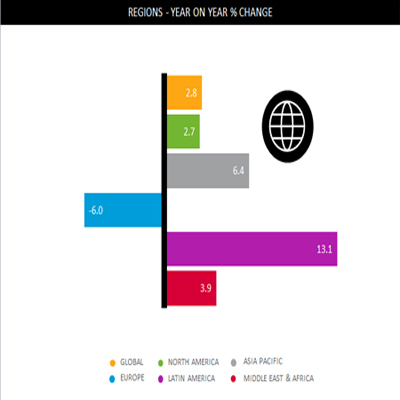
    Mumbai: Global advertising expenditure is expected to grow 8 per cent in 2022, according to Zenith’s latest Advertising Expenditure Forecasts report, which was released on Wednesday. This represents a minor downgrade from a little over 9 per cent growth rate provided by Zenith in December 2021. 

    The Winter Olympics, the mid-term US elections, and the soccer World Cup, which will be held for the first time in the most advertising-intensive period of the year, the run-up to Christmas, will all help to boost growth. Faced with this difficult comparison, the growth will slow down to 5.4 per cent in 2023, before the Summer Olympics and US presidential elections help boost it to 7.6 per cent in 2024.

    Zenith’s forecasts for North America, MENA and Western Europe this year are unchanged at 12 per cent, 7 per cent and 6 per cent growth respectively. Latin America was downgraded slightly from 9 per cent to 8 per cent, but the Asia Pacific was upgraded from 6 per cent to 7 per cent, thanks to a very strong performance from India. 

    Severe disruption in Russia and its closest trading partners after the invasion of Ukraine will lead to a 26 per cent decline in ad spend in Central & Eastern Europe, even though most other markets in the region will continue to grow.

    Ad spend has remained on track despite the macroeconomic headwinds that emerged this year. High inflation, concentrated in essentials like heating, petrol, and food, is forcing consumers to reprioritise their spending, particularly the less well-off, and has led to a drop in consumer confidence. 

    But for now, consumer spending continues to grow, as consumers demonstrate their strong appetite for the travel and entertainment experiences that were denied to them over the pandemic. Business confidence is generally high, corporate investment is rising, and there is little evidence of widespread cost-cutting.

    India to lead growth with 21 per cent expansion this year

    Global ad spend is expected to increase by $58 billion in 2022, rising to $781 billion from $723 billion in 2021. Most of the new ad dollars will come from the US, which is forecast to expand by $33 billion in 2022, driven by continued, rapid digital transformation, accounting for 57 per cent of all the money added to the ad market this year. 

    China, Japan, and the UK come next, supplying 9.1 per cent, 6.2 per cent, and 5.8 per cent of new ad dollars, respectively. India is in fifth place, accounting for 4.6 per cent of the growth in ad spend this year, even though it is only the 12th largest ad market. India will be the fastest-growing market in percentage terms, expanding by 20.8 per cent, driven by election advertising and the resumption of festivals that were cancelled at the height of the pandemic.

    Zenith India chief executive officer Jai Lala said, “India continues to have a robust adex growth on the back of digital and TV. Key categories continue to be led by FMCG and the new app-based clients in the area of fintech, edutech, food tech amongst others.”

    Higher prices in traditional channels accelerate shift to digital alternatives

    The sustained growth in demand from advertisers is pushing up media inflation, particularly in television, where the supply of audiences is falling steadily as viewers switch to alternatives. Price rises vary widely for different audiences in different countries, but the global average cost of television advertising across all audiences is expected to rise by 11 per cent-13 per cent this year. 

    Online video prices are expected to increase by about 7 per cent, although in this case the supply of audiences is rising. Other digital channels where supply is climbing and volumes are flexible are inflating only modestly, with three per cent average price rises forecast for social media and other digital displays. 

    Out-of-home and radio prices will go up about four per cent this year, while print prices will remain stable, because demand for advertising in printed publications is falling as rapidly as readership.

    Brands that simply buy broad audiences to reach targets will not be able to avoid having to spend more to reach the same audiences. But brands that use first-party data to identify their most profitable customers, and combine it with third-party data to target their best prospects in the most efficient channels, will be able to mitigate much of the effect of media inflation. 

    The huge and growing volume of digital content consumption is making it more effective for brands to scale by aggregating digital audiences. Zenith predicts 62 per cent of ad budgets will be spent on digital media in 2022, up from 59 per cent in 2021, and that this proportion will reach 65 per cent in 2024. 

    Zenith Global Chief Strategy Officer Ben Lukawski said, “In a world where trading is becoming dominated by auctions, competitive advantage is achieved not by scale, but by data.”

    “Inflation will hit cheap reach buyers hard, but brands that make smart use of their data will manage costs and grow their business at the same time,” he added.

    Online video overtakes social media as the fastest-growing channel 

    Online video is now predicted to be the fastest-growing channel over the next three years: Zenith forecasts it will grow 15.4 per cent a year on average between 2021 and 2024, driven by the rapid development of connected TV, ad-funded video-on-demand, streaming and other video formats. 

    Connected TV is now a mainstream video platform in the US, with a higher penetration than cable TV, and is becoming established in other markets, especially in Western Europe and Asia Pacific. The introduction of cheaper ad-funded tiers by SVOD services like Netflix and Disney+ will boost growth further by providing new high-quality environments for brand communication. 

    Mixed video-on-demand models that combine subscriptions with advertising will also help online video audiences continue to grow across the world by recruiting consumers unwilling or unable to afford the growing roster of subscription-only services. Zenith expects online video ad spend to rise from $62 billion in 2021 to $95 billion in 2024.

    Online video will overtake social media, the fastest-growing channel for the previous nine years. Social media ad spend (which includes video ads in social media feeds) is still forecast to grow at an average rate of 15.1 per cent a year between 2021 and 2024, propelled by rising competition among platforms that is driving continued innovation on formats and closer integration with commerce. 

    Meta’s share of social media ad spend outside China has been falling steadily since it peaked at 89 per cent in 2019, reaching 85 per cent in 2021 as TikTok, Snapchat, LinkedIn and Pinterest gained market share. Zenith forecasts social media ad spend will rise from $153 billion in 2021 to $187 billion in 2022, when it will account for 25 per cent of expenditure on advertising across all media.

    Cinema and out-of-home will take third and fourth place among the fastest-growing media, averaging 11.9 per cent and 8 per cent annual growth between 2021 and 2024, respectively. 

    These are still recovering from the deep losses they suffered in 2020 and 2021 when cinemas were closed, and consumers were confined indoors. Cinema and out-of-home have a lot of ground to make up, however, and are taking their time to do so. Many brands that were forced to find alternatives, often digital, have found them effective, and see little need to shift their budgets back again. 

    Zenith expects cinema ad spend to reach $3.9 billion in 2024, well below its pre-pandemic level of $4.8 billion in 2019, while out-of-home will reach $45.0 billion in 2024, exceeding the $42.3 billion it achieved in 2019 for the first time.

    Linear television advertising will grow by 1.1 per cent a year on average between 2021 and 2024, from $173.6 billion to $179.2 billion, as price rises continue to compensate for loss of audiences. This ongoing decline in reach and efficiency will drive brands to digital channels, however, including online video. Television’s share of total ad spend is forecast to fall from 24.6 per cent in 2021 to 20.8 per cent in 2024, while online video’s share increases from 8.8 per cent to 11.1 per cent.

    “Online video is growing by creating new opportunities for building brand awareness, complemented by social media’s capacity for cost-effective targeting with low barriers to entry,” said Zenith Head of Forecasting Jonathan Barnard. “Online video is steadily narrowing the spending gap with television, and will be half as large as television by 2024.”

  • India fastest-growing market globally at 14.6%: dentsu Global Ad Spend Forecast report

    India fastest-growing market globally at 14.6%: dentsu Global Ad Spend Forecast report

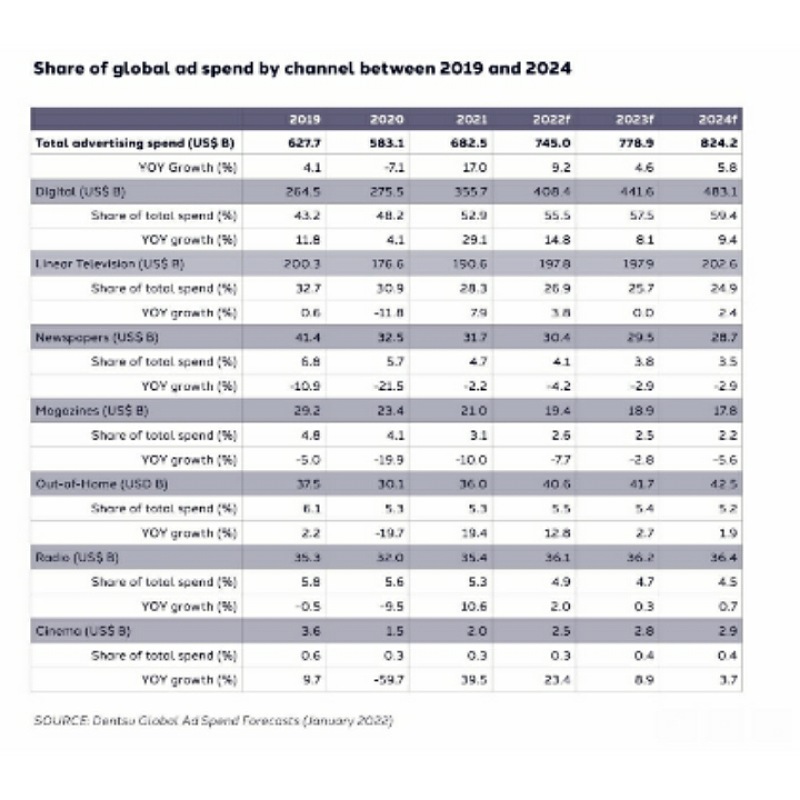
    Mumbai: Advertising expenditure in the Asia Pacific is expected to grow by 5.9 per cent, with India being the fastest-growing market globally at 14.6 per cent, followed by the US, Russia and Canada, according to dentsu’s Global Ad Spend Forecast report. Digital forecast is expected to increase 9.6 per cent to a share of 61.1 per cent of total APAC advertising spend, even as advertising investment overall is forecast to grow by 9.2 per cent globally in 2022, as per the report.

    In APAC, overall ad spend growth is boosted by key sporting events such as the Indian Premier League, FIFA World Cup, Winter Olympics, and country elections in Australia and India.

    Moving towards a second consecutive year of growth following the five per cent market dip in 2020, 2022 is projected to build on a stronger than expected recovery in 2021 which itself saw a record-high 14.4 per cent growth in APAC, totalling $241 billion. The twice-yearly report which combines data from over 50 markets globally, anticipates $745 billion will be spent globally. 

    Digital and television continue to be the two powerhouses driving global and APAC ad spend, yet with opposite dynamics. Following a 24.8 per cent increase in 2021 (vs 29.1 per cent globally), dentsu forecast digital investment to grow by 9.6 per cent (vs 14.8 per cent globally) in 2022, fuelled by Social and Programmatic in APAC. This will result in the digital share of spend increasing to 61.1 per cent ($150 billion) of the total ad spend in APAC, over twice as big as the television share of spend (24.5 per cent) in 2022.

    Linear TV ad spend increased by 5.1 per cent in 2021, the highest rate since 2013. In 2022, dentsu forecast linear TV ad spend to grow by 1.4 per cent to reach $60 billion in APAC. Unlike digital and despite staying in high demand, dentsu is seeing linear TV share of spend on the decline – both globally and in the region – as connected TV and video on demand (VOD) grow.

    Out-of-home (OOH) and cinema will both see encouraging growth in 2022, respectively 12.8 per cent and 23.4 per cent globally (vs 2.8 per cent and 30.0 per cent in APAC). Radio too is forecast to grow, yet at a slower pace of 1.5 per cent in APAC (vs 2.0 per cent globally). As with previous predictions, ad spend in newspapers and magazines will continue to decline globally and in APAC. 

    Globally, the industries that will see growth in ad spend this year will include the beleaguered travel industry which is forecast to see a 10.3 per cent rise. There is also confidence the automotive advertising spend will grow by 7.6 per cent in 2022. Growth follows an 11.5 per cent increase in 2021 and steep declines in 2020 of -15.9 per cent. With pent-up demand and a trend towards personal vehicles in how people want to travel post-pandemic, there is confidence in the recovery of the automotive industry.

    Looking further ahead, APAC ad spend is predicted to grow by 5.6 per cent (vs 4.6 per cent globally) in 2023 and 4.9 per cent (vs 5.8 per cent globally) in 2024 – exceeding growth before the pandemic (4.1 per cent in 2019). Digital is forecast to increase its share of spend domination to 64.6 per cent in APAC (vs 59.4 per cent globally) in 2024. Of course, many factors contributing to the uncertain economic outlook could influence the predictions, from the evolution of the pandemic to supply chain issues, and dentsu recommends the industry keep a close eye on key economic indicators.

    “APAC region is expected to post robust growth in ad spend in 2022. India, Hong Kong and Vietnam will drive double-digit growth with the rest of the region showing strong growth,” said dentsu International CEO Media APAC Prerna Mehrotra. ” The share of digital spends in APAC is set to increase to 61.1 per cent up from 50.1 per cent in 2019 (pre-covid), driven by Greater China and ANZ. TV as a platform will continue to play a key role especially in Southeast Asia and South Asia.”

    “Marketers will need to be nimble, leaning on technology and maximizing opportunities in video, social, connected TV and e-commerce. The use of data to drive business outcomes without compromising privacy or security will continue and we expect data collaboration to be a big focus for 2022. In light of the ongoing global turbulence and recovery, we will continue to work with brands to accelerate efforts to engage consumers and drive attentive reach,” she further added.

    When compared to previous global financial and advertising crises, notably the financial crash of 2008, this rebound is almost three times greater, said the report. In 2022 the growth forecast at 9.2 per cent is nearly three times the 3.4 per cent growth in 2011 – the second-year post-global financial crisis. In 2022 the global ad market exceeded the 2019 pre-pandemic level of spend by 18.7 per cent, whereas in 2011 the global ad market continued to be one per cent lower than in 2008.

    “The bounce back from the early pandemic impact continues to be strong, especially in digital,” remarked dentsu International Global CEO media and global clients Peter Huijboom. “As we spend more time consuming digital media, brands have the opportunity to tap into the increased flexibility in which consumers engage through multiple touchpoints. Businesses who truly understand these developed human behaviours have the best opportunity to build lasting relationships with them.”

    “It also comes as no surprise of the increased popularity in gaming. Dentsu launched its global gaming proposition in 2021. Along with the burgeoning Metaverse, there has never been a more exciting time for brands to experiment, innovate and engage with their customers – as all forms of media are increasingly more central to daily life and routine,” he further said. 

  • TV ad volume soars in 2021, Oct-Dec records highest quarterly growth since 2019: Barc India

    TV ad volume soars in 2021, Oct-Dec records highest quarterly growth since 2019: Barc India

    Mumbai: The television ad volume recorded significant growth in 2021, beating the previous year’s performance, according to the latest data released by the Broadcast Audience Research Council (Barc). The total ad volume in October-December 2021 was in fact recorded to be the highest during a quarter since 2019, as per the data.

    Riding high on the festive wave, as many as 2,524 advertisers and 4,104 brands advertised on TV in December 2021, out of which at least 19 per cent were new advertisers and brands. Overall, December 2021 recorded a total of 155 mn seconds of ad Volumes, which was 25 per cent higher than December 2019

    “Post a rollercoaster ride in 2020 on account of the pandemic and lockdown, 2021 was a strong positive year for the broadcast industry. We witnessed increased attention from marketers towards television, across languages, while welcoming new brands to the medium throughout the year,” said Barc India head-client partnership revenue function Aaditya Pathak.

    E-commerce, BFSI, retail, and textile sectors independently registered over 40 per cent growth each when compared to December 2019. Ad volumes for the corporate/brand image category surged by 42 per cent over December 2020, as per the Barc Think Report for the month.

    “Ad volumes for digital native and e-commerce brands indicate that marketers continued to bet on television to establish stronger relationships and effective communication with their consumers. With a total of 155 million seconds of advertising volumes in December 2021, we can say with optimism that the broadcast industry ended 2021 on an encouraging note,” added Pathak.

    According to the data, ad volumes on Hindi language channels continued to grow consistently with 15 per cent and 22 per cent growth over December 2020 and 2019 respectively. While the ad volumes for English language channels recovered with a 15 per cent growth over December 2020

    On the other hand, Bhojpuri language channels witnessed the highest growth of 120 per cent over December 2019 while Punjabi increased by 83 per cent over December 2019. Oriya and Assamese Ad Volumes recorded a 50 per cent growth over December 2019, while the ad volume for Marathi channels grew by 47 per cent as compared to December 2019.

    In a piece of good news for TV, advertisers beyond the Top 50 enhanced their presence on TV with 30 per cent and 26 per cent growth over December 2020 and 2019 respectively, said Barc India.

    Q4 2021 showcased stronger growth than Q4 2020 and Q4 2019

    According to Barc India, Q4 021 recorded 489 mn seconds of Ad Volumes, registering 27 per cent growth over Q42019 and six per cent over Q4 2020. Brands across BFSI, e-commerce, corporate/brand image and personal accessories categories led this growth in Q4 2021 over Q4 2019

    The ad volumes on South language channels i.e. Tamil, Telugu, Malayalam and Kannada – registered 25 per cent growth in Q4 2021 over Q4 2019.

  • GUEST COLUMN: One accurate measurement is worth a thousand expert opinions

    GUEST COLUMN: One accurate measurement is worth a thousand expert opinions

    MUMBAI: Management guru Peter Drucker once said, “Because its purpose is to create a customer, the business enterprise has two — and only these two – basic functions: marketing and innovation.”

    Marketing is more important today than ever before as it leads to brand creation, which is the growth driver of the business. A brand is the biggest moat and one of the most powerful intangible assets a business has. Today around 11 per cent of a company’s revenue is spent on marketing. The second most important quote of Peter Drucker was, “If you can’t measure it, you can’t improve it.” And, how true is this even today in this age of data overload.

    Around 70 per cent of marketing spends are on media. Advertisers have never been under more pressure to prove ROI. TV has been leading and digital has been growing over the years. Together they contribute to around 80 per cent of spending. Measurement of both remains important, but it’s critical to focus on the right metrics which can drive action.

    TV viewership has undergone changes over the years, especially with digitisation, NTO & OTT. The pandemic has led to increasing the overall TV viewership with rural growing faster. If one has to look at genre level, then News, FTA & Regional has been on a continuous growth & Niche has been facing challenges. The good part about TV is that it has an industry-accepted third-party measurement system which drives most of the decisions on planning and investment. However, the industry needs to sort the recent ambiguity on news measurement.

    The consumer looks at TV and digital as a continuum. The majority of OTT content is TV shows, acting as catch-up TV. Growth of connected TV has been fast, though on a smaller base and with NTO 2.0 closer, it’s an indication that TV might keep tilting the balance towards rural & OTT will emerge as new Urban TV. The question is “When”? The audience being the key, can TV take a step further towards digital with improving targeting capabilities at a geo level as well as consumer interest and affinity?

    Digital has been growing and the launch of 4G and Jio has accelerated the growth. Specific measurement is possible at the customer level due to the availability of large data sets; however, digital comes with the challenge of a common currency and a heavy reliance on self-claimed platform level data.

    Platforms do not talk to each other leading to higher inefficiencies in planning. Over the last 18 months, digital spending has been moving to lower-funnel actions driving purchase and conversion. Evolved businesses do understand the need to balance the spending across the funnel (TOF) to get more efficiency on performance marketing without compromising on brand building.

    One of the major changes over the last few years is the advent of the creator economy. Scale is a challenge here and the industry needs to enable this. There is a need to move beyond views and likes. Coupon codes and affiliate links are solving the attribution question. However, the focus should also be to measure brand advocacy.

    With large data sets and extremely sharper targeting capabilities, digital also faces the wrath of privacy which is now being spoken at various industry forums and is at a cusp of change with regards to customer opt-in and usage of data.

    Hence TV & digital will have to come closer and there is a need for standardisation of the measurement mechanics, for improving the investment decisions. While the basic measures like monitoring reach, frequency, views, etc. are important to track, other outcomes remain critical like brand searches including marketplace, direct traffic, time spent, footfalls, etc. Tracking customer satisfaction, mind metrics, and NPS is also a key measure of brand health.

    While today’s consumer is multiscreen, measurement of media is operating in silos and the absence of single-source data adds to the woes. The industry has to take steps to arrive at a cross-media third-party measurement currency that helps measure effectiveness as well as efficiency of marketing spending.

    And finally, brand metrics across the marketing funnel, like awareness, consideration, and purchase intent will remain critical varying from business to business depending on customer engagement. The power of the brand will be determined by the ability to charge a price premium, loyalty, and advocacy, and it is imperative to measure these continuously.

    (Rahul K Shah is general manager, Motivator at GroupM. The views expressed in this column are personal and Indiantelevision.com may not subscribe to them.)

  • TV Brand Fest 2021: Marketers relook at TV ad spends in times of disruption

    TV Brand Fest 2021: Marketers relook at TV ad spends in times of disruption

    Mumbai: The media industry and the economy saw an unprecedented level of disruption post-lockdown phase. As marketers went back to the drawing board to scrutinise their media spend, TV advertising moved from strength to strength commanding the highest share of advertising spends.

    “Television will continue to command the majority share of ad-spends in the next five to seven years,” asserted ITC head of media Jaikishin Chhaproo, as he began the discussion at the ‘TV Brand Fest 2021’ – a five-day event being organised by Indiantelevision.com, and co-powered by Star India. Day one of the event saw marketers and prominent TV advertisers discuss ‘The power of television in times of disruption’ and ways of ‘Using TV + digital strategy’.

    Maruti Suzuki India executive director – marketing and sales Shashank Srivastava noted that out of the Rs 700 crore spent on advertising, the brand spent 34 per cent on TV and 27 per cent on digital. “In terms of building brand imagery, especially in the auto category, there’s no substitute for TV,” he noted.

    Most industries were impacted by the pandemic. However, the edtech sector was one of the few that saw an increase in demand during the lockdown. Byju’s head of marketing Atit Mehta observed that this was an important moment for the edtech industry to build top of the funnel awareness. “One of the categories that increased their advertising spends during lockdown was edtech,” he said.

    The fast-moving-consumer-goods (FMCG) category remains the largest advertiser on TV. Despite the impact of the pandemic on the bottom line of most consumer goods companies, this category remained visible on TV. “FMCG cannot do without TV because you need the reach, frequency and eyeballs,” said ITC’s Chhaproo.

    “A significant number of categories operate around the magic price point of Rs 10. Due to the impact of the pandemic on the supply chain, continuing to offer this price point to consumers became a challenge”, said Chhaproo. “We had to constantly communicate to consumers to drive them to our products.”

    The category which usually invests on general entertainment channels, shifted media spends on other genres on TV. “We shifted our spends on TV to the news genre because consumption had gone up significantly,” remarked Dabur head of media Rajiv Dubey.

    Covid was a timeout for the entire world and when the normal choices were unavailable to consumers they began experimenting with different modes of consumption. When fresh content returned to GECs last year, Dubey observed that there was a significant consolidation of viewership in the eight regional markets that Dabur looked at including South (Karnataka, Andhra Pradesh/Telangana, Tamil Nadu and Kerala), West Bengal, Maharashtra, Orissa and Bihar.

    “The viewership has been on the upswing in these regional markets with consolidation of viewership in fewer programs and channels,” said Dubey. “We’ve seen that if you speak to a consumer in Maharashtra, in Marathi, using a Star of his choice, it works better.”

    There are 40-50 million homes that watch only free-to-air channels on Prasar Bharati’s free DTH platform DD Free Dish, Dubey said. “The FTA channels work like magic if you want to advertise products with smaller price points. Unfortunately, the major FTA channels only cater to Hindi-speaking audiences and no other language audiences.”

    In terms of consumer behaviour, there is a key overlap in terms of audiences on TV and digital. Audiences are watching both these media at different points in time. For Policybazaar.com’s vice president and head of brand marketing Samir Sethi it became important to map these audiences to optimise ad spends.

    He said, “The attention is now divided between a TV and mobile phone. Earlier, people watched TV undivided but now they’re also multitasking on a mobile phone. We’ve seen that there are times when people are influenced enough by your communication on TV that they respond by checking out your website or downloading your app on mobile.”

    A lot of digital and direct-to-consumer brands have understood and leveraged this behaviour. When it comes to achieving their growth targets, “all the major D2C brands have come on our platform (TV) to reach audiences at scale,” remarked Disney and Star India head of sales for infotainment, kids and regional cluster Dev Shenoy.

    In the last 18 months, ad spends have inevitably shifted to digital media platforms. For example, with retail spaces closed, certain category spends have completely moved to e-commerce. Maruti Suzuki’s Srivastava said, “At the top end of the funnel there is no substitute for TV. Digital becomes more important at the lower end. In the consideration stage of the brand, there’s an overlap.”

  • Digital boom spells out recovery for the industry during festive season

    Digital boom spells out recovery for the industry during festive season

    MUMBAI: As the world adapts to the post-pandemic world, there’s been a significant shift in the way people shop, eat and look for entertainment among other things. With the festive season around the corner, there are massive expectations riding on digital media as brands experiment and figure out ways to reach their consumers effectively within the online space.

    The rapid expansion of the digital advertising space in India has opened up a promising avenue for businesses and brands amid the pandemic. According to Dentsu’s Ad Spend Report from June 2021, the digital ad spend in India has grown from 20 per cent in 2019 to 29.4 per cent in 2021. And while television remains the most popular medium for advertising, its growth was just 7.7 per cent, which goes to show that the digital advertising ad spend is fast catching up with TV.

    Advertising Standards Council of India (ASCI’s) ‘Trust in Advertising’ report interestingly revealed that it is not just the metro cities that are viewing ads online. The viewership of digital ads in rural centers, too, was found to be at par with the metros.

    “The consumer today is looking out for convenience, everything at the press of a button,” says Madison Media Ultra COO Jolene Fernandes Solanki. “Digital advertising is expected to be the driver for growth across businesses during festivals. With online being the only medium that has grown during Pandemic, digital ad-ex will gain momentum and further grow during this festival. With this significant growth, digital will maintain its second position and contribute a share of 32 to 35 per cent.”

    The online market is also seeing an upsurge in Direct-to-consumer players. D2C brands have seen a nearly 200 per cent growth in categories such as beauty, personal care, nutrition, and small electronics, as per industry experts.  Brands such as Mamaearth, MyGlamm, SUGAR Cosmetics, Lenskart, Licious, Zivame, Epigamia, BoAt, Wow Skin Science, Country Delight, among others are establishing a strong presence in the D2C arena, fulfilling customer demands despite the challenges thrown in by the Covid-19 pandemic.

    With the digital revolution that is connecting customers and businesses across the country, the rise of the usage of social media, apps, and instant messaging platforms has been witnessed. According to Admitad Affiliate India, head, eCommerce vertical Abhijit Banerjee, a lot of brands will be experimenting with digital platforms, which will not just be limited to promotion but will also be the preferred point of purchase. “Each year, brands are leveling up with different marketing strategies and choosing ROI driven marketing channels, coupon codes, deals, and discounts for their consumers,” he says.

    The spending skew in digital is growing steadily this time around since it is getting increasingly cluttered on traditional media to get consumer attention, feel industry executives. Apart from that, brands agree that it is much more efficient to tap into new geographies with digital rather than TV. Even as major players already dominate the online space, now smaller, regional players are realising the importance of the medium. Brand advocacy on digital has become quite important; brands are not hesitating to opt for the influencer marketing route like last year as their brand advocates in their campaigns.

    The gap between ad spends on TV and digital is narrowing every year. Digital at 35 per cent market share has overtaken print at 16 per cent and is closing the gap with television which stands today at 45 per cent, as per estimates by media agency GroupM. 

    According to Voiro founder and CEO Kavita Shenoy, online spending is on a steady upward trajectory and digital-first businesses are leaning on this trend to encourage customer consumption. This will see advertisers explore new ways of addressing target segments, across media inclusive of music apps, gaming, contextual commerce, and of course live events.

    “Marketing spends will be performance focussed and largely be focussed online as the world is still in lockdown and consumers are still wary of stepping out of home, but prefer to transact online, for everything from groceries to luxuries,” Shenoy says, adding, “The spends indicate that the addressable advertising audience is far more engaged online and that it is easier for brands to measure effectiveness and see ROI in real-time.”

    With e-commerce driving consumption, online advertising spends are likely to see a significant uptick this festive season. According to e-retailer Myntra, the adoption of digital channels for shopping continues to accelerate, and there is a continuous increase in the number of categories a customer purchases. The festive sales season which started last week will go on till Diwali and later Christmas and New Year’s, driven by purchases from tier 3 and 4 cities. 

     As per a recent study conducted by the HI + AI research division, ‘Gipsi’, eCommerce/ Online shopping now has become a habit and will continue to see a rise in spends during the festive season. Even the digitally-hesitant audiences who used to prefer digital shopping only during offers and sales are now shopping online as a convenient option, says Tonic Worldwide’s Unmisha Bhatt.

    While digital spends have been consistently rising for the past many years, the pandemic accelerated it to another level. Coupled with the issues with deliveries of newspapers during the extended lockdown, the percentage share of digital spends has spurted in the last year and a half, with digital spends now second only to TV.

     “This year, we are slowly seeing things going back to normal but changes in the marketing landscape might stay, ” says DViO Digital founder and CEO Sowmya Iyer.  “Brands see a good return on ROI with digital marketing and with the advanced technologies we have at our disposal today, it opens up a wide range of possibilities right from gamification to user-generated content. A lot of brands were seen collaborating with the OTT and gaming platforms for integrating their products and advertising purpose. Here, the targeting is very specific and we see more and more brands wanting to allocate their marketing budgets for OTT collaborations,” she adds. 

    Pandemic has indeed turned out to be a catalyst for digital transformation. “The non-adaptors of digital media (laggards and e-payment skeptics) were also forced to bite the bullet since physical shopping/ consumption was practically impossible during the lockdown. Digital has already taken a larger share in the media ad spend pie overtaking Print. It can now, in fact, be termed ‘mainstream,” says Havas Media India managing partner Saurabh Jain.