Tag: ABP

  • Viewing on TV, digital doesn’t have to be either-or question

    Viewing on TV, digital doesn’t have to be either-or question

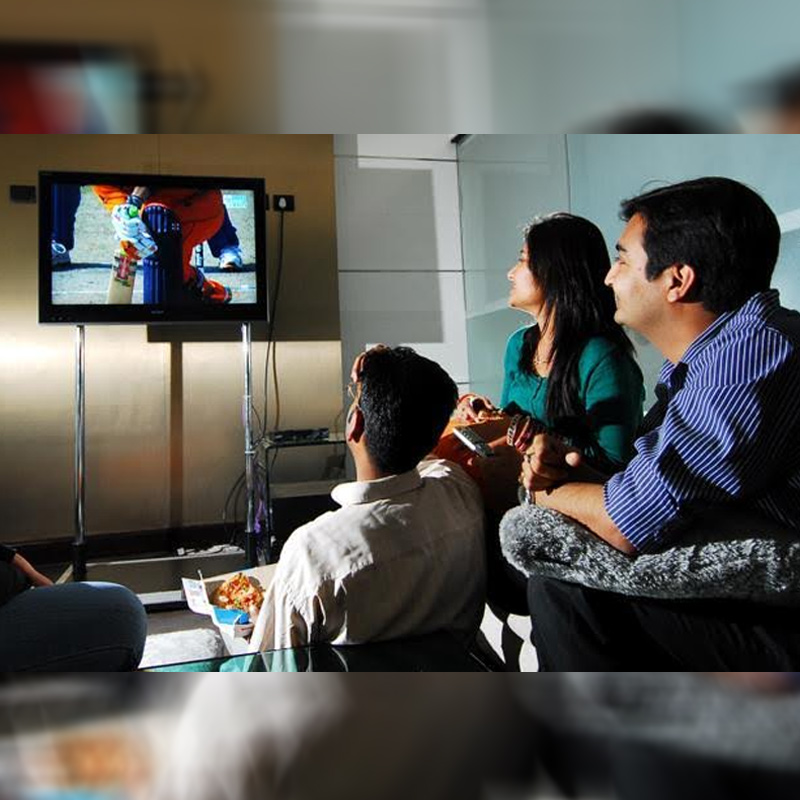
    MUMBAI: For decades, television has been the platform that’s commanded the attention of the maximum number of people in India. However, thanks to cheap mobile data costs and smartphones, there has been a surge in digital video consumption, and audiences are fast changing the way they view content.

    With viewers starting to divide their content consumption across TV and digital, it now makes sense for broadcasters to also spread their budgets across both mediums to reach more audiences.

    To address this change, the Confederation of Indian Industry (CII) has organised the Big Picture Summit 2020, where it deliberated upon India’s multi-screen obsession and what it means for content owners. The panel comprised Shemaroo Entertainment COO Kranti Gada, ministry of information and broadcasting additional secretary (broadcasting) & CVO Neerja Sekhar, ABP news CEO Avinash Pandey, Discovery India MD Megha Tata, and Boston Consulting Group MD & partner Vikash Jain.

    Of late, and especially with the onset of Covid2019, broadcasters are pushing the digital agenda, realigning their content strategies, business models to cater to consumers’ interests; some fear this may be to the detriment of their traditional business, noted Gada. However, Tata, who has spent more than three decades in the media and entertainment industry, pointed out how every time a new platform emerges, talking heads pronounce the death of the previous one. Contrary to this perception, all mediums have stayed strong and grown – whether its print, radio, cinema, television, and now digital.

    “We don’t have to be an either-or world all the platforms can co-exist. It is absolutely not an easy decision to make but yes we need to think about where we are putting our money. These are very difficult questions where there is no rule book. Our approach is that both need to survive,” said Tata.

    She highlighted that unlike the west, where the death knell has been sounded on linear television, India has actually beaten the trend. This requires a fine balancing act on the part of broadcasters. Both the mediums are important – one is the business of today and the other is the business of tomorrow.

    “During pandemic, there has been a huge growth in television consumption but at the same time OTT growth has been stupendous. We launched Discovery+ in the middle of the lockdown. The question is how do you balance this act. You have to protect our linear business that is funding your digital business because there is still time for digital business to reach profitability and monetisation status and TV has to play a key role in that,” she explained.

    There’s no denying that streaming platforms have emerged as a major challenge to linear television, but the latter is a Rs 79,000 crore industry that has stood the test of time and is still going strong, claimed Sekhar. “We are seeing the convergence in infrastructure where wired broadband and wireless distribution are much in demand and both are giving better choices to consumers. We are seeing one content on different platforms with multiple screen options.”

    She went on to say that the pandemic threw up major changes in viewership pattern, where family viewership has taken over. But one factor that has remained consistent is content. There has been a huge uptick in demand for entertainment, followed by localised or regional content. She also shared that during the lockdown, OTT content was watched double that of linear programming. But linear television remains primary as far as the consumer is concerned. “With the number of OTT players rising we don’t know how self-sustaining OTT platforms are going to be. Market will change, technology will change but content will be of utmost importance.”

    The question that arises in a multiscreen world is how the business model changes. Television was largely advertising-driven whereas in digital, larger multinational companies take away 60 to 70 percent of the ad pie and then broadcasters grapple with what is remaining. There are other players also who are looking at the same ad pie. It is quite a challenging situation for broadcasters.

    Pandey explained that the whole ecosystem has changed: a content is created then there is a distributor cable operator which downlinks the signal and sends it to the consumer. Based on the business model, whether you are a free channel or a paid channel, you get the subscription money which is shared by the DPO operators. Then the carriage fee is accordingly paid to some other person. Broadcasters are in control of their audience through a third party – BARC, which tells you what the consumer is watching, and the price is determined on that basis. Things work differently on digital – streaming platforms that serve the consumer on pull medium, where the viewer looks for his choice of content and consumes that; the entire push system of that content is now controlled by two companies.

    “Streaming platforms decide what rate to sell and they give you the share. There is no value for the content that we are creating. If you look at two big content creators, they take your content and serve it to the consumers. They know the data and how to push their content and they will be the one who will take the share out of the advertising and give you some money,” he stated.  

    Behind all this lies the platforms’ algorithm, which pushes the content, but no one knows what makes it tick. In Pandey’s view, the government will have to step in and see to it that all parties are treated fairly. At the end of the day, content creators need to get their due.

    “Fortunately, we are seeing that in the European Union and Australia, creators are looking at getting good value for their content,” said Pandey, adding that he hopes that the day’s not far off for India, too.

  • 3 Reasons why news industry is miffed with BARC

    3 Reasons why news industry is miffed with BARC

    NEW DELHI: The recent TRP manipulation scam has reopened old wounds that news channels and Broadcast Audience Research Council (BARC) had been mending. The genre had never been absolutely satisfied with how the authority is measuring ratings and the recent sequence of events has once again brought the matter to the fore. At the recently concluded News Television Summit hosted by Indiantelevision.com, several speakers from the news world pointed out the errors that they feel BARC is making in measuring news TRPs. Here is a comprehensive overview:

    1.  Incorrect Sample Size

    Zee News CEO and editor-in-chief Sudhir Chaudhary pointed out, “I think the main problem with BARC ratings is that the sample size is so small. Statistically speaking, we are a 32,000 crore industry and BARC has its meter in just 44,000 homes. As we traditionally say that of the overall sample size only 10 per cent watch news, we are left with just 4,400 boxes, which is very less for a huge market like India.”

    2.  Incorrect Data Points 

    ABP News Network CEO Avinash Pandey, who has been an open critic of the BARC measurement systems, stated that he’s against the minute-by-minute stock market-like analysis of news shows, where BARC points out at what precise moment the TRP took a jump. According to him, this is prompting all the news channels to run a similar sort of programming and picking up a similar tone with its stories. He said, “Until and unless BARC effectively manages the impact of news, and not just the number of people watching the channel for a certain time, unfortunately, we all will be in the rat race of chasing the ratings and it will destroy our businesses, people’s lives, and our country.”

    3.  Improvement Needed in the Backend

    Times Network MD & CEO MK Anand stated, “From what I’ve seen in the last four years, fixing the back-end of the measurement mechanism is required. BARC CEO Sunil Lulla has been trying to bring a lot of sense to the process. He has been continuously improving it. But whether it is inside BARC or outside, there are people who break ranks and resort to corrupt means. We have seen them use shortcuts to get to the numbers and that is not acceptable.” 

    According to the industry, these drawbacks have also degraded the quality of programmes that news channels are running these days. They highlighted that the blind contest for maximum TRPs has prompted news outlets to run similar shows with little to no differentiation, which in turn is harming the industry as a whole. 

    While BARC under Sunil Lulla is making strides in streamlining the measurement process for the better, there are still loopholes that need to be filled. 

  • TRP rat-race is destroying business models, country: ABP’s Avinash Pandey

    TRP rat-race is destroying business models, country: ABP’s Avinash Pandey

    NEW DELHI: The business models of how news broadcasting is done in India needs a huge overhaul, opined ABP News Network CEO Avinash Pandey in a virtual fireside discussion with Indiantelevision.com founder, CEO, and editor-in-chief Anil Wanvari on day two of the News Television Awards Summit. According to him, the two areas that require urgent overhaul are how TRP is measured and the high dependence on advertising revenue for running the business. 

    “The news business model in India is very flawed. It is 100 per cent dependent on advertising revenue, which should not be the case. That’s why we are soon going to be a paid platform,” Pandey said. 

    He added that going premium entails a lot of investment and the ABP News Network is actively working towards it. “If I give you an example of our Bihar election coverage, Poll Khol, hosted by Shekhar Suman, is a show that demands investment worth the complete election coverage budget of some other channels. Our reporters are doing debates in every tehsil, every district and it is a cost-heavy affair. It’s a very tough call for us to take as we have very limited resources but unless we do that, good content will take a backseat.” 

    He said that news channels should take a conscious call of doing good reporting and not just chase the numbers. This leads Pandey to the matter of TRP measurement, stating that he is completely against the ‘minute-by-minute stock market-like analysis of news’ showing what exactly spiked the viewership on a certain channel. 

    “Until and unless BARC effectively manages the impact of news, unfortunately, we all will be in the rat-race of chasing the ratings and it will destroy our businesses, people’s lives, and our country,” he warned. 

    Pandey insisted that the whole industry – from broadcasters to regulators – should introspect how the measuring systems are working and how the quality of news is impacting the country at large. 

    “To give an example, I think the biggest reform that happened in India in the past few months was the education reform. I feel it is going to bring in a lot of changes for the next decade; they have liberalised it greatly. It will also save a lot of foreign exchange. Millions of dollars are otherwise spent globally in educating our kids, which will stop. Now, none of the channels covered this because they were busy covering a certain crime story because the general consensus was that ratings will not come if you talk about anything sensible,” he bluntly stated. 

    In regards to how news consumption will be moderated in future, he opined that Indians will watch a lot of content on connected TVs in future and that’s how broadcasters should be preparing their strategies. 

    On an additional note, Pandey also talked about his expectations with the advertising revenue in the coming months. He projected that November will be bigger than last year with major high-ticket events like Bihar elections, IPL finals, and Diwali coming together. He is positive that the market will pick up from here as certain categories are already showing signs of revival in terms of sales and that will also reflect in their advertising spends. 

  • ABP garners 271 million viewership on Ayodhya verdict day

    ABP garners 271 million viewership on Ayodhya verdict day

    MUMBAI: Committed towards bringing vital information to its viewers on a real time basis, India’s most trusted media conglomerate – ABP News Network has yet again topped the charts with a gross viewership of 271 Million in the 46th week of 2019. (Source: BARC; TG- ABC 15+; Mkt:HSM; Weekly GVMs).

    With its minute-to-minute updates, of each and every issue to delivering analysis and comprehensive insights on salient policies, ABP News ensured all its viewers were well-informed.

    As per the BARC data, ABP news has maintained its supremacy during the prime-time hours for the crucial week of November 9 to November 15, 2019 in delivering each and every key fact of the nation’s pressing issues. These include Ayodhya Verdict, Maharashtra Political Crisis and Supreme Court’s Rafale Verdict, among others.

    Speaking on the success, Mr. Avinash Pandey, CEO, ABP News Network said, “This data is a reiteration of our commitment and dedicated towards updating our viewers on a real time basis. It proves our dominance in the television landscape and affirms our content as reliable, unique and preferable. I am delighted to see that our efforts and hard work have garnered the trust of millions of viewers. Keeping the momentum going, our goal is to ensure the same credibility to our viewers and be the vanguard of ethical journalism.”

    Last month during the elections in Maharashtra and Haryana, ABP had earned the recognition of being the most prominent source of information in providing minute to minute updates of the states, rallies and the movements.

  • BARC week 31: Colors Gujarati drops to fourth position

    BARC week 31: Colors Gujarati drops to fourth position

    MUMBAI: In week 31 of BARC India's ratings, regional channels have witnessed some changes in their respective segment. In top five table of Gujarati channels, Colors Gujarati has slipped down to fourth position from second position. In Telugu segment, Star Maa has replaced Gemini Movies at fifth position.

    Colors Gujarati has slipped down from second to fourth position  whereas ABP Asmita moved up from third to second position and TV9 Gujarati also moved up from fourth to third position.

    Gujarati

     
    Rank Channel Name Weekly Impressions (000s) sum
        Week 31
    1 Colors Gujarati Cinema 38271
    2 ABP Asmita 27115
    3 TV9 Gujarati 25310
    4 Colors Gujarati 22734
    5 Sandesh News 19828
    Guj / D&D / DNH (U+R): NCCS All: 2+ Individuals, 

    Star Maa Movies replaced Gemini movies at fifth position. Zee Telugu and Gemini TV exchanged their places at third and fourth position.

    Telugu
     
    Rank Channel Name Weekly Impressions (000s) sum
        Week 31
    1 STAR Maa 747432
    2 ETV Telugu 457153
    3 Gemini TV 441196
    4 Zee Telugu 422961
    5 Star Maa Movies 200233
    AP/ Telangana (U+R) : NCCS All : 2+ Individuals, 

    Zee Bangla Cinema moved from fifth position to fourth position and Aakash Aath moved down from fourth to fifth position in week 31 of BARC India ratings.

    Bangla

     
    Rank Channel Name Weekly Impressions (000s) sum
        Week 31
    1 Zee Bangla 360021
    2 STAR Jalsha 247465
    3 Jalsha Movies 75672
    4 Zee Bangla Cinema 69157
    5 Aakash Aath 61956
    WB (U+R): NCCS All : 2+ Individuals, 

    Top three bhojpuri channels- Bhojpuri Cinema, B4U Bhojpuri and Big Ganga remained same. Dabangg moved down from fourth to fifth position and BHojpuri Dhamaka Dishum moved up from fifth to fourth position.

    Bhojpuri
     
    Rank Channel Name Weekly Impressions (000s) sum
        Week 31
    1 Bhojpuri Cinema 67119
    2 B4U Bhojpuri 64253
    3 Big Ganga 46464
    4 Bhojpuri Dhamaka DISHUM 17661
    5 Dabangg 12926
    Bihar/Jharkhand (U+R) : NCCS All : 2+ Individuals, 

    No changes were observed in the pecking order of Kannada channels in week 21 of BARC India ratings


    Kannada

     
    Rank Channel Name Weekly Impressions (000s) sum
        Week 31
    1 Zee Kannada 484120
    2 Colors Kannada 277496
    3 Udaya TV 213647
    4 Star Suvarna 165683
    5 Udaya Movies 153221
    Karnataka (U+R) : NCCS All : 2+ Individuals, 

    No changes were observed in the top five Malayalam channels.


    Malayalam

     
    Rank Channel Name Weekly Impressions (000s) sum
        Week 31
    1 Asianet 304369
    2 Flowers TV 110445
    3 Mazhavil Manorama 94162
    4 Surya TV 77869
    5 Asianet Movies 62223
    Kerala (U+R) : NCCS All : 2+ Individuals, 

    No changes were observed in the top five Marathi channels. 

    Marathi

     
    Rank Channel Name Weekly Impressions (000s) sum
        Week 31
    1 Zee Marathi 374086
    2 Fakt Marathi 231936
    3 Colors Marathi 187549
    4 Zee Talkies 157102
    5 STAR Pravah 115591
    Mah/ Goa (U+R) : NCCS All : 2+ Individuals, 

    Sun TV, Star VIjay, Zee Tamil, KTV and Star Vijay Super were the top five Tamil channels in the week 31 of BARC India Ratings


    Tamil

     
    Rank Channel Name Weekly Impressions (000s) sum
        Week 31
    1 Sun TV 841476
    2 STAR Vijay 533302
    3 Zee Tamil 374655
    4 KTV 261989
    5 STAR Vijay Super 102422
    Tamil Nadu/ Puducherry (U+R) : NCCS All : 2+ Individuals, 
  • ABP launches All new Siyasat ka Sensex show

    ABP launches All new Siyasat ka Sensex show

    MUMBAI: Taking the highest election recall programme in the country – ‘Kaun Banega Mukhyamantri’ forward, ABP News launches the all-new program – Siyasat Ka Sensex. The one – hour show will be hosted by anchor – Neha Pant, and will be aired from Monday – Friday between 8pm – 9pm.

    The show will aim at giving viewers opinion poll data of Madhya Pradesh, Chhattisgarh and Rajasthan during the upcoming elections. Siyasat ka Sensex will showcase research along with data driven reporting and detailed analysis of the report. The extension of all-time hit – Kaun Banega Mukhyamantri will feature all the major happenings and big news from the 3 states and will act as a barometer to see the changing dynamics for voting process and seat share.

    This show will keep the audience updated with the topical stories (from these 3 states) and opinion poll dynamics including new topics every day, and their impact on seat and vote sharing.

    Mr. Avinash Pandey, COO, ABP News Network said, “We are delighted to announce the launch of Siyasat ka Sensex under the banner of our highest election recall program with maximum viewership – Kaun Banega Mukhyamantri. Time and again we have pioneered the innovation in content creation and extensive editorial coverage, so when it comes to news and information that matters – ABP news is the only destination for viewers.”

    He added, “This show is a sincere attempt from our side not just to deliver another election news, but to inform the people of our country about the reality of the society and thereby empower them to take decisions which will shape the future of the country. This show will redefine the way news is projected on television and consumed by the viewers & would aptly unravel the election drama as it unfolds in the three states.”

    Mr. Yashwant Deshmukh, Founder, C-Voter said, “The Siyasat Ka Sensex is a ground-breaking effort by ABP and CVoter in terms of Data Journalism in India. Based on the methodology and technology used in our daily tracker for US Presidential elections in 2012 and 2016, the Daily State Tracker for Rajasthan, MP and Chattisgarh are first of Its kind exercise ever taken up in Indian Media. It will change the way Public Perception is tracked in India in a thorough scientific approach. We are happy to partner with ABP News in this historic initiative.” 

  • Hotstar is an important platform for us: ABP’s Avinash Pandey

    Hotstar is an important platform for us: ABP’s Avinash Pandey

    MUMBAI: The days of tuning into the news channel at 7 pm in your living room are gone. Today’s consumers want news to come to them not vice versa. Taking note of this, ABP News bought a Hotstar ticket, which boasts of 10 million downloads on Android devices.

    ABP is the first Hindi news channel on the platform. New entrant Republic TV had secured a place in May this year.

    ABP COO Avinash Pandey feels it unwise to consider Hotstar as a media product. He rather gives it the title of a platform in itself. “The exponential growth in business happens when you move from product delivery to platform delivery. A platform becomes a dissemination medium when multiple people for multiple reasons converge. Hotstar is a promising and future-ready platform and it is important to be on such a destination,” he says.

    ABP shares its DNA with Star India since the channel was formerly called Star News – a partnership between ABP and Star from 2003 till Star decided to give up news for giving attention to entertainment in 2012. The synergy made a compelling case for both to unite.

    The deal benefits both parties. While ABP can reach a large audience on a trusted platform, Star can give value addition to its Hindi-speaking audience via ABP News. Let us not forget the increased traction that advertisers will get through it.

    At the 13th Indian Digital Operators Summit 2017, BARC India CEO Partho Dasgupta highlighted that the Hindi news genre grew by 93 per cent in week 41 of 207 over 2015. Pandey calls this growth as exponential, not progressive.

    “People want news as video rather than text and heavy consumption happens via mobiles and tablet due to lower data charges,” says Pandey. The channel is cooking up something as he says that this partnership is just ‘the tip of the iceberg’ and more should be expected.

    With the latest addition, Hotstar has live feeds of five channels – Fox News, Sky News, Asianet News, Republic TV and ABP news.

    As per the comScore report for April 2017, ABP News had 20.7 million viewers on mobile out of the total 200 million news population on digital. It had just 1.7 million views via desktop devices. The report also showed that people across ages, both male and female prefer mobile to desktop any day.

    Star India chairman and CEO Uday Shankar had earlier said, “Young India has embraced Hotstar. We believe that young, digital-savvy Indians are deeply interested in understanding their country and the world they live in.”

    Hotstar has managed to hook viewers to its entertaining content. Now can it manage to get them to spend more time watching news as well?

  • DishTV-ABP rolls out Pujo campaign

    DishTV-ABP rolls out Pujo campaign

    MUMBAI: Asia’s largest DTH brand DishTV, in order to add to the festivity fervour, has undertaken various activities in West Bengal in association with ABP Ananda. They have come up with the campaign — “Every home HD home” to amplify the HD reach during Durga Pooja (Pujo, in Bengali) celebrations.

    This campaign comprises digital, social media, broadcasting, radio and ‘pandal’ branding. The HD offer comprises 26 HD channels at Rs 84 (plus 18 per cent GST).

    DishTV SVP – marketing Sukhpreet Singh said: “With users aspiring for HD channels, this move is to encourage them to embrace HD channels at the most minimal costs.”

  • ABP continues to capture most video views on Facebook in Aug ’17: Vidooly

    ABP continues to capture most video views on Facebook in Aug ’17: Vidooly

    MUMBAI: For the second month on the trot, it has stayed at the top. Repeating its performance of July 2017, the Hindi news TV channel ABP News, has netted the most viewed videos, according to Vidooly’s most popular ‘Facebook Video Publishers’ from India report for August 2017.

    ABP News was the numero uno on the list with around 290 million views, even as sister channels — ABP Live and ABP Majha — captured the fifth and sixth slots with 132 million and 120 million views, respectively.

    Aaj Tak came a close second with around 227 million total views for its videos. Dainik Bhaskar was at the third position with 202 million views, and Vijay Television at No 4 with 140 million views.

    Star Plus occupied the 22nd spot with 50 million views while Zee News occupied the 26th position with 48 million views. IndiaTV News was at the 29th position with 42 million views.

    Dainik Jagran stood at number 21 with a total viewership of 51 million leaving behind News18 Hindi at the 33rd spot. The business channel Quint was placed at the position of 59, Times Now remained at the position of 100, garnering only 12 million views on its page in August.

    Video marketing and analytics software Vidooly has launched a report that analyses top Facebook pages from India that focus on online videos. The ranking is based on the number of views clocked only for the month of August 2017 and does not consider pages of political parties/personalities, pages that freeboot videos or only upload video memes, pages of movie stars, singers or brands like Amazon, Cadbury, etc.

    The report has been broadly categorised into eight major genres — food, lifestyle, new age entertainment, traditional entertainment, new age news, traditional news, independent creators, and sports creators. And, it rates pages according to popularity (number of likes) and video viewership.

    In the sports category, SportsKeeda Wrestling generated more viewership than ESPNCricinfo and Cricbuzz while Lallantop continued to remain the most viewed Facebook page in the category of new-age news.

    National Geographic India became the top channel in traditional entertainment with 61 million Facebook page likes beating Zoom, MTV India and Colours channel.

    In the traditional news space, Hindi news channel Aaj Tak became the most liked page on Facebook followed by ABP News and Dainik Jagran in the second and third places, respectively.

    Vidooly will soon launch its report for YouTube Creators for the month of September. It will be interesting to see that report to find how well are Youtubers leveraging the digital platform.

  • AajTak topples Times of India as the top news video page on Facebook

    New Delhi, 13th July 2017: AajTak-India’s No.1 News channel- has also topped the rankings on the digital space  by  becoming the most popular on social network for continuous 3 months with over 29.7 million video viewership on Facebook in May, 2017. By crossing this monthly viewership mark, AajTak has stormed the digital platform with its exclusive content.

    Vidooly, the leading video intelligence software product suite for content creators, media companies and brands, had come up with the report  for MOST POPULAR FACEBOOK VIDEO PUBLISHERS IN INDIA – May 2017  which is categorized into six major genres – Health & Lifestyle, New age Entertainment, Traditional Entertainment, New age – News, Traditional News and Independent creators. The report highlights that the top 100 pages collectively clocked more than 2.8 billion viewership in May 2017.

    AajTak has a video viewership of 297,645,571 on Facebook which is way ahead in comparison to the Facebook pages of ABP news and Times Of Indiawhich are ranked in second and third position with 184,526,769 and 114,406,951 viewership respectively.

    Commenting on the report, Ms. KalliPurie, Group Editorial Director (Broadcast & New Media), India Today Group said, “AajTak’s leadership on television and on the digital space can be attributed to the brand philosophy of staying true to the promise of being ‘SabseTez’. The consistent focus on speed, user experience and quality of content at Aajtak.in has made it the most preferred for news content”.   

    public://f1_2.jpg

    AajTak has been instrumental in reaching out to its viewers on traditional media for many years now and this achievement shows the popularity of the channel in the digital world too. There is a constant engagement with the audience on AajTak Facebook page through Discussions, Satire, Backstage Conversations, News Capsules, Photo Blogs, Engagement Posts, TV Primetime Teasers, Primetime Promotions and a lot more.

    SubratKar, Co-Founder & CEO, Vidooly commented on the developments saying, ”Over the last 6 months, we have been closely tracking the tremendous growth in viewership of videos on Facebook in India. As expected, News related content dominates all the other genres since Facebook has been playing a pivotal role in shaping up the socio political opinions in the country. We are also seeing a steady increase in independent video creators utilizing the platform, catering to both the urban and rural population. It is a very interesting time in the online video business in India as both YouTube and Facebook are attracting content creators. However; given the fact that Facebook is yet to launch monetization for creators, YouTube still is the place to be if you’re looking to make a business out of it.”

    For further information please contact:

    public://f2_2.jpg