Tag: AB Vajpayee

  • “There is only one competitor and it would not be difficult to overtake that” : Rajat Sharma – India TV promoter

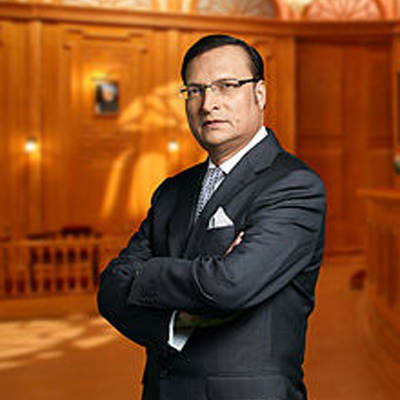
    “There is only one competitor and it would not be difficult to overtake that” : Rajat Sharma – India TV promoter

    It's the festival of lights. And for many the festival of noise courtesy exploding fireworks. In the hope of reducing the number of those belonging to the latter tribe, we, at indiantelevision.com, decided to put a display of firecracker articles for visitors this Diwali. We have had many top journalists reporting, analysing, over the many years of indiantelevision.com's existence. The articles we are presenting are representative of some of the best writing on the business of cable and satellite television and media for which we have gained renown. Read on to get a flavour and taste of indiantelevision.com over the years from some of its finest writers. And have a happy and safe Diwali!

    (Written By Anjan Mitra in 2004. Anjan is today exeuctive director Casbaa India)

    From living in a one-room tenement in Delhi to the city's up market Pamposh Enclave has been a long trek for Rajat Sharma, one of Indian television's best known faces. However, even he admits that luck has played an important part in shaping his life and career. One stroke of luck came in the late 1980s when Zee Telefilms supremo Subhash Chandra, looking at starting a new venture in India, convinced Sharma to conceive a TV programme that would empower the average citizen, while putting on the dock people in seats of power. Thus was Aap Ki Adalat born and the rest as they say is history. Incidentally, the show with its original name is slated to stage a comeback on Sharma's news channel – India TV.

    Today, as Sharma surveys his about-to-be-finished office room on the studio complex situated on a massive 80,000 sq. ft of space, there is a look of satisfaction on his face. His life and business partner – as he loves to describe her – Ritu Dhawan comfortably pales into the shadowy background, letting Sharma hog the limelight, while she tightens the nuts and bolts of the business venture.

    But apart from satisfaction, there is also a bit of anxiety as Sharma has just turned a broadcaster from being a TV software producer. His dream of having a news channel of his own has come true as India TV, a 24-hour Hindi-language news channel, attempts flexing its muscles in the already overcrowded news channel market in India. Sharma is also realising that having personal and school friends in high places – former Prime Minister AB Vajpayee's foster son-in-law Ranjan Bhattacharya, lawyer-turned-politician Arun Jaitley, Delhi University students' union neta-turned-politician Vijay Goel, former minister Pramod Mahajan, to name a few – has its pros and cons. Though he is willing to come clean on his business associates, according to one of the theories doing the rounds of the industry, India TV venture is funded by people who are sympathisers of the Bharatiya Janata Party.

    Still, Sharma is unfazed. He is slowly realising that one has to pay a lot for success and that too in a cut-throat world of television. In between concentrating on building on his dream, Sharma spoke to indiantelevision.com's Anjan Mitra.

    Excerpts:

    What has been basis of starting India TV?

    For me, India TV is not merely a news channel, it's a movement to give more credibility to TV news reporting. It's an endeavour to give the viewers a feeling that there is a channel that stands up for their rights, for them. Rather, I'll invite everybody to join me in the movement.
     

    Do you mean that other news channels are everything else except credible?

    The channel has been in the making for the last one and a half years. During this time, I traveled all over India, met people and got feedback on news channels. The feedback that I got was that people are getting increasingly fed up with sensational news reporting as news channels' editorial policies were getting dictated by commercial considerations. People wanted a channel that they could trust.

    Was that the reason why the channel has an ambitious tag line, which says 'Desh badalna hai to, channel badlo' (if you want to change the country, change your channel)?

    That is the line that is used in promotional campaign of India TV. I'd say the tag line of India TV is 'Badle Bharat Ki Tasveer' (Will change the face of India). The idea is to help people see the changing face of India and also play a role changing the face of the country. Before launching the channel, we had IMRB carry out a survey as to what the expectations were from India TV. The survey showed that people associated credibility with the name of Rajat Sharma. Their expectation was to get responsible reporting from Rajat Sharma. Such feedback went into conceptualising the channel.

    Considering you have started India TV with such lofty ideals, do you think there is room for another news channel in the country as the advertising pie hasn't increased that rapidly and there are others who already have a head start?

    A lot depends on the way you create content. I don't see any reason why revenue should not follow quality programming because quality programming would get you the viewers.
     

    You haven't answered the question that there are other established channels already pulling in revenue and it would be that much more difficult for a new product to break that stranglehold…

    Most of the news channels that are there in the market are, I'd say, look-alike channels. It's like the Bollywood formula. You have one success story and the others are all pocket editions of that success story.

    I feel, there is only one competition and it would not be difficult to overtake that.

    Do you mean apart from Aaj Tak, there is no competition for India TV?

    I would not like to take names, but let me assure you that we are totally confident of ourselves and that we would be able to achieve what we have set out to do – that is become the real No. 1.

    Since you feel that most news channels are look-alikes of the success story, is one of the reasons that the same set of limited people are doing the rounds of various channels?

    Maybe one of the reasons is that. But I feel there is no dearth of talent in the country. You need to identify them, nurture them and let them bloom. Though it may sound as if I am bragging, but most of the heads of news channels now have sometime or the other worked with me in the past.

    This goes to show that if you let people be, their talent would flower. That is why, in India TV, the endeavour is to build up other brand names too.

    You are getting people associated with the channel who are more seen on page three. What sort of message would this send out to viewers?

    I would not agree with that analysis. Take, for example, Maneka Gandhi. Nobody can deny that she is an authority today where environment is concerned. Then there is Tarun Tejpal (of Tehelka fame). He is someone who is synonymous with crusading against corruption. There is Nafisa Ali too. She may be appearing on page three oft and on, but you cannot deny that her involvement with social service is genuine.

    When do you think the venture would break even?

    Hopefully in a year's time we should reach the break-even point. Our belief has been confirmed after the response that we have got initially from the cable operators and viewers.
     
    The channel is still facing severe distribution problems. Wouldn't it upset the business plans?

    I agree there are some distribution problems, but I am also sure that our distribution team would be able to iron out the differences successfully. But we are not here to pay the cable operators to carry India TV. Our refrain, rather request, is that we are giving a quality product that ought to be carried on the strength of its content.

    (Indiantelevision.com's information is that several cable operators in Delhi, at least, have refused to carry India TV on their networks as, reportedly, 'carriage fee' was not given. Their excuse: There are already so many news channels and adding more channels would put their network under strain.)

    How different is the on-air look and is there any innovative marketing plans for selling airtime?

    For the on-air look, you should see for yourself and decide. Ours is an uncluttered look that has been designed by a person who is responsible for the on-air look of the likes of CNBC, ABC, etc. in the US. There are several other things like an animated logo, but these are all facts that should come as feedback from the viewers and not from us.

    (Incidentally, India TV's logo is the first animated TV logo in India where its colour too changes according to the day part. That would mean the day time colour is different from the evening time.)

    Unlike others, who have been going overboard with advertisements, we have only eight minutes of commercial time every hour and in between news bulletins there is space enough for just one advertisement. This, again, ensures that an advertiser doesn't have to fight for recall.
     
    Newer modes of delivery are slated to come to India, including DTH, broadband and even MMDS (multi-purpose, multi-point distribution system). Is India TV open to joining such platforms?

    Of course. Our programming and business plan have taken such developments into account.
     
    Have broadband players like Reliance and Bharti approached India TV to be part of their network?

    Several such players, including Reliance, have approached us and the matter is under consideration. (India TV, anyway, uses Reliance's fibre optic network from 100-odd locations in the country to send TV feeds to the broadcast center). We have also got offers from the US to work out a distribution mechanism there, where we wouldn't have to pay to be on a network. A few non-resident Indians did make an offer to this regard, but at this moment our focus is to establish the channel in India before we start looking outside. We also plan to remain a digital free to air channel.
     
    How true is the Indian TV folklore that Subhash Chandra was responsible for your entry into television?

    It's absolutely true. I must admit that but for Subhashji, I wouldn't have got into TV. I only had ideas, but he persuaded me to turn those ideas into a reality. I enjoyed every moment of my five-year stay in Zee. That is why for the party to celebrate my 'adalat' show's completion of 150 episodes, I invited Subhashji too. (The party held in Delhi's Ashoka Hotel several years back was attended by News Corp chairman Rupert Murdoch and the then Prime Minister Atal B Vajpayee, amongst a houseful of who's who of India. Chandra did not turn up for the do).
     
    Also enjoyed the acrimonious breakup?

    Well, those are things of the past.

    How true is the buzz that you had been in talks with Rupert Murdoch's Star for heading Star News when the channel came under Star's control?

    Several options were discussed, but they did not work out. But let me clarify that the talks did not only center around me heading a channel.
     
    You had told us in the past that you would like to start an entertainment channel also. What is the status of those plans?

    Somewhere down the line, we would have that too. It's more Ritu's dream than mine. I have promised her (an entertainment channel) and she would have one. But at the moment the whole focus is on establishing India TV.

    (Ritu informs us that, probably, towards the latter half of next year, work on the entertainment channel would start).

    You have been avoiding a direct reference, but how much did it cost you to set up this swanky state-of-the art complex with four studio floors?

    I wouldn't be knowing how much exactly was spent, but the project cost was around Rs 700 million. So, I assume we must have invested that much, though Ernst & Young has valued the company (India TV) to be worth Rs 1 billion.

  • BJP spokesperson M A Naqvi

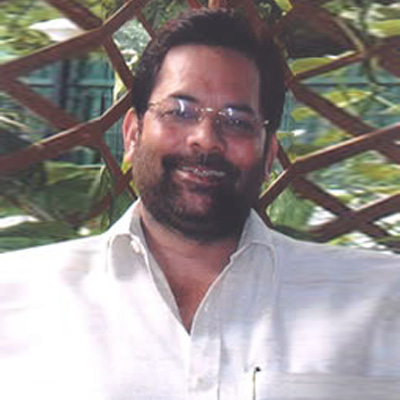
    BJP spokesperson M A Naqvi

    From being a junior minister to former information and broadcasting minister Sushma Swaraj few years back, Mukhtar Abbas Naqvi has come a long way to become one of the young Turks for the Hindu-dominated Bharatiya Janata Party, which has been accused to be having allegedly an agenda against the minorities of the country.

    Though many had thought that the political career of this Muslim leader from Uttar Pradesh would be short-lived after he was shunted out of the government to the party, Naqvi has proved skeptics wrong. Not only has he risen up within the party ranks as one of the general secretaries and a party spokesperson, he was also nominated to the Rajya Sabha by the BJP soon after.

    As part of an integral part of the media cell of the BJP, Naqvi is hopping from one TV studio to another these days in the run up to the general elections. In this interview with indiantelevision.com’s Anjan Mitra in his Delhi residence, Naqvi discusses some of the issues relating to the party’s media and communication strategy for the elections.

    Excerpts:

    On the broad media strategy of the party for the general elections…
    The party is totally geared up for the elections and though some of the things are yet to be fine-tuned, our strategy this time embraces both traditional and new media. Some of the initiatives can already be seen. The total strategy hinges on issues like development, foreign affairs, national security and a sound economy. In short, India Shining. This time we’d fight
    the elections from the sky (through satellite channels) as also on the ground.

    On the people behind the media strategy…
    Every decision is taken with the consent of Prime Minister AB Vajpayee and his deputy LK Advani. But there are certain senior leaders who are core to the strategy. People like party president Venkaiah Naidu and leaders like Pramod (Mahajan), Arun (Jaitley), finance minister Jaswant Singh, Gujarat chief minister Narendra Modi and Sushmaji (Swaraj). Of course, there are inputs from every nook and corner of the party, but the details are fine-tuned by these people.

    On the type of media spend that has been that has earmarked for the general elections.

    The full budget is not yet ready and it’d be difficult also to put a figure to it. In our party such things work at various levels. There is a central media budget, while the state units have their separate funds too. Full information on this is still to come to the party headquarters.

    But I must point out that media speculations on the BJP’s advertising and media budget have put figures on the higher side.

    (A recent news report in a business daily had stated that BJP alone may end up spending close to one billion rupees on its media and communications plan)

    “Technology has made us feel that Internet is a medium that should be tapped”

    On whether TV channels too would form an integral part of the plan…
    TV channels certainly would form an important part of the plan, but we feel that satellite TV’s reach is between 30-35 per cent only. Keeping that in mind, we’d have to use the medium innovatively. Moreover, there is a feeling within the party that taking airtime on news channels only would not serve the purpose. The mass-based entertainment channels too would have to be added to increase the reach of the message.

    But, at this moment, the details of the channels have not been finalized as we are still awaiting a directive from the Election Commission and would also have to wait for the final outcome of the issue of advertising on the electronic medium.

    On the break-up of media share of various segments
    Roughly TV would take up 15 per cent of the media budget, while another 25 per cent would go to the print medium. The rest would be made of other media and initiatives like the Internet, SMS (over cellular phones), promotional stuff aired via video vans, outdoor hoardings (wherever permitted), audio cassettes and cinema halls. The last would be tapped in a big way and some 200 cinema halls round the country have already been identified for this purpose.

    On the two major new areas being tapped for media…
    Technology has made us feel that Internet is a medium that should be tapped. The hows, whys and whens are being worked upon by the techno-savvy ones. (Pramod Mahajan and his team, including his one time OSD, Ajay Singh and Sudhanshu Mittal, are said to be the techno-savvy ones who are coming up with ways to exploit technology and the Net.)

    The second major area could be TV, if the controversies are ironed out.

    On outside professional help being taken this time…
    As always, the core idea comes from within the party that is given a shape and articulated by advertising agencies. There are several of them, including a Mumbai-based firm headed by one Mr Khandelwal, working with us. But most of the catchy lines have been coined in-house till now.

    On whether surrogate advertising, targeting opposition politicians like Sonia Gandhi is in good taste…
    I think everybody is to be blamed. The opposition too has been flooding the media with surrogate advertising questioning the government’s achievements. Whether something is good or bad is subjective and depends on various factors.

  • Speculation rife that Mahajan to replace Swaraj as I&B minister

    Speculation rife that Mahajan to replace Swaraj as I&B minister

    Speculation is rife in the Capital that in the impending reshuffle of the Union Cabinet which Prime Minister AB Vajpayee is slated to undertake over the weekend to be announced around 1 July, information and broadcasting minister Sushma Swaraj may be relieved of her present responsibilities and entrusted with new work.

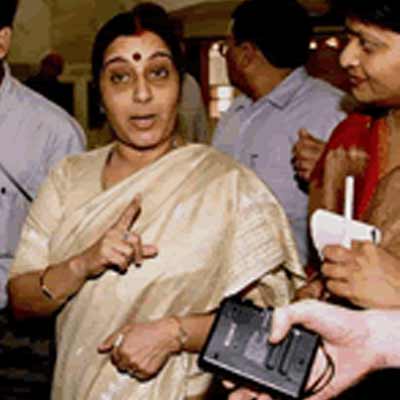
    I&B minister Sushma Swaraj. Is she in or out? Political sources told indiantelevision.com that the front-runner for the I&B minister’s post is information technology, telecommunications and parliamentary affairs minister Pramod Mahajan. 

    “But if Mahajan is given the additional responsibility of I&B ministry also, which will translate into a true “convergence ministry” of sorts, then he is likely to shed the parliamentary affairs portfolio,” a political source close to the Prime Minister said.

    Though Mahajan has held the I&B portfolio earlier too, but if Swaraj exits from the present ministry to take up party work or other responsibilities, then the fate of several issues relating to media will become unknown. 

    In the forefront is the issue of conditional access system (CAS) that Swaraj had been pushing through opposing legislators and political rivals passionately.

    The Bill relating to the amendments to the Cable TV (Networks) Regulation Act 1995, which will pave the way for final implementation of CAS in phases in the country, has been passed by Lok Sabha (the Lower House of Indian Parliament). But awaits the Rajya Sabha’s (Upper House) okay that was earlier expected during the monsoon session of Parliament, beginning 15 July.

    IT, telecommunications and parliamentary affairs minister Pramod Mahajan. Eyeing the I&B portfolio as well?

    “If in the reshuffle Mrs Swaraj is shunted out of the I&B ministry (which as a stand alone ministry has been steadily losing its relevance in the era of convergence being piloted by the telecom sector), then the CAS issue may be buried and forgotten,” said an independent cable operator in New Delhi.

    It is well known that amongst those few who had raised their voices against CAS is Mahajan.

    Political sources also say that in private, of late, Swaraj has been “thinking aloud that the human resources development ministry” would not be a bad place for her to go after the I&B ministry.

    ” But if wishes were horses then the politicians would be on them instead of zipping around in their air-conditioned cars on the busy roads of the capital.

    Points out a political editor of a Calcutta-based newspaper: “Swaraj may want something, but whether that fits in with the gameplan of the Prime Minister is the big question.”