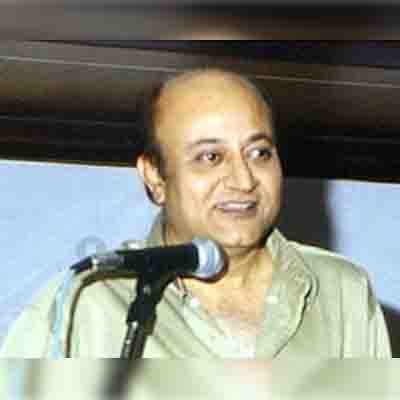
Rakesh Sarang is one of the few cameramen in the industry who have made the transition to direction effortlessly. The fact that his work has been equally appreciated as a director, speaks volumes for Sarang’s talent.
He started off as director in the mid 1990s with the Tracinema comedyV3+ and went on to direct Shatranj, which had an underworld backdrop. Soaps like Aashirwaad, Abhimaan and Kartavya followed. Another high point in Rakesh’s career was Sarhadein, a novel concept that somehow failed to strike the right chord with the audience. After a brief lull, Sarang is now set to strike again with the new one-hour soap on Star Plus, Kehta Hai Dil. The serial, an adaptation of Picket Fences, promises to be engrossing fare, what with its small town setting and issue-driven plots
In the midst of a hectic schedule, Sarang took time off to speak to indiantelevision.com correspondent, Amar.
From being a cameraman, and a well known one at that, how did you get into direction?
My family has always been actively involved with Marathi theatre. My father Kamlakar Sarang was a theatre director while my mother Lalan Sarang is still a theatre actor. I took to theatre at the early age of 12. Till I was 20, I was part of an experimental theatre group in various capacities – I would carry out the lighting, act and later on even got to direct. Thereafter, I took to commercial theatre. A close friend of mine suggested I should learn camera work as my light designing was of a high calibre and so I started assisting a cinematographer on serials. In two years, I became an independent cameraman. Thereafter, while I was working as cameraman on one of Tracinema’s projects, Raman Kumar was impressed by my work and suggested that I take to direction. He gave me my first break with a comedy, V3+. I enjoyed directing and haven’t looked back since.
Which directors have significantly influenced your style?
Vijay Anand has always been my favourite director. I have seen his movies several times over.
Have you picked any stylistic elements from him?
For many years, directing TV serials did not involve any technique. It was largely a medium of close-ups and nobody tried anything different. Of course, in the last two years, given the huge competition, lots of innovations have taken place. As far as I am concerned, instead of imbibing things from other directors, my aim has been to weave together in my directorial efforts the best elements of what I have learnt doing theatre and what I have learnt as a cameraman. This is what gives me a distinctive style of my own.
How important is it to be formally trained in filmmaking?
From the technical point of view, it is definitely important to be trained. But as far as conceiving or visualizing a scene goes, the ability has to be within you. Every story, every block of episodes, every episode and every scene in an episode has to have a graph. The beginning, middle and end points have to be very clear in the director’s mind. I do feel that these things come more through experience or an aptitude for them rather than through training.
|
“The positive side of not having been trained is that my style is totally uninhibited and not bookish. Whatever comes out through instinct or gut feel usually strikes the right chord.”
|
 |
In hindsight, do you regret, by any means, not having undergone formal training in filmmaking or not having assisted any director?
Yes and no. The positive side of not having been trained is that my style is totally uninhibited and not bookish. Whatever comes out through instinct or gut feel usually strikes the right chord.
What are the factors you take into consideration before taking up a new project?
I like to work on limited projects and believe in giving them my best. So, when a project is offered to me I do my own surveys to ascertain whether the project is strong enough to see the light of the day. At present, none of my pilots are lying idle for want of channel approval. The basic criteria I follow in taking up a project is whether the concept is new or path breaking and whether that would go down well with our audience’s sensibilities in the current scenario.
You have always worked with big producers – Tracinema, Siddhant Cinevision and UTV. Has this been by design or is it just a coincidence?
I’m open to working with other producers but the fact is that one tends to feel reassured working with a big time producer. The biggest advantage working with a big producer is that you are not jammed for resources – whether it’s the right locations or the right artistes, both have a bearing on the producer’s budgets. At the same time, any issue that needs to taken up with the channel is addressed speedily.
In spite of being a path-breaking concept, Sarhadein somehow never clicked with our audiences. What went wrong?
The biggest disadvantage for Sarhadein was the slot it got. It started off at 11 pm, by which time a significant chunk of viewers hit the bed. Then it was shifted to 8:00 pm with a re-run of all previous episodes. So, whatever dedicated viewership it had managed initially was also weaned away. In any case, the story of Sarhadein appealed more to the city and metro audiences for whom the 8:00 pm slot was a little too early. The fact that the channel’s viewership by itself was going down only worsened the problem.
 |
“The biggest advantage working with a big producer is that you are not jammed for resources – whether it’s the right locations or the right artistes, both have a bearing on the producer’s budgets”
|
What groundwork did you do for Sarhadein? Did you try to find out the psyche of a typical Pakistani Muslim family and how this family would be disposed towards a counterpart Indian Hindu family?
I spoke to a lot of friends, both Hindus and Muslims in Mumbai, especially those who had an inter-religious marriage and tried to find out how their families had reacted at different stages of their relationship – for instance what the reaction was when they first got to know of their children’s liking for someone who belonged to another religion and how they behaved after the marriage. This proved helpful to me. Otherwise, at least for Sarhadein, I did not feel the need to specifically study the psyche of a Muslim Pakistani family… as the family shown was city-bred and well off, I felt there would not be a big difference between a Muslim Pakistani family and its Indian counterpart in so much as the attitude towards an unconventional marriage went.
Do you prefer directing dailies or weeklies? On hindsight, do you feel Sarhadein could have come out better had it been a weekly, given its huge canvas?
I prefer weeklies because directing a daily today is a battle against time to meet deadlines. Shooting an episode a day eats into your creativity. Yes, most certainly, Sarhadein would have come out better as a weekly. Shooting a daily in unknown foreign locales was one hell of an effort. We canned 16 episodes in Malaysia in 10 days, most of the scenes being outdoor scenes in temperatures around 44 degrees.
What temperamental adjustments do you make between shooting a cross border love story like Sarhadein and a small town issue based story like Kehta Hai Dil?
Well, I have to think in a different pattern. When I started working onSarhadein, the thrust of my thinking was on the violent reactions that the lovers’ parents will show. As against that for Kehta Hai Dill, which is a lighter subject, I try to be more flexible and absorbent in my thought process because every episode I have to deal with a new issue – hit and run, dowry, bigamy, adoption etc. Unless the treatment of each of these issues is fresh, it will not have the desired effect.
How do you handle performances from actors?
Well, there are two ways. Experienced actors like Kanwaljeet or Govind Namdeo basically need a director to bring about some change in their character or get-up. Otherwise, they know their job and what is expected from them. As against that, for a new actor, the director has to be a teacher. The director has to guide him or her on pauses in delivery, movement, body language and even the quantity in which the emotion has to come out.
Do you also edit the work you direct?
I am involved with editing, but I like the editor to first edit the episode himself. When the first draft is out, I suggest corrections.
| “I prefer weeklies because directing a daily today is a battle against time to meet deadlines. Shooting an episode a day eats into your creativity” |  |
Does your experience as cameraman help you in direction?
Well, earlier I used to be the cinematographer as well as director for my serials. In such a case, it definitely helped because I managed to can shots much faster by virtue of knowing how exactly I wanted a shot to be taken. But the cinematography background does sometimes have its disadvantages. I can’t always handle the camerawork for my serials. In such a case, my expectations from my cameraman are rather high and I’m not easily satisfied.
In hindsight, is there any scene you regret shooting and would like to shoot again given a chance?
When I look back at my earlier serials, there are times I feel I could have done it this way or that. But I feel such a thing is only natural as you mature. The shortcomings in my earlier work were not the result of any ineptitude on my part but had to do more with the compromises that are often inevitable on TV – like the budget or the deadline. It is perhaps possible that even today I am not able to give my best shot to a scene due to various unavoidable constraints.
For, Kehta Hai Dil, how exactly have you gone about giving it a small town feel, being shot in Mumbai?
We have identified a location – the RCF colony in Chembur, which has an ideal small town look about it. It has lots of trees and the atmosphere is very serene. Nobody can say that this area is a part of Mumbai. Sixty per cent of the scenes that will depict small town life will be shot here.
What does the future hold for you? Movies?
I will continue to take up projects that excite me and those that I believe in. As far as movies go, I think every TV director has a dream to do movies. But till such time something concrete shapes up, it would be premature to talk about it.
Which has been the happiest moment of your career?
Getting the Screen Videocon Best Director award for Shatranj.