Tag: Aaj Tak

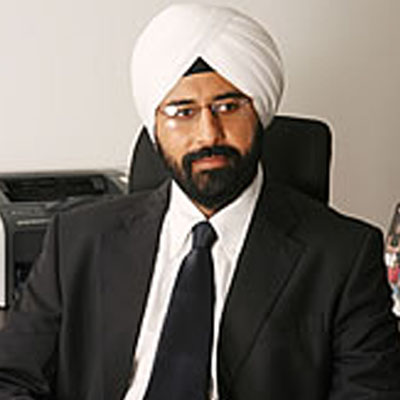
  • ‘We are developing a 100 per cent Indian company’ : G Krishnan – TV Today Network CEO

    ‘We are developing a 100 per cent Indian company’ : G Krishnan – TV Today Network CEO

     TV Today Network Ltd. has been very conservative in expanding its footprint. While TV news organisations Network18 and NDTV Ltd. have scaled up their business model to work out a non news empire, the Aroon Purie-promoted company has stuck to its basic strength of running a string of news channels.

    Holding tight the purse strings, TV Today has stayed a profit-focussed company. Flagship Hindi news channel Aaj Tak continues to be the market leader while Tez and Dilli Aaj Tak are add-on channels serving targeted spaces. English general news channel Headlines Today has got a new positioning of being “refreshingly different.”

    The company intends to merge Radio Today Broadcasting Ltd, a group firm, with itself. TV Today, which currently holds 10 per cent in Radio Today, believes the synergy will help it to pocket local advertising much more efficiently.

    In an interview with Indiantelevision.com’s Sibabrata Das, TV Today Network CEO G Krishnan talks about the company’s plans to launch more news channels to service the need gap while stressing on the need to get it correct.

    Excerpts:

    Why has TV Today been reluctant to scale up like TV18 or NDTV when it is sitting on Rs 1.7 billion of cash on books?
    Some media companies have tied up with international majors to fund their expansion. We are developing a 100 per cent Indian company. But we will have more channel roll outs. We are firming up a robust business plan. We are looking at all possibilities and are taking our time as we want to do it correctly.

    Will you wait for digitalisation to take off in a big way before adding more channels?
    We are studying the feasibility of launching niche channels. Distribution is currently the major cost in the P&L (profit and loss) account. However if we feel there is potential in any space in the long term, we will look at launching channels to service the need gap.

    Isn’t TV Today too dependent on flagship Hindi news channel Aaj Tak with Tez and Dilli Aaj Tak being low-cost channels?
    Media companies tend to depend on a single flagship channel. Star India has Star Plus as the main revenue channel while in case of Zee, it is Zee TV. But Headlines Today is growing and targeted channels like Tez and Dilli Aaj Tak contribute both to our turnover and our profitability. Tez has shorter news wheels while Dilli Aaj Tak is a Delhi/NCR specific Hindi news channel with the content led by utility in the capital region.

    TV Today had floated a wholly owned subsidiary company, TV Today Network (Business) Ltd, a few years back and was talking to American financial and business news major Bloomberg. Are the plans to launch a business news channel still alive?
    Bloomberg was talking to several players at that stage. We are still open to launching a business news channel, with or without partners.

    Are there any big plans for Headlines Today?
    Headlines Today has been on the growth track with the new positioning of “refreshingly different” and targeting the younger audience. We will further consolidate our position and launch more properties to strengthen the various time bands.

    News channels are paying Rs 5 billion as carriage fee. It is for us as a group of broadcasters to see if we can ensure that this doesn’t gallop further

    Do you see a slowdown in the Indian economy affecting the TV news organisations?
    The TV news market, pegged at Rs 10 billion, is growing at 17 per cent. The size of the Hindi news market is Rs 6 billion while English general news channels make about Rs 2 billion. The healthy thing is that each segment is growing. The English business news space will see market expansion when the Times of India Group launches its product in this segment.

    Aren’t a rise in carriage and personnel costs a worrying feature?
    News channels are paying Rs 5 billion as carriage fee. The surge in distribution costs is killing the industry. It is for us as a group of broadcasters to see if we can ensure that this doesn’t gallop further. The personnel cost has not grown at an alarming pace for us in the last fiscal (Rs 552 million compared to Rs 445 million in FY’07). For some networks, though, the rise in costs will be really tough.

    The new players also should stick to reasonable ad rates. Everybody is hoping that good sense would prevail and the market shouldn’t be spoilt.

    TV Today’s revenue jumped 22 per cent to Rs 2.3 billion in FY’08. Was this driven by an ad rate hike and improved utilisation of Headlines Today?
    We had an effective ad rate hike of 12-13 per cent in the last fiscal. We have further increased our rates by 8-9 per cent in July.

    Was the 43 per cent surge in net profit to Rs 435.5 million led by an income in international distribution?
    We made Rs 100 million from international distribution. We plan to take both Aaj Tak and Headlines Today to Canada. We are doing research to assess that market.

    Do you see domestic pay revenues kicking in this year?
    We are a pay channel and are part of the One Alliance bouquet. We have turned pay in select markets as we do not want to lose our viewership and ratings. We will see distribution income grow.

    Zee News Ltd. has started the franchising model to have a footprint in the smaller markets. Do you see this as a growth model you would like to follow?
    We have not explored the franchising model. We feel launching our products directly in the marketplace is a better route.

    TV Today is in the process of merging Radio Today Broadcasting Ltd, a fellow subsidiary company, with itself. Why?
    The radio business will synergise with our TV business. We will tap local advertisers.

    If the government allows news on private FM radio, will we see a radical change in positioning from its current talk show format for women?
    We will have a heavy dose of news. And the synergy will work. When we launch more local channels in other markets, it will add strength to our radio advertising revenues.
    What has been the progress made by the News Broadcasters Association (NBA) on the Content Code?
    The NBA is putting systems in place for a content code based on self-regulation for news television channels. We understand the need for a self-regulatory system and are aggressively pursuing it. We have formed the ‘News Broadcasting Standards (Disputes Redressal) Authority’ to enforce NBA’s code of ethics and broadcasting standards. The authority will become operational from 2 October.
  • Rat-ings race on News TV

    Rat-ings race on News TV

    In a world of 56 news channels, the only objective currency of success is high placing in the rating meters. The battle to beat the ratings means that news channels are constantly ‘experimenting’ and ‘looking for the magic formula’. As one editor points out, “The approach is to hit entertainment TV… to enter the market of Saas Bhi Kabhi Bahu Thi… News is trying to enter into the area consciously… deliberately.” Three genres of news television started specifically as tactics to capture high ratings: reality television, lifestyle shows and crime news.

    Reality television is not an Indian innovation but it has taken an interesting form on news channels here. A case in point is Zee News’ two-hour special on the Gudiya case in late 2004, a programme that the Zee News director proudly refers to as his achievement…

    The week Zee ran the show was the only week it became number one in the ratings that year. The Zee News editor explains the rationale behind the show, “…As far as news is concerned, earlier it was only about politicians. We are changing that. Various kinds of things are now news because the canvas has increased.”

    The rush for ratings was the backdrop to this coverage. Gossip that once might have ended at the village well was now prime-time national viewing. The battle for ratings turned the private tragedy of Gudiya into a public spectacle. Zee wasn’t the only channel to pursue the Gudiya case in this manner. While Zee had her entire family into the studio, other TV channels too rushed reporters who woke up her remaining relatives in her villages at midnight on live television to get sound bytes.

    The Gudiya example spurred similar experiments with reality television in a bid to increase ratings. In January 2006, Channel 7 telecast a live six-hour argument between a divorced mother and her estranged husband in the Middle East over custody rights for their child. The anchor introduced the show as one that took a deep look at social issues and the mother appeaed live with her seven-year-old daughter in tow. The channel then called her estranged husband on telephone and the two argued bitterly over the next six hours, fighting over domestic matters while her underage daughter looked on. She was even asked to comment on who she would like to live with, all in the cold glare in the camera. It was the kind of battle that should have taken place in a divorce court. Here it unfolded on national television, and it wasn’t a one-off. For channel 7, such programming, along with cricket and crime, was the key component of its strategy to register on the ratings.

    It was the quest for ratings that spurred Star News in 2004 to start a new afternoon show called Saas, Bahu aur Saazish. It is a show that seeks to build on the popularity of popular soap opera on Star’s sister channel Star Plus – Kyunki Saas Bhi Kabhi Bahu Thi and Kahaani Ghar Ghar Ki. The storylines of these soaps are based on intrigues within the huge extended families and they have been among the most popular television shows in India since the early 2005…

    The third new genre that Indian television has experimented with is lifestyle programming. In 2003, NDTV started prime time shows called Night Out on NDTV 24X7 and Raat Baaki on NDTV India. These were the daily shows which were anchored live out of a different night club in a different city each day and the idea was to take viewers on a party trip with the hip and the happening. The producers took care to choose a nightclub where famous models or film starts were partying that night, and that was the selling point: party with the stars. The shows proved so popular that all other news channels started similar shows in the time and 2003 became the ‘Year of Night Outs’ in news parlance. Advertisers liked these shows because they brought in new non-news viewers and, more importantly, young viewers.

    After the experiment with party programmes in 2003, news channels turned to crime programming in 2004. Aaj Tak experimented first with a programme called Jurm. Uday Shankar, who was then news director of Aaj Tak, says he got the idea from American television where crime is hugely popular. NDTV followed suit with FIR, Crime and the City, and Dial 100. Zee News started Crime Reporter and Crime File, Sahara aired Hello Control Room and Crime and Punishment. Aaj Tak responded with a second crime show Vardaat and Star News launched Sansani. CNBC India also started a programme on economic crimes.

    The move towards crime shows can be explained by one factor: they fared well on the yardstick of TRPs (television rating points). Zee News’ Crime File in the 10:30- 11 pm slot on Saturday nights registered a 100 per cent jump in ratings over the show in the previous block. Similarly, Red Alert (Star News) showed a 63 per cent jump and Jurm (Aaj Tak) an 18 per cent jump from the previous show. The ratings were much higher than any other genre in Hindi news. And advertisers came in thick and fast. The most remarkable aspect of these shows remains the presentation. There is an overt, overdone bid to create tension with the visuals as well as soundtrack, as though the crime is happening next door. Even the anchors seem to have a certain edge: they speak loudly, menacing voices taut with tension. According to one observer, it is as if “KN Singh, Pran, Ajit, Gulshan Grover, Amrish Puri and other such screen villains have all been rolled into one composite face.” According to one editor, the anchors are deliberately styled in this theatrical manner because their ‘personality helps stylise and package the show.’

    …But television is a complex business and ratings do not always translate into revenues. They do most of the time, but not always.

  • TV Today Q4 net profit up at Rs 135.1 million

    TV Today Q4 net profit up at Rs 135.1 million

    MUMBAI: TV Today Network has posted a standalone net profit of Rs 135.1 million for the quarter ended 31 March 2008, up from Rs 122.6 million in the corresponding quarter last fiscal.

    During the period, the company’s revenue stood at Rs 702.2 million as against Rs 612.6 million in the year ago period.

    TV Today Network’s expense has increased in the quarter to stand at Rs 493.7 million (from Rs 424.2 million). Advertisement, marketing and distribution cost has increased from Rs 92 million to Rs 137.9 million.

    For the entire year ended 31 March 2008, TV Today Network’s net profit has surged 40 per cent to touch Rs 435.5 million from Rs 310.9 million in the year ago period.

    The topline has grown by 24 per cent to Rs 2.51 billion as against Rs 2.02 billion last year.

    During the year, Aaj Tak expanded its international footprint by launching in UK and continental Europe.

    TV Today CEO G Krishnan said, “In spite of a highly competitive market, we are on the growth track. We will continue to deliver value to our investors and advertisers by further expanding the news base.”

  • Aaj Tak’s executive editor Deepak Chaurasia quits

    Aaj Tak’s executive editor Deepak Chaurasia quits

    MUMBAI: Deepak Chaurasia, executive editor and anchor of TV Today’s Hindi news channel Aaj Tak, has put in his papers.

    If the buzz in the market is to be believed, the next port of call for Chaurasia is likely to be Star News. However, Indiantelevision.com could not independently corroborate this at the time of filing this report.

    Earlier, after a long association with Aaj Tak where he was heading the political bureau, Chaurasia had a brief stint in DD News as consulting editor in 2003. After almost nine months he made his way back home to Aaj Tak in July 2004.

  • High Court sacks ESPN Star Sports’ suit against news channels

    High Court sacks ESPN Star Sports’ suit against news channels

    MUMBAI: Delhi High Court on Monday gives a major relief to news channels by dismissing a suit, filed by ESPN Star Sports again them for using footages from Indo-Australian cricket series.

    The suit had sought a restrain on showing footages of the on going cricket series in programmes other than scheduled news bulletins.

    “This suit is not maintainable and hence it is dismissed,” Justice S Ravinder Bhatt said while dismissing the sports broadcaster’s plea, reports PTI.

    ESPN Star Sports had sought a restrain on using footages from matches played, and to be played, including the Tests, T-20 and One-day matches, in programmes other than scheduled news bulletins.

    ESPN-Star had contended that the usage of footages in programmes other than scheduled news bulletins was in violation of ESPN Star Sport’s terms and conditions which say that the footages could only be utilised in scheduled news bulletins for 30 seconds and for a total of two minutes per day, and that too with its permission.

    The sports broadcaster had said that footages were being utilised for programmes of commercial purpose by carrying advertisements.

    It had sought restrain against five news channels– CNN-IBN and its sister channel IBN7, Aaj Tak, Star News, Zee News and NDTV 24X7.

    When contacted by Indiantelevision.com, ESPN officials refused to give any comments.

  • Hindi news channels see tough Muqabala

    Hindi news channels see tough Muqabala

    Lights flashed, cameras rolled, news was created and records made. With no sure route to success, the tussle for bragging rights in the Hindi news space aggravated, with ever more bizarre stories being thrown up. In stark contrast, investigative, true journalism could not collect much by way of worthwhile brownie points on the ratings graph-o-meter. 2007 has indeed been an active year for news channels; sting operations, saas bahu stories, khatarnak baba, Nag Nagin Ki Shaadi, and the like ruling the roast.

    IBN7 managing editor Ashutosh says that this year has clearly shown how ratings and TRPs can affect content.

    NDTV Group director Narayan Rao says, “This was a year when the question was asked as to where the advertisers were putting their money: trash channels or genuine ones. From the limited perspective of a news channel, particularly Hindi news, I can see that a large number of them have gone the tabloid way: the sex-and-violence route.”

    Indiantelevision.com’s analysis of Hindi news channels using Tam data (HSM, C&S 15+, all day parts) during the one-year period beginning January 2007 throws up some interesting insights into the genre while the battle among the players intensifies.

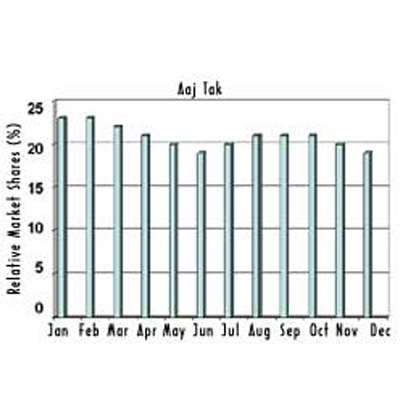
    Refusing to budge from the top position for the ‘golden’ year of Hindi News channels is India Today Group’s Aaj Tak, with an annual average of 20.83 per cent market share. Being the forerunner, it has been consistent in its performance as far as relative market share. Beginning the year with 23 per cent in January, it reached its lowest in the month of June and December with a market share of 19 per cent in both the months. In June it was neck to neck with Star News, but in the month of December it had to finally give way as Star News took over pole position.

    Aaj Tak’s sister concern Tez has also maintained its consistency with an almost constant share of 5 per cent of the market for eight months.

    Aaj Tak news director QW Naqvi says, “As for our channels, it is extremely satisfying that we have retained the number one position despite a virtual dogfight in the TV news market. We are proud to present balanced news content. Though this is a remarkable achievement for Aaj Tak, we are aware of the challenges ahead. A number of new channels coming in the fray and with a growing audience base, it will be our effort to retain our number one position – both in terms of content perfection and market share.”

    A huge attrition seen by Aaj Tak during the year however did not have any direct effect on the score card. Its top rung journalists have made tracks, either to upcoming Hindi news channels or already established ones. Aaj Tak lost its executive editor Punya Prasun Bajpai who switched sides to Samay (then Sahara Samay) as editor-in-chief. Bajpai took along with him a host of other Aaj Tak journalists including anchor and deputy editor Sanjay Bragta and crime bureau chief Nazim Naqvi.

    Aaj Tak executive editor and Mumbai bureau chief Shishir Joshi quit to join Mid Day Multimedia as group directorial editor. Aaj Tak also lost Ram Kripal and Rahul Kulshetra to Triveni Group. While Kripal joined as group editor for their upcoming news channels, Kulshetra will head technical operations.

    With an annual average of 18.08 per cent is News Corp backed Media Content and Communication Services (MCCS)’s Star News, which stands next to Aaj Tak in terms of market share. Star News began the year with 17 per cent market share in January. By mid-year it had picked up 19 per cent. It carved a share of 20 per cent each in the months of September, and October but could not surpass Aaj Tak in the numbers game. December, however, was a good month for Star News as it broke Aaj Tak’s monopoly by getting to the top place with 20 per cent of the market share in its kitty.

    Next in the rung is India TV with an annual average of 13.75 per cent. India TV had 11 per cent in January, but slipped down to 9 per cent in February. From May, India TV joined the race in high spirits with its highest grab of 16 per cent. What followed in the later months was consistence in terms of performance in market share, dabbling between 15 to 16 per cent in the last two quarters of the year.

  • ‘Any attempt to gag freedom of media in garb of regulation has to be resisted’

    ‘Any attempt to gag freedom of media in garb of regulation has to be resisted’

    Television news industry was faced with a dilemma and consequently a huge challenge in the year 2007 – content. Numerous questions were raised on the kind of news that was aired on various news channels. And in some quarters a sense prevailed that television news must regulate itself, as there is a limit to shabby content.

    Self-regulation in itself is not bad. But any attempt to gag the freedom of media in the garb of regulation has to be resisted. No doubt, every freedom comes with a sense of responsibility. Barring a few aberrations, media in our country has fulfilled its duty with diligence. Hence any attempt at forced regulation will be counter-productive. As such free press has been the foundation stone of our thriving and vibrant democracy.

    No doubt, television news industry has grown at such a frantic pace, that it has created certain pitfalls. All out efforts in the past year were made to grab viewership. In this mad race, at times content was compromised and true journalism took a back seat. Compounding this malady, mushrooming news channels tended to water down the impact of many meaningful news reports.

    To buttress my point, I would talk about “Operation Kalank” (Aaj tak-Tehelka exposé on connivance of state administration in sheltering and helping the riot accused in 2002). In a normal news environment this news report would have shaken the foundation of governance in Ahmedabad and Delhi both. But the shelf live of this haunting exposé was hardly a few days. It did shake up the intelligentsia and society for a while, but it was not the topic of discussion in most drawing rooms after even a week. Not much changed either. Even though our channels kept the issue alive for a few days, the story didn’t really move forward. And this I presume is largely due to a variety of news being aired by a host of channels.

    Not just “Operation Kalank”, there was a good story on another channel, portraying a major scandal in UP. That exposé showed how police in UP has surpassed all levels of corruption. For as little as Rs 3,000, police officers were acting as contract killers and shooting down people in the name of ‘encounters’. This was not an insignificant story. Rather it was a crucial expose showing the depths of corruption within our police force. Had this story appeared a few years ago, it would have made national headlines and would have been the talking point for a long time. But in today’s circumstances, it vanished from the scene within days and couldn’t even attract print media’s attention.

    Mushrooming news channels watering down impact of meaningful news reports
    _____****_____

    This has to be attributed to the overcrowding in the TV news space, which has reduced the audience attention span. There are so many news items being dished out that your interest in something of importance vanishes swiftly. Rather to retain audience interest many a times too many stories are being splashed, so that the audience doesn’t move away.

    This was not the case, when a handful of established papers and news channels were in operation some years ago. For example, the much highlighted Maya Tyagi rape case, was covered extensively two decades ago. But today, such incidents barely make up for sustained coverage. This is the price of viewership/readership being paid by journalism.

    But, there have been instances where TV news coverage has led an issue being brought to its logical conclusion. This was highlighted during Jessica Lal murder case and Rizwan ur Rehman suicide case. Such stories found news space on all networks for months together. Increasingly an impression has gained momentum that news reports pertaining to the urban upper middle class finds more space on TV than rural issues like farmers suicide. This can be explained by the logic of market forces. Television audience is mostly urban and news pertaining to urban middle class has greater retention value. Hence to cater to its core audience, television lays more emphasis on urban stories.

    Talking of the year 2007, I feel, the audience has changed its choice and appeal. Issues like corruption don’t appeal to viewers anymore. Maybe people have accepted it as an integral part of our society. Therefore an exposé featuring corruption doesn’t interest the audience, to a large extent.

    The problem with television is that it has only one screen and can show only one story at a time. While a newspaper may have more than 30-40 pages and it can publish many news items on one page. Also it has a luxury to have theme based pages like, national, international, sports, business, regional, henceforth. The reader has the choice to read or skip items or even an entire page that does not interest him/her. If a reader doesn’t find a news item or even some pages of the newspaper of his/her interest, he/ she may skip the news item or that particular page, but he/she will not change the newspaper only because some stories were not of his/her interest.

  • News Channels: Sensation-fatigue, government’s attitude and regional channels will decide future content

    Why has phenomenon of unrestrained inputs developed is one question that if answered well, will rid us of taking moralistic positions. In this the points made by QW Naqvi, News Director at TV Today are pertinent.

    Naqvi says that first there was none, and then there was clutter of private news channels and the clutter will increase as days go by. To cut the clutter, channels did what has been seen in Bollywood in terms of genres of films. Some channel did something, which clicked and all channels started doing the same thing, which became a wave.

    Successive waves of formulae came and went, first family tension-based stories, then crime, then violence and sex and then bhoot-pret and the seemingly ridiculous, as this year the channels bent over backwards to snatch the ephemeral eyeballs from each other.

    Part of the phenomenon is because Indian news channels spend relatively much less money and try to break even fast and run the shortest course, cutting at the corners, but that is only part of the story.

    The other part is that over the past year, lifestyles have vastly changed and worries have shifted in the urban middle class areas from roti-kapda-makaan to a restless quest about how to best entertain themselves. The news channels have been trying to answer that quest for the viewers by experimenting with their own formulae, from serious to sensatonal.

    In this process Aaj Tak itself became a victim, in the sense that it did go over to the sensational, though it did not banish serious news or socially relevant stings that shook the country.

    And here comes the third point: Aaj Tak is – despite the veering away from serious news – doing the best in terms of turnover. What does that show? That advertisers are flocking for the raw hide?

    Quite contrarily, Narayan Rao says that despite sticking to the hard news path, they are today not number three in ratings, but firmly sticking to the number two position in terms of revenue, so what does that show?

    Perhaps the picture will become clearer if we see that despite drawbacks, IBN 7 did reach a point where it had a 14 per cent market share this year, from a lowly six a year ago, and though it could not retain that share that for too long, according to Ashutosh, “this shows that there is scope for serious news”.

    Also, according to industry sources, India TV is far more disadvantaged in revenue terms than its ideological opponent IBN 7, which though it has not broken even is doing better business.

    But the ethical debate in 2007 was really being driven by the fact that there has been a consistent fear in the minds of the CEOs that the vanilla channels with soaring and consistent ratings, would sooner or later bag the big brands, who could shift greater proportions of their spendings to higher rated channels.

    Rating itself has been debated widely this year, especially in the captains in the news channel space, and barring India TV, which says that only those gripe about rating who get the wrong end of the stick, all major channels are today questioning various aspects of rating system of TAM, even while agreeing that it is as of date the industry standard.

    The sample size has been questioned, so has been the possibility of tampering with people metre homes, and also the issue that it is a Western system that does not take into consideration the plurality of Indian society, and even the highest rated channel’s news head, Naqvi too feels that there is need for vast improvements in the system.

    This year, TAM has ruled the market, creating what Sardesai has termed the ‘tyranny of the eyeball-driven marketplace’.

    But then going by the above discussion, where we saw Aaj Tak stay at No. 1 with its mix of the sensational and serious in equal measure, and yet NDTV stay at No. 2 with its insistent on serious journalism, it seems that TRP is not driving revenue flows: it is after all, perceptions, and here is why.

    Let us not forget that Aaj Tak had started out a decade ago as the private sector’s perfect answer to sterilised government reporting on Doordarshan and had been marked by three specific attractions: accuracy and speed and courage. The perception of Aaj Tak as a credible channel that talked a lot more things than the PMs and the CMs had made it a darling of the masses as well as the classes.

    When advertisers today decide on apportioning monies from their budget, their perception of NDTV and Aaj Tak have remained the same, though one changed and the other did not.

  • ‘Any attempt to gag freedom of media in garb of regulation has to be resisted’

    ‘Any attempt to gag freedom of media in garb of regulation has to be resisted’

    But, television viewer has only one option, to change the channel, if he/she doesn’t find the content interesting. Because TV viewers don’t have the option of skipping the news report and watching something else, as they might do with a newspaper. Therefore, at any given time television will have to put the best possible visuals on air. And it has been observed that if the viewer finds the story interesting, he stays on – else he shifts to another channel. So to stay in the rating game a TV channel has to give such content that makes the viewers stick with it.

    Therefore, the point to be noted is that the content on TV is not being controlled by the content maker, i.e, the journalist, but someone else who has the remote control in his hand. Basically the channel surfers, today decides the content and not an avid news watcher.

    Another observation is that news channels behaved like typical Bollywood producers in 2007. That is, if a certain formula was a hit, it was copied and you had a wave of that formula. Likewise in TV news, first came a wave of family drama, matrimonial discord, violence, divorce… People lapped it up. Once the novelty factor was gone, the audience got bored.

    Then came, ghost stories. So one after another channels started showing horror stories. While this content was very short lived, it was also alleged that some of the news reports were concocted. There might be some truth in these allegations, too. Just as it was proved in the Uma Khurana case (where a school teacher from Delhi was made a victim of a fake sting operation). Stories such as these do dent the credibility of the media, but the damage is limited.

    After ghost stories, came the Baba wave. Followed by amazing videos. This was a completely new phenomenon. In these videos, channels showed people doing crazy things. But finally this too seems to be nearing its end.

    Hence I believe that classical news will perhaps never die. Because, it is truly “new”, everyday. It’s unique and touches society. So amazing videos, Baba syndrome, ghost stories are fading in comparison to real news.

    This realisation is both internally generated and induced. Induced, as the government is considering a Broadcast Bill. Yet the handling of the bill raises many questions.

    I have stated earlier – freedom of press comes with some responsibilities. This freedom is critical for nation building. But freedom does not mean anarchy. It is necessary to give deep thought to what impact certain news will have on society. Then why are we opposing the Broadcast Bill? Because when the draft bill was brought out, it became very clear that the government wanted to bring in such a mechanism which can gag the media.

    Amazing videos, Baba syndrome, ghost stories are fading in comparison to real news
    _____****_____

    I strongly feel that self regulation is the need of the hour and to achieve this, we need a truly independent and free media body, with a transparent method of electing its members, which is funded by the media, runs its own independent office, and has some powers to deal with channels that flout guidelines. Currently this responsibility has been undertaken by the News Broadcasters Association, which has brought together editors of all news networks to work on the industry’s content code.

    But one thing is clear. Government can’t gag the media and any ‘regulation mechanism’ which is in the hands of bureaucrats or any such body which is directly or indirectly controlled by the government in any way is not acceptable to us.

    Coming to the issue of the media concentrating on the urban scenario and not doing ‘real’ stories – the rural stories… I do not think this will change vastly. Media will naturally give content that is relevant to the market it addresses. And it is that market which will assess its success or failure. Similarly, the channels will also modify their content as per the market’s needs and response, for instance, it would have been noticed that business content has vanished from most general news channels. While stock market has been hitting the roof, audiences prefer to watch business news channels for this news rather than general news channels. Hence most Hindi news networks did away with their business news bulletins.

    The changed economic reality has tremendously impacted the middle class psyche. Therefore the middle class does not relate to issues that they used to be concerned with a few years ago. So the content mix today cannot be the same as it was a decade ago. The viewer today is different. Plus, we have more than 50 per cent of our population below the age group of 25. Needless to say their taste and psyche is different and this changed reality today dictates the media’s content mix. We found this change quite apparent when Headlines Today showed the wedding of Aishwarya Rai and Abhishek Bachchan. Though it may be termed routine coverage, during these two or three hours, Headlines Today reigned supreme, all other English news channels paled in comparison.

    This changed content mix has dominated Hindi news for a while and we should accept the fact that it is here to stay. Similar will be the scene among English language news channels also, with the growth in audience base. So now we have to cast a new dye for moulding this new content. In today’s world, both technology and market are driving content – just as mobile phones have changed telephony, and sms has changed English.

    As for our channels, it is extremely satisfying that we have retained the number one position despite a virtual dogfight in the TV news market. We are proud to present balanced news content. Though this is a remarkable achievement for Aaj Tak, we are aware of the challenges ahead. A number of new channels coming in the fray and with a growing audience base, it will be our effort to retain our number one position – both in terms of content perfection and market share.

  • ‘Ten Sports’ distribution is open for negotiations’ : Gurjeev Singh Kapoor – Set Discovery head

    ‘Ten Sports’ distribution is open for negotiations’ : Gurjeev Singh Kapoor – Set Discovery head

    Riding high on the ICC World Cup, Set Discovery reaped a harvest of $120 million (around Rs 4.8 billion) in 2006-07.

    The challenges, though, are stiff this year as flagship Hindi general entertainment channel Sony TV is floundering. But direct-to-home (DTH) revenues will start kicking in substantially as subscribers have doubled. And the cricket play is not over yet.

    The One Alliance, Set Discovery’s brand, has recently added three news channels from TV Today including Hindi market leader Aaj Tak. It is also planning to form regional bouquets with presence in Tamil, Telugu and Bengali markets.

    In an interview with Indiantelevision.com’s Sibabrata Das, Set Discovery head Gurjeev Singh Kapoor speaks about the distribution company’s interests in bidding for Ten Sports and HBO as they come up for grabs while chalking out its expansion plans.

    Excerpts:

    Will Set Discovery manage to retain its last fiscal revenue of $120 million in a year where it doesn’t have strong cricketing properties?
    I wouldn’t like to comment on the revenue front. But we would surpass it this fiscal, thanks to DTH (direct-to-home) where the numbers have doubled. We are also close to signing up with Reliance ADAG and Bharti Airtel’s upcoming DTH ventures. We have done IPTV deals with players like IOL Broadband, HFCL and Aksh Optifibre. And don’t forget that Ten Sports had a lineup of live cricket telecast.

    But Ten Sports admits that not having India cricket will affect their ad revenues this fiscal. Won’t this same logic extend to distribution?
    Ten Sports is a good sporting channel for distribution. Though it doesn’t have live India playing content this fiscal, we could capitalise on other cricket as it was exclusive. Having no India cricket may affect advertising. But our experience shows that distribution profits if there is live and exclusive content on the channel. Besides, Ten Sports has WWE which is a good property for distribution.

    Will Ten Sports not slip out of The One Alliance after the term ends in March 2008, particularly after Zee has taken a 50 per cent stake in the sports channel?
    Ten Sports’ distribution is open again for negotiations, despite Zee having taken a 50 per cent stake. The channel strategically helped us in pushing our bouquet and with the ICC World Cup, we had back to back cricketing properties. We gained from the ‘synergy effect.’ We are going to bid for it again. The distribution is up for grabs.

    Why didn’t Sony bid for the ICC World Cup, if it is crucial to have a cricketing property to push distribution bouquets?
    Our experience shows that on the distribution revenue front, it is always good to have 2-3 boards if you are getting live and exclusive cricket. We, undoubtedly, gained in subscription revenue because of the World Cup. But it is also true that we couldn’t encash on smaller markets because the World Cup is a largely shared property. We had to share with Doordarshan the India and other important big matches.

    Which is why Sony bid and took the New Zealand cricket board?
    Our cricket story will not stop there. We are looking at cricketing properties that make business sense for us. The thought process is that we will bid for IPL and other boards that come up for renewals.

    We are actively seeking a regional presence. We are looking at having Tamil, Telugu and Bengali channels

    Sony was in talks to distribute Neo Sports. Did it fail because Neo was asking for very high minimum guarantees?
    We couldn’t agree on the commercial terms. Though Neo has the BCCI rights to international cricket played in India, matches will have to be shared with DD. We felt the asking price was on the higher side.

    Set Disocery has recently signed a pact with TV Today Network to distribute Aaj Tak, Headlines Today and Tej. Will Aaj Tak help you to push Sony TV, which has weakened its position, and Sab TV in the Hindi heartland?
    It will complement our two Hindi general entertainment channels. But more than that, it will open up the Hindi news channels to go pay. Star News and Zee News are virtually free. As Aaj Tak is the No. 1 in its genre, cable operators will now have to understand that Hindi news channels are also pay. Already NDTV India is planning to go pay.

    Our bouquet will have pay channels in every genre. We already had NDTV as the leading English news channel; and with Aaj Tak, we will now have the leader in the Hindi news segment.

    How much of an upside do you see in revenue terms?
    The only way we can ask for more revenues from cable operators is by expanding our content. As we are adding the three TV Today news channels, we are hiking our second bouquet price from Rs 58 to Rs 65. We have a 40-month deal with TV Today which extends across all distribution platforms – cable, DTH, IPTV.

    Is The One Alliance planning to add more channels?
    We will be pitching for English movie channel HBO as its distribution deal with Zee Turner comes up for renewal early next year.

    What about forming regional bouquets?
    We are actively seeking a regional presence. We are eagerly looking at having Tamil, Telugu and Bengali channels. While Andhra Pradesh has an estimated 11 million cable households, in case of Tamil Nadu it is 10 million and West Bengal five million. Even if we manage to convert 50 per cent of that, that is a lot of pay revenues. Kerala is not on our radar as even popular channel Surya is free-to-air.

    Along with the regional channels, we can push our national bouquet more aggressively into these markets.

    Will more existing channels go pay as carriage fee shoots up?
    Several existing channels are looking to go pay fast. Carriage or placement fee is going to shoot up and up as cable networks have no frequency available. Between Star, Set Discovery, Zee Turner and ESPN Star Sports, there are about 70 pay channels. So where is the space on analogue cable. Bandwidth is going to be a big problem for everybody to handle.

    The telecom regulatory authority of India (Trai) has asked for a la carte pricing from broadcasters in non-Cas (conditional access system) areas. Do you see this contributing to more carriage fee?
    If the tariff order sails through, Trai will actually be promoting carriage as a concept. The multi-system operators will charge for carrying the channels while we have to offer them on an a la carte basis.

    Why has Sony moved the Tdsat (Telecom Disputes Redressal and Settlement Tribunal) against the Trai tariff order for non-Cas areas?
    We have two points of contention. Even if broadcasters offer channels on a la carte basis, how do we get paid for the exact number of our subscribers? The other reason is that we will have to reduce the rates of our channels for non-Cas areas. In Cas areas we do so but are compensated in a way because there is exact declaration of subscribers.

    And for whose benefit is this a la carte rate for? How the hell does the consumer benefit as technology won’t allow for a la carte choice of channels without a set-top box?

    If the Trai tariff order for non-Cas areas goes through, it will be a disaster for the broadcasters. It will send bad signals to a new channel wanting to come to India.

    Aren’t broadcasters also unhappy with the progress of Cas?
    For the first time, all of us came under one roof to foster Cas. But what we realised is that MSOs were in a way curbed by the last mile operators who did not want Cas.

    We are concerned about the low penetration of set-top boxes. There was the T20 World Cup on ESPN Star Sports, India won the championship, and it was live and exclusive. How in a Cas market, there was no big upside? This defeats the purpose of Cas and leads to a lot of questions.

    Besides, Trai came out with a particular reporting format, but we haven’t got anything of that from the MSOs. We have no choice but to knock at the doors of Trai. We want the sector regulator to intervene.

    Why aren’t broadcasters joining hands with MSOs to market for set-top box penetration?
    We are willing but the MSOs have internal problems. The last mile operators see a bigger threat from digital cable rather than DTH.


    How do you see new entrants impacting the market?
    Competition is healthy for everybody so long as the new MSOs can invest in technology and have financial stability. If cable monopolies are attacked in towns, it means more choice for customers and more revenues for us.