Tag: a la carte

  • Sanjay Gupta on executing the new tariff regime, Star India’s strategy and channel pricing

    Sanjay Gupta on executing the new tariff regime, Star India’s strategy and channel pricing

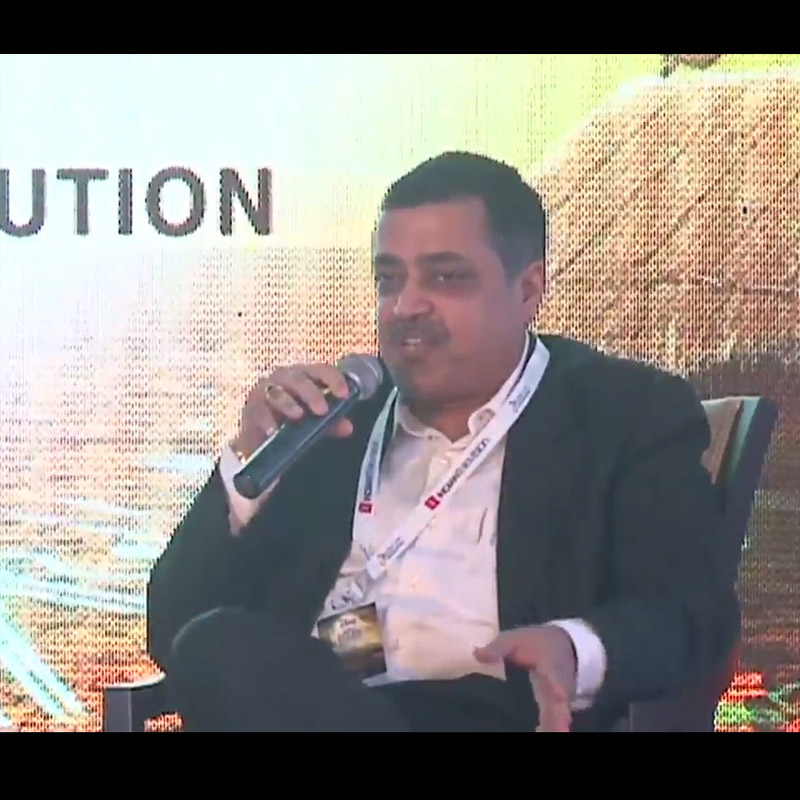
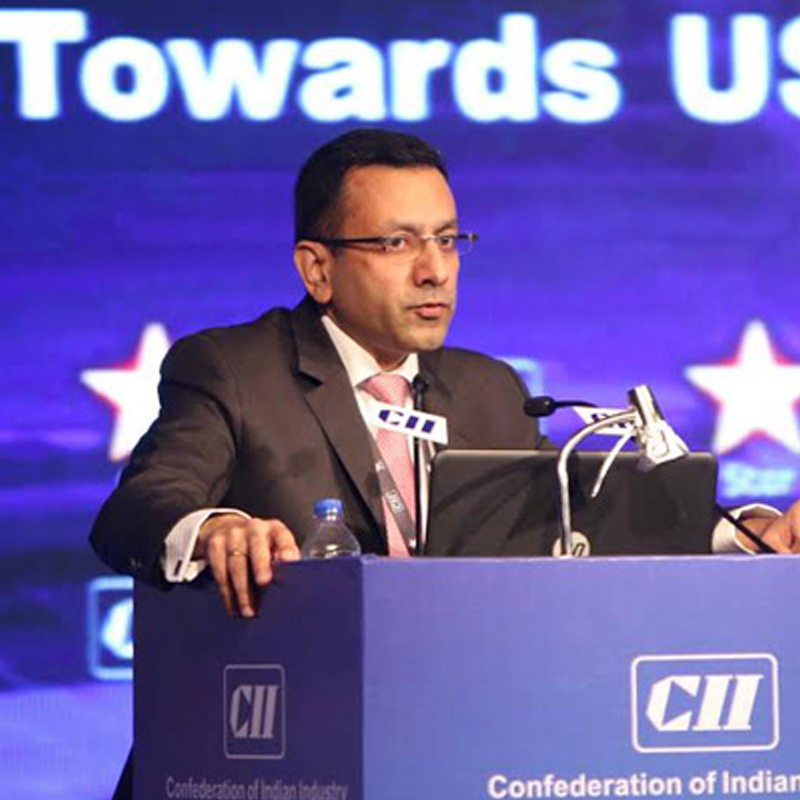
    MUMBAI: Star India MD Sanjay Gupta is a veteran of many high-stake battles. The one he’s currently involved in could be long drawn, unpredictable, unlike anything he’s encountered before and potentially his toughest in a while. However, as India’s broadcast bosses put their heads down to implement TRAI’s new tariff regime, Gupta and Star seem to be first off the blocks. Over the weekend, the network unleashed a nation-wide, multi-media and multi-starrer campaign to educate the consumers across about the radical changes.

    While Star fought the TRAI order tooth and nail in India’s top court, Gupta and team deserve full marks for the sheer scale and speed at which they seem to have got things moving after an unfavourable ruling on 30 October. Gupta says his team at Star is ‘excited’ and sees the new tariff regime as an ‘opportunity’. More power in the hands of the consumer and transparency in the value are the two major highlights as India’s broadcast sector undergoes a facelift, he feels.

    That’s not all. Gupta also articulated his views on Star India’s strategy, channel pricing, disruption in the value chain, the SLP filed by the TRAI in the SC, its implications and more as he fielded wide-ranging questions on a balmy Monday morning on the 37thfloor of Star House.

    On the tariff order’s impact

    The biggest change the tariff order is making is bringing transparency into the whole system of how content gets created to how content gets bought. The biggest change you’re going to see is the transparency, which is existent in almost every industry. It is the biggest shift this industry could have asked for and is great value from a consumer point of view. 

    On preparedness of the system 

    I think people will learn. Over the next two-four weeks, it’ll be an intense learning experience. The good thing in this country is people learn very well quickly. The biggest change in this tariff order is the transparency and power to the consumer.

    On Star India’s strategy

    Our strategy has been in delivering great value to consumers. You know that we invest in making marquee content. Be it our channels in drama, movie, sports, National Geographic or any other content that we deal with. And the question that we ask ourselves is how do we ensure that we provide great value to our consumer through our pricing. We offer content in every geography – be the drama we create with Star Plus and Star Bharat in Hindi, Asianet in Malayalam, Star Vijay in Tamil, we add movies to it in each of the markets, National Geographic – which has some of the best infotainment content to consumers – and on top of it sports. What we are trying to do is make the price affordable to ensure that every consumer has access to this content. Not only do they have power but it is power at a great value from a Star bouquet point of view.

    On channel pricing

    The reason we started the communication early, at Star and IBF, is to let the consumers know that a change is happening. I think it requires a lot of education and communication for people to talk to. To my mind, it’s critical and important. And we wanted to begin early, as early as practically possible. Our price is not led by sports but it is also regionally decided. So, we have a different price in Tamil Nadu as compared to Bengal. Depending on what we think is the strength of our bouquet and the quality of content we are offering. So there is differential pricing like in any business that you decide it regionally and locally. We have a strong channel in Asianet, we have a much weaker channel in Vijay. So we are trying to ensure that consumers get dramatic value in each geography.

    For content with mass requirement, we have tried to make it as cheap as possible within the constraints of the investment we make in each of the businesses.

    On weaker channels

    As I said, the real big change is the power to consumers. They have a choice to decide. Less performing channels cannot come to consumers if they don’t like it. The business will be forced to perform better and better to meet consumer expectations.

    On viewership and ad revenue

    If the channels are powerful and the consumers want you, they will take that option. I think the real question is – Are the channels and content powerful enough? Great content will get viewership. It will force everyone to up their game in terms of the kind of content they offer.

    On TRAI’s SLP in SC

    It is up to the court to decide that. I think now as an SLP is in SC, whenever it gets picked up, the courts will decide. I don’t have a view beyond that. But at this moment, the current ruling is that there is no discount cap. It may change going forward depending on the SC ruling.

    In case the court has a new ruling that discounts have changed, pricing needs to change, both a-la-carte and bouquet pricing in that case, because the distance between them has to be only 15 per cent. I think we are still awaiting the court’s decision and if we need to adapt to it, then we’ll adapt to it. But there will be a shift again in pricing if that comes through.

    On whether distribution chain is ready

    I think we will know closer to time. It is possible that they are all not ready at one time and at that point in time TRAI will have to take a view whether they’ll give more time for people to transit. For now, 29 December is the deadline and we are following the TRAI deadline fully in our intent, in our communication and our effort on ground. In the last few months, we have invested aggressively both in putting together our communication, putting up our pricing on the website, training our teams internally because this is such a massive change. All our internal teams need to get prepared too because this has never been done before. It requires a complete re-understanding within the organisation and briefing our partners.

    On potential change in pricing

    Pricing once defined will remain the same. This is the pricing we have published. People can change their pricing but once consumers pick it up, it applies for the next one year. You can’t change it then. This will also bring about discipline in the industry.

    On the impact on advertisers

    I don’t have a firsthand view on it. But I think this will mean some challenges in implementation. A massive shift of this kind brings out a bit of chaos in the beginning. But I think when I look back – when we went from analogue to digital there were similar concerns, and personally, I carry that worry more than anyone else. But if you look back, it happened more smoothly than what all of us anticipated. Given the enterprise of our partners and consumers, we find solutions to difficult problems quickly. So I think this transition will be a little chaotic but hopefully, it will settle down in a few weeks.

    On disruption in distribution chain

    Consumers are used to buying everything else on MRP and choosing. So, they are used to it across business and categories. It is a big shift for people who deliver content to them, i.e., all of us and distributors – both DTH and cable. I think I personally feel all of them have been working hard over the last few months to prepare.

    On readiness of DPOs

    I think DTH is ready in any case because they do this for a living. DTH covers around 60 million homes. They are fully ready. I think cable is ready from a technology point of view. I think from a people point of view they are getting ready. They have been working hard to get ready. I do hope that given the value this is going to unleash, given the power to consumer this is going to provide, our consumers will really come forward and adopt it and force the transition to happen quickly and smoothly.

    On nature of agreements with DPOs

    Now the nature of agreements is simple – there is no long term agreement. You offer your RIO, which is offered by all content owners on the website. People can download and sign it. Basis the number of consumers that you get every month and the price that you set, you get paid. So it’s a fully transparent way of working for everyone. There is nothing like a long-term agreement anymore.

    On how content will be offered to consumers 

    I think DPOs will decide that. But we are offering to every DPO a-la-carte content and bouquet content both. It’s the same price to DTH and cable. It’s a transparent price to all. They can now choose to make their own bouquets by using a-la-carte channels or they can combine bouquets of different broadcasters. I think that’s the strategy each distributor will define on its own. The interesting thing will be from a consumer point of view, you’ll know everything – what’s the a-la-carte price for a channel, what’s the DPO bouquet and what’s the content bouquet. This kind of transparency has never existed in content business ever before.

    On impact on content offering

    Low performing channels will be under pressure. It will put pressure on content to be better and better. Hence, everybody will have to invest in quality to ensure your channels become better. Content has to work well.

    On consumer awareness

    We have launched a big campaign across eight languages. We are doing a big digital push led by Hotstar and digital assets outside. We are trying to make a very simple communication, at both IBF and Star, to simply explain to consumers what is the change. I’m sure all DPOs and channels are investing equally. The amount of communication consumers will see on this front will be quite significant. So I think communication will be a big draw for both the distribution industry and the content industry in the next few weeks.

    On the relationship between broadcasters and distributors

    One big change that is happening is (and that is the power of the TRAI ruling) that pricing is the same for all distribution partners. There is no difference. It’s equitable and it’s transparent, which means more trust. I think this should help drive a much better and a deeper partnership with the distributors.

    On measuring viewership

    As consumers shift, each of them won’t behave the same way. Each distributor won’t behave the same way. Some of the challenges on measurement would be the sampling, which is an important backbone of any measurement, might go for a toss. Because there are 180 million homes measured through 40 thousand boxes. So if there is chaos in 10 thousand boxes, the ratings may not reflect. Hence the IBF made a request (to not release viewership data for two months) to BARC. Now the BARC board has to decide what the next step should be.

  • Offer Premium channels as a la carte, don’t bundle: TRAI

    Offer Premium channels as a la carte, don’t bundle: TRAI

    NEW DELHI: The Telecom Regulatory Authority of India, which issued draft DAS tariff earlier today, decided that a broadcaster will be free to declare any of its channels as ‘Premium’ so long as its maximum retail price is notified to the subscriber.

    TRAI considered all the issues relevant to the classification and pricing of ‘Premium channels’ recognising the fact that encouragement of quality content through a rational classification and a distinctly different ‘Premium’ pricing policy will benefit all.

    TRAI decided that the premium channels shall be offered only on a-la-carte basis to subscribers and shall not form a part of any bouquet or package in the entire value chain.

    The distributors of television channels will also display MRP of Premium channels in their EPG and also provide a special flag in EPG for easy identification of Premium channels by subscribers.

    It noted that, with a maturing TV audience, a demand was felt for content that may not have a mass following. This is borne by the fact that there have been an increasing number of channels that cater to a niche audience. A number of niche channel issues like redefinition, classification criteria, tariff fixation, gestation and related facets were posed for consultation.

    It noted that most stakeholders responded enthusiastically to the idea of redefining ‘Niche channel’ in the new scenario and their regulation in a manner that is different from mass viewing channels like general entertainment, etc. The stakeholders also expressed concerns about possible misuse if genre price cap is totally withdrawn for certain category of the content while submitting their suggestions for classification of such niche channels.

    TRAI noted that broadcasters provide popular content for mass viewing to get large viewership of their channels, and hence more revenue from advertisements. This has resulted in minimal investments in the development of content which is viewed by a select class of viewers. Such content is not limited to niche channels only; there is other type of content which has a select viewership such as education, health, and women welfare etc.

    The advertisement revenues for Premium channels may also be relatively limited due to the limited viewership. Therefore, TRAI is of the view that the MRP of a premium channel will be under forbearance. It can be argued that forbearance may allow the broadcasters to fix high MRP for premium channels. However, high MRP may deter customers to subscribe to such channels impacting the subscription as well as advertising revenue of a broadcaster. This will compel broadcasters to price their premium channels reasonably.

    The categorization of a ‘Premium channel’ will be agnostic of the content, format (SD/HD etc). Once a broadcaster has reported a channel as a ‘Premium channel’, it will continue to do as long as the broadcaster chooses to, subject to a minimum period of six months. Any reported change in the category of a ‘Premium channel’ to other genre would then be subject to the reporting related to the genres and associated ceilings.

  • Offer Premium channels as a la carte, don’t bundle: TRAI

    Offer Premium channels as a la carte, don’t bundle: TRAI

    NEW DELHI: The Telecom Regulatory Authority of India, which issued draft DAS tariff earlier today, decided that a broadcaster will be free to declare any of its channels as ‘Premium’ so long as its maximum retail price is notified to the subscriber.

    TRAI considered all the issues relevant to the classification and pricing of ‘Premium channels’ recognising the fact that encouragement of quality content through a rational classification and a distinctly different ‘Premium’ pricing policy will benefit all.

    TRAI decided that the premium channels shall be offered only on a-la-carte basis to subscribers and shall not form a part of any bouquet or package in the entire value chain.

    The distributors of television channels will also display MRP of Premium channels in their EPG and also provide a special flag in EPG for easy identification of Premium channels by subscribers.

    It noted that, with a maturing TV audience, a demand was felt for content that may not have a mass following. This is borne by the fact that there have been an increasing number of channels that cater to a niche audience. A number of niche channel issues like redefinition, classification criteria, tariff fixation, gestation and related facets were posed for consultation.

    It noted that most stakeholders responded enthusiastically to the idea of redefining ‘Niche channel’ in the new scenario and their regulation in a manner that is different from mass viewing channels like general entertainment, etc. The stakeholders also expressed concerns about possible misuse if genre price cap is totally withdrawn for certain category of the content while submitting their suggestions for classification of such niche channels.

    TRAI noted that broadcasters provide popular content for mass viewing to get large viewership of their channels, and hence more revenue from advertisements. This has resulted in minimal investments in the development of content which is viewed by a select class of viewers. Such content is not limited to niche channels only; there is other type of content which has a select viewership such as education, health, and women welfare etc.

    The advertisement revenues for Premium channels may also be relatively limited due to the limited viewership. Therefore, TRAI is of the view that the MRP of a premium channel will be under forbearance. It can be argued that forbearance may allow the broadcasters to fix high MRP for premium channels. However, high MRP may deter customers to subscribe to such channels impacting the subscription as well as advertising revenue of a broadcaster. This will compel broadcasters to price their premium channels reasonably.

    The categorization of a ‘Premium channel’ will be agnostic of the content, format (SD/HD etc). Once a broadcaster has reported a channel as a ‘Premium channel’, it will continue to do as long as the broadcaster chooses to, subject to a minimum period of six months. Any reported change in the category of a ‘Premium channel’ to other genre would then be subject to the reporting related to the genres and associated ceilings.

  • Going a la carte with Star and Indiacast has helped: Bibhu Prasad Rath

    Going a la carte with Star and Indiacast has helped: Bibhu Prasad Rath

    Bhibu Rath heads one of the small regional cable TV players in the TV distribution business: Ortel Communications. The MSO began as a local player in the state of Odisha. But, it has since spread into neighboring states such as Chattishgarh, West Bengal, Andhra Pradesh and Telangana. In fact, it is one of a handful of cable TV distribution companies which went in for an IPO and are listed on the Bombay Stock Exchange.

    Rath has been with Ortel since 1999 and no one probably knows the company and the business it operates better than he does. Hence, he has focused on building a two-way state-of-the-art communication network enabled for ‘triple play’ services (video, data, and voice capabilities) with control over the ‘last mile’ over the last few years. That regulation has stymied his VoIP ambitions, has not been a stumbling block. In fact, it has emboldened him to move aggressively in the direction of broadband.

    Rath was one of the key note speakers at IDOS 2016 here. And, he had a one-on-one conversation with the Indiantelevision.com CEO and Editor-in-Chief Anil Wanvari. He was forthcoming and transparent on a range of issues. Read on to find out what he had to say:

    Are you at an advantage or disadvantage of being a niche player ?

    It’s a great advantage actually. You need to understand that why we are a regional player.  Because, we have always believed in depth and not in width. So, we are actually a last-mile player unlike other national MSOs. In a lighter vein, in fact, I keep telling people that we are not a MSO, we are the largest LCO. So, if you are  doing a last-mile network, you have limitations of national presence. So, we have consistently focused on the regional markets and, even within regional market, we have consistently focused on Phase III markets – tier 2, tier 3 markets. Not on the metros.  Like we are there in Telangana but not in Hyderabad. So, currently, we are focusing on four states even though we are present in six states  — that is Odisha, Chattisgarh, Andhra Pradesh and Telangana. And, we have a small presence in West Bengal and Madhya Pradesh. So, it gives us a great advantage that we are focused, we are localized, we are last mile, we are going directly to the consumer.

    Your non-Odisha market is around 233,000 subscribers and your major part, that is, 770,000 subscribers, are in Odisha. Is non-Odisha market going to grow or Odisha?

    That’s (non-Odisha) the one which is growing. In March 2015, when we went public we had half a million subs. Today, we are close to 800,000. Our guidance to the market has been — we will get to a million by March 2017.  If you see the growth in the last five quarters — that is four quarters of last year and Q1 of this year — you will see 70-75 per cent incremental growth has come from outside Odisha, and they are mostly in Andhra Pradesh, Telangana and Chhattisgarh. So that’s the trend going to continue and most of the growth will come from outside Odisha.

    Your analog and digital ARPUs are at Rs 141 and Rs 169 a month, but your digital ARPUs have come down. Why is that and where do you see it going?

    Well, digital ARPUs have come down marginally. But, the mix of analog and digital has gone up. So, digital as a percentage of cable TV swap has gone up very significantly in last five quarters. As of June-end, it was 45 per cent. That’s the reason why ARPU has marginally gone down.

    I have a slightly different view from the rest of the people from the industry. We don’t think this is a great ARPU-driven business. You need to realize that this is a wireline business — not wireless like DTH. So, the wireless guys like DTH have an inherent advantage that they can choose and pick their customer. 5,000 customers in Delhi, 50,000 in Odisha – it’s the same for them. We are in the wireline business. We are laying cable in front of homes and its extremely capex-heavy unlike the MSOs model. If you keep aside the STB, the last mile model is capex-heavy as compared to the MSO-LCO model, because a large part of the network is actually built by the LCO. Whereas, here we deal with it ourselves.

    Now, say, you network 100 homes. My objective is to get as as many of these 100 homes as I can as my customers instead of trying to raise my ARPU by Rs 10. I would prefer to operate at a moderate to low ARPU but I increase my market share and penetration ratio and make up through the number of customers than trying to increase the ARPUs.  So, if you see my penetration ratio: 770,000 customers I have 1.2 million home passes – that is like 60 per cent. To my mind that is a more important metric in the business than just the ARPU numbers. Having said that ARPU will increase – but only marginally, I am not a great believer invery high level of ARPU increase.

    Even in the context of digitization, I kept saying that its objective is not to increase ARPU. Why would the government and the regulator do something wherein the cost to the customer would go up? That’s just the antithesis of what the government does. The government would like to do what helps the consumers, and what helps the consumers is to give them choice, not raise prices.

    So, in doing digitization, give the choice to the consumer — let the consumer pick up at Rs 99, and let someone else pick up at Rs 500. Let your average be at Rs 150-200. Hence, we operate at high penetration, and moderate ARPUs.

    Being a regional player, do you have enough negotiating power? You recently concluded deals with Star and Indiacast which were challenging. Has it become easier for you to deal with the broadcaster?

    It’s a relationship  with the broadcasters — which has been going on but recently we have tried to bring a major shift in the relationship. The two deals which you mentioned with Indiacast and Star TV – they are two of the top half a dozen bouquets operating in India. What we tried to do actually is we tried to test and implement the true spirit of digitization. This means consumer should decide. Whether he wants a channel or not, he should decide and if he should pay.

    With these two deals, we said we will go a la carte. And, as you know, a la carte prices are extremely high. The effective price that a broadcaster gets from the consumers is typically between 10–15 per cent of a la carte price.

    So, for example, the Star TV bouquet – the a la carte prices are at Rs 200, the bouquet prices are typically at Rs 25-26. Despite the a la carte being high, we decided to try it. And we decided to offer it to our viewers and consumers, and allowed them to decide. And, to my surprise, the results have been fantastic.

    Being a last mile model, I don’t have issues of packaging, etc. So, we have complete packaging on our network. We have a backend which can activate a channel. A consumer can send an SMS and get his channel in two minutes via a call centre as well. The payout to me has come down significantly – very significantly — on these two bouquets. But, for consumers, it has gone up, for some it has gone down. So, it’s working very well. This is the way forward. Having done these two deals, I don’t want to do any more soon. I would like to stabilize these two first.

    Has your revenue been impacted because of this?

    Not at all, because when you put a channel on a la carte, there are two models that have been implemented. One is we have put a la carte add-on – that is consumers pay and take it. In another experiment I did, I just threw open the channels to consumers. I said you don’t have to pay anything extra, just decide what you want.  There are
    consumers who will be happy to pay a significant amount for the channels like Fox Life, CNBC, TLC and that’s beauty of doing a la carte, instead of dumping a CNBC channel on the entire base.

    In our markets, 90-95 per cent of the viewers don’t watch CNBC or Fox Life. Why should I dump it? Instead, let me give it to these 2-3 per cent consumers, and let them pay.

    So my revenue has not gone down and my costs have reduced. I am even ready to let go my revenue because these two are interrelated. Whether I increase the ARPU by Rs 10  or I reduce my cost by Rs 10, it doesn’t matter to my ROC. The whole idea is to move on to a pass on the model where consumers decide. The revenue may increase or decrease, only time will tell.

    The MIB says that 93 per cent of Phase III has been digitized whereas you have stated in your areas it is 50-55 per cent. Where lies the truth?

    I don’t want to comment on the MIB numbers because I actually don’t know where the numbers are coming from. We are below 50 per cent. As regards the litigation of DAS Phase III, we are one of the guys who went to court and got a stay. And, that hearing for case is coming up in October.

    That does not mean I did not want to digitize. I definitely want to godigital. I definitely want to get to 100 per cent but we wanted time. And, in many parts of the country, analogue was running in the month of January, and it is running even today. And I can safely tell you, if there was no stay order, analogue would have continued for some more time. I wanted legal cover that If I am doing analogue, I am not doing something illegal. I am pursuing digital in the true spirit. And, the offtake of digital has been very good actually. And, I don’t expect the court order to continue for a very long period. Irrespective of what happens in court, I am pursuing it and I will complete digitalization. We are fully committed to it.

    Your content cost has come down to Rs 50 or so is it because of Star and Indiacast deals or is it because of other factors? Do you expect them to go down further?

    I expect content costs to go down little further. It has been the combination of a couple of factors;  it is not because I got better deals with  broadcasters. The content cost has come down is because of two factors — one is the deal with Star TV and Indiacast on a la carte basis. But, this cost will go up in the long run because consumers will adopt more and more channels and we are mentally prepared that this will go up.

    And, at some point, even a la carte may actually exceed and go beyond what I was paying on a fixed-fee model. It will take time. But, we should be prepared to pay more on a la carte model. But, by then, consumers should also take more a la carte channels and my revenue should also go up.

    The other reason is that we are expanding a lot to other markets and, our expansion strategy has been to acquire LCOs  and the local MSOs. So, we basically do a lump sum, lock stock and barrel buyout. And, those guys we take over have been extremely efficient as compared to what we were doing in terms of negotiating with the broadcaster – their costs are low. Their costs essentially get passed on to us. So that counts for a little cheaper price. But, it will increase.

    You will not set up digital headends rather will go with opex model by taking intercity bandwidth. Is it a way forward for smaller players rather than investing in digital headends which are expensive?

    I think it cost around Rs 10 lakhs a year per link – that’s the deal I have.  I am sure Hathway, Den and Siti must be having better deals because of the size.. So we have taken a view that we will go on opex model. It will be like we will have one head end in Odisha and one for Andhra and Telangana  and one for Bengal and Chhattisgarh because they have language issues and content mix is different. That’s the way forward for the smaller guys.  But when you talk about the smaller guys, they may not have multiple locations to take link actually one of the reason the cable community in Phase III and Phase IV are finding difficult to execute digitization is essentially this.

    Because of this in Phase III you have markets with a million population and you have markets with 10,000 population. If you see the list that the government has issued, there are markets with 10,000-15,000 population at the low end. There are some states which have removed those lists and there are some states which never reacted.

    I have seen the Telangana, Andhra Pradesh list. There are homes with 10,00-20,000  population. For 20,000 population places,  that is about 4,000-5,000 homes. Out of this, 1,000 will be on DTH. You will have 3,000-4,000 cable customers. How does one actually do digital? Hathway, DEN, Siti and I can do it. Because, I have many other locations, I can take a link for Rs 10 lakh.

    But, if there is an independent guy, it is simply not possible, not viable from his perspective to set up a headend. The link is not an option for the smaller guys. That is one of the fundamental reasons why there has been a resistance to digitalization in Phase III and Phase IV. So that’s slowly getting sorted out. The link costs are coming down. The headend costs are coming down. The awareness is going up. So I am sure it will happen.

    You are investing  Rs 120 crore in coming year?

    When I did my IPO on 15 March, I had a two-year capex plan for FY-16 and FY-17. For FY-16 and FY-17, my plan was to go from half a million to one million by  FY17. So, to add this 500,000 customers, we had to put a capex of Rs 250 crore in these two years. Maybe this year’s numbers are part of it. So, if you are asking me, where is this going – in video, broadband or cable? In technology, nothing is called video or broadband, everything is based on the packet. So, given that we are a last mile player, our entire money goes into the network or buying out the LCO. And, even when I buy out an LCO, I dismantle the entire network and build my own network. So, the entire money goes into the network, creating the homes passed.

    Your broadband ARPUs are Rs 400. Are they going to up? Are the markets resistant to ARPU hikes in broadband?

    On the broadband side, the story is different. Video operates on a high penetration ratio. Broadband is on low penetration.  And, I believe that Broadband ARPUs will grow faster than cable TV ARPUs. Simply because there is a lot of upgradation change happening in the product itself. Earlier, we were on DOCSIS 2.0. We could provide 10 MBPs. Most of the consumers were on 512 KBPs or 1 MBPS or 2 MBPS. Now we have started DOCSIS 3.0. The technical spec is 300 MBPs. On the ground, we are able to deliver 100 MBPs. And the offers we have are 10 MBPS, 20 MBPs, 50 MBPS, and 100MBPs. This number is very less. This ratio between DOCSIS 2.0 and DCOSIS 3.0 is going to change. Increasing the speed will obviously lead to more downloads and streaming online. Hence, these ARPUS will increase.

    What we also have been doing is build mobility into the wire line. For example, you have a home wifi modem, you can use it to make your home wireless. You don’t need to put a separate router, the cable models of DOCSIS 3.0 have inbuilt routers. We are also building public hotspots. A KFC or a coffee shop — where consumers spend an hour or so. So you use the public hot spot and use your login and password to continue enjoy all the broadband speeds you enjoy at home. All these factors will lead to our broadband ARPUs going up.

  • Going a la carte with Star and Indiacast has helped: Bibhu Prasad Rath

    Going a la carte with Star and Indiacast has helped: Bibhu Prasad Rath

    Bhibu Rath heads one of the small regional cable TV players in the TV distribution business: Ortel Communications. The MSO began as a local player in the state of Odisha. But, it has since spread into neighboring states such as Chattishgarh, West Bengal, Andhra Pradesh and Telangana. In fact, it is one of a handful of cable TV distribution companies which went in for an IPO and are listed on the Bombay Stock Exchange.

    Rath has been with Ortel since 1999 and no one probably knows the company and the business it operates better than he does. Hence, he has focused on building a two-way state-of-the-art communication network enabled for ‘triple play’ services (video, data, and voice capabilities) with control over the ‘last mile’ over the last few years. That regulation has stymied his VoIP ambitions, has not been a stumbling block. In fact, it has emboldened him to move aggressively in the direction of broadband.

    Rath was one of the key note speakers at IDOS 2016 here. And, he had a one-on-one conversation with the Indiantelevision.com CEO and Editor-in-Chief Anil Wanvari. He was forthcoming and transparent on a range of issues. Read on to find out what he had to say:

    Are you at an advantage or disadvantage of being a niche player ?

    It’s a great advantage actually. You need to understand that why we are a regional player.  Because, we have always believed in depth and not in width. So, we are actually a last-mile player unlike other national MSOs. In a lighter vein, in fact, I keep telling people that we are not a MSO, we are the largest LCO. So, if you are  doing a last-mile network, you have limitations of national presence. So, we have consistently focused on the regional markets and, even within regional market, we have consistently focused on Phase III markets – tier 2, tier 3 markets. Not on the metros.  Like we are there in Telangana but not in Hyderabad. So, currently, we are focusing on four states even though we are present in six states  — that is Odisha, Chattisgarh, Andhra Pradesh and Telangana. And, we have a small presence in West Bengal and Madhya Pradesh. So, it gives us a great advantage that we are focused, we are localized, we are last mile, we are going directly to the consumer.

    Your non-Odisha market is around 233,000 subscribers and your major part, that is, 770,000 subscribers, are in Odisha. Is non-Odisha market going to grow or Odisha?

    That’s (non-Odisha) the one which is growing. In March 2015, when we went public we had half a million subs. Today, we are close to 800,000. Our guidance to the market has been — we will get to a million by March 2017.  If you see the growth in the last five quarters — that is four quarters of last year and Q1 of this year — you will see 70-75 per cent incremental growth has come from outside Odisha, and they are mostly in Andhra Pradesh, Telangana and Chhattisgarh. So that’s the trend going to continue and most of the growth will come from outside Odisha.

    Your analog and digital ARPUs are at Rs 141 and Rs 169 a month, but your digital ARPUs have come down. Why is that and where do you see it going?

    Well, digital ARPUs have come down marginally. But, the mix of analog and digital has gone up. So, digital as a percentage of cable TV swap has gone up very significantly in last five quarters. As of June-end, it was 45 per cent. That’s the reason why ARPU has marginally gone down.

    I have a slightly different view from the rest of the people from the industry. We don’t think this is a great ARPU-driven business. You need to realize that this is a wireline business — not wireless like DTH. So, the wireless guys like DTH have an inherent advantage that they can choose and pick their customer. 5,000 customers in Delhi, 50,000 in Odisha – it’s the same for them. We are in the wireline business. We are laying cable in front of homes and its extremely capex-heavy unlike the MSOs model. If you keep aside the STB, the last mile model is capex-heavy as compared to the MSO-LCO model, because a large part of the network is actually built by the LCO. Whereas, here we deal with it ourselves.

    Now, say, you network 100 homes. My objective is to get as as many of these 100 homes as I can as my customers instead of trying to raise my ARPU by Rs 10. I would prefer to operate at a moderate to low ARPU but I increase my market share and penetration ratio and make up through the number of customers than trying to increase the ARPUs.  So, if you see my penetration ratio: 770,000 customers I have 1.2 million home passes – that is like 60 per cent. To my mind that is a more important metric in the business than just the ARPU numbers. Having said that ARPU will increase – but only marginally, I am not a great believer invery high level of ARPU increase.

    Even in the context of digitization, I kept saying that its objective is not to increase ARPU. Why would the government and the regulator do something wherein the cost to the customer would go up? That’s just the antithesis of what the government does. The government would like to do what helps the consumers, and what helps the consumers is to give them choice, not raise prices.

    So, in doing digitization, give the choice to the consumer — let the consumer pick up at Rs 99, and let someone else pick up at Rs 500. Let your average be at Rs 150-200. Hence, we operate at high penetration, and moderate ARPUs.

    Being a regional player, do you have enough negotiating power? You recently concluded deals with Star and Indiacast which were challenging. Has it become easier for you to deal with the broadcaster?

    It’s a relationship  with the broadcasters — which has been going on but recently we have tried to bring a major shift in the relationship. The two deals which you mentioned with Indiacast and Star TV – they are two of the top half a dozen bouquets operating in India. What we tried to do actually is we tried to test and implement the true spirit of digitization. This means consumer should decide. Whether he wants a channel or not, he should decide and if he should pay.

    With these two deals, we said we will go a la carte. And, as you know, a la carte prices are extremely high. The effective price that a broadcaster gets from the consumers is typically between 10–15 per cent of a la carte price.

    So, for example, the Star TV bouquet – the a la carte prices are at Rs 200, the bouquet prices are typically at Rs 25-26. Despite the a la carte being high, we decided to try it. And we decided to offer it to our viewers and consumers, and allowed them to decide. And, to my surprise, the results have been fantastic.

    Being a last mile model, I don’t have issues of packaging, etc. So, we have complete packaging on our network. We have a backend which can activate a channel. A consumer can send an SMS and get his channel in two minutes via a call centre as well. The payout to me has come down significantly – very significantly — on these two bouquets. But, for consumers, it has gone up, for some it has gone down. So, it’s working very well. This is the way forward. Having done these two deals, I don’t want to do any more soon. I would like to stabilize these two first.

    Has your revenue been impacted because of this?

    Not at all, because when you put a channel on a la carte, there are two models that have been implemented. One is we have put a la carte add-on – that is consumers pay and take it. In another experiment I did, I just threw open the channels to consumers. I said you don’t have to pay anything extra, just decide what you want.  There are
    consumers who will be happy to pay a significant amount for the channels like Fox Life, CNBC, TLC and that’s beauty of doing a la carte, instead of dumping a CNBC channel on the entire base.

    In our markets, 90-95 per cent of the viewers don’t watch CNBC or Fox Life. Why should I dump it? Instead, let me give it to these 2-3 per cent consumers, and let them pay.

    So my revenue has not gone down and my costs have reduced. I am even ready to let go my revenue because these two are interrelated. Whether I increase the ARPU by Rs 10  or I reduce my cost by Rs 10, it doesn’t matter to my ROC. The whole idea is to move on to a pass on the model where consumers decide. The revenue may increase or decrease, only time will tell.

    The MIB says that 93 per cent of Phase III has been digitized whereas you have stated in your areas it is 50-55 per cent. Where lies the truth?

    I don’t want to comment on the MIB numbers because I actually don’t know where the numbers are coming from. We are below 50 per cent. As regards the litigation of DAS Phase III, we are one of the guys who went to court and got a stay. And, that hearing for case is coming up in October.

    That does not mean I did not want to digitize. I definitely want to godigital. I definitely want to get to 100 per cent but we wanted time. And, in many parts of the country, analogue was running in the month of January, and it is running even today. And I can safely tell you, if there was no stay order, analogue would have continued for some more time. I wanted legal cover that If I am doing analogue, I am not doing something illegal. I am pursuing digital in the true spirit. And, the offtake of digital has been very good actually. And, I don’t expect the court order to continue for a very long period. Irrespective of what happens in court, I am pursuing it and I will complete digitalization. We are fully committed to it.

    Your content cost has come down to Rs 50 or so is it because of Star and Indiacast deals or is it because of other factors? Do you expect them to go down further?

    I expect content costs to go down little further. It has been the combination of a couple of factors;  it is not because I got better deals with  broadcasters. The content cost has come down is because of two factors — one is the deal with Star TV and Indiacast on a la carte basis. But, this cost will go up in the long run because consumers will adopt more and more channels and we are mentally prepared that this will go up.

    And, at some point, even a la carte may actually exceed and go beyond what I was paying on a fixed-fee model. It will take time. But, we should be prepared to pay more on a la carte model. But, by then, consumers should also take more a la carte channels and my revenue should also go up.

    The other reason is that we are expanding a lot to other markets and, our expansion strategy has been to acquire LCOs  and the local MSOs. So, we basically do a lump sum, lock stock and barrel buyout. And, those guys we take over have been extremely efficient as compared to what we were doing in terms of negotiating with the broadcaster – their costs are low. Their costs essentially get passed on to us. So that counts for a little cheaper price. But, it will increase.

    You will not set up digital headends rather will go with opex model by taking intercity bandwidth. Is it a way forward for smaller players rather than investing in digital headends which are expensive?

    I think it cost around Rs 10 lakhs a year per link – that’s the deal I have.  I am sure Hathway, Den and Siti must be having better deals because of the size.. So we have taken a view that we will go on opex model. It will be like we will have one head end in Odisha and one for Andhra and Telangana  and one for Bengal and Chhattisgarh because they have language issues and content mix is different. That’s the way forward for the smaller guys.  But when you talk about the smaller guys, they may not have multiple locations to take link actually one of the reason the cable community in Phase III and Phase IV are finding difficult to execute digitization is essentially this.

    Because of this in Phase III you have markets with a million population and you have markets with 10,000 population. If you see the list that the government has issued, there are markets with 10,000-15,000 population at the low end. There are some states which have removed those lists and there are some states which never reacted.

    I have seen the Telangana, Andhra Pradesh list. There are homes with 10,00-20,000  population. For 20,000 population places,  that is about 4,000-5,000 homes. Out of this, 1,000 will be on DTH. You will have 3,000-4,000 cable customers. How does one actually do digital? Hathway, DEN, Siti and I can do it. Because, I have many other locations, I can take a link for Rs 10 lakh.

    But, if there is an independent guy, it is simply not possible, not viable from his perspective to set up a headend. The link is not an option for the smaller guys. That is one of the fundamental reasons why there has been a resistance to digitalization in Phase III and Phase IV. So that’s slowly getting sorted out. The link costs are coming down. The headend costs are coming down. The awareness is going up. So I am sure it will happen.

    You are investing  Rs 120 crore in coming year?

    When I did my IPO on 15 March, I had a two-year capex plan for FY-16 and FY-17. For FY-16 and FY-17, my plan was to go from half a million to one million by  FY17. So, to add this 500,000 customers, we had to put a capex of Rs 250 crore in these two years. Maybe this year’s numbers are part of it. So, if you are asking me, where is this going – in video, broadband or cable? In technology, nothing is called video or broadband, everything is based on the packet. So, given that we are a last mile player, our entire money goes into the network or buying out the LCO. And, even when I buy out an LCO, I dismantle the entire network and build my own network. So, the entire money goes into the network, creating the homes passed.

    Your broadband ARPUs are Rs 400. Are they going to up? Are the markets resistant to ARPU hikes in broadband?

    On the broadband side, the story is different. Video operates on a high penetration ratio. Broadband is on low penetration.  And, I believe that Broadband ARPUs will grow faster than cable TV ARPUs. Simply because there is a lot of upgradation change happening in the product itself. Earlier, we were on DOCSIS 2.0. We could provide 10 MBPs. Most of the consumers were on 512 KBPs or 1 MBPS or 2 MBPS. Now we have started DOCSIS 3.0. The technical spec is 300 MBPs. On the ground, we are able to deliver 100 MBPs. And the offers we have are 10 MBPS, 20 MBPs, 50 MBPS, and 100MBPs. This number is very less. This ratio between DOCSIS 2.0 and DCOSIS 3.0 is going to change. Increasing the speed will obviously lead to more downloads and streaming online. Hence, these ARPUS will increase.

    What we also have been doing is build mobility into the wire line. For example, you have a home wifi modem, you can use it to make your home wireless. You don’t need to put a separate router, the cable models of DOCSIS 3.0 have inbuilt routers. We are also building public hotspots. A KFC or a coffee shop — where consumers spend an hour or so. So you use the public hot spot and use your login and password to continue enjoy all the broadband speeds you enjoy at home. All these factors will lead to our broadband ARPUs going up.

  • Hathway launches campaign for new channel packages

    Hathway launches campaign for new channel packages

    MUMBAI: Multi system operator (MSO) Hathway Cable & Datacom is out on a mission: to educate cable TV subscribers about their new power – ‘The power to choose.’ And to spread this message the MSO has come out with three TVCs, print ads and radio jingles. 


    The campaign will use multiple media to inform and educate consumers about the different packages that the MSO has created. The move comes in the wake of broadcaster Star India’s decision to enter into only Reference Interconnect Offer (RIO) deals with MSOs. 


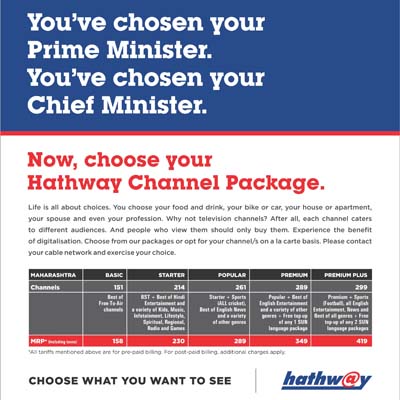
    The five packages for Maharashtra that have been rolled out by Hathway include: 


    · Basic Pack priced at Rs 158: This will have the best of all the free to air channels.


    · Starter priced at Rs 230: This will have best of Hindi entertainment and a variety of kids, music, infotainment, lifestyle, spiritual, regional, radio and games. 


    · Popular priced at Rs 289: This will have channels from Starter pack + sports (all cricket, best of English news and a variety of other genres).


    · Premium priced at Rs 349: This will have channels from Popular pack + bets of English entertainment and a variety of other genres + free top up of any one Sun language package.


    · Premium Plus priced at Rs 419: This will have channels from Premium pack + sports (football, all English Entertainment, news, best of all genres + free top up of any two Sun language package. 


    Conceptualised and created by Gasoline, while one of the TVCs has life reference, the other two are animated. Speaking to Indiantelevision.com, Gasoline founder and chief creative officer Anil Kakar says, “The brief given to us was that the MSO wanted the power of choice to be in the hands of consumers.” 


    The campaign highlights the five different packages as well as the a la carte prices being offered by Hathway. 


    Incidentally, the work on the campaign started in October, which is the same time when Star announced its plan to enter into RIO deals. “While the client wanted life reference, we wanted to bring in animated characters. The reason being that while the message is hard selling, animation makes it light,” informs Kakar. 


    The ad film draws an analogy from contexts wherein a consumer makes a choice. For instance, the first film opens on a lady buying a soap in a soap store. The salesman is seen pushing various soap brands on offer. The lady quips, ‘You aren’t trying to sell the whole store, are you?’ and smiles. Cut to a CG section wherein we see a host of channel logos and a voiceover, which says, ‘We choose everything in life, why not television channels?’  


    The strategy is to communicate the cost-effectiveness of a Hathway package subscription. The campaign extends with a couple of animation films, which demonstrate how a subscription is reasonably priced vis-a-vis other things in life. In the first film, we see a young character in a cafe going through his mobile bills, only to find his café bill more expensive, thus communicating the fact that a monthly subscription to a Hathway channel package is still cheaper than two cups of coffee and a sandwich.


    The radio spot extends the idea further with a groom who is choosing a bride and in another, a waiter rattling off the menu in a rapid-fire sequence. The radio jingles have been co-produced by 94.3 Radio One. 


    The print ad is topical and captivating. It reads: ‘You have chosen your Prime Minister. You have chosen your Chief Minister. Now choose your Hathway channel package.’


    While the TVC will be aired on the Hathway channels, radio ads will be played in Kolkata, South Indian states (except Chennai), Mumbai and Delhi and the print ad will also be published all over India in the mainline newspapers. 


    “The campaign has been designed to ease the life of cable operators, who are facing issues in informing consumers about the packages and its pricing,” concludes Kakar.

  • IMCL introduces prepaid payment options

    IMCL introduces prepaid payment options

    MUMBAI: It was in February 2014, when Tony D’silva took charge as the MD and group CEO of IMCL and laid the vision of adopting a prepaid model. And as the year comes to an end, the dream has been accomplished.

    The multi system operator (MSO) has brought in two important additions in its operations. One, it has introduced prepaid model for all its a-la-carte including Star channels and mini packs for consumers; and two, the MSO has introduced a prepaid system for last mile owners (LMOs) offering packages to their consumers.

     “The prepaid model is applicable for a-la-carte, Star channels and for the mini-packs. So if a consumer wants all the GECs plus sports or English entertainment channels, they can create a mini-pack and can pay for that through our website or by going to the cash counters. We have introduced all the payment modes that are available for recharge of DTH and telecom,” informs D’silva.

    The prepaid model for a-la-carte channels and mini packs was introduced after broadcaster Star India decided to enter into only Reference Interconnect Offer (RIO) deals with MSOs.  

    This apart, a prepaid mode of payment for LMOs selling packages to their consumers has also been introduced from 1 December. “The reason behind this is that the same pack is priced differently in different parts of the city by the LMOs. In this case, we, as MSOs have no control over the pricing given by the LMO and so we decided that the LMO should pay for the packs they give to their consumers upfront to us,” he informs.

     “In case the LMO does not pay for the packs that they give to their consumers, we will either downgrade them or remove all pay channels from them,” adds D’silva.

    It can be noted that MSO Siti Cable too is looking at a similar prepaid model, wherein the LMOs would deposit an advance to the MSO to take signals and then collect the same from the consumer. The LMO according to the prepaid model will get the signals from the MSO till his credit balance remains.  The MSO is testing the viability of the model in Delhi first, and has decided to replicate it in other states, at a later stage.

    According to D’silva, prepaid model of payment is the only way by which the process of monetisation of packages can begin. Talking about the response, he says that of the 2.2 million IMCL subscribers, so far 100,000 subscribers have used the prepaid model. “This shows that the market wants a payment mode like this,” he adds.

    Also from the LMO point of view, as per D’silva, the collection is going good. “This is the only way that cable industry can move,” he opines.  

    So will the prepaid model help increase ARPUs? Says D’silva, “Everything is about packaging and bundling. Nobody watches more than 20 channels, so if I can give these 20 channels at a reasonable price and after that add extra channels of the choice of consumers; it wouldn’t pinch the consumer’s pocket.”


  • Leading MSOs decide to put Star channels on a la carte in Mumbai

    Leading MSOs decide to put Star channels on a la carte in Mumbai

    MUMBAI: The leading multi system operators (MSOs) in Mumbai, except Hathway Cable and Datacom, have agreed to put all Star channels on a la carte. With IndusInd Media and Communications Limited (IMCL) being the first one to agree to the demands of Maharashtra Cable Operators Federation (MCOF), the others including Den Networks, Digicable and Siti Cable have also agreed to give the Star network channels only on viewer’s choice.

    Starting immediately, all the Star channels will go off air from all the platforms. “A landmark decision has been taken today. All the leading MSOs have agreed to put Star channels on a la carte, on the rate published by the broadcaster in the Reference Interconnect Offer (RIO),” informs MCOF president Arvind Prabhoo adding that the MSOs have agreed to forego their share and will sell the channels on the RIO price only.

    “The last mile owner (LMO), depending on the area he is dealing with, will add the collection charges and give it to his customer,” he says.

    As reported earlier by Indiantelevision.com, the cable operators in Mumbai have already started with their surveys to find out which customer wants which Star channels. “We will start informing the customers about the Star channels going a la carte and will switch on those channels which the subscriber wants,” informs Prabhoo adding that the only way to increase the Average Revenue Per User (ARPU) is by putting channels on a la carte.

    With all the other MSOs, at least in Mumbai moving to a la carte, one will have to wait and watch the packaging that Hathway comes up with. “We will be announcing the packages by 1 December,” says a source from Hathway.


  • IMCL has agreed to give Star channels on a la carte, says Arvind Prabhoo

    IMCL has agreed to give Star channels on a la carte, says Arvind Prabhoo

    MUMBAI: When Maharashtra Cable Operators Federation (MCOF) stepped into the office of IndusInd Media & Communications Limited (IMCL) today the agenda was clear: to get the Star network channels on a la carte and to get them to sign the interconnect agreement. 


    “We had a very positive and fruitful meeting with IMCL,” informs MCOF president Arvind Prabhoo.  The multi system operator (MSO) has not only agreed to give Star channels on a la carte, but has decided to even let go of its share on the channel’s pricing. “The MSO has said that until the consumers take the channels, the a la carte price of Star channels will be as per the price mentioned by the broadcaster in its RIO,” says Prabhoo adding that the last mile owner is free to either add his 33 per cent share to the channel pricing or give it to subscribers at subsidized rates.


    The a la carte availability of the Star channels to IMCL subscribers will start immediately. “Since InCable has decided to forego its share, subscribers can get Star Plus at around Rs 15-18, which otherwise could have gone up to Rs 27,” he informs.


    Starting 1 December, MCOF will come up with the exact pricing for the channel. “We will be meeting Siti Cable and Den Networks on 26 November and based on the meeting with them, we will work out a strategy to come up with the exact pricing of the channel,” he says, adding that only 15-16 Star channels are viewed by 75 per cent of the cable TV subscribers in Mumbai.


    “Each LMO is surveying their customers to know the channels of their choice,” informs Prabhoo who has done the same for his 300 customers. The result shows that while 80 per cent of those surveyed want Star Plus, 75 per cent want Star Pravah and 60 per cent want Life OK.


    Not only this, IMCL has also agreed to sign the interconnect agreement. “They could sign it as early as next week,” says Prabhoo. 


    MCOF also met Hathway Cable and Datacom and submitted its charter of demands. “They haven’t revealed their strategy as yet,” he says adding that Hathway will sign the interconnect agreement towards January.  


  • LMOs demand Star channels on a la carte, or face switch off, non-payment of monthly charges

    LMOs demand Star channels on a la carte, or face switch off, non-payment of monthly charges

    MUMBAI: The multi system operators (MSOs) and broadcaster Star India could have moved into the no-war zone, after Star declared that it would give its channels only on the basis of Reference Interconnect Offer (RIO). While this led to MSOs going ahead and declaring that the network’s channels will now be given to consumers only on a la carte, the incentives given by Star, melted most.  Unhappy now are the last mile owners (LMOs), who fear losing their subscribers.


    Leading the way is Maharashtra Cable Operators Federation (MCOF) president Arvind Prabhoo, who today called for a meeting, which was attended by close to 400-500 LMOs. The agenda of the meeting was simple: Getting Star channels only on a la carte.


    “While the MSOs had earlier said that the Star channels will be available on a la carte, suddenly everyone is switching on the Star channels and including it in the existing packs,” informs Prabhoo.


    The LMOs in the meeting took two resolutions. “The first one is that we will meet at least two MSOs tomorrow (25 November) and tell them that they should remove the Star channels from the packages and sell it only on a la carte,” he says.


    MCOF will meet InCable and Hathway Cable and Datacom first and then move on to meeting Siti Cable and Den Networks. “We don’t want any of the Star channels in any of the packs. We will go to our customers and ask them for the channels they want to watch and bill them only for those as per the published a la carte rate,” he adds.


    The LMOs will first request the MSOs to put the channels on a la carte, on immediate basis. “But if this doesn’t happen, we will start switching off the STBs on our own and also will not pay the MSOs the monthly charges,” informs Prabhoo, who says whatever they are demanding is as per the Telecom Regulatory Authority of India (TRAI) regulation.


    The second resolution passed is on the interconnect agreement which was drafted months ago by MCOF as per the suggestion given to TRAI and also accepted by both InCable and Hathway. “Though they had agreed to the interconnect agreement drafted, they have still have not signed it. We are going to ask them to sign it or else have decided not to pay them the monthly charges,” he says.


    According to Prabhoo, the move has been taken as the LMOs are losing their subscribers to the direct to home (DTH) players. “It is getting difficult to manage the business,” concludes Prabhoo.