Tag: 5G

  • DoT & TRAI officials feel satcom policy needs ‘fundamental rethink’

    DoT & TRAI officials feel satcom policy needs ‘fundamental rethink’

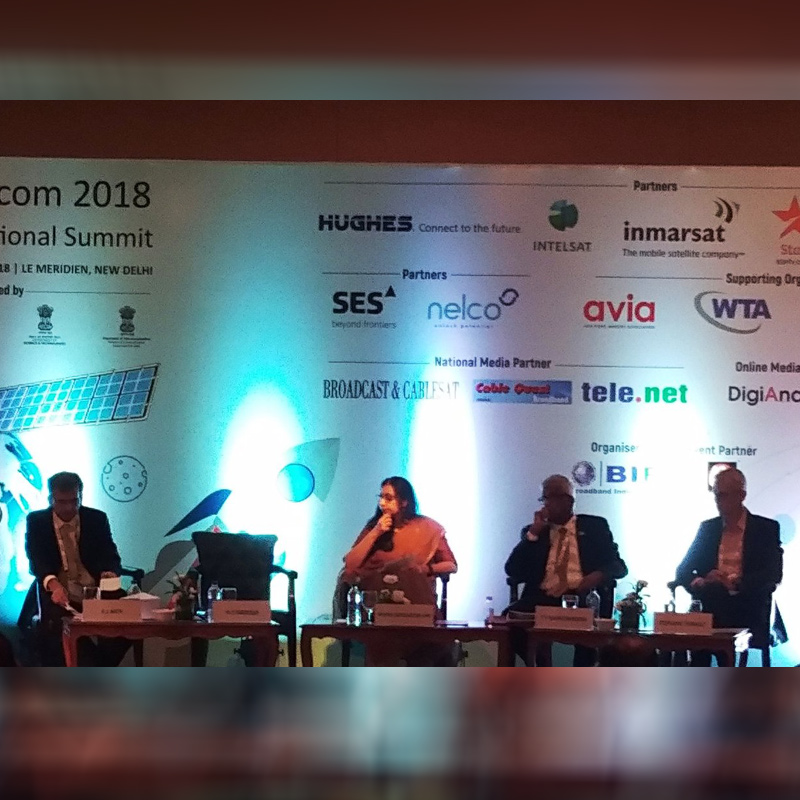
    NEW DELHI: Two top Indian government officials from Telecom Ministry and TRAI feel the country must have a "fundamental rethink" on satellite communication policy to meet rising connectivity needs that are being fuelled by mobile data growth, digital aspirations, demand from the country’s broadcasting sector and advent of new-age technologies.

    Telecom secretary Aruna Sundararajan on Wednesday outlined the massive growth in mobile data consumption, driven by first-time users, and India's increasing digital clout, and said there is "no looking back" for the country when it comes to strengthening its communications infrastructure.

    She said that in an era of 5G and Internet of Things (IoT), the demand for communication infrastructure "far from slowing down, will increase exponentially".

    "We must have digital communications infrastructure that facilitates all this…We really must have a fundamental rethink on India's satcom policy in light of what are the emerging requirements and India's aspirations," Sundararajan said addressing the annual satcom summit 'India SatCom-2018' organised by Broadband India Forum (BIF), a PTI report stated.

    She further said that the demand for communication network is also being propelled by financial service industry, digital payment companies, smartphone usage and social media.

    Sundararajan noted that the draft national digital communications policy aims to provide universal broadband connectivity at 50Mbps to every citizen by 2022, create four million additional jobs, and also talks of enhancing the contribution of digital communications sector to eight per cent of India’s GDP from approximately 6 per cent now.

    "If we are to achieve robust modern digital communications infrastructure that the country needs…it has estimated the need for investment at USD 100 billion. Often, we in government are asked if that is a high figure, but I don't think so…I think this is realistic investment number in sync with our infrastructure requirements," PTI quoted her as saying.

    Stating that the country must embark on comprehensive review of its satellite communications policy, she stressed on the need to strike a balance between autonomy, security and the country's communications demand. "…it is possible to find a sweet spot between these three aspects. Other countries have done so, and I don't think it is impossible for India to strike a calibrated position keeping these three imperatives in mind…Keeping our strategic capabilities and requirements in mind, we need to look at how we can bridge the deficit in term of communication requirements," she pointed out.

    The summit also delved on various aspects of communications, including broadband connectivity to the remote parts of the country, satellite mobility, inflight connectivity, new technologies and innovations.

    Echoing sentiments similar to Sudararajan, telecom and broadcast regulator TRAI secretary SK Gupta, while addressing the valedictory session of the event, opined that “mainstreaming of satcom” issues was heartening.

    Pointing out that satellite transponder allocation process in India “needs a review” and the mechanism an “overhaul”, Gupta said that no regulatory hurdle should be created against use of any technology as satellite communication is very important for various applications and services.

    The one and half day satcom conference saw the convergence of not only ideas and trends, but also of representatives from the industry and government, including those from India’s space agency ISRO, Ministry of Information and Broadcasting and BECIL.

  • India Mobile Congress Day –  2 Run Down

    India Mobile Congress Day – 2 Run Down

    New Delhi: The second day of India Mobile Congress, which is one of the biggest marquee Mobile, Internet, and Technology event for South-East Asia, saw the overwhelming response and attended by more than 18000 people.

    Key Highlights of the Day- 2

    Sessions

    The 2nd day of IMC 2018 started on a high note with the Global CEOs Conclave, which included plenary sessions on subjects such as Networks of Tomorrow, Emerging Technologies, Power of Content, Open Source Technologies etc. Who’s who of the global technology arena came together to deliberate on the future of technology and how it will bring about paradigm shifts in the way we go about our day to day lives.

    The conversational sessions were attended by global speakers such as Mr. Durga Malladi, Senior Vice President, Engineering, Qualcomm, Mr. Sanjay Kaul, President, Asia Pacific and Japan, Service Provider Business, Cisco, Dr. Jay Kim, VP, Samsung Electronics, Mr. Jay Chen, CEO, Huawei India, Dr. Anand Agarwal, Group CEO and Whole-time Director, Sterlite Technologies Limited, Mr. Nunzio Mirtillo, Senior Vice President and Head of Market Area, South East Asia, Oceania & India, Ericsson. The session was moderated by Balesh Sharma, CEO, Vodafone India Limited. They talked about how 5G would be the key drivers for new technologies and innovations. 5G is not just about speed but more about adaptability and flexibility. 5G will enable us to connect many new devices and this will be supported by AI. The next generation networks will be very complex for humans to handle and therefore AI and machines will be needed to manage.

    Panelists included Mr. Pardeep Kohli, President and CEO, Mavenir, Mr. Jim Jefferies, President and CEO, IEEE, Mr. Phil Twist, VP, Networks Marketing and Communications, Nokia, Mrs. Nivruti Rai, VP, Data Center Group, Country Head, Intel India, Mr. Jimmy Mizrahi, GM Global Portfolio, ECI Telecom.

    “Power of Content” was the session which focused on how technology is driving exponential data creation and consumption and how content delivery is going to be paramount in the future. The speakers highlighted the growth in user generated content, even from Tier 2 & 3 cities, where the content is both produced and consumed by consumers themselves.

    The panelists for the session included Mr. Matteo Maga, Managing Director, CMT, Accenture, Mr. Hiren Gada, CEO, Shemaroo Entertainment Limited and Mr. Sameer Batra, CEO, Wynk.

    IEEE-TSDSI 5G Technology and Standards Workshop

    The IEEE-TSDSI 5G workshop brought together technology experts and stakeholders from the Government, Industry, Research and Development Organizations, Academia to discuss emerging trends in 5G technologies, the opportunities and challenges that these pose for a broad spectrum of verticals including tactical and first responder missions, and infrastructure and ecosystem preparedness. The workshop is expected to serve as a catalyst to help define various use cases, drive standards, and investigate deployment issues suitable for 5G networks.

    Mr. Jim Jefferies, President, IEEE mentioned that, "Given the complexity of 5G technology, a successful implementation of this technology would require deep expertise ranging from semiconductor physics, Massive MIMO, Software Defined Networks, Shared Spectrum Access, Wireless Backhaul, Security and Applications to name a few."

    Mr. Jim added that "IEEE through its research and technical depth across its societies and through the IEEE Future Networks along with strong expertise in standards development through IEEE Standards Association will play a key role in driving this next generation technology globally. IEEE is also focusing on the region specific use cases and applications, including specific requirements for success of 5G deployments in India".

    Attendees learnt about and discussed emerging trends in 5G technologies, and the opportunities and challenges that these pose for a broad spectrum of verticals including tactical and first responder missions, and infrastructure and ecosystem preparedness. Ultimately, this workshop will serve as a catalyst to help define various use cases, drive standards and investigate deployment issues suitable for 5G networks.

    Innovation sessions

    Similarly, there were sessions on pro-innovation regulation and privacy, The Emerging World of Analytics, Artificial Intelligence, E-tail – The need of the Future, HealthTech – Age of Cyborgs, Industry 4.0: Building Factories of the Future, M-Education, Value Creation through Digital Marketing, Future of Enterprise, Aadhaar etc.
    Other sessions of Day 2 included discussions around The Emerging World of Analytics: Creating Business Solutions, HealthTech – Age of Cyborgs, Value Creation through Digital Marketing, Artificial Intelligence: Innovation, Investments, Ethics and Responsibilities, Industry 4:0: Building Factories of the Future, Future of Enterprise – Serving the Millennials, Next Generation Devices. Panelists for these sessions included Mr. Sandeep Bhushan, Director and Head Global Marketing Solutions, Facebook, Dr. Praveen Chandra, Chairman of Interventional Cardiology, Medanta, Gurgaon, Ms Sumili Chatterjee, VP and Head Brand, BCCL, Mr. Santanu Bhattacharya, Chief Data Scientist, Bharti Airtel Limited among others.

    Huawei

    Huawei today announced the launch of its OpenLab in India to provide a one-stop ICT infrastructure support for smart city and enterprises digitisation transformation. A testimony to Huawei’s commitment to Government of India’s Digital India agenda, the OpenLab Delhi aims to establish an industry ecosystem and serve as a co-innovation platform for Huawei, its customers and partners, both in India and global, for incubating industry solutions to address the challenges of digital transformation.

    Sterlite Tech

    Sterlite Tech leverages Red Hat technology to enable Programmable Networks of the future

    Sterlite Tech, a global data networks solutions company, announced that it will develop and deliver software-enabled programmable solutions using Red Hat’s portfolio of open, enterprise-grade technologies. The solutions will enable communication service providers, enterprises and citizen networks to realise the full potential of web-scale Network Function Virtualisation Infrastructure (NFVI) platform, for their network automation and Software Defined Network (SDN) initiatives.

    Given the volume and variability in data demand by end users in today’s digital landscape, the networks of today and tomorrow need to be higher-speed, more secure, programmable and more reliable. To enable this, Sterlite Tech will leverage Red Hat’s suite to help develop a solution-stack that is more open and vendor agnostic. This will be set up at Sterlite Tech’s Centre for Smarter Networks (CSN), showcasing its SDN and NFV offerings and next-generation revenue-management software, which builds upon the Red Hat NFV solution.

    Sterlite Tech combines network design innovation, service engineering with FTTx MANTRA

    Sterlite Tech, a global data network solutions company, today launched all new – FTTx MANTRA – an end-to-end FTTx-as-a-service solution. This solution allows swift roll-out of Fibre-to-the-Point (FTTx) networks at the scale, latency and agility needed to suit all future requirements of 5G, Internet of Things (IoT) applications, for global communication service providers, data centres and citizen networks.

    Uniting design innovation and expertise in service engineering onto a single technology platform, the Company’s indigenously developed FTTx MANTRA – Massive Agile Network Transformation, brings together the power of five I’s: Ingenious optical-fibre products, Integrated network design, Innovative virtualisation, Inclusive approach to hyper-scale network deployment, Intelligent software solutions that use analytics and Big Data.

    As consumers’ expectations for a seamless user experience across all devices is on the rise, and with 5G, IoT, Virtual and Augmented Reality on the verge of disrupting the global data consumption, Sterlite Tech has developed this technology to ensure faster and easier fibre infrastructure roll-out to the customers’ end-point. This new hands-on technology assists early adopters to reduce time-to-market of consumer broadband services as well as capital and operational costs of network deployment.

    Sterlite Tech is showcasing its inventive data network capabilities that make up the FTTx MANTRA along with the world’s slimmest 432F Cable, LEAD360 Execution Approach, Network Virtualisation approach with Digital Commerce and Customer Management platform and many other exciting experiences and technologies in Hall B, Booth 1.4 at India Mobile Congress 2018, taking place at Aerocity, New Delhi, India until October 27, 2018.  

    Follow updates on #IMC2018

    For more information please visit us at www.indiamobilecongress.com

    Write to us at:

    Twitter: @exploreIMC

    Facebook: https://www.facebook.com/IndiaMobileCongress
     

  • 5G stole the limelight at IMC 2018 Day 1, with Live Demonstrations

    5G stole the limelight at IMC 2018 Day 1, with Live Demonstrations

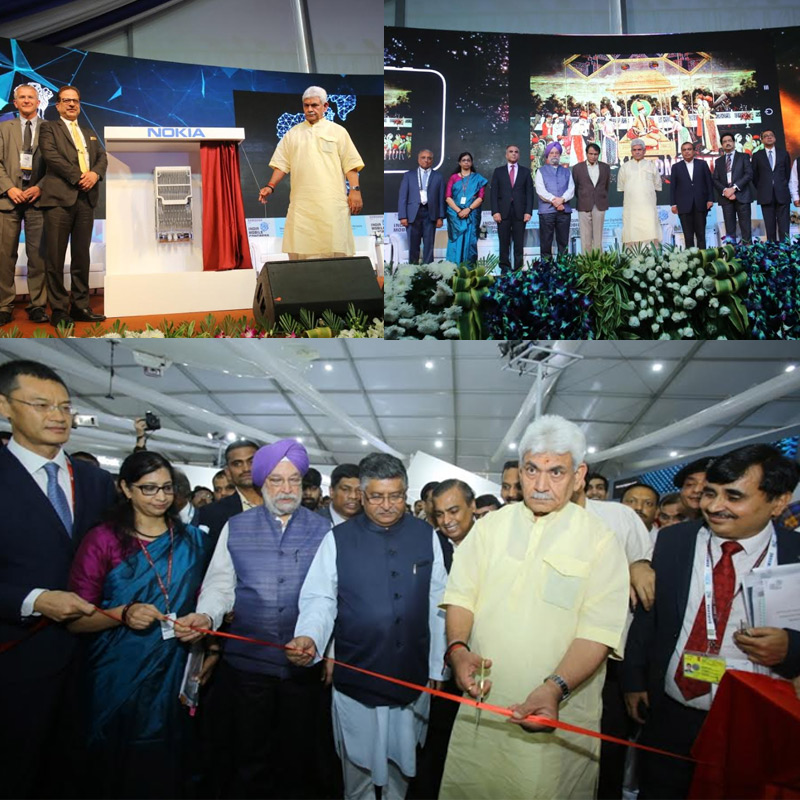
    New Delhi : India Mobile Congress 2018 (IMC 2018), South Asia’s biggest Mobile, Internet and Technology event, kicked-off today amidst much fan-fare at Aerocity, New Delhi. Chief Guest, Shri Manoj Sinha, Hon’ble Minister of State (Independent Charge) for Communications and Minister of State for Railways, inaugurated the event, which is jointly organised by the Department of Telecommunications and COAI. The event witnessed the presence of more than 15,000 people including international exhibitors, media, global speakers and other notable delegates, including several established and budding entrepreneurs.

    While addressing the gathering, Hon’ble Minister Shri Manoj Sinha, stated that the Government would leave no stone unturned in extending its support to India’s ICT and TMT sectors. Apart from showcasing India’s rich technology heritage and the road ahead, the three day event highlighted India’s massive ICT innovation potential and brought to light, several game-changing technologies that will shape India’s digital future in the coming times. The event, themed “New Digital Horizons: Connect, Create, Innovate”, witnessed exemplary participation and support from global information and communications technology companies. The platform saw an impressive international presence with over 300 exhibitors, 2000 CXOs and 190 global speakers.

    Key Highlights of the Day-1

    On Day 1, a number of exhibitors including Reliance Jio Infocomm, Intel, Nokia and Qualcomm participated in 5G trials. This was the first time people could get a glimpse of what is to be expected from 5G in the years to come and how it can affect the scope and development of futuristic technologies. A number of discussions were pivoted around how such technologies will shape India’s digital future. The sessions showcased India’s 5G potential and the numerous unique use cases 5G will have in India. There were live 5G demonstrations by companies such as Nokia, Ericsson, Qualcomm, Reliance Jio infocomm and the like.

    The introductory panel discussion, around the theme – The India Story (Stack 3.0) – Connect, Create, Innovate, was the pick of the conference sessions. The second-half of the day saw a number of interesting and vital discussions on The Evolving Regulatory Landscape in the New Digital Ecosystem-Regulatory Brief, Enabling Futuristic Networks – Reducing complexity to Redefine connectivity, Digital Identity – A revolution or a threat, Connecting the Unconnected – Building Next-Gen ICT Infrastructure for the Masses, Gadgets of Tomorrow – Connected Intelligence, graced by speakers such as Mr. Ajit Pai, Chairman, U.S. Federal Communications Commission, Mr. David Hammarwall, Head of Product Line 5G RAN, Product Area Networks, Ericsson, Mr. Vinayak Godse, Senior Director, Data Security Council of India, Mr. Bimal Dayal, CEO, Indus Towers and Mr. Jonathan Wood, Senior Director, Intel Next Generation and Standards, Intel.

    IMC 2018 also hosted the ASEAN & BIMSTEC Conclave which was addressed by delegates including Shri Manoj Sinha, Hon’ble Minister of State (Independent Charge) for Communications and Minister of State for Railways and 16 other Ministers from ASEAN & BIMSTEC Countries, H.E. Mr. Pichet Durongkaveroj, Hon’ble Minister of Digital Economy and Society, Govt. of Thailand, H.E. Khennavong Bounsaleumsay, Vice Minister, Ministry of Posts and Telecommunications (MPT), Lao PDR, H.E. Thant Sin Maung, Hon'ble, Union Minister of Transport and Communications, Govt. of Myanmar, H.E. Chea Manit, Under Secretary of State, Ministry of Posts & Telecommunications (MPTC), H.E. Tram Iv Tek, Minister of Posts and Telecommunication, H.E. M Shahidul Islam, Secretary General, BIMSTEC. A number of topics curated for consumer interest garnered excitement and enthusiastic participation from the delegates. One such session involved a discussion on “Smart Cities: Automating the way we live”.

    Key highlights of the day:

    Nokia

    Nokia’s state-of-the-art manufacturing unit in Chennai has started manufacturing 5G New Radio (NR) based on the 3GPP 5G New Radio Release 15 standard. It is the factory to start manufacturing 5G radio equipment in India. The Chennai plant is one of the largest telecom equipment manufacturing plant in the country, recently reaching the 4 million units annual production milestone of 2G, 3G and 4G units. It serves both domestic as well as global customers, shipping to over 100 countries.  As part of an on-going program, known as the ‘Conscious** factory’, the Nokia Chennai plant recently implemented the first 'real-world' Smart Manufacturing application of Industry 4.0 in India leveraging solutions such as Augmented and Virtual Reality (AR/VR), connected Robotics, Artificial Intelligence, Big Data Analytics, and Internet of Things to enhance operations and increase productivity.  The plant is equipped with cutting-edge manufacturing technologies, such as the state-of-the-art surface mounting technology, with a capacity of 12.8 billion components every year, 3D automated optical inspection and X-Ray inspection capability.

    Huawei

    Huawei Reiterates Commitment to Bringing 5G to India with Full Range End-to-End Technology Showcase at IMC 2018 – Conducting industry’s first 5G use case demos in partnership with Airtel, Huawei paves ROADS to a fully connected and intelligent world.

    Mr. Randeep Sekhon, Chief Technology Officer, Bharti Airtel said, “Ubiquitous high speed networks will open doors to a digital world that will be full of exciting digital innovations. Having conducted India’s first in-lab 5G test with Huawei, we are delighted to extend our partnership to demonstrate cutting edge AR and VR based use cases for 5G.”

    Follow updates on #IMC2018

    For more information please visit us at www.indiamobilecongress.com

    For more updates please visit:

    Twitter: @exploreIMC

    Instagram: @exploreIMC

    Facebook: http://www.facebook.com/IndiaMobileCongress
    YouTube: https://goo.gl/UcZhCP

  • Telecom sector continues to be highly taxed: Sunil Mittal

    Telecom sector continues to be highly taxed: Sunil Mittal

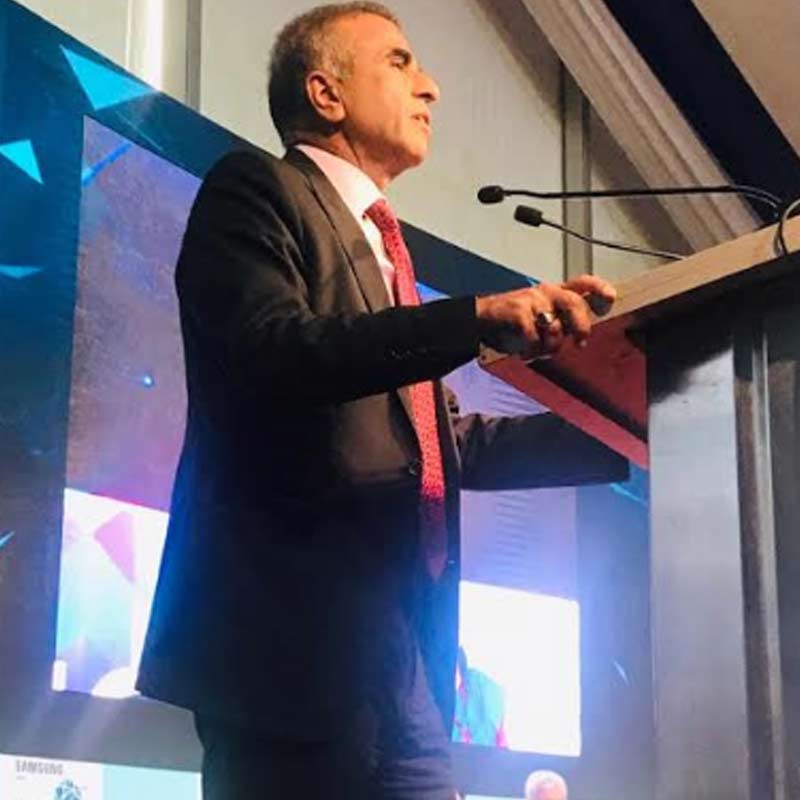
    MUMBAI: Speaking at India Mobile Congress 2018, Bharti Airtel chairman Sunil Mittal said telecom sector continues to be highly-taxed just like the tobacco industry. He also urged that the issue of high levy needs to be resolved and mentioned it as a deterrent to PM Narendra Modi’s digital India vision. He also added that the industry is a heavy capital-intensive industry, requires laying of fibre and heavy investment in networks.

    “Telecom levies are as high as 37 per cent. Spectrum fee and licence fee are very high coupled with GST at 18 per cent,” said Mittal.

    However, he thanked Telecom minister Manoj Sinha and secretary Aruna Sundararajan for the new telecom policy, NDCP 2018, as it includes all important elements. But he also mentioned that the policy clearly acknowledges that revenue maximisation is not the objective.

    "There is also one overarching objective of previous policy and also enshrined in NDCP that revenue maximisation is not the objective…Then why operators and Department of Telecom are under litigation for revenue maximisation," Mittal added.

    He also spoke about the consolidations happening in telecom sector across the world. The consolidation process hasn’t happened in an orderly way in India other than the Vodafone-Idea merger.

    “India's (telecom sector) consolidation hasn't happened in an orderly fashion with $59 billion wiped off, although the merger of Vodafone and Idea has happened and we are happy with that,” Mittal commented.

    Explaining the consolidation trends in other countries, he mentioned China and the US. While the upcoming merger of T-Mobile and Sprint would lead to three telecom players in the US, China is also moving towards a two-player market.

    While he believes India is not lagging behind in adopting 5G technology, he urged the government to come up with consultations on making fibre a national asset.

  • DoT to inquire TRAI about 28 GHz band for 5G service

    DoT to inquire TRAI about 28 GHz band for 5G service

    MUMBAI: The Department of Telecommunications (DoT) is planning to initiate talks for new bands to support 5G services in the country. The DoT will soon start discussing with the telecom regulator TRAI for 28GHz band for 5G commercial deployments. As per Economic Times, the DoT will also analyse pricing estimates of such airwaves.

    The practicability of this spectrum band in the country for 5G is being checked out by the government of India. The government is exploring the chances of allocating the spectrum band in India as very soon after South Korea auctions these airwaves and the US Federal Communications Commission makes a decision to do so from 14 November.

    According to a senior DoT official, “It is mandatory to refer the matter of assessing suitability of a specific bandwidth and its pricing to TRAI (Telecom Regulatory Authority of India), and the government shall do so before taking a call on allocating millimetre spectrum in 28 GHz band for early 5G deployments in India.”

    A panel will be soon formed to study the chances of installing 5G systems in the 28 GHz band and coinciding with the working satellite services in the same band.

    As per the DoT official, the government had been interested in this 5G airwave prospect after a recent meeting of Asia-Pacific Telecommunity wireless group in Bangkok. Globally, 28 GHz is perceived as “a frontier 5G band” and considered very crucial for early 5G deployments.

    TRAI’s proposed base price of Rs 492 crore per unit of 3500 MHz 5G spectrum is higher than the Rs 65 crore a unit of the recent 5G auction in South Korea. Hence, specialists say that Vodafone Idea and Bharti Airtel may skip the 5G spectrum auctions.

  • Lack of uniform policy framework hampering 5G growth in India: Deloitte-CII report

    Lack of uniform policy framework hampering 5G growth in India: Deloitte-CII report

    MUMBAI: A Deloitte-CII report said that the growth of 5G connectivity in India lacks uniform policy framework and will stand as a challenge towards cellular mobile communications.
    “The current regulatory framework for deploying network infrastructure has always been one of the most contentious issues in the industry,” the report said. It also mentioned how the industry is also “crippling under margin pressure”.
    The report expressed “Right of Way” (RoW) and lack of a uniform policy framework as a huge barricade and obstacle to come over to for a positive 5G growth in India.
    Even though, in the year 2016, new RoW rules and methodised processes were introduced, the published report says, “Roadblocks have hampered implementation of the new rules”.
    The report also said how the government has released the National Digital Communication Policy (NDCP) after analysing and looking at the benefits of 5G connectivity. The Union Cabinet had approved the NDCP 2018 on 26 September with the goal to provide “broadband to all”.
    Replacing the National Telecom Policy 2012, NDCP targets to initiate a “comprehensive data protection regime for digital communications that safeguards the privacy, autonomy and choice of individuals and ensure India’s “digital sovereignty”.
    Related to investments on 5G connectivity, the Deloitte-CII report said, “While the investment for 5G would grow incrementally as advancements on existing 4G/LTE technology, with 5G spectrum and network densification needs, it is anticipated that industry might require an additional investment of $60-$70 billion to seamlessly implement 5G networks.”

  • Telcos may skip 5G spectrum auction due to high prices: Fitch Ratings

    Telcos may skip 5G spectrum auction due to high prices: Fitch Ratings

    MUMBAI: Credit rating agency, Fitch Ratings, stated that India’s new National Digital Communication Policy (NDCP) could manage to benefit the telecom sector by making it easier to meet continuous rising data demand and focusing on tax and fee duty on the manufactory.
    5G spectrum auctions could be skipped by the Indian telcos if prices are too high. The Indian telecommunication companies are likely to raise investment in 5G spectrum which directly depends on the 5G spectrum principal price. This can overextend the liabilities on balance sheets of these companies.
    Furthermore, Fitch also explained how private telcos are going to benefit and enlarge their broadband coverage funded by the universal service obligation fund.
    By initiating and creating two million Wi-Fi hotspots in rural areas and another one million in urban areas, the NDCP plans on connecting almost more than 600,000 villages to the digital network. Although, according to Fitch, there are going to be a few execution challenges but it will only lead to broadband adoption rate increasing and going higher.
    The research report also stated that telco costs and red tape could be cut by the NDCP’s plans to review and rationalise the sector’s tax structure and optimise future spectrum asset pricing.
    A Fitch statement read, “Indian telcos face heavy and multiple taxes – including licence fees, spectrum usage charges, and universal service fees on top of expensive spectrum assets. Meanwhile, intense competition has limited telcos’ pricing power. Overall, these pressures have stretched balance sheets”.

  • Cabinet approves new telecom policy

    Cabinet approves new telecom policy

    MUMBAI: New telecom policy branded as the National Digital Communications Policy (http://www.indiantelevision.com/iworld/telecom/new-telecom-policy-may-go-to-cabinet-in-2-weeks-dots-sundararajan-180905) (NDCP) 2018 finally got an approval from the cabinet. The new policy aims to attract USD 100 billion in investment and create 40 lakh jobs in the sector by 2022, PTI reported.

    Providing broadband access to all, creating 40 lakh new jobs, and increasing India’s ranking in the global ICT Index to 50th spot- these are some of the key objectives of NDCP 2018.
    “We also expect GDP contribution of the telecom sector, which has been around six per cent, to grow to 8 per cent… and expect USD 100 billion investment to come in,” communication minister Manoj Sinha said.
    As communication systems have been going through rapid change globally in areas like 5G, Internet of Things and Machine to Machine Communication, Sinha said a “consumer-centric and application-driven policy” was needed to be brought in.
    The new policy(http://www.indiantelevision.com/iworld/telecom/comment-indias-ntp-2018-gets-digital-makeover-but-needs-complimentary-policies-180508) is focused on increasing high-speed broadband penetration, with use of modern technologies like 5G and optical fibres across the country at affordable rates.

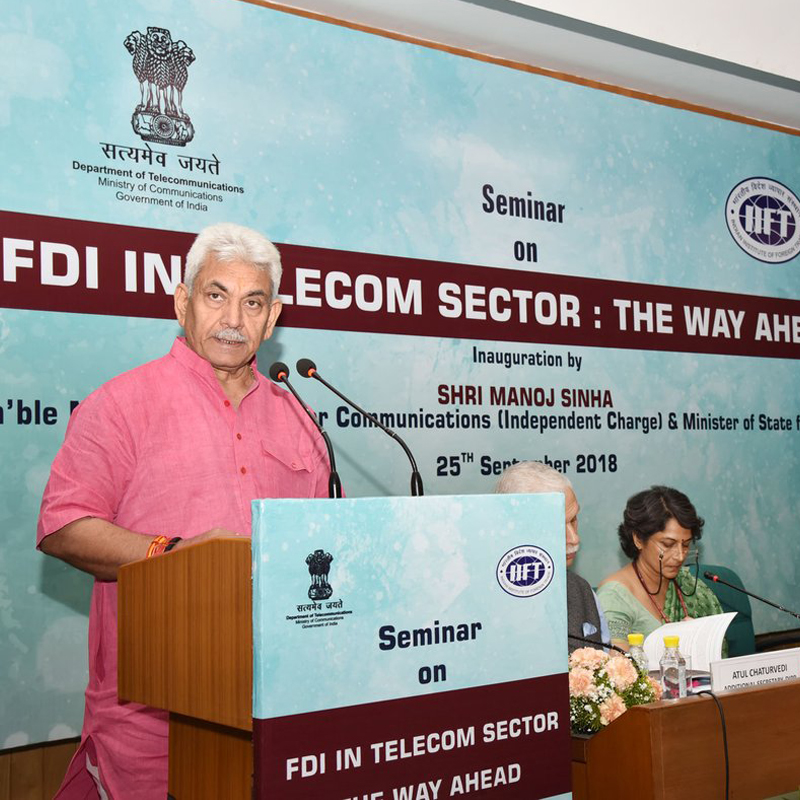
  • FDI in telecom jumped 5X in 3 years

    FDI in telecom jumped 5X in 3 years

    MUMBAI: During the last three years, the Indian telecom sector has not only witnessed major disruptions but also nearly five times jump in foreign direct investment (FDI). While the amount of investment stood at $ 1.3 billion in 2015-16, it reached $ 6.2 billion in 2017-18, Communications minister Manoj Sinha said. The government is also looking at the funding of $100 billion for the draft National Digital Telecommunications Policy.
    “India needs massive investment in developing newer technologies which are accessible and affordable to the people and at the same time creates productive employment. For India to utilise its demographic dividend it is absolutely necessary to create semi-skilled jobs in short run, and the telecom sector will play an important role in creating those employment opportunities,” he added.
    The sector has also seen a few mergers, acquisitions in the same period. Highlighting that, Sinha said consolidation in the sector will strengthen it. He also calls international investors and telecom players to take part in the growth of the sector as Indian economy is back on the growth trajectory.
    He also added India already announced plans to launch commercial 5G networks by the year 2020. The 5G rollout will leave big opportunities for investing in the newer emerging technologies like AI, IoT, data analytics.
    Telecom secretary Aruna Sundararajan was also present at the occasion. She emphasised the fact that foreign investment is necessary to secure scientific, technical and industrial knowledge. The expert pointed out that the telecom sector has always been one of the core sectors attracting highest FDI inflows and overall this trend has been positive for the past two decades.
    “National Digital Communications Policy, 2018, will be the new platform for convergence of all the stakeholders, where we will be working with growth-oriented investment perspective, rather than with fiscal perspective alone,” she added.

  • BSNL ties up with Softbank, NTT for 5G, IoT deal

    BSNL ties up with Softbank, NTT for 5G, IoT deal

    MUMBAI: BSNL, a mobile service provider, has tied up with two top telecom operators of Japan, Softbank and NTT Communications, to roll out 5G and internet of things (IoT) technology in India, according to a report by the Press Trust of India.
    The service provider will partner with Softbank for its satellite constellation which will have around 900 satellites to provide high speed internet services across the globe.
    BSNL chairman and MD Anupam Shrivastava said, “We have signed agreement with Softbank and NTT Communications to roll out 5G and IoT products and services in India. Under the agreement, we will look at solutions specifically for smart cities.”
    Indian telecom operators are aiming to launch 5G in 2020. Operators such as Bharti Airtel, Idea Cellular and Vodafone launched 3G seven years after the technology was available in other foreign markets and 4G services after a four-year lag.
    BSNL has signed an agreement with Finland-based telecom equipment maker Nokia and US-based enterprise networking company Cisco Systems for developing 5G ecosystem and working to finalise test cases for using 5G in India.
    BSNL is in advance stages of starting 5G field trials. The government is in agreement to provide 5G spectrum for trials.

    Earlier media reports said that the Indian government will not auction 5G spectrum in 2018 or 2019 due to weak financial conditions in the Indian telecom market.
    The Telecom Regulatory Authority of India (TRAI) has recommended auction of about 8,644 MHz of telecom frequencies at an estimated base price of Rs 4.9 lakh crore. The government is yet to finalise details of allocation of spectrum for 5G services.