Tag: 5G

  • SES completes C-Band transition ahead of schedule with Harmonic’s XOS Edge Software

    SES completes C-Band transition ahead of schedule with Harmonic’s XOS Edge Software

    Mumbai: Harmonic (NASDAQ: HLIT) has completed technology upgrades associated with SES’s Phase one transition plan for C-band spectrum in just nine months, it announced on Monday.

    This was accomplished utilising Harmonic’s XOS Edge software-based solution for satellite media processing and edge delivery.

    “Tight-knit collaboration between partnering companies led to a successful world-first deployment of software solutions for the transformation of C-band spectrum,” said Harmonic senior vice president – business development Jeremy Rosenberg. “Deploying software on off-the-shelf appliances for both the uplink and at hundreds of affiliate locations enabled rapid completion of this project, exceeding the FCC’s stringent deadline. It is a testament to the flexibility that Harmonic’s edge media processing provides and has opened the door to additional and ongoing opportunities with video programmers for new edge distribution strategies.”

    Harmonic’s XOS Edge media processing solution, integrated with encryption from NAGRA, enables satellite delivery networks to distribute video services with optimised bandwidth and improved quality utilising the inherent flexibility of software.

    “We are excited to lead this transformation for the communications industry and accelerate the path to 5G,” said SES vice president of technology Steve Corda. “Freeing up the 5G spectrum while maintaining the quality and resilience of critical video services was a significant challenge. We can ensure that millions of people across the United States will continue to receive high-quality programming.”

    The project aims at seamless transition for Comcast Technology Services (CTS) and its Managed Satellite Distribution affiliates.

    “The task of freeing up C-band spectrum was massive and complex,” said Comcast Technology Solutions vice president and general manager of the Communications and Technology Provider Suite Allison Olien. “We are in the midst of a significant technology change, and SES and Harmonic provided a clear and streamlined transition path that assures service continuity for our partners and customers.”

  • TRAI seeks suggestions to prevent misuse of fixed broadband licence fee exemption

    TRAI seeks suggestions to prevent misuse of fixed broadband licence fee exemption

    KOLKATA: One of the sectors that received a rapid boost last year amid the work from home scenario was fixed-line broadband. After years of tepid growth, deep-pocketed players, as well as smaller cable operators began increasing focus on the segment as the demand escalated.

    On Wednesday, the Telecom Regulatory Authority (TRAI) issued a supplementary consultation paper in this regard. The paper titled ‘Roadmap to promote broadband connectivity and enhanced broadband’ sought feedback from stakeholders on issues such as incentivisation, licence fee exemption, how to prevent licence misuse and verify revenue from the segment.

    Back in March, the Department of Telecommunications (DoT) wrote a letter seeking consolidated and updated recommendations from TRAI on the proliferation of fixed-line broadband in the country.

    “DoT has raised certain new issues like exemption of the licence fee on the revenues earned from fixed-line broadband keeping in view the current factual matrix and relevant issues, the likelihood of misuse by the licensees through misappropriation of revenues due to the proposed exemption,” TRAI said in an official statement.

    TRAI in 2015 had recommended that the licence fee on the revenues earned on fixed-line broadband should be exempted for at least five years. Apart from misuse of exemption, DoT has asked TRAI to give a reference on if the proliferation of fixed-line broadband services can be better promoted by providing direct benefit to consumers for usage of fixed-line broadband services.

    Although TRAI released two consultation papers on broadband-related issues in 2015, 2020, none of them discussed these issues. Hence, it started the supplementary consultation.

    The latest paper has also invited suggestions on how to permit the use of public places and street furniture for the effective rollout of 5G networks as it would play a significant role in offering good quality services by expanding the network coverage and going closer to the consumers.

    “It is also pertinent to understand the process which can be used by local bodies to grant permissions for use of street furniture and the associated policy and regulatory interventions,” it added.

  • AVIA hosts the Satellite Industry Forum focusing on video in the satellite world

    AVIA hosts the Satellite Industry Forum focusing on video in the satellite world

    KOLKATA: The Asia Video Industry Association (AVIA) will be hosting this year’s Satellite Industry Forum (SIF) as a virtual conference, taking place over two days, from 24 – 25 September, 9.30am – 11.30am (SGT).

    As Asia’s leading satellite conference, the theme of Video in the Satellite World will look at the key conversations driving the industry today, with industry leaders sharing their thoughts on The State of the Satellite Industry with the Impact of COVID-19, a view on Asia with the outcomes from WRC-19, and weighing the Bear vs Bull Case for 5G. There will also be much conversations on the coming year, as we look at Satellite Financing and what to watch for in 2021, if it will truly become the landmark year for 4K UHD, and what will Drive Global Growth for the industry in the next decade.

    Speaking at the Industry Leaders Talk will be Christophe Cazes, CEO of Eutelsat Asia. In this opening panel, Cazes will be sharing his perspectives and predictions on the satellite industry over the course of the coming year.

    “Satellite industry in Asia has been undergoing a big transformation with the emergence of new players and the launch or investment in satellites of new generation. The COVID-19 situation will either be a catalyst or a disruptor of these trends,” said Cazes.

     This year, the conference will also be taking a look at Women in Satellite, a predominantly male industry, for a conversation on their perspectives, challenges and ideas for putting together best practices to strengthen gender equality both in the sector and within our organisations, as well as their perspectives on what the industry might look like in the coming year. This panel will bring together  KISPE Space strategic business manager Anita Bernie; SES Networks SVP global government Nicole Robinson; EMEA Satellite Operators Association (ESOA) secretary general Aarti Holla-Maini; Mynaric USA  president Tina Ghataore.

    “I’ve seen a small shift in women being invited to speak at satellite forums – and not just on topics related to diversity in the industry – but clearly more needs to be done. I look forward to the day when I’m invited to speak and I see around me panelists reflecting both gender and cultural diversity,” commented Ghataore.

    Other key speakers joining the Satellite Industry Forum this year include:

    Marc Halbfinger, CEO, PCCW Global

     Yew Weng Soo, VP sales and market development, SES Video, SES

    Terry Bleakley, regional VP, Asia Pacific, Intelsat

    Shakunt Malhotra, MD, Asia, Globecast

    Roger Tong, CEO, AsiaSat

     Lon Levin, president and CEO, GEOshare

    Alvaro Sanchez, CEO, Integrasys

    Paul Estey, EVP, Customer Relations and Advisor to CEO, Maxar Technologies

     Mark Dankberg, CEO, ViaSat

    The Satellite Industry Forum aims to deliver as close an experience as possible to a physical event. All delegates will be able to enjoy a full event platform which will include access to the live conference sessions, virtual networking opportunities as well as meeting rooms to connect and engage with industry peers during the conference. All sessions will also be available for catch-up viewing on demand after the live event. 

  • 5G remote production: Need of the hour or call of the future

    5G remote production: Need of the hour or call of the future

    Broadcast to mobile is a fascinating concept which came into light in the early 2000s. The mobile networks were busy with offering GPRS based services. The early days saw a variety of mobile broadcast solutions including DVB-H, DMB, DAB-IP, ISDB-T and MediaFLO. The success of such solutions would depend on availability of compatible handsets and broadcasters could not justify huge investment into alternate/parallel network just to deliver content to mobile users.

    As 5G infrastructure garners pace into 2020, the response from media and entertainment industry has been very encouraging in terms of testing and potential adoption of 5G technology. Broadcasters are looking at ways to leverage and capitalize on this next-generation mobile technology. As the internet takes centre stage in content delivery and distribution, 5G will play the role of a catalyst in the growth of both, broadcasters and technology providers.

    Almost 92 per cent of broadcasters are planning to adopt 5G in the next two years(IBC report) and remote production has been identified as a major application of 5G wireless technology. As broadcasters continue to realize the potential of 5G, 65 per cent would imbibe it for remote production and 61 per cent of the broadcasters are willing to adopt 5G for distribution as an alternative to satellite, DTT or cable (OnePoll, Nevion).

    With its unique qualities like mobility, flexibility and reliability, remote production has emerged as the most vital application of 5G technology and could forever change the production workflows of live content such as events, sports and news. 5G has great potential to enable broadcasters to enhance coverage and streamline production by allowing multiple cameras and microphones. 5G will help in managing multiple live events from a central broadcast facility.

    Having said that, the transition to 5G will not be an easy one. It will take immense effort and courage to completely replace centralised production studios and widely popular OB vans with cloud-based workflows. Also, migration from SDI to IP will define the near future production techniques and it will be very interesting to see how 5G merges with these new techniques.

    Ultimately, adoption of 5G will hugely depend on the efficiency of the business model around which it will be built. The revenue-generating power of 5G is yet to be tested and broadcasters must be facing a dichotomy about migrating from the existing model which has been tried and tested for years. Change is the only constant but coexistence is nature’s amazing trait which could possibly lead to 5G complementing existing technologies and create an enhanced ecosystem for the growth of all the relevant stakeholders of the media and entertainment industry.

    (The author is founder and executive director, Planetcast Media Services. The views expressed are his own and Indiantelevision.com may not subscribe to them.)

  • Nokia achieves world-record 5G speeds

    Nokia achieves world-record 5G speeds

    MUMBAI: Nokia has announced it has achieved the world’s fastest 5G speeds in its Over-the-Air (OTA) network in Dallas, Texas. Utilizing 800 MHz of commercial millimeter wave 5G spectrum and Dual Connectivity (EN-DC) functionality, Nokia achieved 5G speeds of up to 4.7 Gbps in tests performed on base station equipment being deployed in major U.S. carriers' commercial networks. This solution will not only provide subscribers with unrivalled mobile broadband speeds, but also enable carriers to sell various latency-sensitive enterprise services, such as network slicing for mission-critical applications.

    The record speed was achieved by combining eight 100 MHz channels of millimeter wave spectrum on the 28 GHz and 39GHz bands, providing 800 MHz of bandwidth, and 40 MHz of LTE spectrum using the EN-DC functionality available on Nokia’s AirScale solution. EN-DC allows devices to connect simultaneously to 5G and LTE networks, transmitting and receiving data across both air-interface technologies. This means devices can achieve a higher throughput than when connecting to 5G or LTE alone. The speeds were achieved on both 5G cloud-based (vRAN) and classic baseband configurations.

    Nokia’s AirScale Radio Access is an industry-leading, commercial end-to-end 5G solution enabling operators globally to capitalize on their 5G spectrum assets. It offers huge capacity scaling and market-leading latency and connectivity by enabling all air-interface technologies on the same radio access equipment.

    Stéphane Téral, chief analyst at LightCounting Market Research, said: “This is a substantial achievement that reflects the careful workings of a brilliant and subtle team with the deepest appreciation for detail and circumstance. In other words, 8-component carrier aggregation in the millimeter wave domain shows the world that there is more than massive MIMO and open RAN to not only truly deliver the promise of commercial 5G, but also pave the way for future Terahertz system.”

    Tommi Uitto, president of Mobile Networks at Nokia, commented: “This is an important and significant milestone in the development of 5G services in the U.S, particularly at a time when connectivity and capacity is so crucial. It demonstrates the confidence operators have in our global end-to-end portfolio and the progress we have made to deliver the best possible 5G experiences to customers. We already supply our mmWave radios to all of the major US carriers and we look forward to continuing to work closely with them moving forward.”
     

  • Airtel collaborates with Cisco to launch India’s first automated ethernet over fibre network

    Airtel collaborates with Cisco to launch India’s first automated ethernet over fibre network

    MUMBAI:  Bharti Airtel (Airtel), India’s largest integrated telco, today announced its collaboration with Cisco to launch India’s largest 5G-ready, 100G IP and optical integrated network designed to enhance network availability, capacity and scale. The deployment is part of Airtel’s initiative to build a 5G ready network that continues to serve the growing demand for high speed data services in the country.

     India is currently the world’s second-largest telecommunications market with a subscriber base of 1.17 billion. Cisco’s recent Annual Internet Report forecasts there will be 67.2 million 5G connections in India by 2023 (4.9 per cent of total mobile connections), and 66 per cent of all devices will be mobile-connected by 2023, (34 per cent will be wired or connected over Wi-Fi).

     Airtel’s network serves over 280 million mobile subscribers across 4G and 2G technologies. This new IP over ethernet over fibre network is the largest hyper-complex brownfield network transformation of its kind in India, collapsing multiple legacy domains to build a flatter, simpler and automated 5G-ready IP network for enhanced customer experiences. It integrates Cisco IP and optical solutions along with segment routing to more easily extend services in rural communities while significantly improving network availability and creating cost efficiencies.

    The simple, flexible and self-healing architecture is built with an agile, programmable and software-defined platform to deliver exponential mobile internet growth. It has already realized significant speeds with scale to enable new, advanced B2B and B2C services. The open standards architecture with automation brings in efficiencies for new and legacy infrastructure, eliminating manual touchpoints in a brownfield environment.

    “Airtel continues to transform its network to ensure greater availability and reach across India to deliver best-in-class mobile experience for our customers,” Bharti Airtel CTO Randeep Sekhon said. “Our ongoing collaboration with Cisco is critical in helping us to be 5G-ready, collapsing multiple legacy domains to build a flatter, simpler and automated network with more bandwidth to support internet services and the endless growth in consumer and business applications people rely on every day,” he added.

    “Airtel is transforming its network to be modern, adaptable and scalable to accommodate the phenomenal mobile growth in India,” Cisco Service Provider Business, India and SAARC managing director Anand Bhaskar said. “Together we are delivering a highly-scalable IP and optical network throughout India that enables broader mobile access to connect more people and more businesses who can do more with the internet."

  • TRAI data shows wireless data revenue, subscribers, ARPU shot up in 2018

    TRAI data shows wireless data revenue, subscribers, ARPU shot up in 2018

    MUMBAI: Wireless data usage in the country is spiking up. According to a report by the Telecom Regulatory Authority of India (TRAI), the total revenue that telecom operators collected through data usage last year was Rs 54,671.44 crore. In 2017, the revenue was Rs 38,882 crore.

    The amount of data consumption from every wireless data subscriber every month was up from 4.13GB in 2017 to 7.69GB in 2018. Simultaneously, the cost to subscriber has also reduced from Rs 19.35 per GB in 2017 to Rs 11.78 in 2018. This can be attributed to the presence of Reliance Jio as a dominant player in bringing down data rates. Additionally, the share of 4G data usage in total volume of wireless data usage has been 86.85 per cent during the year 2018.

    Average revenue per wireless data subscribers (data ARPU) per month increased from Rs 79.98 in the year 2017 to Rs 90.61 in the year 2018. It was recorded Rs 71.25 per wireless data subscriber per month in the year 2014.

    Total wireless data usage more than doubled from 20,092 GB in 2017 to 46,404 GB in 2018. The number of wireless subscribers went from 424.02 million in 2017 to 578.2 million in 2018. This shows an annual growth of 36.36 per cent.

    TRAI’s report states that though 4G adoption is on the rise in India, the world is witnessing even higher levels of data usage through the commercial deployment of 5G technology. Both the government of India and the telecom industry have announced that they have initiated preparatory steps for smooth and efficient rollout of 5G for the benefit of the consumers and the overall economic development of the country.

  • RIL likely to infuse Rs 20,000 cr in Reliance Jio

    RIL likely to infuse Rs 20,000 cr in Reliance Jio

    MUMBAI: Mukesh Ambani-led Reliance Industries Ltd (RIL) is likely to infuse Rs 20,000 crore in Reliance Jio to boost its broadband and 5G services. As per a Mint report, Reliance Jio will issue 4 billion non-cumulative optionally convertible preference shares to its parent at Rs 50 each for cash.

    “The capital would be used to expand operations of Reliance Jio. The non-cumulative optionally convertible preference shares carry an interest rate of 9 per cent," Mint report said citing a source. Jio has built a subscriber base of 306.7 million in a very short span of time.

    An analyst at a domestic brokerage said that capital requirement for the telecom sector will stay high due to the constant infrastructure upgradation and the proposed 5G expansion. He added that Jio is now focused on reaching out to the country’s underserved homes and enterprise connectivity market.

    RIL has an outstanding debt of more than Rs 2.87 trillion as of 31 March which increased by Rs 69,000 crore during the year due to investments in Jio. The telco giant has decided to transfer its fibre and tower arms to two infrastructure investment trusts (InvITs) – Digital Fibre Infrastructure Trust and Tower Infrastructure Trust to cure debt.

    “In our view, the InvIT has effectively allowed RIL to replace ₹710 billion of external debt with very-long-term (20-year) money and thereby remove any refinancing need on this amount of debt. It also gives more balance sheet flexibility and allows RIL to further increase spending across its consumer business if it chooses to do so,” said an earlier JPMorgan report as quoted by Mint.

  • 5G to challenge 4G services: Jio President

    5G to challenge 4G services: Jio President

    MUMBAI: With time, third generation services (3G) were replaced by fourth generation services (4G) and Reliance Jio played a vital role in the transforming phase. And once again India’s youngest telecom company is eager to quickly roll out the ultra-fast fifth generation services (5G).

    While speaking to the Economic Times, Jio president Mathew Oommen spoke about the challenges which 4G will face after the deployment of 5G.

    Oommen explained, “Once 5G digital services arrive, business will be based on the actual value that the telcos offer a consumer in terms of digital solutions, content, and services.”

    He briefed about traditional pricing models being revamped, “4G will be challenged by the imminent wave of 5G services that will no longer be charged based on minutes, bits or bytes anymore.” Rather telcos would adapt to a new pricing mechanism which would look to measure the “overall revenue per subscriber” for a combination of digital services.

    With that being said, Jio believes that it’s high time for telcos to “either disrupt the marketplace or face disruption”.

    Oommen stated that “normalcy would soon get restored” in the telecom sector as once the telcos catch up with the technological advancement which will only increase usage that would drive compensation from newer services.

    The 5G spectrum allocations will take place by the second half of 2019 according to the government. Jio Chairman Mukesh Ambani recently had said that India would be ready for 5G services by 2020. Jio has indicated its eagerness to roll out 5G services as it seeks an early auction of 5G airwaves, whereas Bharti Airtel and Vodafone Idea want the auction dates to be pushed back to late-2019 and 2020, respectively.

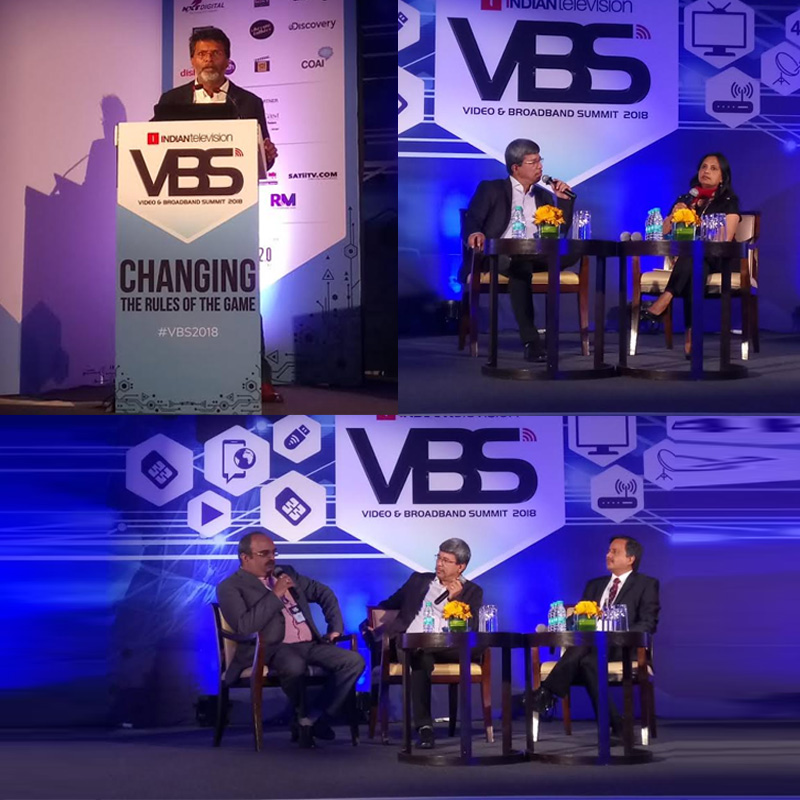
  • VBS 2018: New tariff regime dominates discussion on Day 2

    VBS 2018: New tariff regime dominates discussion on Day 2

    GOA: The second day of the Video and Broadband Summit started with a keynote speech from Times Network MD and CEO MK Anand where the media veteran shared his insights on how to keep playing when the game itself changes.

    “Media Business is primarily about distribution of content to serve consumers needs profitability. If that remains the core purpose, the why to keep playing becomes clear,” Anand said in the beginning. While everyone is talking about disruptive forces, he said coping in the media business is highly dependent on keeping up with changes in distribution technology. He also spoke about how Times Network dealt with such issues.

    Anand’s visionary speech was followed by a fireside chat between Indiantelevision.com founder and CEO Anil Wanvari and Sony Pictures Networks monetization strategy and consumer insights head Saurabh Yagnik. Analytics, big data and content were the focus of the session.

    Doordarshan additional director general Mr.Sunil talked about DD Free Dish, the major force in distribution of satellite television in a presentation. While a huge number of consumers across India use Free Dish, he said its user base is expected to grow by 40 million by 2020. He was also part of a fruitful discussion on the future of pay-TV with Travelxp CEO Prashant Chothani in a session moderated by Anil Wanvari.

    Following that engaging session, Doordarshan director general Supriya Sahu highlighted the evolving role of the public service broadcaster in a fireside chat with Anil Wanvari. She said there should not be comparison between a private broadcaster and pubcaster as the latter’s mandate is totally different.

    While the first evening witnessed a lively discussion on monetization of TV, the second day dealt with the ‘big advertising hangover’. Viacom18 Hindi mass Entertainment Ad Sales head Simran Hoon, TAM India CEO LV Krishnan, Prashant Chothani were part in the panel.

    The second half of the day focused on the new tariff order, the next biggest disruptor in the complex industry, and evolving models in the cable industry. Talking about the disruptors in the distribution industry, KCCL CEO Shaji Mathews said technology has been the enabler, not the driver. In another session, IMCL CEO Vynsley Fernandes said on a positive note that if LCOs, MSOs come together magic can be made.

    More interestingly, TRAI secretary Sunil K Gupta interacted with audience via Skype. Gupta answered questions of local cable operators who seemed to be really concerned about the new regime. He informed the audience of how TRAI is taking initiatives to make consumers aware of the upcoming change.

    BARC India CEO Partho Dasgupta, another media veteran who has witnessed the ups and downs of the industry spoke about the digital matrix measurement in India. “Data protection is of utmost importance in the age of GDPR policy compliance and Srikrishna (SPDI) committee regulations. BARC is keen to ensure the consumer data is protected in our suite of products,” said Dasgupta.

    The last session of the day focused on the e-gaming scene in the country as Nodwin Gaming content head Gautam Virk explored the possibilities about how e-gaming could usher in the next wave of content consumption. Talking about possible potential partners he said, “It is easier to work with OTT platforms because they are more updated with the technology.” He also reaffirmed e-gaming is to stay here and is not a short term trend.