Tag: 5G

  • Trai accommodates Prasar Bharati’s concerns on 5G auctions; overlooks private broadcasters

    Trai accommodates Prasar Bharati’s concerns on 5G auctions; overlooks private broadcasters

    Mumbai: Despite several requests from private broadcasters, the Telecom Regulatory Authority of India (Trai) seems to have overlooked their request in the much-awaited recommendation on the 5G spectrum auction released on Monday. The telecom regulator, however, has accommodated Prasar Bharati’s concerns regarding the auctioning of the 526-582 MHz frequency band being used by Doordarshan for providing terrestrial TV broadcasting.

    The private players had requested for an adequate guard band of 100MHz between the 3300-3670 MHz allocated to 5G and 3700-4200 MHz being used by them in accordance with the international telecommunication union (ITU) norms. 

    Trai has instead recommended the department of telecommunication (DoT) to ask the ministry of information and broadcasting (MIB) to take appropriate action and sensitise the MSOs, DTH operators, and other users to ensure the use of high-quality bandpass filters operating in 3700-4200 MHz range to avoid interference from IMT stations.

    “As the IMT emissions in the 3300-3670 MHz may saturate the low noise block (LNB) of the fixed-satellite service (FSS) earth station which traditionally operates in the 3400-4200 MHz, there is a need to make use of high-quality bandpass filters operating in 3700-4200 MHz range,” a statement issued by Trai said. 

    ALSO READ | Broadcasters huddle up as 5G roll-out plan gathers pace

    Broadcasters claimed to have faced interference on downlink frequencies during the initial 5G trials, following which they raised the issue with the MIB, DoT, and WPC (Wireless Planning and Coordination Wing of DoT), and the Trai. There were apprehensions around potential interference due to the larger C band allocation to 5G and the limited guard band of 30 MHz between the two services.

    “The 526-612 MHz frequency range should not be put in the forthcoming auction,” Trai recommended while stating the following reasons:

    (i)  Band plan(s) for the frequency range 526-612 MHz is yet to be defined by 3GPP/ITU.

    (ii)  Development of ecosystem for IMT in the 526-612 MHz frequency range will take some time.

    (iii)  MIB is using the 526-582 MHz band extensively across the country for TV transmitters.

    The telecom regulator has urged the DoT to come out with a plan for reframing the 526-582 MHz band to be utilised for IMT deployments. “To make 526-582 MHz band available for IMT, DoT should work with MIB to prepare a plan for an early migration from analogue to digital transmission, so that the frequency band from 526-582 MHz can be vacated for IMT services,” it said.

    Prasar Bharati had earlier argued that airwaves in the 526-582 MHz frequency band are required for the expansion and modernisation of its services. The public broadcaster had told Trai that “availability of spectrum is very crucial for planning DD TV Transmitters. Thus, the decision to use frequency band 470-698 for IMT purpose can be taken only after finalisation of terrestrial TV services by Doordarshan or other private broadcasters.”

    “Many analogue, digital-ready and digital terrestrial TV transmitters are operating in the band. Also, digital-ready transmitters are under installation in the union territory of Jammu & Kashmir for which the wireless planning & coordination wing (WPC) has provided for in this band only,” it added.

    The DoT, through its letter dated 13 September 2021, requested Trai to furnish its recommendations on the auction of spectrum in the frequencies identified for international mobile telecommunications (IMT)/5G. The recommendations were sought on the applicable reserve price, band plan, block size, the quantum of spectrum to be auctioned and associated conditions for auction of spectrum in 526-698 MHz, 700 MHz, 800 MHz, 900 MHz, 1800 MHz, 2100 MHz, 2300 MHz, 2500 MHz, 3300-3670 MHz, and 24.25 – 28.5 GHz bands identified for IMT/5G in India.

    Except for 526-698 MHz, Trai has recommended that all available spectrum in the abovementioned bands be put to auction for 5G services.


  • PMO wants 5G launch by 15 Aug; DoT seeks Trai recommendations

    PMO wants 5G launch by 15 Aug; DoT seeks Trai recommendations

    Mumbai: In view of the prime minister’s office (PMO) being keen on initial 5G launch by 15 August, the Department of Telecommunications (DoT) has requested the Telecom Regulatory Authority of India (Trai) to expedite its recommendations on 5G spectrum auctions, possibly before March.

    “In response to decisions/action points emanating from deliberations of a monitoring group, PMO has requested DoT to work towards the initial launch of 5G by 15 August 2022, and also explore the possibility of obtaining requisite recommendations from Trai before March 2022,” said DoT.

    The telecom regulator is working on the DoT’s request for recommendation on modalities such as reserve price, band plan, block size and quantum of spectrum to be auctioned, that were earlier expected to come in by March-end.

    According to recent indications by the telecom department, 5G spectrum auctions are likely to be held in May. Telecom secretary K Rajaraman told news agency PTI that the DoT has already selected MSTC as the auctioneer for the upcoming auction.

    In light of revised spectrum availability in 900 Mhz and 800 Mhz as a result of vacations/surrenders by Indian Railways and GoI, the DoT has also requested Trai to examine the need to review channel plan in 800 Mhz band and number of spectrum blocks that can be made available for telecom services in 800 Mhz band while providing their recommendations in response to DoT’s reference dated 13.09.2021 regarding upcoming spectrum auctions.

    Airwaves in several bands including 526-698 MHz, 700 MHz, 800MHz, 900 MHz, 1800 MHz, 2100 MHz, 2300 MHz, 2500 MHz, 3300-3670 MHz, and 24.25-28.5 GHz have been identified for 5G auctions in India.

    Norms for 526-698 MHz and millimetre band (24.25 – 28.5 GHz) are being worked out even as the aviation and broadcasting industries in India, and globally have voiced concerns regarding possible interference in C band spectrum (3.7-4.2 GHz). Public broadcaster Prasar Bharati has also raised an objection to the auctioning of 526-582 MHz frequency band that is being used by Doordarshan for providing terrestrial TV broadcasting.  

  • 5G auctions likely in May

    5G auctions likely in May

    Mumbai: 5G spectrum auction in India is expected to be held in May this year subject to the Telecom Regulatory Authority of India (Trai) submitting its final recommendations on various aspects of the sale process by March, said a senior official of the telecom department.

    Trai is expected to respond to DoTs request for recommendations on modalities such as reserve price, band plan, block size, and quantum of spectrum to be auctioned by next month, following which the department will initiate the auction.

    “Trai has indicated that they will send it (recommendations) by March. Thereafter, it will take us a month to make a decision around it,” Telecom secretary K Rajaraman told PTI.

    Rajaraman also informed that the DoT has already selected MSTC as the auctioneer for the upcoming auction.

    Meanwhile, the telecom regulator has asked telecom and satcom companies to submit any additional comments before 15 February, especially with details around methods for valuation of the spectrum. While both stakeholders have argued for a steep cut in the band price, they remain divided on other aspects including the auction of a high-frequency range of 27.5- 28.5 GHz.

  • Trai asks sparring telcos, satcom players to provide submission on 5G auction by 15 Feb

    Trai asks sparring telcos, satcom players to provide submission on 5G auction by 15 Feb

    Mumbai: The Telecom Regulatory Authority of India (Trai), which is expected to submit its final recommendations on various aspects of 5G spectrum auctions in March, has asked telecom companies and stakeholders to provide their additional submissions before 15 February, especially with details around methods for valuation of the spectrum.

    The submissions were invited during an open house discussion held by Trai, where telecom operators and satellite players remained sharply divided.

    According to the PTI release, the telecom regulator had earlier recommended the base price of the proposed 5G spectrum in 3,300-3,600 MHz band at about Rs 492 crore per MHz unpaired spectrum on a pan-India basis. Telecom operators interested in buying radiowaves for 5G will have to shell out a minimum of Rs 9,840 crore on a pan-India basis to buy spectrum in the 3,300-3,600 Mhz band. If the telecom operators’ demands are met then the medium band spectrum should cost them only Rs 492 crore at the base price.

    Major telecom players suggested that Trai should fix the base price of the 5G spectrum in mid-band and high-frequency bands using international benchmarks. They recommended the regulator to map international pricing benchmarks at the telecom circle level by using a matrix of average revenue per user, GDP of the country, etc.

    Meanwhile, satellite players opposed telecom operators’ demand to auction a high-frequency range of 27.5- 28.5 GHz.

    Satcom players are of the opinion that as per global practice, 27.5-28.5 GHz have never been auctioned, and hence should be allocated administratively in India as well. Providing in-flight services and maritime connectivity to 500 vessels in the 28 GHz and allocation of this frequency will adversely impact the company’s operation, they said.

  • T-Series forays into streaming with A-list directors

    T-Series forays into streaming with A-list directors

    Mumbai: Indian music label and film studio T-Series has announced its foray into the world of streaming with A-list directors in India.

    The company’s OTT platform will create content across genres in partnership with renowned filmmakers including Aanand L. Rai (“Atrangi Re”), Anubhav Sinha (“Article 15”), Nikkhil Advani (“Mumbai Diaries 26/11”), Hansal Mehta  (“Scam 1992: The Harshad Mehta Story”), Sanjay Gupta (“Mumbai Saga”), Bejoy Nambiar (“Solo”), Suparn S. Varma (“The Family Man”), Mikhil Musale (“Made In China”) and Soumendra Padhi (“Jamtara: Sabka Number Ayega”).

    “With this expansion, we aim at offering original and exclusive binge-worthy content tailored for our viewers across the globe. It will also help us in tapping new markets. We are thrilled to be diversifying and becoming a creative hub for producing music, films, and web shows,” said T-Series chairman and MD Bhushan Kumar. “With the recent budget announcement by our finance minister, there is great progress in the pipeline with the introduction of 5G. It has been projected that rural India will be connected via optic fibres by the year 2025. The easy and cost-effective availability of the internet will provide a great boost to the world of OTT [streaming] and content creators all over, expanding their audience exponentially.”

  • Budget 2022: 5G & rural broadband BharatNet to boost overall internet connectivity

    Budget 2022: 5G & rural broadband BharatNet to boost overall internet connectivity

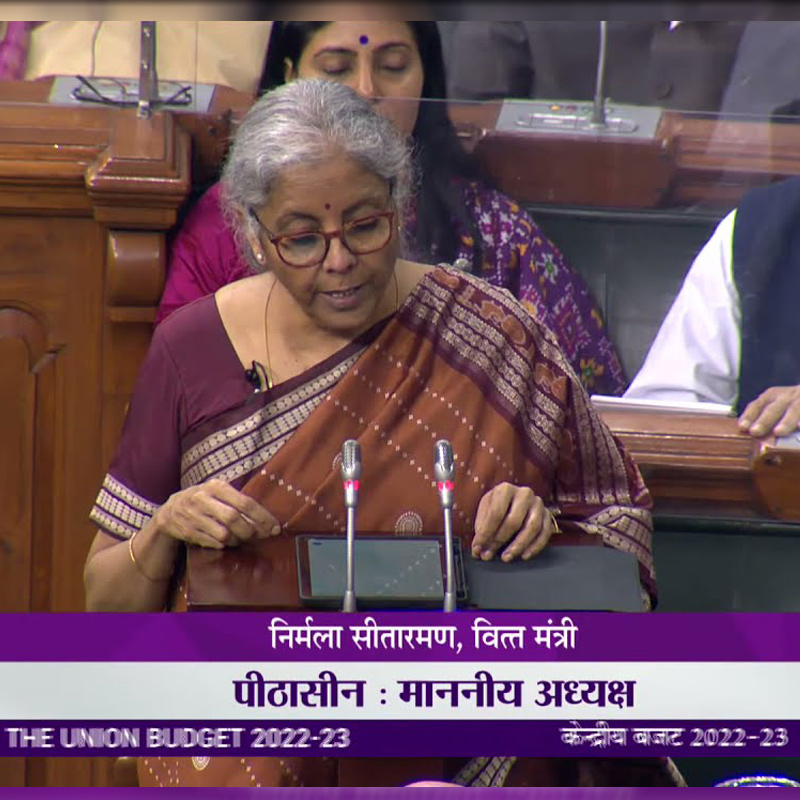
    Mumbai: Giving a boost to the country’s Digital India ambitions, finance minister Nirmala Sitharaman while announcing the union budget 2022 on 1 February said that 5G telecom services will be introduced in India in FY2022-23. Spectrum auctions are likely to be held soon to facilitate the roll-out of 5G by private telecom companies. Design-led initiatives for 5G and other technologies will henceforth be included in the production linked incentive (PLI) scheme, added Sitharaman.

    Among other big announcements impacting telecom/internet connectivity, BharatNet broadband is expected to be ready by 2025. Contracts for laying optical fibres in all villages will be awarded under the project through public-private partnerships in 2022, 2023. “Our vision is that all villages and their residents should have the same access to e-services as urban areas,” stated Sitharaman while adding that five per cent of the annual collections Universal Service Obligation Fund will be allocated to enable affordable broadband and mobile penetration in rural and remote areas.

    The government’s flagship rural broadband connectivity program, BharatNet aims to bring broadband to 361,000 villages across 16 states, including 1.37 lakh gram panchayats. by acting as a middle-mile network allowing Internet service providers (ISPs), local cable operators, MSOs and other agencies to use its bandwidth and incremental fibre.

    According to the economic survey released on 31 January 2022, as on September 2021, 5.46 lakh km Optical Fiber Cable has been laid, a total of 1.73 lakh Gram Panchayats (GP) have been connected by Optical Fiber Cable (OFC) and 1.59 lakh Gram Panchayats are service ready on OFC under the BharatNet project. In addition, 4173 GPs have been connected over satellite media. Wi-Fi hotspots have been installed at 1.04 lakh Gram Panchayats of which services are being provided at 0.64 lakh, catering to more than 16.17 lakh subscribers with a data usage to the tune of 5670.42 TB per month

    The survey further revealed that internet penetration in the country is growing steadily with internet subscribers increasing from 302.33 million in March 2015 to 833.71 million in June 2021. While 67.2 percent of internet subscribers had narrowband connections and 32.8 percent had broadband connections in 2015, the composition had reversed by June 2021 with only 4 percent of subscribers having narrowband and 96 percent with broadband connections. As of September 2021, around 161 villages out of 354 villages have been covered with mobile service.

    Here is what the industry experts had to say:

    Elara Capital’s Karan Taurani noted, “Push towards affordable and high speed fixed broadband internet will boost digital content consumption and smart TV penetration into rural and smaller towns. It will also lead to shifting of eyeballs from TV to digital at a much rapid pace in smaller towns too, just like it has happened in metros.”  This will help enable strong user and consumption growth for the B2C-led internet and new-age companies, which in turn will lead to a rapid shift from traditional to digital. According to him, this could have a positive impact on overall advertising, as internet companies now account for a sizable share of ad spends in India.

    However, Taurani rued the absence of initiatives to protect the interests of traditional media despite the negative impact of Covid. “There was no relaxation on the license fees or royalty for radio industry, no financial grant or tax benefit for the traditional media which has seen a sharp decline over last two years and still struggles to get back to pre Covid levels, and no reduction in GST for cinema ticket prices, despite cinema being one of the most impacted medium during the pandemic,” he said.

    Welcoming the push for internet connectivity, Logicserve Digital founder and CEO Prasad Shejale said, 5G spectrum auctions will finally make the dream of a tech-savvy India a reality, further boosting the country’s digital infrastructure. Additionally, the launch of a design-led manufacturing scheme for the 5G ecosystem as part of the PLI scheme will ensure affordable broadband and mobile communication even in far-flung areas. The availability of high-speed internet connectivity in urban as well as rural areas will encourage marketers to experiment with blockchain, AR, VR. The overall budget is future tech-enabled and balanced.”

    “Media consumption is in for a disruption like never before. 5G is going to change the way digital functions and is going to just accelerate the metaverse and Web3 adoption,” added White Rivers Media CEO and co-founder Shrenik Gandhi.

    Specialised task force for AVGC

    The M&E industry will also benefit from setting up a specialised task force for the promotion of Animation, visual effects, gaming and comics (AVGC) industry, as well as the expansion of the ‘One class, one TV channel’ program of PM eVIDYA from 12 to 200 TV channels proposed under the budget.

    Zeel MD and CEO Punit Goenka said, “The holistic focus on broad-based economic recovery in the Union Budget, with a huge emphasis on job creation and digital ecosystem of the country, is positive for India Inc. at large. The steps announced to build domestic capacity for the Animation, Visual-Effects, Gaming, and Comics segment will certainly help enhance capabilities, enabling the Country to compete more effectively at a global stage. An extension in the credit line guarantee scheme is also a welcome move, which will provide some much-needed relief to the relevant sectors which were impacted due to the pandemic.”

    According to vernacular audio platform Khabri’s co-founder and CEO Pulkit Sharma, regional languages will be empowered through the program, which enables all states to provide supplementary education in regional languages for classes 1 to 12. “These digital initiatives will provide for a more conducive environment for the adoption of tech-based learning and which will directly route to empowering youth from real Bharat,” he said.

  • Google to invest $1 billion in Airtel

    Google to invest $1 billion in Airtel

    Mumbai: Bharti Airtel and Google on Friday announced that the latter intends to invest $ one billion in the telecom major as part of its Google for India Digitisation Fund which includes equity investment as well as a corpus.

    The investment will be for potential commercial agreements to be identified and agreed on mutually agreeable terms over the next five years. This will comprise a $700 million investment in Bharti Airtel at a price per share of Rs 734. Up to $300 million of that will go towards implementing commercial agreements which will include scaling Airtel’s offerings. Google will acquire a 1.2 per cent shareholding of Bharti Airtel including partly paid shares.

    The deal will be subject to regulatory approvals.

    “Airtel and Google share the vision to grow India’s digital dividend through innovative products,” said Bharti Airtel chairman Sunil Bharti Mittal. “With our future-ready network, digital platforms, last-mile distribution and payments ecosystem, we look forward to working closely with Google to increase the depth and breadth of India’s digital ecosystem.”

    Airtel and Google will work together to explore opportunities to bring down barriers of owning a smartphone in partnership with various device manufacturers, potentially co-create India-specific network domain use cases for 5G and other standards and focus on growing and shaping the cloud ecosystem in India.

    “Airtel is a leading pioneer shaping India’s digital future, and we are proud to partner on a shared vision for expanding connectivity and ensuring equitable access to the Internet for more Indians,” said Alphabet and Google CEO Sundar Pichai. “Our commercial and equity investment in Airtel is a continuation of our Google for India Digitization Fund’s efforts to increase access to smartphones, enhance connectivity to support new business models, and help companies on their digital transformation journey.”

  • Trai to come up with recommendations to facilitate 5G rollout

    Trai to come up with recommendations to facilitate 5G rollout

    Mumbai: The Telecom Regulatory Authority of India (Trai) will soon come up with recommendations to facilitate telecom connectivity and for easing out network rollout issues being faced by telecom companies, especially with regard to 5G.  

    During a virtual event organised by Digital Infrastructure Providers Association (DIPA), Trai chairman PD Vaghela said that it will be difficult to get 5G coverage inside buildings as signals will be transmitted on high frequencies which cover very small distances.

    “Holistic approach will be required to ensure availability of digital infrastructure in building complexes, that also in a non-discriminate manner. There is a huge problem in getting access to the buildings by the infrastructure providers, telecom service providers and other players. We have already prepared a consultation paper and very soon we will come out with a recommendation. This will require a change in by-laws and working with the states very closely,” stated Vaghela.

    Minister of state for telecom Devusinh Chauhan added that digital connectivity empowers people on the ground, and the government is committed to supporting telecom infrastructure companies in this context. “Realising the importance of connectivity, states will also give precedence to connectivity over revenues in the near future,” he further said.

    Telecom secretary K Rajaraman said that the recently announced telecom reforms are a step towards bringing the cost of operations of telecom services in the country further down.

    The telecom department said that it is working towards resolving network rollout issues being faced by telecom companies, as well as enhancing the ease of doing business in the sector.

  • VBS 2022: Getting ready for the post-pandemic world

    VBS 2022: Getting ready for the post-pandemic world

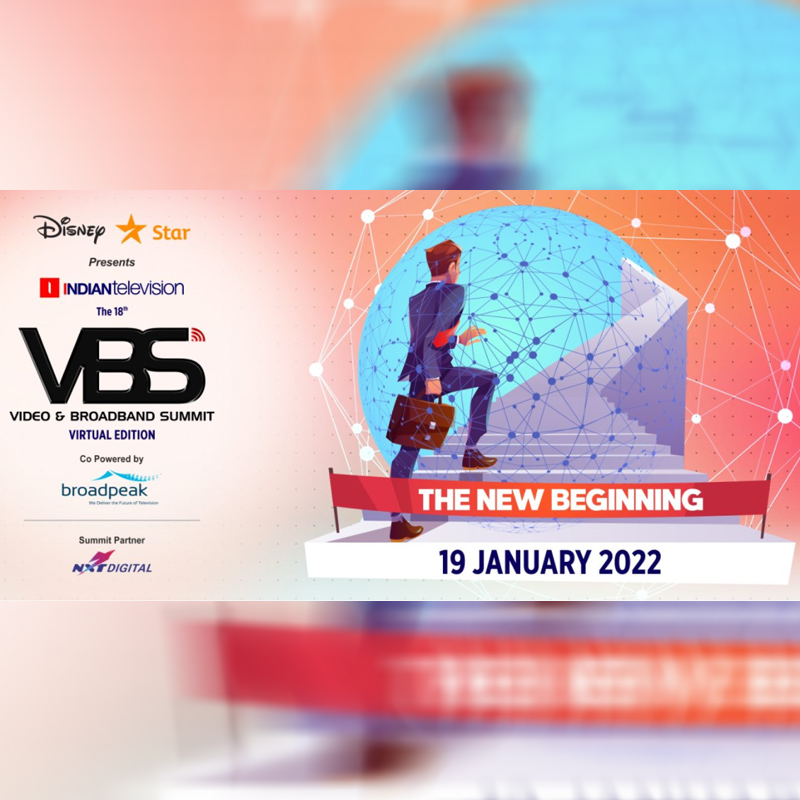
    Mumbai: Indiantelevision.com is back with the 18th edition of the Video & Broadband Summit (VBS). The day-long summit will be held virtually on 19 January 2022, from 10.00 am to 5.00 pm. VBS 2022 is co-powered by broadpeak. Disney Star is presenting partner and NxtDigital is the summit partner.

    This year’s Video & Broadband Summit will provide a platform for industry and opinion leaders to discuss key issues being faced by the television industry as a result of the Telecom Regulatory Authority of India (Trai)’s New Tariff Order 2.0, broadband-fuelled growth of digital platforms, and the impact of cord-cutting on DPOs, as well as the possible ramifications of the impending 5G launch that has already created a stir among broadcasters and distributors.

    Some of the broad themes to be covered include Rising Cost of Video Entertainment, Changing Business Models and Revenue Models, Value-Added Services, and getting back to basics in a Post-Pandemic World. VBS 2022 will also delve into the concerns and opportunities around the 5G Teleco Threat, Virtual MVPDs, Cable TV’s Technology, and Back-End Challenges, DPO’s Marketing Drive, and the gradual expansion of Over the Top (OTT) Platforms.

    The summit will begin with an introduction by Indiantelevision.com Group founder CEO and editor-in-chief Anil Wanvari, followed by a presentation on the rising cost of video entertainment.

    First on the agenda is a fireside chat with M&E consultant Anuj Gandhi. During the next session moderated by former senior VP Star TV and CEO KCCL Shaji Mathews, Fastway’s Prem Ojha, Travelxp’s Prashant Chothani, Asia Satellite Telecommunications Holdings’ Rajdeepsinh Gohil, Shemaroo Entertainment’s Sandeep Gupta, BBC Global News’ Sunil Joshi, and Zeel’s Anil Malhotra will share their thought on ‘Getting Back to Basics and to a Post Pandemic World’.

    Lined up next is another fireside chat between NxtDigital MD and CEO Vynsley Fernandes and Anil Wanvari. Thereafter Gurjeev Singh Kapoor (Star & Disney India), Vynsley Fernandes, Amit Arora (Indiacast Media Distribution), Sambasivan G (Tata Sky), Ashish Pherwani (E&Y), and SN Sharma (DEN Networks) will delve on ‘Shaping the growth of linear TV distribution and subscription’.  

    In the post-lunch session, a panel consisting of MN Vyas (founder-director PlanetCast), Abhishek Gupta  (vice president IT, Dish TV), Yann Begassat (business development director, Broadpeak), and Salil Thomas (general manager & head ACV & Technology,  Asianet Satellite Communications Ltd) will demystify ‘The 5G Opportunity’ for the viewers. The talk will be moderated by Satcom Industry Association – India, senior director technology and policy Rajeev Gambhir.

    Following a fireside chat with Jio Platform’s Saurabh Sancheti, the event will wrap up with a discussion on ‘Delighting the Indian Consumer – Challenges & Opportunities’ between Rajib Mukherji (EVP-Strategy, IndiaCast Media Distribution Pvt Ltd.), Nagesh Chhabria (promoter, Metrocast), Rouse Koshy (chief operating officer, NXTDigital) and Yatin Gupta (senior VP, GTPL).

    The Video & Broadband Summit (VBS) 2022 will be live-streamed on Indiantelevision.com’s social media handles.

    For more details: https://www.videoandbroadbandsummit.com/ 

  • Broadcasters huddle up, as 5G roll-out plan gathers pace

    Broadcasters huddle up, as 5G roll-out plan gathers pace

    Mumbai: Just as the industry was gearing up to welcome 2022, the Telecom Regulatory Authority of India (Trai) set the ball rolling on the 5G roll-out in India. The next wave of disruption in the telecom sector is set to hit 13 cities in the first phase: Gurugram, Bengaluru, Kolkata, Mumbai, Chandigarh, Delhi, Jamnagar, Ahmedabad, Chennai, Hyderabad, Lucknow, Pune, and Gandhi Nagar.

    The auctions are likely to be held in mid-2022 following the Telcom department’s request for a recommendation on modalities such as reserve price, band plan, block size, and the quantum of spectrum. But amid all this, the broadcasters’ concerns continue to escalate, with apprehensions regarding a potential spectrum clash with 5G.

    5G Vs Broadcasters

    Airwaves in several bands including 526-698 MHz, 700 MHz, 800MHz, 900 MHz, 1800 MHz, 2100 MHz, 2300 MHz, 2500 MHz, 3300-3670 MHz, and 24.25-28.5 GHz have been identified for 5G auctions in India, whereas downlinks by all broadcasters intended for reception by MSOs are in the band of 3700-4200 MHz as prescribed by the International Telecommunication Union (ITU), and are also governed by the downlink policy by the government. Over 600 licensed satellite channels in India operate in this band.

    Ever since the 5G trials started in India in June 2021, broadcasters who claim to have faced interference on downlink frequencies during that period have been raising the issue with the MIB, DoT, and WPC (Wireless Planning and Coordination Wing of DoT), and the Trai. There are concerns regarding potential interference due to the larger C band allocation to 5G and the limited guard band of 30 MHz between the two services.

    The current upper limit of the National Frequency Allocation Plan 2018 is 3600 MHz. “A guard band of 100 MHz is ideal,” broadcasters say. They further contend that the proposed revision of NFAP-18 to include new bands for 5G use by DOT’s arm WPC may even stretch beyond 3670 MHz to 3800 MHz. This could lead to serious disruption of satellite services for media and broadcast in the 3700-4000 MHz band.

    Prasar Bharati joins the chorus against 5G

    Joining the chorus, Prasar Bharati recently raised objections to the auctioning of the 526-582 MHz frequency band that is being used by Doordarshan for providing terrestrial TV broadcasting. According to media reports, the public broadcaster argued that airwaves in this frequency range are required for expansion and modernisation of its services. Prasar Bharati has told Trai that “availability of spectrum is very crucial for planning DD TV Transmitters. Thus, the decision to use frequency band 470-698 for IMT purpose can be taken only after finalisation of terrestrial TV services by Doordarshan or other private broadcasters.”

    “Many analogue, digital-ready and digital terrestrial TV transmitters are operating in the band. Also, digital-ready transmitters are under installation in the Union Territory of Jammu & Kashmir for which the wireless planning & coordination wing (WPC) has provided for in this band only,” it added.

    Another hurdle on the way: Field trials

    Private broadcasters have also expressed displeasure about field trials of 5G services without notifying the framework – specifically the study of emission and interference on already existing C Band satellite service, non-involvement of incumbent users of the C-band who have been using the satellites for over 30 years in the trials, lack of study on the use of band pass filters at cable headends as well as no consideration of their funding, non-determination of emission safeguards and monitoring architecture for 5G emitting towers, and absence of potential options which can be implemented immediately.  

    As a solution, they have suggested the use of alternative bands for 5G – an option unavailable for C&S services. Based on trial information available with the regulator and DoT, they have further urged the authorised bodies to recommend and publish the specifications for appropriate Band Pass Filters to be used by MSOs, IPTV, and HITs operators per downlink chain for receiving satellite TV signals.

    In order to compensate for the lower availability of C-band transponder capacity, the regulators have been requested to allow broadcasters to use foreign satellites without seeking any clarification from them. Fast track approval for newer compression technologies such as HEVC or H.265 that use lower transponder capacity in comparison to present MPEG4 bandwidth recommendation without any reduction in the quality of the television channels has also been sought. The minimum bandwidth recommended for approval by all regulatory bodies for HEVC is 4Mbps per HD channel and 1.5Mbps per SD channel.

    The television broadcasting and distribution industries in India are facing major disruption under the new tariff regime. Even though they welcome the launch of 5G, which holds great opportunity for the M&E sector in the era of convergence, the smaller players have argued for government intervention in the form of subsidies if they have to move to a higher or alternative frequency.