Tag: 4K Ultra HD

  • Challenges we face in the production and broadcast industry are universal: Stefan Pfütze

    Challenges we face in the production and broadcast industry are universal: Stefan Pfütze

    Mumbai: The second day of the Broadcast India Show at the Jio World Convention

    Centre in Mumbai pulsated with the vibrant energy of the broadcast media and

    infotainment sectors. In an industry where technology evolves at lightning speed, the

    impact on broadcast and entertainment is profound. For over 30 years, the Broadcast India Show has served as an interactive platform, showcasing groundbreaking shifts in infotainment technology while connecting attendees with the innovators behind these marvels.

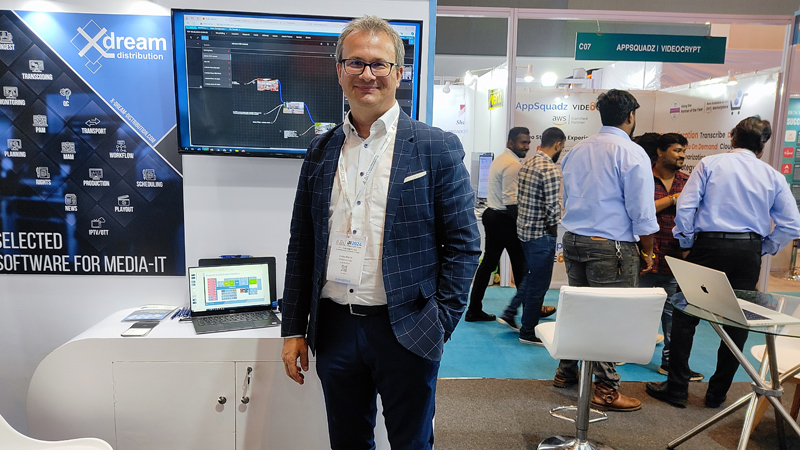
    While exploring the booths, we were particularly drawn to x-dream-group, a full-service provider for the media industry as well as for any commercial or public organisation that utilises audiovisual media. Their clientele includes post-production facilities, broadcasters, telecom operators and public entities.

    Indiantelevision.com’s Rohin Ramesh at the sidelines of this event, caught up with x-dream-group managing director Stefan Pfütze, who shared insights about his organisation with a beaming smile.

    Edited excerpts

    On brief overview of your organisation:

    We are known as x-dream-group, which encompasses three distinct types of activities. One of these is x-media, our company that specialises in software integration, focusing on creating end-to-end solutions using products from other software providers. We are solely dedicated to software and do not engage in hardware manufacturing.

    Through our work at x-dream-media, we’ve identified several established engineering companies that offer excellent products—many now in their second or third generation—but lack international market reach. To address this gap, we established an umbrella organisation called extreme distribution, which serves as a brand ambassador and master distributor for these companies. I am currently representing these various brands at Broadcast India.

    On elaborating some of the productised solutions you have developed for your customers:

    In our journey of development, we began with plugins for transcoders, which have become less relevant over time. From that foundation, we created a business called 1 GUI—a centralised user interface that integrates with various tools such as transcoders, ingest tools, quality control tools, workflow tools, and file transport tools. This interface serves as a cockpit for managing workflow and job queues.

    Over time, we expanded our offerings by adding a workflow starter and a workflow layer. Our latest release is the broadcast suite, a desktop application designed for playback, recording, and multi-viewing—targeted at professional AV users and broadcasters in need of quality control and engineering solutions. While it may not function as a traditional video server in a server room, it provides similar capabilities on a desktop level.

    Our flagship product, extreme fabric, is an end-to-end solution tailored for the media industry. Unlike our software integration approach, which involves customising ecosystems for clients, extreme fabric is a ready-to-go, pre-designed, pre-integrated, and pre-configured solution. Users can simply download and install it to establish a fully functional TV station.

    This may sound ambitious, but our primary target customers are tier one broadcasters who seek custom solutions and want to collaborate closely with us. For tier two and tier three broadcasters, as well as clients from sectors like corporate, banking, insurance, and government, the need is different. These customers often lack broadcast engineering capabilities and require a ready-made solution. When we ask them about their production business processes, they often look at us in confusion—many have little understanding of the necessary workflows.

    We showcase our capabilities on our website and at conferences and trade shows, aiming to enhance the overall process. This challenge is prevalent not only in emerging markets but also in regional TV stations, where organisations may have one or two knowledgeable individuals but lack the capacity to manage large integration projects. They require a more accessible solution. As I travel to various countries, I often hear the excuse that “it’s different in our country” regarding technology, habits, business processes, or even infrastructure. I believe that the challenges we face in the production and broadcast industry are universal whether in India, the Middle East, Europe or America.

    On identifying and addressing the specific needs of your clients:

    To identify and address the specific needs of our clients, we begin with clear demands. For example, when selling individual products, a customer may say they need software to integrate their central ingest desk with their newsroom and post-production systems. From there, we ask probing questions: “Do you also manage remote offices? What about live feeds or social media content?” This often leads to a realisation of additional needs they hadn’t considered.

    When it comes to transcoding, some clients initially believe that open-source solutions are sufficient. However, as they aim for advanced features like 4K Ultra HD, HDR colour spaces, or delivery to professional platforms, they soon realise they must meet strict requirements, such as delivering certified ProRes formats to companies like Apple. This is where we step in to provide the necessary support.

    Monetisation is another crucial area where we see demand for features like ad insertion, graphic overlays, audio track management, and subtitle management—more sophisticated needs than the basics. When we engage with clients, particularly during visits or trade shows, we often hear about inefficiencies in their workflows, such as the inconvenience of using USB devices to transfer content between departments. We can certainly improve these processes, especially for companies with distributed setups that include on-premises installations, cloud services, and multiple facilities across different cities.

    Another significant project category involves managing the business side of operations, particularly through media asset management systems. These systems serve as essential repositories, often involved in both the beginning and end of media business processes. Many vendors offer mini MAM systems for temporary storage, but we approach media management on a larger scale. We focus on publication strategies for marketing, advertising, and B2B or B2C content sales. For B2C, this includes video-on-demand portals, while our B2B offering, called the media market, enables broadcasters and content producers to sell their content online to a global audience.

    Editing is also a critical aspect, where our goal is to manage the bridge between business processes and the editing suite. This includes project management, approval workflows, and remote editing capabilities. Our product portfolio consists of software solutions, allowing customers to select their own hardware, rather than being tied to specific storage systems.

    Additionally, we have introduced a new component we refer to as “storytelling,” which functions as a newsroom system. This terminology resonates with clients outside the media industry, making it more relatable. Our applications are designed to be cross-media, supporting not just TV but also radio, web, and social media. This means that our playout solutions are essentially a form of publication across multiple platforms.

    When it comes to integrating these production systems, aside from editing challenges, we also face issues like ensuring compatibility between various tools and managing different workflows efficiently. We overcome these challenges through thorough assessments of client needs, providing tailored solutions that enhance their overall operations.

    On some common challenges you face when integrating an isolated production system:

    As software developers, it’s natural for us to explore the APIs of various software solutions. Today, most applications typically offer RESTful APIs, though some might have soft APIs, database connections, or file-based integrations. About 99 per cent of software now utilises rest APIs, and when we integrate systems, we prefer this approach because it provides optimal control, monitoring, and failure handling when working with third-party software.

    A common scenario I frequently encounter among system integrators and other vendors involves the use of watch folders. Many systems still rely on a chain of watch folders, where one application drops files into the watch folder of another. This approach is outdated and leads to significant operational overhead, particularly in process management and troubleshooting.

    Another prevalent trend is the transition from on-premises solutions to cloud-based systems. For many of our projects related to publication, we emphasise a hosted approach. However, this doesn’t necessarily mean a public cloud; it could involve dedicated or boutique hosting solutions with either physical servers or virtual machines. While public clouds often rely on virtual machines, they may not be cost-efficient for long-term engagements—though they can be suitable for short-term needs.

    We are witnessing a shift from fully on-premises elements, such as archives and publication systems, to remote data centres. This transition is driven by improved network connections, enhanced security, and better hosting capabilities, including power supply and cooling. Offloading hardware management allows for 24/7 operations without constant oversight, which is a significant advantage of a hosted approach, whether private or public.

    We support this trend through hybrid systems. For instance, high-resolution operations can remain on-premises, where the personnel and content are physically located, and archives may still reside on LTO tapes. Meanwhile, we can move the access components of the system to a hosted solution, connecting both sides to function as a single entity.

    The challenge today is ensuring that these systems operate seamlessly together. Currently, the approach often results in a disruption; the inner system handles publishing to the outer system while the outer system feeds information back to the inner one. Unfortunately, these remain separate systems that do not behave as a unified business process, despite essentially being one.

    On some upcoming trends:

    Discussing trends can be challenging. We’ve seen fads like 3d technology, ultra hd, and hdr come and go. In hindsight, many of these were just hype—something everyone talked about but few actually implemented. Today, most television remains hd and sdr. However, AI is different; it’s here to stay. Currently, we see practical applications like transcriptions and translations being effectively utilised.

    In our portfolio, we offer a product that provides live subtitling with translation capabilities. This tool is actively used in practice, and customers are willing to invest in it because it’s reasonably priced, making it a sensible option.

    One trend I observe is the shift toward on-premises artificial intelligence. Many customers are often unaware of their options and feel compelled to rely on public cloud solutions simply because that’s what vendors are promoting. However, the same software can often be deployed on-premises, which can be advantageous. While it may be challenging to navigate training models and related complexities, the cost savings on data traffic, time, and hosting and processing fees can be substantial.

    Artificial intelligence will also significantly impact storytelling in news, but I view this with some caution. There’s a common misconception that you can simply input a topic into an artificial intelligence and receive a well-formed story. In reality, we still need journalists and reporters in the field, gathering information and engaging with people. Artificial technology can assist in processing and shaping that information into a coherent story, but it cannot create news on its own. While artificial intelligence can generate lyrics or fiction, the essence of news relies on human insight and experience. Ultimately, it is the human mind that remains irreplaceable.

  • Q2-16: DISH Network reports 27% profit hike, loses 281K pay-TV subscribers

    Q2-16: DISH Network reports 27% profit hike, loses 281K pay-TV subscribers

    BENGALURU: DISH Network Corp. (DISH) reported 26.52 percent increase in its net profit for the quarter ended 30 June 2016 (Q2-16, current quarter) at $ 410.46 million as compared to $ 324.42 million in the corresponding year ago quarter. Despite activating approximately 527,000 gross new pay-TV subscribers, net pay-TV subscribers declined approximately 281,000 in Q2-16. Comparatively, in Q2-15 approximately 638,000 gross new pay-TV subscribers were added with a net loss of approximately 81,000 pay-TV subscribers.

    DISH reported almost flat revenue (grew by 0.12 percent) in the current quarter of $ 3,837.04 million as compared to revenue of $ 3,832.29 million in Q2-15. Subscriber related revenue in Q2-16 grew 0.7 percent to $3,826.22 million as compared to $3,801.42 million in Q2-15.

    EBIDTA in Q2-16 declined slightly (2.7 percent) to $ 899.54 million from $ 924.45 million in the corresponding year ago quarter.

    Subscribers, ARPU, SAC

    The company closed Q2-16 with 13.593 million pay-TV subscribers, compared to 13.932 million pay-TV subscribers at the end Q2-2015.

    DISH lost approximately 15,000 net broadband subscribers in the second quarter, bringing its broadband subscriber base to approximately 613,000.

    Pay-TV ARPU for Q2-16 totalled $89.98, compared to Q2-2015 pay-TV ARPU of $ 87.91. Pay-TV subscriber churn rate in the current quarter was higher at 1.96 percent versus 1.71 percent for Q2-2015.

    Pay-TV subscriber acquisition cost (SAC) in Q2-16 was $353.08 million as compared to $ 405.70 million in Q2-15.  Pay-TV SAC was $782 per subscriber during Q2-16 compared to $767 during Q2-15 an increase of $15 or 1.9 percent.  

    DISH says that this change was primarily attributable to an increase in advertising costs per activation, partially offset by a decrease in hardware costs per activation. The decrease in hardware costs per activation was primarily due to a higher percentage of remanufactured receivers being activated on new DISH branded pay-TV subscriber accounts and by a reduction in manufacturing costs related to certain receiver systems. This decrease was partially offset by an increase in the percentage of new DISH branded pay-TV subscriber activations with Hopper 3 receiver systems, which have a higher cost per unit than the prior generation Hopper receiver systems.

    Notes

    It may be noted that DISH includes all of its Sling TV subscribers in the company’s total pay-TV metrics, including in the pay-TV subscriber, pay-TV ARPU and pay-TV churn rate numbers set forth below. Sling TV subscribers are reported net of disconnects in DISH’s gross new pay-TV subscriber activations. The Sling branded pay-TV services consist of, among other things, live, linear streaming over-the-top (OTT) internet-based domestic, international and Latino video programming services.

    DISH markets broadband services under the dishNET™ brand in the United States.  In addition to the dishNET branded satellite broadband service, DISH also offers wireline voice and broadband services under the dishNET brand as a competitive local exchange carrier primarily to consumers living in a 14-state region in the western United States.  It primarily bundles dishNET branded services with its DISH branded pay-TV service.

    During Q1-2016 DISH made its next generation Hopper, the Hopper 3, availableto customers nationwide.  Among other things, the Hopper 3 features 16 tuners, delivers an enhanced 4K Ultra HD experience, and supports up to seven TVs simultaneously says the company.

  • Q2-16: DISH Network reports 27% profit hike, loses 281K pay-TV subscribers

    Q2-16: DISH Network reports 27% profit hike, loses 281K pay-TV subscribers

    BENGALURU: DISH Network Corp. (DISH) reported 26.52 percent increase in its net profit for the quarter ended 30 June 2016 (Q2-16, current quarter) at $ 410.46 million as compared to $ 324.42 million in the corresponding year ago quarter. Despite activating approximately 527,000 gross new pay-TV subscribers, net pay-TV subscribers declined approximately 281,000 in Q2-16. Comparatively, in Q2-15 approximately 638,000 gross new pay-TV subscribers were added with a net loss of approximately 81,000 pay-TV subscribers.

    DISH reported almost flat revenue (grew by 0.12 percent) in the current quarter of $ 3,837.04 million as compared to revenue of $ 3,832.29 million in Q2-15. Subscriber related revenue in Q2-16 grew 0.7 percent to $3,826.22 million as compared to $3,801.42 million in Q2-15.

    EBIDTA in Q2-16 declined slightly (2.7 percent) to $ 899.54 million from $ 924.45 million in the corresponding year ago quarter.

    Subscribers, ARPU, SAC

    The company closed Q2-16 with 13.593 million pay-TV subscribers, compared to 13.932 million pay-TV subscribers at the end Q2-2015.

    DISH lost approximately 15,000 net broadband subscribers in the second quarter, bringing its broadband subscriber base to approximately 613,000.

    Pay-TV ARPU for Q2-16 totalled $89.98, compared to Q2-2015 pay-TV ARPU of $ 87.91. Pay-TV subscriber churn rate in the current quarter was higher at 1.96 percent versus 1.71 percent for Q2-2015.

    Pay-TV subscriber acquisition cost (SAC) in Q2-16 was $353.08 million as compared to $ 405.70 million in Q2-15.  Pay-TV SAC was $782 per subscriber during Q2-16 compared to $767 during Q2-15 an increase of $15 or 1.9 percent.  

    DISH says that this change was primarily attributable to an increase in advertising costs per activation, partially offset by a decrease in hardware costs per activation. The decrease in hardware costs per activation was primarily due to a higher percentage of remanufactured receivers being activated on new DISH branded pay-TV subscriber accounts and by a reduction in manufacturing costs related to certain receiver systems. This decrease was partially offset by an increase in the percentage of new DISH branded pay-TV subscriber activations with Hopper 3 receiver systems, which have a higher cost per unit than the prior generation Hopper receiver systems.

    Notes

    It may be noted that DISH includes all of its Sling TV subscribers in the company’s total pay-TV metrics, including in the pay-TV subscriber, pay-TV ARPU and pay-TV churn rate numbers set forth below. Sling TV subscribers are reported net of disconnects in DISH’s gross new pay-TV subscriber activations. The Sling branded pay-TV services consist of, among other things, live, linear streaming over-the-top (OTT) internet-based domestic, international and Latino video programming services.

    DISH markets broadband services under the dishNET™ brand in the United States.  In addition to the dishNET branded satellite broadband service, DISH also offers wireline voice and broadband services under the dishNET brand as a competitive local exchange carrier primarily to consumers living in a 14-state region in the western United States.  It primarily bundles dishNET branded services with its DISH branded pay-TV service.

    During Q1-2016 DISH made its next generation Hopper, the Hopper 3, availableto customers nationwide.  Among other things, the Hopper 3 features 16 tuners, delivers an enhanced 4K Ultra HD experience, and supports up to seven TVs simultaneously says the company.

  • Videocon d2h launches Active HD Hollywood Channel Services

    Videocon d2h launches Active HD Hollywood Channel Services

    MUMBAI: After the first 24-hour 4K Ultra HD multi genre channel in January, Videocon d2h Limited has launched a new active HD Channel – Active HD Hollywood Channel services for its subscribers. Skoda has been roped in as channel partner for this launch. This is a part of Videocon d2h’s ongoing commitment to provide unmatched viewing experience for its subscribers. 


    The channel – Active HD Hollywood Channel Services will be available on Ch No. 940 on its network. It will air handpicked Hollywood movies everyday at 9 pm. All High Definition subscribers of Videocon d2h will be able to avail it for free in the initial phase of launch. The service will be available on paid subscription basis from a later date.


    Active HD Hollywood Channel Services will showcase a line up of critically acclaimed popular films. With new titles being released every day at 9pm, viewers can look forward to quality Hollywood movies, including such mega-hits as  Pandorum, Broken City, Jobs, Astro Boy, Remember Me, A Single Man, Agoraa, The Women in Black, Blindness, Something Borrowed, The Conspirator, The Twilight Saga Breaking Dawn Part -2, London Boulevard and Now You See Me among others.


    “We have observed that there is a genuine requirement to watch highly acclaimed Hollywood movies in HD and there are very few catering to this opportunity”, said Videocon d2h executive chairman Saurabh Dhoot. “Not only are we launching a new premium Hollywood HD movie channel, but we’re bringing value to our consumers. This channel will definitely resonate well with the young audience,” he further added.


    Videocon d2h CEO Anil Khera said, “We are excited to offer Hollywood movies fans across India access to high-quality entertainment in HD. With Active HD Hollywood Channel Services, we continue to provide high quality world class programming content delighting consumers. We are confident that our unique content offering of Hollywood movies in HD will make this an instant hit with subscribers.”


    Speaking on the same Skoda Auto India sales, service & marketing director Ashutosh Dixit explained, “Skoda looks at innovative platforms that resonate with the brand’s image to connect with its audiences. The audience of the Active Hollywood HD channel largely overlaps with the kind of consumers our brand converses with. This association will benefit both brands and we expect good traction from this partnership.”

  • DirecTV launches two satellites to increase HD & 4K capacity

    DirecTV launches two satellites to increase HD & 4K capacity

    MUMBAI: DirecTV is expanding its satellite fleet in both the US and Latin America with the dual launch of two new spacecraft that will significantly increase HD capacity, further secure the future of 4K Ultra HD and backup DirecTV ’s existing satellite fleet.


    DirecTV -15 (D-15), a versatile all CONUS (Continental United States, including Hawaii, Alaska and Puerto Rico) beam satellite, and Sky Mexico-1 (SKYM-1), Sky Mexico’s first owned-and-operated satellite has been successfully launched on a single ARIANE 5 launch vehicle operated by Arianespace from the European Spaceport in Kourou, French Guiana.


    D-15, a more than six ton spacecraft designed and built by Airbus Defence and Space, will be the first DirecTV satellite with the capability to operate in all five DirecTV US orbital slots and in all frequency bands (Ku, Ka and Reverse Band). This is the first all CONUS beam DirecTV satellite to launch in 10 years, and it will expand national capacity for both HD and 4K Ultra HD channels, as well as provide critical backup for existing CONUS transponders.


    Controllers made contact with both satellites confirming that all systems are functioning properly.


    “We congratulate the launch team and our partners, Arianespace, Airbus Defence and Space, and Orbital ATK on a spectacular and historic launch. D-15, the most versatile spacecraft in the fleet and the robust SKYM-1, secure DirecTV ’s ability to continue delivering the best video experience with the most advanced technology,” said DirecTV senior vice president, space and communications Phil Goswitz.


    SKYM-1, weighing in at more than three tons, was built by Orbital ATK on its flight-proven GEOStar-2 platform. The new satellite will double HD capacity for Sky Mexico and provide direct-to-home broadcast services to Mexico, Central America, Cuba and the Caribbean.


    D-15, the seventeenth satellite launched for DirecTV and the twelfth owned and currently operated satellite in the DirecTV fleet, will be positioned at 103 degrees West longitude and is designed to provide service for more than 15 years.


    SKYM-1 will be positioned at the 79 degrees West longitude orbital slot adding to the IS-21 satellite capabilities at 58 degrees West longitude, and will have a life span of more than 18 years.


    In December of 2014 DirecTV successfully launched D-14, which became operational in Q2 of this year.

  • Videocon d2h and Broadcom partner for HD service

    Videocon d2h and Broadcom partner for HD service

    MUMBAI: A few weeks after Videocon d2h familiarised Indians with 4K Ultra HD technology, it has now announced an official deal with Broadcom, which is a leader in semiconductor solutions for wired and wireless communications, for growing its HD service.


    The DTH provider has selected Broadcom’s integrated satellite set top box (STB) system-on-a-chip (SoC) device to power its HD digital video recorder (DVR). Broadcom’s BCM7358 HD satellite STB SoC enables the operator to fasten the deployment of its HD STBs with reduced design complexity, size and cost.


    Videocon d2h’s DVR is capable of recording on a USB device with digital picture quality and 1080p resolution. The HD USB DVR is supported by Broadcom’s BCM7358 single-channel 1080p HD advanced video coding (AVC) satellite receiver chip, featuring a high performance CPU and graphics engine, digital living network alliance (DLNA) connectivity support and advanced security functionality.


    Says Videocon d2h CEO Anil Khera, “The silicon innovation that Broadcom provides has been a key factor in our continued success in delivering rich content to our growing subscriber base. We’re leveraging a variety of Broadcom STB silicon throughout our portfolio and plan to extend our manufacturing capabilities to meet the needs of other cable operators in the region.”


    “The Indian television market is undergoing a major transition and operators such as Videocon d2h are leading the charge in dramatically improving the quality and variety of content delivery,” adds Broadcom India senior director of business development Rajiv Kapur. “As an established leader in STB silicon innovation around the world, Broadcom is delivering the technology required for a growing number of consumers to enjoy more sophisticated features such as HD quality content, digital video recording and on-demand services.”


    IHS Technology states that STB industry revenue will reach a record $ 22.8 billion in 2015, driven largely by growth in emerging markets and subscriber demand for HD content. “As pay-TV operators move to accommodate changes in delivery platforms and formats, including the adoption of HD, STB shipments will continue to rise, hitting record levels for the next few years,” said IHS Technology director for connected home research Daniel Simmons.


    “Technology-based service differentiation is becoming increasingly important for pay-TV operators in emerging regions, as these markets begin to mature and saturate. Transitioning subscribers from SD to HD at minimal cost will be critical for driving further pay-TV growth in emerging markets.”

  • Is India ready for HD HEVC set top boxes?

    Is India ready for HD HEVC set top boxes?

    MUMBAI: India may be struggling with completing the strenuous task of digitising the close to 9.4 crore cable TV homes, but when it comes to keeping pace with technology as compared to the rest of the world, we are not very far behind.

    While it was direct to home (DTH) player Videocon d2h which first announced that it was working out to launch its 4K Ultra HD service, Tata Sky followed soon. And with this, came the one big question: is the country ready for a technology such as this? Answers Broadcom Corporation associate product line director Brett Tischler, “The consumer is ready for 4K technology, which gives a clearer, sharper and brighter viewing experience. When people see it, they want it.”

    Worldwide, when the first 4K Ultra HD TV was launched, it cost close to $20,000. “This has now come down to $1000. This makes the TV much more affordable. The premium consumer is quick to respond,” he adds.

    The chip making company, Broadcom has forayed into 4K technology as well. And if sources are to be believed, it is Broadcom’s chip that has been used in the 4K Ultra HD set top boxes (STBs) introduced by both Videocon d2h and Tata Sky.

    While one may feel that there is not enough 4K content available the world over, Tischler feels otherwise. According to him, 4K content can be made available on Over the Top (OTT) platforms or through Live TV, Video on Demand (VOD) and web based content. Sports and movies are the two genres which will be popular in 4K. “There are a few Hollywood movies which are being made in 4K. Also the last three or four 2014 FIFA World Cup matches were broadcast in 4K in South America,” adds Tischler.

    Broadcom, in the past had also telecast the winter Olympics using 4K technology. According to Broadcom managing director Rajiv Kapur 4K will be adopted faster world over.

    Ultra HD filming, transmission and broadcast requires a significant increase in bandwidth. “Our Ultra HD video decoder solutions with integrated high efficiency video codec (HEVC) technology reduces bandwidth usage by 50 per cent, allowing users to download Ultra HD content in half the time,” informs Tischler.

    Both Kapur and Tishler are of the view that HEVC is the standard that the industry will move towards now. And if the duo is to be believed, the operators in India will soon move towards HD HEVC set top boxes (STBs), since the technology compresses the content and reduces the bandwidth needed to half.

    “India has the potential. We have developed an optimised technology that works well in the country. It is an exciting time for the country,” opines Tischler.

    Content today is generally produced and transmitted in 8 bit but HEVC take it up to 10 bit, giving a wider colour gamut. And so a lot of the content creators will now be looking at adopting this technology. “Most producers and broadcasters know that they will need to create content in 10 bit for better experience, but if they make it in 8 bit, even that will work,” informs Tischler.

    On the flip side, with Indian DTH operators facing transponder space constraints, will the technology be accepted? Answers Tischler, “HEVC content at the same resolution is about half the size. So the 10 megabit AVC content can be reduced to 5 megabit HEVC content, without having any effect on the quality of the content. HD moving to 4K is a multiplier by four and by using the HEVC, this can be halved, and so it’s a multiplier by two.”

    For both Kapur and Tischler, cable satellite and IP TV operators either have definite plans to move to HEVC or are planning to move to it. “It is a better codec for them to use. They are already putting it in their next generation equipments,” says Kapur.

    4K Ultra HD is a premium service, which according to Kapur will start as VOD and then move to OTT and then to full channels.

    The primary obstacle for introducing 4K is gone. With TV sets being sold, the operator cannot ask the consumer to first go and buy TV and then launch the service. “TVs are selling and  the service can’t be far behind. 4K initially will be a premium product, but HEVC as an HD codec, applies to everybody. So some operators who are doing HD will go right into HEVC, and will only do HD in HEVC. So we see HEVC being adopted by some of the biggest and most developed DTH operators in the world and also some of the emerging markets which are going into digitisation,” opines Tischler.

    HEVC is future-proof and will give better returns on investment. “We have a range of HEVC chips, but the 4K p60 10 bit HEVC chip is what we are planning to put in people’s houses,” adds Kapur.

    If the operator chooses to do VOD in HEVC, they can do it using half the bandwidth. According to Kapur, the early decision of deploying boxes by the operators will now play a critical role, since changing the boxes, after the operator has installed them over a large subscriber base will be a tedious task. 

    The HEVC boxes will move into production this year and will be available by 2015. “We are right at the cusp of these developments,” informs Tischler.

    Both Tischler and Kapur are of the view that the phase III and phase IV markets in India will not be using HEVC, since MPEG 2 SD boxes will dominate these markets. “Currently, the operators are looking at grabbing as many subscribers as possible. So they want to push as many and cheapest boxes as possible. It is only later they will introduce newer technology boxes. Then they will try to grow their revenue and give more services to their consumers,” opines Kapur.

    Unlike DTH, the cable TV market in India is still dominated by the SD STBs. Will that also see introduction of HD HEVC boxes? Says Kapur, “DTH also took decades to grow from basic SD boxes to some of the latest technologies. Cable will go through similar evolution.”

    Broadcom which has some 70 offices worldwide, invests heavily on R&D. The company which has close to 35 R&D offices, spends close to 21-23 per cent of its total revenue on R&D.

  • Dish TV adds some Zing to Maharashtra

    Dish TV adds some Zing to Maharashtra

    MUMBAI: After targeting the east of the country, Dish TV has trained its sights on the diametrically opposite part of India – Maharashtra – with its regional sub brand Zing.  The western state has arguably the highest penetration of TV viewing homes nationally.

    Zing has been spreading out gradually over various towns and districts of Maharashtra right from Nashik to Ratnagiri to Aurangabad to Amravati over the past few days. It will however be focusing primarily in the heartlands and on areas where language consumption is very high; hence bigger cities like Mumbai, Thane, Pune and Nagpur won’t be exposed to the brand.


    Earlier this year, Zing was launched in West Bengal, Odisha and Tripura. The aim is to provide a DTH offering that can compete with cable but with digital picture quality, stereophonic sound and at affordable rates. Says Dish TV marketing VP Anjali Malhotra, “When these analogue consumers think of going digital we come as the first proposition. As markets will open up in phase III and IV, we do see an opportunity between other private DTH players and DD’s Freedish.”


    There are three packs available – Utsav, Anando and Shubharambh that will have 16 Marathi channels such as Zee Talkies, Zee 24 Taas, Zee Marathi, Star Pravah, Mi Marathi, ABP Mazha, IBN Lokmat, Saam TV, Maayboli, 9X Jhakaas, Jai Maharashtra, TV9 Maharashtra,  DD Sahyadri and ETV Marathi.


    Estimates peg Maharashtra’s cable TV and DTH homes at around 4-5 crore with a considerable amount of that being covered under the first two phases of digitisation.

    A marketing campaign worth Rs 6 crore has already begun across various towns and cities. The first phase was ground activations through mobile vans and merchandising activities. The ATL campaign that just commenced includes Marathi newspapers, local radio spots and close to 100 outdoor billboards in city and market areas. The ATL marketing that has been executed by McCann with planning in the hands of Madison will go on for a month.

    “Consumers are warming up to the idea that they are getting an offering that his cablewallah will have,” says Malhotra while highlighting some of the learning from Zing in the east. West Bengal and Odisha were test areas and she says that at an aggregate level the two brands, Dish and Zing, have collectively taken 40 to 50 per cent share.


    The regionalisation of DTH also means that new channels need to be added as and when they come. Earlier this year the DTH operator secured additional transponder space on the newly launched SES 8 satellite, thus allowing it to add several more channels.


    While there is a worry that the sub brand may eat up into the parent brand, Malhotra says that research has shown that isn’t the case. “The customers for Dish and Zing are very different. Which is why we aren’t even bringing Zing to the cities. In some places we will only display Zing, in some Dish and in some both, depending upon the language consumption in each of the areas,” she says.


    While on the one hand, a couple of DTH operators are going high tech and targeting premium viewers with 4K Ultra HD announcements, Dish TV, the oldest of them all, is going desi and local.