Tag: 4G

  • BSNL rings in a revival with Rs 4,969 crore revenue

    BSNL rings in a revival with Rs 4,969 crore revenue

    MUMBAI: BSNL has dialled up a major financial comeback, posting a profit before tax of Rs 262 crore in Q3 FY25, a staggering reversal from a Rs 1,569 crore loss in the same quarter last year. With revenue growth, strategic cost reductions, and a push for 4G and fibre-optic expansion, the state-run telecom operator is charting a path to profitability while reinforcing its position in India’s evolving telecom landscape.

    BSNL’s revenue from operations climbed to Rs 4,969 crore in Q3 FY25, up from Rs 4,546 crore in Q3 FY24, reflecting a steady rise in demand for its mobility, fibre-to-the-home (FTTH), and leased line services. These key growth segments saw year-on-year increases of 15 per cent, 18 per cent, and 14 per cent, respectively.

    “This milestone reflects the company’s focus on innovation, aggressive network expansion, cost optimisation, and customer-centric service improvements,” the BSNL said in an official statement.

    With improved revenue and reduced costs, BSNL’s EBITDA surged to Rs 1,466 crore in Q3 FY25, up from just Rs 316 crore in the same quarter last year, marking a 364 per cent increase. For the nine-month period, EBITDA stood at Rs 2,369 crore, nearly tripling from Rs 893 crore in the previous year. 
    Total expenditure for Q3 FY25 (excluding depreciation and finance costs) was Rs 4,210 crore, significantly lower than Rs 4,741 crore in Q3 FY24, demonstrating effective cost control measures.

    For the nine-month period ending December 2024, revenue grew to Rs 14,197 crore, up from Rs 12,905 crore in the same period last year, demonstrating consistent business expansion. Other income for Q3 stood at Rs 706 crore, a significant 38 per cent increase from Rs 511 crore in the same quarter last year. However, for the nine-month period, other income was Rs 1,406 crore, slightly lower than Rs 1,528 crore in FY24. BSNL’s loss before tax for the nine-month period ending December 2024 was Rs 2,527 crore, a sharp improvement from the Rs 4,522 crore loss recorded last year. Significantly, 20 BSNL circles reported EBITDA-positive performance in Q3 FY25, compared to just 12 in Q3 FY24.

    Announcing the quarterly financial results, BSNL chairman & managing director Robert J. Ravi stated, “We are pleased with our financial performance this quarter, which reflects our focus on innovation, customer satisfaction, and aggressive network expansion.”

    “With these efforts, we expect revenue growth to improve further, exceeding 20 per cent by the end of the financial year. BSNL has successfully reduced its finance cost and overall expenditure, leading to a decline in losses by over Rs 1,800 crore compared to last year. To enhance our customer experience, we have introduced new innovations such as national wifi roaming, BiTV – free entertainment for all mobile customers, and IFTV for all FTTH customers. Our continuous focus on quality of service and service assurance has further strengthened customer trust and reinforced BSNL’s position as a leading telecom service provider in India.” Ravi added.

    Today is a significant day in the history of the Indian telecom industry, according to minister Jyotiraditya Scindia. He added, “the prime minister intends for the telecom industry to lead India’s digital future, and all the nation’s telecom service providers are honestly working towards this goal.”

    With total quarterly income touching Rs 5,675 crore, up from Rs 5,057 crore in Q3 FY24, BSNL is firmly on a growth trajectory as it expands its digital footprint. One of the biggest reductions came in network operating expenses, which dropped to Rs 1,336 crore, down from Rs 1,397 crore in Q3 FY24. This streamlined network management approach is helping BSNL maximise efficiency while maintaining service quality.

    Employee benefits expenses also saw a notable decline, falling to Rs 1,735 crore from Rs 2,011 crore in the same quarter last year. The reduction in workforce-related costs has played a crucial role in improving BSNL’s financial health while ensuring operational effectiveness.

    A significant shift in BSNL’s financial strategy is reflected in its depreciation and amortisation costs (DAC), which nearly halved to Rs 814 crore from Rs 1,443 crore. This sharp reduction underscores the company’s commitment to next-gen infrastructure and digital transformation, as BSNL accelerates investments in modern telecom technology while efficiently managing legacy assets.

    Meanwhile, finance costs saw a 12 per cent decline, falling to Rs 389 crore from Rs 442 crore, further easing financial pressure and contributing to stronger bottom-line performance.

    Ever since it last posted a quarterly net profit in 2007, the state-owned telecom services company turned a profit for the first time in the last quarter. In a remarkable turnaround, BSNL’s subscriber base has risen to about nine crore in December from 8.4 crore in June. During the same quarter, leased line services revenue increased by 14 per cent, mobility services revenue by 15 per cent, and fibre-to-the-home (FTTH) revenue by 18 per cent. A key priority is fast-tracking 4G and 5G rollouts, aimed at enhancing network coverage and service quality while keeping pace with industry advancements. 

  • Bharti Airtel awards multibillion dollar contract to Ericsson

    Bharti Airtel awards multibillion dollar contract to Ericsson

    MUMBAI: It’s network upgradation time at Bharti Airtel. India’s second largest telco has awarded a multi-year, multibillion extension deal to Swedish company Ericsson for 4G and 5G radio access network (RAN) products and solutions. Ericsson has been a trusted connectivity partner for Airtel for over 25 years, supporting every generation of mobile communications.

    As per the new contract, Ericsson will deploy centralised RAN and open RAN-ready solutions for network transformation which will help customers with wider coverage and enhanced capacity on the network. Ericsson will also undertake the software upgradation of its current deployed 4G radios thereby enhancing the customer experience.  

    A 5G RAN relies on a fully coordinated, multi-layer network with low-band, mid-band and high-band to provide wireless connectivity to devices and deliver the best network performance. New 5G use cases will deliver new revenue streams for communication service providers (CSPs) and new connectivity opportunities for subscribers.  These use cases include:  cloud gaming, AR/VR,  autonomous driving, fixed wireless access  
    In order to deliver these use cases, the RAN consists of antennas, radios, baseband (RAN compute), and RAN software to enable incredible speeds and mobility.  

    Ericsson currently powers 170 live 5G networks in more than 70 countries. Ericsson’s technology leadership is recognized by independent  analysts such as Frost Radar’s 5G Network Infrastructure Market 2024 , where Ericsson was ranked as the leader for the fourth consecutive year. Ericsson has also been positioned as a leader in the Gartner Magic Quadrant for 5G for the fourth year in a row.  

    Says Bharti Airtel CTO  Randeep Sekhon:  ”The strategic partnership with Ericsson to deploy the latest technology is a testament to Airtel’s pursuit of network excellence. This deployment will enable us to further improve the speed, reliability, and coverage of our network, ensuring an exceptional experience for our customers.”    
                                
    Adds Ericsson south-east Asia, Oceania & India head Andres Vicente: “This partnership extension reflects our shared vision to build a robust 4G and 5G infrastructure for Bharti Airtel to serve the connectivity needs of its  customer base – including the new 5G use cases as they emerge. We will work closely with Bharti Airtel to deliver great user experiences for their customers.”  

    (Picture courtesy: Ericsson)

  • BSNL focusing on increasing 20 per cent market share – Report

    BSNL focusing on increasing 20 per cent market share – Report

    Mumbai: As per the Telecom Regulatory Authority of India (TRAI) latest data, BSNL held lost market share in the country by year-end. According to media reports, BSNL is losing subscribers hence it is targeting 20 per cent of mobile subscribers in the country.

    The BSNL planned to roll out 4G services this year, also focusing on the quality of the network along with frequency and speed.

    According to media reports, BSNL chairman and managing director P K Purwar said, ‘ Company aims for 20 per cent subscribers is practically possible. It depends on the quality of our services and how fast we roll out 4 G, and 5 G services. Customers are looking forward to our 4 G services. People have trust in BSNL. We are upgrading our services.’

    In the last financial year, TRAI data highlighted the loss of subscribers of BSNL. Data specified by TRAI on 3 January indicate Jio and Airtel’s dominance in the market segment with 39.3 per cent and 32.85 per cent respectively. It is followed by Vodafone Idea at 19.6 per cent.

    BSNL planned to expand its telecom 4 G services on 1 Lac base transceiver stations. (BTSs). BSNL also has plans to roll out 5 G services in 2025.

    Recently IT Minister Ashwini Vaishnav in the BSNL event also emphasised the growth of BSNL services saying, ‘In June and July this year, 4 G services will be expanded to 50000 towers.’

  • GUEST ARTICLE: What are the advantages of the advertising industry with the new 5G technology

    GUEST ARTICLE: What are the advantages of the advertising industry with the new 5G technology

    Mumbai: In the recently ended spectrum sale, India auctioned 51,236 MHz of spectrum to incumbent operators for Rs 1,50,173 crore across several 5G networks. This implies a speedier experience for customers, with mobile devices interacting with wireless networks significantly faster and users seeing enhanced download and upload speeds. According to a Deloitte analysis, India’s digital economy is expected to reach one trillion dollars by 2025 as a result of growing smartphone use, fast internet penetration, and the acceleration of mobile broadband and data connectivity. However, 5G is expected to be the primary driver of this expansion.

    5G, like the radio, the internet, and other disruptive technologies before it, will allow advertisers to better engage customers by sending enormous amounts of data at speeds significantly quicker than current 4G technologies allow. Although 78 per cent believe 5G technology will be superior to 4G, 95 per cent are unaware of which 4G features are currently available on their devices. More than 70 per cent are prepared to pay for new technologies (with payment used as a proxy for perceived value). Faster downloads are significant for 71 per cent of 5G users. Respondents do not grasp the phrases “connectivity,” “capacity,” and “latency” and place a low value on these benefits. Here are the advantages for the advertising industry with the new 5G technology:

        Making your creatives suitable for 5G users.

    5G users interact with gadgets in a unique way, which can assist in personalising advertisements to what they’re most interested in. 5G has several concrete benefits, such as downloading a two-hour HD movie in roughly 18 minutes, live streaming a concert or live event to friends or family in HD, and low-latency gaming with 30-50 millisecond ping. However, tailoring your ads to fit consumers’ preferences is extremely critical for 5G over 4G. Users that have a strong interest in gaming, entertainment, and live streaming are more likely (92 per cent) to pay for 5G technology and purchase a 5G enabled phone early on, compared to the overall average (81 per cent). With all of the new 5G updates, there is also a huge opportunity to get creative with brand advertisements and innovate with new benefits.

        5G technology unlocks AR/VR advertising

    Because of 5G’s low latency and rapid download rates, advertisers and publishers will have more options to build new streaming media formats with better capabilities. As customers spend more time on 5G phones, they want new experiences to justify the higher cost. Therefore, advertising must capitalise on this. AR and VR have several applications. Over the next year, it is predicted that 100 million consumers will utilise augmented reality for purchasing. Creating increasingly meaningful, immersive experiences is the future of online engagement, and 5G will usher in those capabilities more naturally.

        Analytics will go real-time

    Already, a fraction of the data we can handle and analyse is considered real-time data. 5G will enable the integration of a broader variety of activities and impressions in real time. If a consumer makes a purchase in the future, they may no longer get any advertising connected to that product or product category. Fundamentally, this will improve targeting, segmentation, customer experience, and customer journey, as well as brand and consumer efficiencies.

        Serve advertisements that leverage 5G advantages

    Users may interact with adverts in novel ways thanks to the ability of 5G for advertisers to create more creative and original immersive content. Real, realistic on-device advertising experiences may be made possible in various ways with minimal latency. Advertisers may display full-screen commercials that let viewers see how a character or product appears in various settings that they can design and modify right from the creative. Additionally, brands may employ VR to present a 360-degree image of the gaming or social environment. Greater capacity also allows for the production of advertisements in a wide variety of audio and video formats. 5G technology has a tonne of unrealized potential, so businesses should be committed to coming up with fresh approaches to interacting with consumers through advertising.

    As with previous technological breakthroughs, advertisers will need to have their fingers on the pulse in order to fully capitalise on the new opportunities presented by 5G and avoid falling behind. Fundamentally, it’s fantastic for innovation that our most imaginative ideas may now confront fewer technological constraints. However, adapting our strategy to the new digital context will be a problem.

    The author of this article is Hotstuff Medialabs founder and CEO Arun Fernandes.

  • Jio leads in 4G download speed, Vodafone Idea fastest in upload: TRAI

    Jio leads in 4G download speed, Vodafone Idea fastest in upload: TRAI

    New Delhi: Reliance Jio continues to reign over the 4G internet segment with 21.9 megabit per second (Mbps) average download speed in June. The download speed has increased marginally from 20.7 Mbps in May, showed the latest monthly data published by Telecom Regulatory Authority of India (TRAI).

    Jio’s network speed in the month was over three times higher than that of the nearest competitor Vodafone Idea, which showed an average download speed of 6.5 Mbps. Meanwhile, Airtel also recorded a marginal improvement in its average 4G download speed, but it was still the lowest at five Mbps, as per the data.

    While Jio tops the 4G download chart, Vodafone Idea leads in the upload segment.

    According to the telecom regulator, Vodafone Idea had an average upload speed of 6.2 Mbps in May, followed by Reliance Jio with an upload speed of 4.8 Mbps and Bharti Airtel with 3.9 Mbps.

    The download speed helps consumers access content from the internet, while upload speed helps them send or share pictures or videos to their contacts. The average speed is computed by TRAI based on the data it collects across India with the help of its MySpeed application on a real-time basis.

    Government owned telecom operator BSNL, which has also rolled out 4G service in select areas, did not figure in the TRAI data.

  • TRAI data shows wireless data revenue, subscribers, ARPU shot up in 2018

    TRAI data shows wireless data revenue, subscribers, ARPU shot up in 2018

    MUMBAI: Wireless data usage in the country is spiking up. According to a report by the Telecom Regulatory Authority of India (TRAI), the total revenue that telecom operators collected through data usage last year was Rs 54,671.44 crore. In 2017, the revenue was Rs 38,882 crore.

    The amount of data consumption from every wireless data subscriber every month was up from 4.13GB in 2017 to 7.69GB in 2018. Simultaneously, the cost to subscriber has also reduced from Rs 19.35 per GB in 2017 to Rs 11.78 in 2018. This can be attributed to the presence of Reliance Jio as a dominant player in bringing down data rates. Additionally, the share of 4G data usage in total volume of wireless data usage has been 86.85 per cent during the year 2018.

    Average revenue per wireless data subscribers (data ARPU) per month increased from Rs 79.98 in the year 2017 to Rs 90.61 in the year 2018. It was recorded Rs 71.25 per wireless data subscriber per month in the year 2014.

    Total wireless data usage more than doubled from 20,092 GB in 2017 to 46,404 GB in 2018. The number of wireless subscribers went from 424.02 million in 2017 to 578.2 million in 2018. This shows an annual growth of 36.36 per cent.

    TRAI’s report states that though 4G adoption is on the rise in India, the world is witnessing even higher levels of data usage through the commercial deployment of 5G technology. Both the government of India and the telecom industry have announced that they have initiated preparatory steps for smooth and efficient rollout of 5G for the benefit of the consumers and the overall economic development of the country.

  • 5G to challenge 4G services: Jio President

    5G to challenge 4G services: Jio President

    MUMBAI: With time, third generation services (3G) were replaced by fourth generation services (4G) and Reliance Jio played a vital role in the transforming phase. And once again India’s youngest telecom company is eager to quickly roll out the ultra-fast fifth generation services (5G).

    While speaking to the Economic Times, Jio president Mathew Oommen spoke about the challenges which 4G will face after the deployment of 5G.

    Oommen explained, “Once 5G digital services arrive, business will be based on the actual value that the telcos offer a consumer in terms of digital solutions, content, and services.”

    He briefed about traditional pricing models being revamped, “4G will be challenged by the imminent wave of 5G services that will no longer be charged based on minutes, bits or bytes anymore.” Rather telcos would adapt to a new pricing mechanism which would look to measure the “overall revenue per subscriber” for a combination of digital services.

    With that being said, Jio believes that it’s high time for telcos to “either disrupt the marketplace or face disruption”.

    Oommen stated that “normalcy would soon get restored” in the telecom sector as once the telcos catch up with the technological advancement which will only increase usage that would drive compensation from newer services.

    The 5G spectrum allocations will take place by the second half of 2019 according to the government. Jio Chairman Mukesh Ambani recently had said that India would be ready for 5G services by 2020. Jio has indicated its eagerness to roll out 5G services as it seeks an early auction of 5G airwaves, whereas Bharti Airtel and Vodafone Idea want the auction dates to be pushed back to late-2019 and 2020, respectively.

  • BSNL to launch 4G in Telangana; may partner Netflix

    BSNL to launch 4G in Telangana; may partner Netflix

    MUMBAI: According to an Economic Times report, BSNL Telangana Telecom Circle Chief General manager V Sundar informed that a project for 4G testing purposes in Telangana has been initiated. The project would be launched in Jadcherla town of Mahabubnagar district and Wyra town in Khammam district in November.

    BSNL is expecting to extend its 4G services all throughout the state by March 2019 after rolling out its services in these two districts of Telangana next month, stated a senior official.

    Even V Sundar confirmed the plans of expanding the company’s services by saying, “By March 2019, we expect to have 8-9 lakh new 4G customers.”

    Sundar also said that the state owned telecom is working to join hands with video service provider Netflix.

    With that, Sundar also briefed about the special tariff vouchers and offers that would be made available as part of its 18th foundation day and a partnership with Amazon for free Amazon Prime Video subscription for BSNL users.

  • 5G to have 400 mn connections worldwide by 2022: report

    5G to have 400 mn connections worldwide by 2022: report

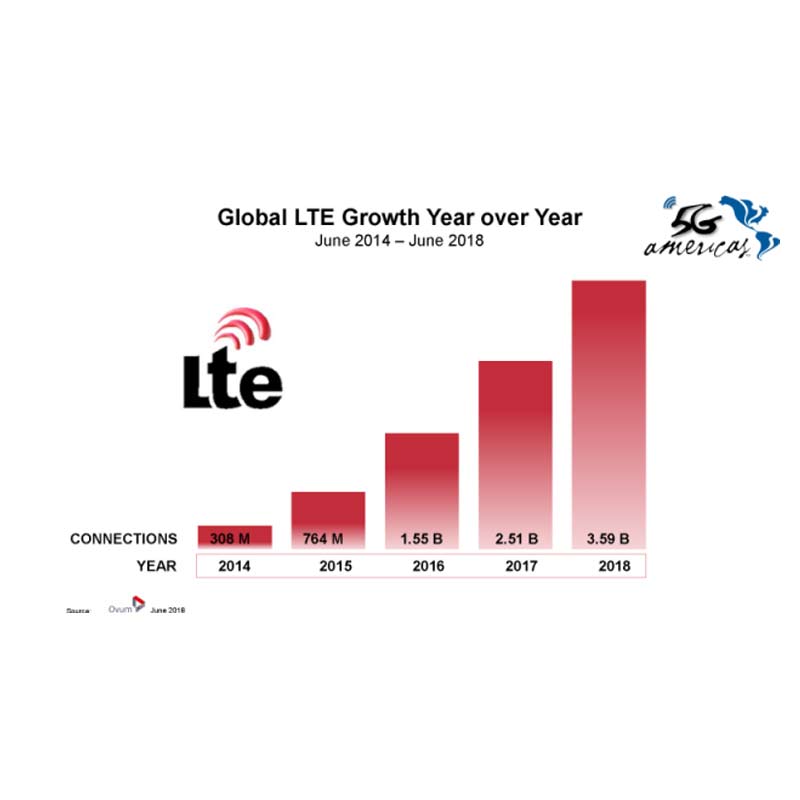
    MUMBAI: A report by 5G Americas states that 5G is expected to accumulate connections starting in late 2018 and by 2022, it is forecast to have almost 400 million connections worldwide. 4G LTE is expected to reach over 5.6 billion connections globally in 2022 at which time LTE market share will stand at 60 per cent, according to a report by ET Telecom.
    5G America, in a statement citing Ovum data, said that the global LTE connections grew by more than one billion connections from June 2017 to June 2018 with a growth rate of 43 per cent. With all subscription data provided by Ovum, the LTE market share compared to all other mobile wireless technologies achieved 42.3 per cent at the end of the second quarter of 2018 with a global total of 3.6 billion LTE connections.
    Ovum senior analyst Kristin Paulin said, “Globally, total mobile connections grew by 6 per cent in the year to the second quarter of 2018, while LTE connections grew a stronger 43 per cent during this time. This substantial LTE foundation leads to the anticipation that soon we will start to see 5G make inroads.”
    Latin America and the Caribbean added 82 million new LTE subscriptions with 52 per cent growth year over year from June 2017. At the end of the second quarter, there were nearly 241 million LTE connections in the Latin America region on commercial LTE networks across all countries.
    5G Americas president Chris Pearson said, “These are exciting days for North America as the early commercial realisation of 5G technology is just around the corner. At the same time, the US and Canadian service providers are heavily invested in the innovation roadmap of LTE to deliver tremendous throughput speeds and coverage as the foundation for future 5G networks.”
    Compared to the population of 365 million in North America, LTE achieved a penetration rate over 103 per cent with 376 million connections. North America holds the largest market share for LTE at 77 per cent and 376 million LTE connections. This penetration rate compares to the next two highest regions, Oceania, Eastern and Southeastern Asia at 88 per cent and Western Europe at 66 per cent.

  • Spectrum auction: TRAI consulting international agencies

    Spectrum auction: TRAI consulting international agencies

    MUMBAI: The Telecom Regulatory Authority of India (TRAI) is in the midst of consulting various international agencies and experts and hopes to finalise its recommendation on spectrum auction “soon”, chairman R S Sharma has said.

    Sharma said that a review meeting on the telecom auction was held in the TRAI last week. “There is a lot of work being done. We are consulting international agencies, consultants as well as experts and we will come out with our recommendations soon,” Sharma told PTI.

    But he declined to give a specific timeframe for the finalisation of recommendations on the issue. The government is planning to hold the largest-ever spectrum auction of 3,000 MHz radiowaves in the upcoming sale. It has sought recommendations from Trai on the applicable reserve price and related issues for auction of spectrum in the frequency bands 700 MHz, 800 MHz, 900 MHz, 1,800 MHz and 2,100 MHz, 2,300 MHz, 2,500 MHz, 3,300-3,400 MHz and 3,400-3,600 MHz.

    Trai is also expected to give its opinion on timing of the proposed spectrum auction.

    In the previous auction held in 2016, the government had put a total of 2,354.55 MHz of mobile airwaves for sale in the bands of 700 MHz, 800 MHz, 900 MHz, 1,800 MHz, 2,100 MHz and 2,300 MHz, cumulatively valued at Rs 5.63 trillion at base price.

    However, nearly 60 per cent of the radiowaves, including premium 4G bands, remained unsold in that auction. In the five-day auction in 2016, seven telecom companies made commitment of Rs 65,789 crore for buying 964.80 MHz of spectrum across multiple frequency bands.

    The apex industry association COAI is of the view that operators are not ready for the next round of spectrum auction at this point given the deep financial stress and ongoing consolidation in the sector.