Tag: 2G

  • Trai effect: Vodafone falls in line with Jio

    Trai effect: Vodafone falls in line with Jio

    Vodafone telecom service provider is committed to continue playing its responsible role in further developing the Indian telecom sector and in creating value for the consumer.

    Vodafone India has always provided Points of Interconnect (PoI) to other operators for all their fair, reasonable and legitimate requirements and will continue to do so.

    Following guidance from Trai and clarifications from Jio regarding its commercial launch, Vodafone India has decided to increase the Points of Interconnect (POIs) between the two operators by three times.
    Accordingly, it will increase the capacity to connect.

    Vodafone is hopeful that all issues that it has raised with Trai and Jio will be duly considered and resolved at the earliest.

    To create a truly connected, inclusive and Digital India, it is vital to have a level playing field between providers offering the same service, encourage innovations and judiciously use a portfolio of technologies – 2G, 3G & 4G to service the evolving needs of consumers across the country.

    Vodafone is one of India’s leading telecom service providers, a co-creator of the telecom ecosystem, and a catalyst of the telecom revolution in India.

  • Trai effect: Vodafone falls in line with Jio

    Trai effect: Vodafone falls in line with Jio

    Vodafone telecom service provider is committed to continue playing its responsible role in further developing the Indian telecom sector and in creating value for the consumer.

    Vodafone India has always provided Points of Interconnect (PoI) to other operators for all their fair, reasonable and legitimate requirements and will continue to do so.

    Following guidance from Trai and clarifications from Jio regarding its commercial launch, Vodafone India has decided to increase the Points of Interconnect (POIs) between the two operators by three times.
    Accordingly, it will increase the capacity to connect.

    Vodafone is hopeful that all issues that it has raised with Trai and Jio will be duly considered and resolved at the earliest.

    To create a truly connected, inclusive and Digital India, it is vital to have a level playing field between providers offering the same service, encourage innovations and judiciously use a portfolio of technologies – 2G, 3G & 4G to service the evolving needs of consumers across the country.

    Vodafone is one of India’s leading telecom service providers, a co-creator of the telecom ecosystem, and a catalyst of the telecom revolution in India.

  • How will Jio’s launch impact the digital ecosystem?

    How will Jio’s launch impact the digital ecosystem?

    MUMBAI: Jio’s launch last week has caused a stir in the telecommunications industry. Calls and messages on the new network are free while mobile data is 3 to 5 times cheaper compared to competitors. For Jio as a disruptor this is a reasonable strategy: Silicon Valley’s leading VC Peter Thiel has said that “[start-ups] have to be 10 times better than second best”.

    But in addition to rattling up the stock market, Jio’s strategy is likely to have a longer and beneficial impact on India’s digital ecosystem.

    Jio has thrown a glove to other mobile operators by slashing service costs for consumers. While Jio’s offering is only available to LTE customers, that is not relevant: consumers on 2G or 3G will ask their carrier, why do they need to pay 3x to 5x more for slower internet speeds? This is likely to create a pricing war between India’s mobile operators. Such price wars have been commonplace across the world, latest example being Singapore just a few months ago.

    As prices go down, more people will switch on their mobile data services for the first time. GSMA Intelligence estimates only 15% of people in India used mobile broadband in Q4 2015, while smartphone ownership would allow much higher rates already today. Cheaper data increases the share of smartphone users who use mobile data but also incentivizes feature phone owners to upgrade to a smartphone as the main benefit (online access) becomes affordable.

    It wouldn’t be an exaggeration to say that this would accelerate the progress of digital democracy or the vision of digital India by breaking the perception barrier among the bottom of the pyramid. “Data is for everybody” would be the new mantra.

    This will also spur the growth of affordable 4G devices and a multi-SIM environment; further reducing the customer loyalty towards the network. Customers will keep on switching for better price or data bandwidth.

    This in turn helps the digital ecosystem grow. While India’s own services like Ditto TV, Hooq and Gaana are already present in the market, a majority of global digital merchants do not have India in their sights yet. Beside few smartphone owners and lack of access to online payment methods, low mobile data penetration has been one of the key roadblocks.

    Globally, average Netflix users watch 133 hours of video per month which translates into roughly 133 gigabytes (GB)  of data consumed. The average Spotify user listens to 28 hours of music (34-35 GB data) per month. In Western markets a large portion of this content is consumed through landline internet, so such data volumes are not an issue. But for a mobile-first market like India, they have so far made such digital services inaccessible to a large part of the population.

    Reduced cost of data will then result in a bigger uptake of digital content services as users can consume more for less. Local providers will be able to increase their audience while international merchants like Netflix, Spotify, Apple and Amazon are going to reconsider their strategy for India in light of the changing ecosystem.

    With the challenges of mobile data considerably reduced, all other factors point to growth and make India one of the most attractive markets for global merchants.

    Another consequence of the data revolution is voice over IP services like Skype, Viber, and others will get more acceptance in the eco-system from the telecom operators; while this will create more opportunities for them we can see many home-grown companies ready to challenge their hegemonies. Obviously, for customers the more means the merrier.

    While the pricing war will create a temporary setback for carriers, in the long run everyone will benefit. Consumers get affordable internet and access to more digital content. Carriers will be able to increase user stickiness (by negotiating and offering exclusive deals and co-promotions with digital service providers) and average revenue per user (from both increased data consumption and from providing carrier billing for these services).

    (The author is the general manager of Fortumo India Mobile Payments. The views expressed are entirely his own and Indiantelevision.com does not subscribe to them)

  • How will Jio’s launch impact the digital ecosystem?

    How will Jio’s launch impact the digital ecosystem?

    MUMBAI: Jio’s launch last week has caused a stir in the telecommunications industry. Calls and messages on the new network are free while mobile data is 3 to 5 times cheaper compared to competitors. For Jio as a disruptor this is a reasonable strategy: Silicon Valley’s leading VC Peter Thiel has said that “[start-ups] have to be 10 times better than second best”.

    But in addition to rattling up the stock market, Jio’s strategy is likely to have a longer and beneficial impact on India’s digital ecosystem.

    Jio has thrown a glove to other mobile operators by slashing service costs for consumers. While Jio’s offering is only available to LTE customers, that is not relevant: consumers on 2G or 3G will ask their carrier, why do they need to pay 3x to 5x more for slower internet speeds? This is likely to create a pricing war between India’s mobile operators. Such price wars have been commonplace across the world, latest example being Singapore just a few months ago.

    As prices go down, more people will switch on their mobile data services for the first time. GSMA Intelligence estimates only 15% of people in India used mobile broadband in Q4 2015, while smartphone ownership would allow much higher rates already today. Cheaper data increases the share of smartphone users who use mobile data but also incentivizes feature phone owners to upgrade to a smartphone as the main benefit (online access) becomes affordable.

    It wouldn’t be an exaggeration to say that this would accelerate the progress of digital democracy or the vision of digital India by breaking the perception barrier among the bottom of the pyramid. “Data is for everybody” would be the new mantra.

    This will also spur the growth of affordable 4G devices and a multi-SIM environment; further reducing the customer loyalty towards the network. Customers will keep on switching for better price or data bandwidth.

    This in turn helps the digital ecosystem grow. While India’s own services like Ditto TV, Hooq and Gaana are already present in the market, a majority of global digital merchants do not have India in their sights yet. Beside few smartphone owners and lack of access to online payment methods, low mobile data penetration has been one of the key roadblocks.

    Globally, average Netflix users watch 133 hours of video per month which translates into roughly 133 gigabytes (GB)  of data consumed. The average Spotify user listens to 28 hours of music (34-35 GB data) per month. In Western markets a large portion of this content is consumed through landline internet, so such data volumes are not an issue. But for a mobile-first market like India, they have so far made such digital services inaccessible to a large part of the population.

    Reduced cost of data will then result in a bigger uptake of digital content services as users can consume more for less. Local providers will be able to increase their audience while international merchants like Netflix, Spotify, Apple and Amazon are going to reconsider their strategy for India in light of the changing ecosystem.

    With the challenges of mobile data considerably reduced, all other factors point to growth and make India one of the most attractive markets for global merchants.

    Another consequence of the data revolution is voice over IP services like Skype, Viber, and others will get more acceptance in the eco-system from the telecom operators; while this will create more opportunities for them we can see many home-grown companies ready to challenge their hegemonies. Obviously, for customers the more means the merrier.

    While the pricing war will create a temporary setback for carriers, in the long run everyone will benefit. Consumers get affordable internet and access to more digital content. Carriers will be able to increase user stickiness (by negotiating and offering exclusive deals and co-promotions with digital service providers) and average revenue per user (from both increased data consumption and from providing carrier billing for these services).

    (The author is the general manager of Fortumo India Mobile Payments. The views expressed are entirely his own and Indiantelevision.com does not subscribe to them)

  • TRAI commences exercise to explore growth of internet through Wi-fi networks

    TRAI commences exercise to explore growth of internet through Wi-fi networks

    NEW DELHI: Noting that Wi-Fi networks offer affordable, scalable and versatile technologies that can facilitate the spread of Internet access in rural and urban areas alike, the Telecom Regulatory Authority of India today issued a consultation paper on Proliferation of Broadband through Public Wi-Fi Networks.

    Through a set of twelve questions, the Authority has sought to get the opinion of stakeholders including internet and telecom service providers on how best Wi-fi (an acronym for Wireless Fidelity) can grow in the country. Comments have been invited by 10 August with counter-comments by 24 August.

    At the outset, the regulator has noted that the growth of Internet penetration in India and realisation of its full potential is closely tied to the proliferation of broadband services. “Broadband” is currently defined to mean a data connection that is able to support interactive services, including Internet access, with the capability of a minimum download speed of 512 kbps. It therefore refers to a means of delivering high-speed Internet access services.

    Broadband services can be delivered through a number of different access technologies, both wired and wireless, including Digital Subscriber Lines (DSL), optical fibre technology, cable TV networks and mobile broadband services like 2G/3G/4G. In addition to these, radio frequency signals (or spectrum) can also be used for the creation of “wireless local area networks” (WLANs), offering an effective mechanism for extending the “last-mile connectivity” of broadband connections to a wider segment of users.

    Trai says Modern technology makes it possible to integrate a server with high storage capacity with the Wi-Fi hotspot equipment. As the cost of such servers has come down significantly, along with the cost of storage, and the form factors of such devices are very small, it should be possible to cache or download content for easy browsing even when the backhaul connectivity is not available. Such an arrangement can find great application in storing children’s study materials, educational data, agricultural and health related information, as well as movies and entertainment content, for the benefit of Wi-Fi users in areas with irregular connectivity, such as rural areas.

    The regulator said that strictly speaking, Wi-Fi is a certification provided by the Wireless Broadband Alliance1 (WBA), which owns and controls the “Wi-Fi Certified” logo that can be applied to products that satisfy certain interoperability criteria.

    WBA is a non-profit organization, formed in 1999, that promotes Wi-Fi technology and certifies Wi-Fi products if they conform to certain standards of interoperability.

    The questions raised by Trai are:

    Q1. Are there any regulatory issues, licensing restrictions or other factors that are hampering the growth of public Wi-Fi services in the country?

    Q2. What regulatory/licensing or policy measures are required to encourage the deployment of commercial models for ubiquitous city-wide Wi-Fi networks as well as expansion of Wi-Fi networks in remote or rural areas?

    Q3. What measures are required to encourage interoperability between the Wi-Fi networks of different service providers, both within the country and internationally?

    Q4. What measures are required to encourage interoperability between cellular and Wi-Fi networks?

    Q5. Apart from frequency bands already recommended by TRAI to DoT, are there additional bands which need to be de-licensed in order to expedite the penetration of broadband using Wi-Fi technology?

    Q6. Are there any challenges being faced in the login/authentication procedure for access to Wi-Fi hotspots? In what ways can the process be simplified to provide frictionless access to public Wi-Fi hotspots, for domestic users as well as foreign tourists?

    Q7. Are there any challenges being faced in making payments for access to Wi-Fi hotspots? Please elaborate and suggest a payment arrangement which will offer frictionless and secured payment for the access of Wi-Fi services.

    Q8. Is there a need to adopt a hub-based model along the lines suggested by the WBA, where a central third party AAA (Authentication, Authorization and Accounting) hub will facilitate interconnection,
    authentication and payments? Who should own and control the hub? Should the hub operator be subject to any regulations to ensure service standards, data protection, etc?

    Q9. Is there a need for ISPs/ the proposed hub operator to adopt the Unified Payment Interface (UPI) or other similar payment platforms for easy subscription of Wi-Fi access? Who should own and control such payment platforms?

    Q10. Is it feasible to have an architecture wherein a common grid can be created through which any small entity can become a data service provider and able to share its available data to any consumer or user?

    Q11. What regulatory/licensing measures are required to develop such architecture? Is this a right time to allow such reselling of data to ensure affordable data tariff to public, ensure ubiquitous presence of Wi-Fi Network and allow innovation in the market?

    Q12. What measures are required to promote hosting of data of community interest at local level to reduce cost of data to the consumers?

  • TRAI commences exercise to explore growth of internet through Wi-fi networks

    TRAI commences exercise to explore growth of internet through Wi-fi networks

    NEW DELHI: Noting that Wi-Fi networks offer affordable, scalable and versatile technologies that can facilitate the spread of Internet access in rural and urban areas alike, the Telecom Regulatory Authority of India today issued a consultation paper on Proliferation of Broadband through Public Wi-Fi Networks.

    Through a set of twelve questions, the Authority has sought to get the opinion of stakeholders including internet and telecom service providers on how best Wi-fi (an acronym for Wireless Fidelity) can grow in the country. Comments have been invited by 10 August with counter-comments by 24 August.

    At the outset, the regulator has noted that the growth of Internet penetration in India and realisation of its full potential is closely tied to the proliferation of broadband services. “Broadband” is currently defined to mean a data connection that is able to support interactive services, including Internet access, with the capability of a minimum download speed of 512 kbps. It therefore refers to a means of delivering high-speed Internet access services.

    Broadband services can be delivered through a number of different access technologies, both wired and wireless, including Digital Subscriber Lines (DSL), optical fibre technology, cable TV networks and mobile broadband services like 2G/3G/4G. In addition to these, radio frequency signals (or spectrum) can also be used for the creation of “wireless local area networks” (WLANs), offering an effective mechanism for extending the “last-mile connectivity” of broadband connections to a wider segment of users.

    Trai says Modern technology makes it possible to integrate a server with high storage capacity with the Wi-Fi hotspot equipment. As the cost of such servers has come down significantly, along with the cost of storage, and the form factors of such devices are very small, it should be possible to cache or download content for easy browsing even when the backhaul connectivity is not available. Such an arrangement can find great application in storing children’s study materials, educational data, agricultural and health related information, as well as movies and entertainment content, for the benefit of Wi-Fi users in areas with irregular connectivity, such as rural areas.

    The regulator said that strictly speaking, Wi-Fi is a certification provided by the Wireless Broadband Alliance1 (WBA), which owns and controls the “Wi-Fi Certified” logo that can be applied to products that satisfy certain interoperability criteria.

    WBA is a non-profit organization, formed in 1999, that promotes Wi-Fi technology and certifies Wi-Fi products if they conform to certain standards of interoperability.

    The questions raised by Trai are:

    Q1. Are there any regulatory issues, licensing restrictions or other factors that are hampering the growth of public Wi-Fi services in the country?

    Q2. What regulatory/licensing or policy measures are required to encourage the deployment of commercial models for ubiquitous city-wide Wi-Fi networks as well as expansion of Wi-Fi networks in remote or rural areas?

    Q3. What measures are required to encourage interoperability between the Wi-Fi networks of different service providers, both within the country and internationally?

    Q4. What measures are required to encourage interoperability between cellular and Wi-Fi networks?

    Q5. Apart from frequency bands already recommended by TRAI to DoT, are there additional bands which need to be de-licensed in order to expedite the penetration of broadband using Wi-Fi technology?

    Q6. Are there any challenges being faced in the login/authentication procedure for access to Wi-Fi hotspots? In what ways can the process be simplified to provide frictionless access to public Wi-Fi hotspots, for domestic users as well as foreign tourists?

    Q7. Are there any challenges being faced in making payments for access to Wi-Fi hotspots? Please elaborate and suggest a payment arrangement which will offer frictionless and secured payment for the access of Wi-Fi services.

    Q8. Is there a need to adopt a hub-based model along the lines suggested by the WBA, where a central third party AAA (Authentication, Authorization and Accounting) hub will facilitate interconnection,
    authentication and payments? Who should own and control the hub? Should the hub operator be subject to any regulations to ensure service standards, data protection, etc?

    Q9. Is there a need for ISPs/ the proposed hub operator to adopt the Unified Payment Interface (UPI) or other similar payment platforms for easy subscription of Wi-Fi access? Who should own and control such payment platforms?

    Q10. Is it feasible to have an architecture wherein a common grid can be created through which any small entity can become a data service provider and able to share its available data to any consumer or user?

    Q11. What regulatory/licensing measures are required to develop such architecture? Is this a right time to allow such reselling of data to ensure affordable data tariff to public, ensure ubiquitous presence of Wi-Fi Network and allow innovation in the market?

    Q12. What measures are required to promote hosting of data of community interest at local level to reduce cost of data to the consumers?

  • Airtel launches Platinum 3G in India; Mumbai first city for launch

    Airtel launches Platinum 3G in India; Mumbai first city for launch

    MUMBAI: Bharti Airtel is all set to enthral Mumbaikars with the launch of its Platinum 3G service. Winning the 900 MHz band in September 2013, Airtel will be using it to complement the existing 2100 Mhz resulting into greater speed and connectivity. 


    Being the first telecom operator in India to launch Platinum 3G, Airtel will offer the services of Platinum 3G at existing 3G tariff. Mumbai is the primary Indian city to experience the superior connectivity. The company has further plans to extend the services to Kolkata. 


    Airtel Platinum 3G is India’s best 3G network offering a variety of benefits. Till date, Airtel has 50 lakh subscribers in Mumbai and claims to be the only network that works on the Platinum band. Airtel customers in Mumbai can browse the Internet 34 per cent faster, get 30 per cent better indoor coverage and enjoy 16 per cent longer extended battery life. Additionally, users can stream videos 25 per cent faster than the existing speed.


    Bharati Airtel India Mumbai Maharashtra, Goa Gujarat Hub CEO Ashok Ganpathy said, “As a leader in the telecommunication space it is our endeavour at Airtel to consistently innovate and provide a seamless network to our customers. The launch of Platinum 3G is an integral part of this commitment to enhance customer satisfaction by providing superior connectivity on existing 3G tariffs. Considering this we would now like to invite data savvy customers in Mumbai to enjoy this world class experience.”


    Airtel signed a contract with data networking and telecom equipment company, Nokia Networks to enhance its 3G network in Mumbai. As part of the deal, a dual band, dual carrier 3G network has been set up at Mumbai, reframing 900 MHz to complement the city’s existing 3G network on 2100 MHz. This is expected to enable higher throughput and thus improved 3G services for Bharti Airtel’s customers.

  • Govt earns about Rs 96,000 crore in telecom spectrum auction; 16% spectrum still available

    Govt earns about Rs 96,000 crore in telecom spectrum auction; 16% spectrum still available

    NEW DELHI: Approximately Rs 96,000 crore has already been committed in the sale of about 84 per cent of the spectrum provisionally allocated to bidders. Around 43 rounds have taken place in the auction of spectrum in 2100 MHz, 1800 MHz, 900 MHz and 800 MHz Bands with six rounds today.


    As spectrum is still available, auction recommenced this morning. The bidding is taking place in all bands. Brisk bidding was seen on seventh day of bidding, with activity requirement set at 100 per cent.


    There is aggressive bidding going on in 1800 MHz, 900 MHz and 800 MHz bands.


     A majority of service areas are going at a premium over reserve price. With 100 per cent activity requirement and activity in new service areas, competitive bidding is expected to continue.


    The government had initially expected to reap around Rs 49,000 crore from the auction.

  • Alcatel’s smartphone ‘Onetouch Fire C’ launches on Flipkart’s Big Billion Day Sale

    Alcatel’s smartphone ‘Onetouch Fire C’ launches on Flipkart’s Big Billion Day Sale

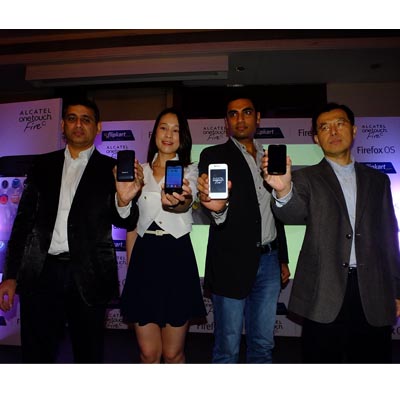
    BENGALURU:  A number of companies have said that they are working on the $20-25 smartphone for India. Alcatel Onetouch (Alcatel) has come in close with a smartphone that seems to have features that just about slot it into the smartphone category, a little above the features phone at a price of Rs 1990, or a little more than $30 – the ‘Onetouch Fire C’.


    The company is targeting first time users of smartphones that want to upgrade from the basic or the features phone in a very price sensitive market like India. The Onetouch Fire C will be available exclusively through Flipkart starting 6 October, or Flipkart’s Big Billion Day (Sale Day), for which the company has initiated a huge multimedia campaign. Flipkart feels that a lot of first time internet users will access the net on the Big Billion Day and hence push up sales of Onetouch Fire C. Flipkart has not planned a special campaign for individual products which include a Lenovo launch on 6 December 2014.


    However, Alcatel plans to push the Onetouch Fire C digitally for now, and through the print media sometime around Diwali. Its creatives are done globally, while media buying is through Ad Syndicate and Zenith Optimedia.


    “Even today, 71 per cent of market in India is feature phones, while 29 per cent is smartphones. Of that 29 per cent, between 30-40 per cent of the market is for the Rs 5000 or lower smartphone, and it is this market that we are targeting primarily with the Fire C,” said Alcatel Onetouch regional director APAC BU Praveen Valecha. The Onetouch Fire C is a 2G phone and the company is likely to come up with an upgraded low cost model sometime in November or December this year, which could have 3G or even 4G capability.


    “As a launch partner for Firefox OS, we know that our customers love its simple user interface and smooth navigation. We see a great deal of opportunity to bring these benefits to more consumers on a greater variety of devices at most affordable price and we are sure of success as it’s an innovative product selling on Flipkart, India’s largest e-commerce platform,” said Valecha.


    Here’s what a press release has to say about the Onetouch Fire C:


    Offering Firefox OS features at entry-level price; the Fire C is a pocket-sized smartphone that is designed to make sharing simple. Its 3.5” HVGA screen and 1 GHZ processor offer smooth and fast Firefox OS apps experience. Complete with mobile broadband and stereo FM radio RDS, the Fire C2G offers all of the features needed to capture, share and enjoy content. Firefox is totally a web HTML based OS which gives best user experience on-the-go. It constitutes marketplace and best adaptive applications search along with rich media and social messaging apps support. A unique dynamic UI will be a big plus for the phone.


    Key features include:

    Onetouch Fire C – 2G: OS version – Firefox 1.3, Compact, pocket friendly design,  3.5” HVGA display, dual sim, 1.0 GHz, 1.3 MP camera; Colour – bluish black and dark chocolate; Multilingual support – English, Bangla, Tamil and Hindi languages.

  • DoT in favour of 10 per cent custom duty on telecom gear

    DoT in favour of 10 per cent custom duty on telecom gear

    MUMBAI: Following the uproar after the union budget proposed imposing 10 per cent import duty on telecom products not covered under Information Technology Agreement (ITA) 1 of WTO to boost domestic production of telecom products, media reports suggest that the Department of Telecommunications (DoT) wants the Finance Ministry to retain the 10 per cent customs duty on specified telecom products as proposed in the budget.


    According to a report in Economic Times, a letter written by the DoT to the revenue secretary said, “Imposition of customs duty on specified telecom products will create a level playing field for domestic manufacturers who suffer severe disability due to poor infrastructure and inverted duty.”


    India is a signatory of ITA 1 as a member of World Trade Organisation. Under the pact, member countries should allow duty free import of products falling under eight categories covering telecom, computers and semiconductors like mobile phones and electronic chips.


    The telecom products mostly fall in the category of 2G, 3G as well as the 4G equipment, including switches and broadband equipment. These products are outside the list of about 220 electronic items on which India has a zero duty commitment under the World Trade Organisation’s Information Technology Agreement (ITA-1).  


    The Government, also, recently declared set top boxes as a part of telecom network. The move exempts STBs from various taxes and duties, bringing down prices, which the government hopes to pass on to consumers. In the first and second phase of cable digitisation, imported STBs accounted for about 95 per cent market share.  


    The letter also added that “India is under no obligation to allow duty free imports of items not covered in ITA-1.”