
I&B Ministry
Radio For The Community


Radio is theater of the mind. Once you get people laughing, they’re listening and you can tell them almost anything.
That’s the motto of Radio MUST, Socho, seekho, bolo, badlo, chamka do duniya ko, jeeet lo is jahaan ko….
(This motto has been composed into a tune by a few students and recently Shankar Mahadevan very cordially sung it for us)
Community radio – as the name suggests – is radio for the community, by the community and of the community.
Of course, the meaning of the word community is interesting and differs from person to person. Today, in the age of radio revolution, the airwaves may appear to be jam packed, but there is still a lot of space for a community radio.
Essentially in India, the concept of community radio is still very unclear as it was never cultivated. But after the Supreme Court verdict that the airwaves are public property, many licences for community radios are being given all across the country. But still, for us Indians who still can’t properly differentiate between traditional radio and the new private radios, community radio is altogether a new concept. Many people will further ask, ‘do we really need another kind of radio? Or is there space for such kind of a radio?’
The community radio movement has gained a lot of pace over the years in the US, UK South America and Australia. In places like Bolivia, there are community radios even for minors and are doing pretty well. It makes sense to have a dedicated community radio for say NRIs residing in a English county or a community radio that caters to the specific needs of the farmer community. Basically a community radio is a non profit, non commercial application used to share information among the given community.
The traditional public radio broadcasting service is a strictly guarded and regulated medium of the government to provide information which they think is right. And we have the new players i.e. the private radio broadcasters for whom it’s a medium to invest in the long run and make money out of entertainment.
Having stated the different types of radio, we need to understand a very basic thing and that is ‘radio par dikhta nahi hai’. One who truly understands this fundamental point will rule the airways. Maybe that’s the reason why most of the radio stations in the metros sound the same.
But talking about community radio, in today’s world, it has a great role to play in terms of providing correct, precise and useful information to the people on a host of topics. Be it farming practices, garbage management, health consciousness, etc. Sounds pretty serious and gross… But if all this information can be transferred through the radio waves in an entertaining manner, the purpose is served. And that’s exactly what you mean by infotainment.
Many universities across the country are now being given licences to operate community radios in their campuses. A community radio service can be heard across a 15 km area as it can have a maximum of 50W transmitter. Anna FM of the Annamalai University, Chennai, was the first campus community radio to be set up in India and it is still doing very well. Many universities have followed but have not been able to match up to the level of broadcast set by Anna FM.
Last year, Mumbai University also got a license to operate an FM community radio from its campus. Not many people have imagined or tried to use the FM radio waves to provide academic information to the people. But Radio MUST @107.8FM (Mumbai University student’s transmission) will dare to explore the hidden treasure of infotainment through this community radio. In a city like Mumbai, which already has eight FM stations, what can a simple FM community radio offer or can it make a difference?
With nearly 75 departments in the university, along with 400 colleges in and around Mumbai affiliated to the university, Radio MUST has huge potential. Also, being a part of the sesquicentennial celebrations (150 yrs) of the university, people have great expectations from Radio MUST. With the radio station coming up at the Kalina campus, this FM community radio needs to be handled with care and in an innovative manner.
Here we would like to set a benchmark in terms of the programming. With Mumbaikars already having had a feel of what FM radio is all about, it will be a great challenge at Radio MUST to provide a similar kind of programming and packaging without the popular music.
The content will be sheer infotainment. Information ranging from academic to social issues to civic responsibilities to slum redevelopment to career options to college festivals to exams and more. The possibilities are unlimited. Not just students but even ex students and volunteers can join in the bandwagon to share important and interesting information through this community radio.
We at Radio MUST hope to utilize the radio waves efficiently with a lot of entertainment. This community radio will be a professionally managed non commercial radio and may just turn out to be the nursery for future radio professionals. This radio station will be run by all the students and these students will get a stipend paid by the university for all the work they do. So it becomes a double incentive for all.
We also plan to upgrade out systems in the near future as the colleges affiliated to Mumbai University are spread over a large area geographically. Also, we plan to stream it live on the Mumbai University website for greater coverage.
Already students from various colleges are working on a variety of programs. So you may soon be able to tune in to Munnabhai and Circuit discussing management fundas, Devdas and Chandramukhi talking about HIV AIDS awareness, James Bond talking about careers in forensic sciences. The list is pretty impressive… mixed together with information about exams, results, festivals, college happenings, social messages etc. this will be an open forum for all who want to make this city a better place to live.
And who better than the future of the country, the youngsters, the students, to do the job. With all the rules and regulations for a FM community radio being followed, Radio MUST will become a must for all of us.
Do you have an opinion on brands taking a social stance. Help Pankaj Athawale write the next chapter. Post your thoughts to editor@indiantelevision.com
(The author is Mumbai University FM community radio head Pankaj Athawale)
(The views expressed here are those of the author and Indiantelevision.com need not necessarily subscribe to the same)



NEW DELHI: If 2025 was India’s year to make waves, the ministry of information and broadcasting (I&B) was its chief surfboard maker. Prime minister Narendra Modi’s call to “create in India, create for the world” wasn’t just ministerial hot air—it triggered a tsunami of creative dealmaking that swept from Melbourne to Madrid, generating Rs 4,334 crores in potential business discussions and putting Indian creators on every continent’s radar.
The centrepiece was Waves 2025, the World Audio Visual and Entertainment Summit, which drew over 90 countries, 10,000 delegates, and roughly 1 lakh punters through its doors. Modi himself dropped by to glad-hand young creators, describing the event as a “wave of culture, creativity and universal connectivity”—and for once, the hyperbole wasn’t entirely unwarranted.
The summit’s CreatoSphere platform, which sounds like something from a sci-fi novel but is actually a hub for film, VFX, animation, gaming, and digital media, launched the Create in India Challenges. Season one attracted over 1 lakh entries from more than 60 countries across 33 categories. Winners weren’t just handed certificates and sent packing—they performed at Melbourne, exhibited at Tokyo Game Show, and pitched at Toronto International Film Festival. I&B minister Ashwini Vaishnav handed out gongs to 150 creators, cementing the government’s commitment to nurturing what it calls the “creative economy.”
WaveX, the startup arm, proved equally industrious. It coaxed over 200 startups into its embrace, enabled 30 to pitch to Microsoft, Amazon, and Lumikai, and somehow got two of its charges—VYGR News and VIVA Technologies—onto Shark Tank India, where they presumably dodged the usual mauling. The initiative’s KalaaSetu and BhashaSetu challenges, focused on AI-driven video generation and real-time translation respectively, attracted over 100 startups and picked ten for collaboration with government media units.
Waves Bazaar, the “craft-to-commerce” global e-marketplace, went on a roadshow between August and December, hitting 12 international events across four continents and four domestic jamborees. The numbers are eye-watering: over 9,000 B2B meetings, 10 memoranda of understanding signed, three more proposed, and the launch of creative corridors with Japan, Korea, and Australia. The ministry claims Rs 4,334 crores in potential deals—potential being the operative word, though in India’s booming content market, optimism often precedes reality by only a few quarters.
On the bricks-and-mortar front, the Indian Institute of Creative Technology opened its temporary Mumbai campus in July with Rs 391.15 crores in budgetary support. The public-private partnership with Ficci and CII has enrolled over 100 students across 18 courses, incubated eight startups, and signed memoranda with Google, Meta, Nvidia, Microsoft, Apple, Adobe, and WPP—a who’s who of tech giants keen to tap India’s creative reserves. A permanent 10 acre campus at Film City, Goregaon, complete with an immersive AR/VR/XR studio, is in the works.
Elsewhere, the ministry set up a Live Events Development Cell to position India’s concert economy as a growth driver. A single-window clearance system is being built on the India Cine Hub platform to expedite permissions for fire, traffic, and municipal approvals—addressing the red-tape nightmares that have long plagued event organisers. Meanwhile, an inter-ministerial committee is tackling digital piracy, that perennial thorn in the creative economy’s side.
State broadcaster Doordarshan snagged the Election Commission’s media award for voter awareness during the 2024 Lok Sabha elections, presented by the president on National Voters’ Day. Community radio added 22 new stations, bringing the total to 551, with workshops and a national sammelan held during Waves to strengthen local broadcasting.
The 56th International Film Festival of India in Goa screened over 240 films from 81 countries, threw in the country’s first AI Film Festival, and staged a grand parade through Panaji that turned the event into a street-level celebration. The accompanying Waves Film Bazaar drew over 2,500 delegates from 40-plus countries and showcased 320 projects—making it one of South Asia’s largest film markets.
The Central Board of Film Certification modernised too, launching a multilingual certification module that allows multiple language versions under a single application, and mandating 50 per cent women’s participation on examining and revising committees. Digital signatures replaced wet ink, and certificates became downloadable—small victories in the fight against bureaucratic inertia.
India’s I&B ministry ended 2025 having turned content creation into something resembling an industrial policy. Whether Rs 4,334 crores in “potential” business materialises remains to be seen, but the ministry has built the infrastructure, corralled the startups, and put Indian creators on international stages. As Modi might say, the wave has been ridden. Now comes the hard part: keeping the momentum going when the cameras stop rolling.
MUMBAI: The Centre has inched closer to making India’s streaming universe easier to watch, hear and enjoy for everyone. The Ministry of Information and Broadcasting has released draft guidelines that aim to standardise accessibility on OTT platforms, ensuring that viewers with hearing and visual impairments are no longer left out of the country’s digital entertainment boom.
Issued on 7 October and now open for public consultation, the draft rules arrive with constitutional and global backing. Minister of State for Information and Broadcasting L. Murugan told the Rajya Sabha that the framework draws from Article 14, the UN Convention on the Rights of Persons with Disabilities and the Rights of Persons with Disabilities Act, 2016. It also mirrors the Code of Ethics under the IT Rules, 2021.
At the heart of the proposal is a two-phase rollout of mandatory accessibility tools such as same-language closed captions and audio descriptions. The ministry said penalties and enforcement steps will be shaped after the consultation, but compliance will be tracked through progressive targets for OTT content libraries.
Parliament was also reminded that the broadcast sector has walked this path before. In 2019, the government notified accessibility standards for television programming, starting with Prasar Bharati and eventually extending them to private broadcasters.
With OTT viewership climbing across urban and small-town India, the draft rules attempt to bring streaming giants in step with a wider vision of inclusive media. The government hopes the move will help millions of Indians with disabilities press play without barriers.
MUMBAI: India’s broadcast heavyweights have mounted a firm resistance to the Ministry of Information and Broadcasting’s proposed rule change on landing pages, arguing that the plan is legally shaky, technically confused and commercially stacked against the industry.
News18, NDTV, Times Now and other major networks have told the Ministry that the amendment deserves to be scrapped altogether. Their submissions note that the proposal attempts to revive a measurement method that the Telecom Regulatory Authority of India had already studied and rejected in 2018 for being unreliable. With the issue currently before the Supreme Court, broadcasters say any fresh intervention now breaches basic principles of administrative fairness.
At the heart of the dispute lies the belief that landing page viewership is somehow suspicious. Broadcasters counter this view, insisting that landing pages act as legitimate promotional real estate, no different from a newspaper jacket or a supermarket’s prime shelf. When a TV set turns on and a viewer decides either to stay or switch away, they argue that this choice represents genuine viewing behaviour, not inflated numbers.
Removing first impressions, they warn, would wipe out real audience actions and twist the ratings picture. TRAI had raised the same concern in 2018, concluding that genuine impressions would be wrongly filtered out.
Industry bodies have added their voice to the chorus. The All India Digital Cable Federation has urged the Ministry to leave current practice intact, while several regional and smaller broadcasters have filed similar objections. The opposition, they say, stretches far beyond a few big brands.
With the sector unified in its stance, broadcasters have urged the Ministry to withdraw the proposal and preserve the current ratings framework. Only then, they argue, can India’s TV market retain a fair contest, clear metrics and a true reflection of what viewers actually choose to watch.

Mukesh Ambani, Larry Fink come together for CNBC-TV18 exclusive

Nielsen launches co-viewing pilot to sharpen TV measurement

Netflix celebrates a decade in India with Shah Rukh Khan-narrated tribute film

Delhivery chairman Deepak Kapoor, independent director Saugata Gupta quit board

Meta appoints Anuvrat Rao as APAC head of commerce partnerships

Brnd.me enters Europe as haircare brands power global expansion

TechnoSport taps quick commerce with launch on Slikk’s 60-minute platform

These ’90s fashion trends are making a comeback in 2017
The final 6 ‘Game of Thrones’ episodes might feel like a full season
According to Dior Couture, this taboo fashion accessory is back
The old and New Edition cast comes together to perform
Phillies’ Aaron Altherr makes mind-boggling barehanded play
Uber and Lyft are finally available in all of New York State
Disney’s live-action Aladdin finally finds its stars
Mukesh Ambani, Larry Fink come together for CNBC-TV18 exclusive
Nielsen launches co-viewing pilot to sharpen TV measurement
Netflix celebrates a decade in India with Shah Rukh Khan-narrated tribute film
Delhivery chairman Deepak Kapoor, independent director Saugata Gupta quit board
Meta appoints Anuvrat Rao as APAC head of commerce partnerships
Brnd.me enters Europe as haircare brands power global expansion
TechnoSport taps quick commerce with launch on Slikk’s 60-minute platform
-
 News Broadcasting3 days ago
Mukesh Ambani, Larry Fink come together for CNBC-TV18 exclusive
-
 iWorld6 days ago
Netflix celebrates a decade in India with Shah Rukh Khan-narrated tribute film
-
 MAM3 months ago
HoABL soars high with dazzling Nagpur sebut
-
 iWorld12 months ago
BSNL rings in a revival with Rs 4,969 crore revenue
-
 I&B Ministry3 months ago
India steps up fight against digital piracy
-
 iWorld3 months ago
Tips Music turns up the heat with Tamil party anthem Mayangiren
-
 MAM3 days ago
Nielsen launches co-viewing pilot to sharpen TV measurement
-
 News Broadcasting2 months ago
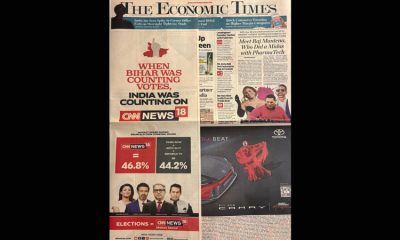
CNN-News18 dominates Bihar election coverage with record viewership

