
Education
Do you need antivirus software?


Anti-malware programs are designed to protect against viruses, among other things. They are denoted by a more modern term that covers all types of malware, including viruses. Anti-malware programs can prevent viruses from entering a computer or removing infected files. At the same time, anti-malware software may not have the functionality to restore files modified or replaced by a virus. Antivirus and anti-malware are referred to by the more general term “cybersecurity tools.”
Installing an antivirus on your computer does not guarantee 100% protection against any intruder’s intrusions, but it usually ensures protection against known forms of viruses and threats. Unfortunately, there is a constant struggle between virus creators and antivirus software developers. Moreover, you can download malware from a copy of a trusted site like the OCB website or similar content. Therefore, you have to be extremely careful.
That is why regular updates and installation of newer antiviruses are prerequisites for complete protection against threats.
It is worth noting that not all antivirus programs block spyware programs. Spyware programs are usually aimed at stealing information and do not cause visible damage to your computer in the form of various changes in a performance like viruses.
Many of you are asking, “Do I need antivirus on Windows? Today we will try to understand what modern antiviruses are and under what conditions you can give them up.
What is a computer virus?
A computer virus is (usually) malicious software that has two characteristics:
● It takes the actions of an unsuspecting user to launch a virus. Opening an attachment in an unsecure E-Mail (spam mail) or starting an infected program may be enough. The virus then starts trying to infiltrate other devices connected to the network or listed in the user’s contact list.
● The virus must have the ability to copy itself. If a program object does not create copies of itself, it is not a virus. Self-copying can, for example, be done by modifying or completely replacing other files on the user’s system. Either way, the final file must exhibit the same behavior as the original virus file.
Computer viruses have accompanied us for decades. The theoretical understanding of “self-replicating automata” (i.e., viruses) was formulated by John von Neumann in a paper published in the late 1940s. However, the earliest viruses began to appear in the 1970s on platforms that preceded the personal computer. At the same time, the history of modern viruses begins with the Elk Cloner program that struck Apple II systems in 1982. This virus, carried by infected floppy disks, did not harm. However, it penetrated all media plugged into the system and spread rapidly, which many computer security experts consider the first-ever large-scale computer virus epidemic.
Antiviruses and scarecrows
Pseudo-antiviruses account for the leading share of scareware sellers. They perform free “scans” (often online), supposedly find something, and then offer to remove it for money. Unfortunately, it is the scarecrows that ruin the reputation of real antiviruses. Real antiviruses, however, are less and less different from fake antiviruses.
The intimidation of the user begins as early as during installation. Then the antivirus bugs you with notifications until you buy a paid version and allow it to do anything on your computer.
Such aggressive promotion tactics undermine the credibility of all security software manufacturers, affecting even the market leaders.
Antivirus and surveillance
The scandal of banning Kaspersky Lab products in the US is still ongoing, but the charges against them can be brought against any antivirus vendor. It is because they all contain cloud scanning tools and send any files they deem suspicious to their servers.
According to the manufacturers’ claims, everything happens automatically and is anonymized, and the technology is unsuitable for collecting information from specific computers. However, the opposite task (finding the source of the distribution of malware or establishing that a file belongs to a particular computer) can generally be solved.
Antiviruses and vulnerabilities
Another problem is that bugs in any popular software are often used to execute attacks, and antiviruses are one of the main targets here. For example, a vulnerability was found in Bitdefender Internet Security 2018 that allows remote execution of arbitrary code. Unfortunately, Avast, AVG, and many others are no better.
Today’s antiviruses are deeply integrated into the system, sometimes creating more problems than it solves. They install their services (which may contain bugs) and intercept system calls (disturbing other programs); they have too many rights and are technically capable of doing anything without user knowledge.
Another alarming thing is the antivirus modules like “secure payments.” You go to a bank’s site with an antivirus browser extension and enter data on its “keylogger-proof” on-screen keyboard. All this seems to be going over HTTPS, but the antivirus has to check the encrypted traffic, so it installed its certificate to decrypt it long ago.
The antivirus company already has all the other identification data – you specified it yourself during registration. Therefore, in purely technical terms, nothing prevents them from manipulating your accounts and attributing everything to hackers’ tricks. Another thing is that a company’s reputation is worth more, which is unlikely to happen in reality. In any case, we are not aware of such facts.
Do you need an antivirus?
It is a complicated question and depends on your knowledge of computers or, better yet, information security. It will be extra with all the improvements, such as the Windows 10 protector and built-in protection against encryption. However, we still advise using some antivirus for people who do not understand computers.
A properly configured firewall, checking downloaded files for viruses, and using virtual machines to test new and suspicious programs is enough for those in the know.
To give up antivirus, you will have to follow these rules:
● Use modern operating systems and update them in time;
● Keep your software up to date;
● Download and install software only from official sites;
● Check the downloaded files at online file scanning services;
● Test downloaded software on a virtual machine;
● Do not use crack codes and keygen;
● Do not browse dubious sites;
● Do not launch executable files received by mail;
● Use a properly configured firewall;
● Disable auto-run flash drives, and don’t use strange flash drives.
You’ll find additional tips and methods for fighting viruses in the article “Protection against viruses” and section “Safety.” The essential thing in the fight against viruses is a sober mind and straight hands.
Paid or free antivirus?
Free antivirus from a reputable company or the built-in Windows defender is enough. There is no need to use paid antivirus.
As a rule, paid antivirus differs from its free counterparts with a few additional options, which are unlikely to help if the virus has been encrypted and has zero detection on online services check files for viruses.

LONDON: ESCP Business School has appointed Professor Marie Taillard as dean of its London campus, effective December 19, 2025, as the institution sharpens its expansion and academic ambitions in the UK.
Taillard, who previously served as interim dean, will take on the role for a three-year term. Her appointment comes as ESCP seeks to strengthen its position in London and expand its academic, industry and societal engagement across the UK.
ESCP Business School executive president and dean Leon Laulusa, said Taillard’s expertise in creativity and marketing, combined with her long association with the institution, made her well placed to shape the campus’s next phase. He credited her with launching the MSc in Marketing & Creativity, now one of the school’s flagship programmes.
ESCP London chairman of the board of trustees Lord David Gold, said Taillard would build on the campus’s recent momentum, citing her academic leadership and international outlook.
A L’Oréal professor of creativity marketing and former UK head of faculty, Taillard has been central to ESCP’s push for innovative pedagogy that bridges academic research and professional practice. She was recently shortlisted for the Times Higher Education’s Most Innovative Teacher of the Year award.
Taillard said her focus would be on expanding the programme portfolio, strengthening lifelong learning and deepening links between academia, industry and local communities, aligned with ESCP’s Bold & United strategy.
She holds an MBA from Columbia Business School and a PhD from the University of London, and has held several senior leadership roles at ESCP since joining its permanent faculty in 2007. The London campus currently serves more than 1,900 students and executive participants each year and is ranked second in the UK by the Financial Times.
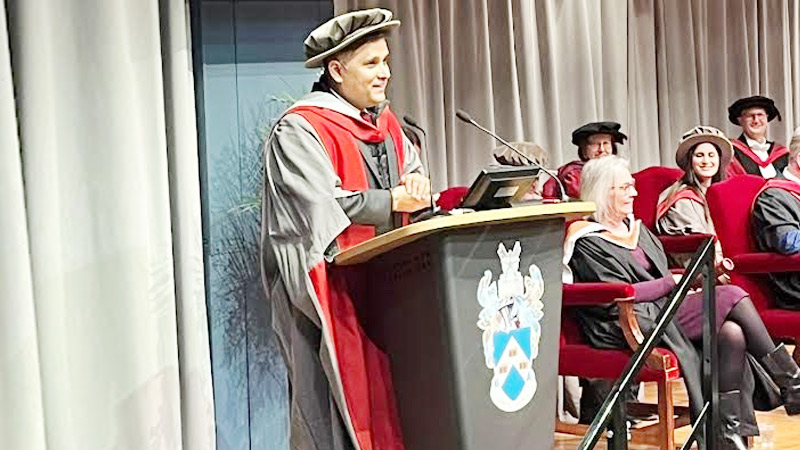
YORK: Bestselling author and former diplomat Amish Tripathi has added a new title to his name, Doctor of the University.
The University of York in the United Kingdom has conferred on Tripathi an honorary doctorate, honouris causa, recognising his contribution to Indian literature and his role in carrying Indian culture to audiences around the world.
In its citation, the University described Tripathi as the fastest-selling author in Indian publishing history. His 12 books have sold over eight million copies globally, earning him a regular place on Forbes India’s list of influential celebrities.
Beyond the printed page, Tripathi is a familiar voice and face to viewers. A seasoned broadcaster, he has hosted acclaimed documentaries, including the award-winning Legends of the Ramayan. He is also co-founder of Tara Gaming, the studio behind Age of Bhaarat, billed as India’s first AAA video game. Before returning to full-time creative work, he served as minister for Culture and Education at the Indian High Commission in London.
The honorary degree was presented at the University of York’s winter graduation ceremony in the second week of January 2026, in the presence of students, faculty and guests from across the world. In awarding the honour, the University praised Tripathi for deepening global understanding of Indian values, traditions and storytelling.
He was joined in this year’s roll of honour by three other distinguished figures: renowned mathematician professor Simon Donaldson, ecologist professor Sue Hartley OBE, and dame Amanda Blanc DBE, group chief executive officer of Aviva.
The University of York awards its honorary doctorates to individuals whose achievements show exceptional distinction and reflect the institution’s values. For Tripathi, it marks another chapter in a career that continues to blend myth, modernity and meaningful dialogue across cultures.
NEW DELHI / SAN FRANCISCO: Niit learning systems limited’s managed training arm, niit mts, has bought 100 per cent of Sweetrush Inc in a deal worth up to $26 million, tightening its grip on the USA and sharpening its ai-led learning offer.
The acquisition, completed through Niit (USA) inc, includes performance-linked earn-outs over five years. Sweetrush, founded in 2001 by Arturo Schwartzberg and Andrei Hedstrom and headquartered in San Francisco, employs more than 100 people across the United States and Costa Rica, with a wider bench of learning specialists.
Niit MTS is betting that Sweetrush’s award-winning, human-centred learning design, spanning certification-driven content and a fast-growing talent solutions practice, will plug neatly into its global, ai-enabled managed learning platform for Global 1000 clients. The aim: turn project work into sticky, annuity-like contracts and lift wallet share across enterprises, professional associations and not-for-profits.
Niit MTS chief executive officer and executive director Sapnesh Lalla, said the tie-up brings “human-centred learning craft and global operational scale, powered by technology and AI, under one roof”.
Sweetrush chief executive officer Danielle Hart, said joining niit offers a bigger global runway while preserving the firm’s culture of care and innovation.
Niit MTS vice chairman and managing director Vijay K Thadani, called the deal a boost to its outcome-focused portfolio, marrying strategic learning interventions with delivery at scale.
Sweetrush’s founders struck a similar note. Arturo Schwartzberg said the teams and culture would remain intact, now backed by Niit’s heft, while Andrei Hedstrom said the combined ecosystem would “amplify” the firms’ impact on mission-critical learning.

Mukesh Ambani, Larry Fink come together for CNBC-TV18 exclusive

Nielsen launches co-viewing pilot to sharpen TV measurement

Netflix celebrates a decade in India with Shah Rukh Khan-narrated tribute film

Delhivery chairman Deepak Kapoor, independent director Saugata Gupta quit board

Meta appoints Anuvrat Rao as APAC head of commerce partnerships

Brnd.me enters Europe as haircare brands power global expansion

TechnoSport taps quick commerce with launch on Slikk’s 60-minute platform

These ’90s fashion trends are making a comeback in 2017
The final 6 ‘Game of Thrones’ episodes might feel like a full season
According to Dior Couture, this taboo fashion accessory is back
The old and New Edition cast comes together to perform
Phillies’ Aaron Altherr makes mind-boggling barehanded play
Uber and Lyft are finally available in all of New York State
Disney’s live-action Aladdin finally finds its stars
Mukesh Ambani, Larry Fink come together for CNBC-TV18 exclusive
Nielsen launches co-viewing pilot to sharpen TV measurement
Netflix celebrates a decade in India with Shah Rukh Khan-narrated tribute film
Delhivery chairman Deepak Kapoor, independent director Saugata Gupta quit board
Meta appoints Anuvrat Rao as APAC head of commerce partnerships
Brnd.me enters Europe as haircare brands power global expansion
TechnoSport taps quick commerce with launch on Slikk’s 60-minute platform
-
 News Broadcasting3 days ago
Mukesh Ambani, Larry Fink come together for CNBC-TV18 exclusive
-
 iWorld6 days ago
Netflix celebrates a decade in India with Shah Rukh Khan-narrated tribute film
-
 MAM3 months ago
HoABL soars high with dazzling Nagpur sebut
-
 iWorld12 months ago
BSNL rings in a revival with Rs 4,969 crore revenue
-
 I&B Ministry3 months ago
India steps up fight against digital piracy
-
 iWorld3 months ago
Tips Music turns up the heat with Tamil party anthem Mayangiren
-
 MAM3 days ago
Nielsen launches co-viewing pilot to sharpen TV measurement
-
 News Broadcasting2 months ago
CNN-News18 dominates Bihar election coverage with record viewership

