Blog

  • Vida unveils agentic AI-powered media factory at IBC 2025

    Vida unveils agentic AI-powered media factory at IBC 2025

    LONDON:  Vida, the London- and Los Angeles-based cloud-native media management outfit, has launched Media Factory, an agentic AI-powered workflow automation engine set to debut at IBC 2025.

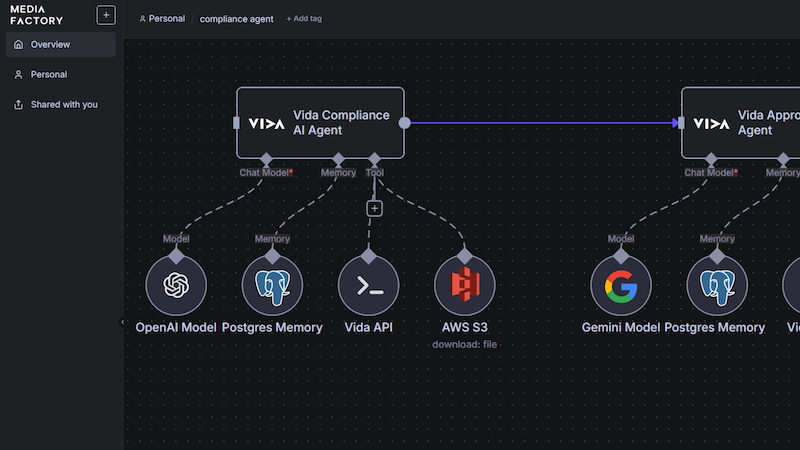
    Billed as a “smarter, faster way” to run the digital media supply chain, Media Factory integrates directly into Vida’s content OS and ships with more than 300 pre-built connectors, from AI tagging and transcription to compliance checks and delivery to fast channels, YouTube and social platforms. What once took weeks of bespoke software coding can now be built, tested and deployed in hours.

    “Media Factory is about giving teams the tools to connect content, configure any workflow, and integrate with any business system. The possibilities are mind-blowing,” said Vida managing director Symon Roue.

    The tool uses a visual drag-and-drop interface to let both humans and AI models orchestrate ingest, metadata packaging, age-appropriateness flagging, analytics integration, and trigger-based delivery. Workflows can be fired by events, webhooks, asset changes or file activity. Unlike legacy systems demanding top-tier software engineers, Media Factory is pitched at operations and technology teams asked to do more with less.

    Vida’s customers already manage over 43m assets and 26 petabytes of content on its platform. The new engine will be available to enterprise clients and partners from September 2025. Demonstrations will run at IBC 2025 in Hall 5, stand 5.D50.
  • Mastercard clinches naming rights to McLaren Formula 1 team from 2026

    Mastercard clinches naming rights to McLaren Formula 1 team from 2026

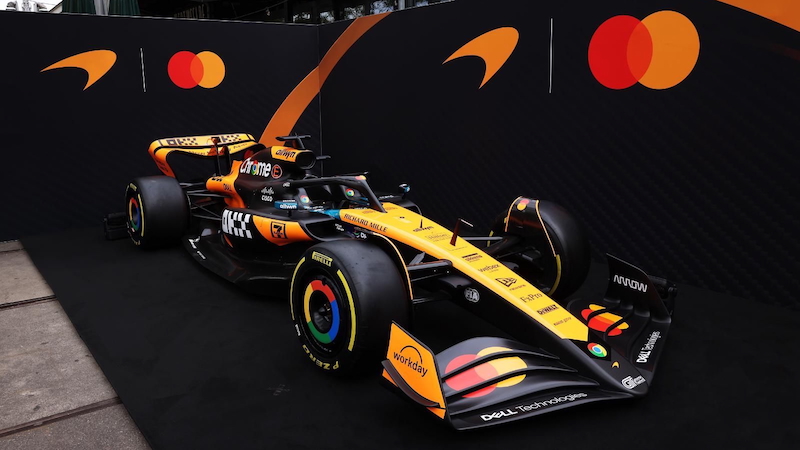
    AMSTERDAM: Mastercard has signed a landmark naming-rights deal with McLaren Racing, under which the team will compete from 2026 as the McLaren Mastercard Formula 1 team. The partnership is valued by industry observers at more than $100 million over several years, putting it among the top tier of F1 sponsorship agreements.

    The announcement was made in Amsterdam by Raja Rajamannar, Mastercard’s chief marketing and communications officer and founding president of its healthcare business, alongside McLaren chief executive Zak Brown and drivers Lando Norris and Oscar Piastri.

    Rajamannar said the tie-up rested on shared values of innovation, performance and fan engagement. “McLaren is the number one team, and this partnership allows us to connect fans to the sport in ways never seen before,” he said.

    As part of the deal, Mastercard unveiled Team Priceless, a global fan programme aimed at bringing supporters closer to the action through behind-the-scenes access, immersive digital activations and exclusive experiences with the drivers.

    The timing is strategic. Formula 1’s popularity has surged since Liberty Media acquired the sport in 2017 for $8 billion. Global TV audiences now exceed 500 million per year, with more than 45 per cent of viewers under 35 — a demographic highly prized by brands. Social media engagement grew 23 per cent year-on-year in 2024, making F1 the fastest-growing sports property online.

    McLaren, meanwhile, has staged a revival, finishing fourth in the constructors’ championship last season and securing eight podiums. New technical regulations in 2026, including hybrid power units with 50 per cent electrical output, are expected to level the playing field — an opportunity McLaren intends to seize with fresh investment.

    For Mastercard, the move reinforces a sponsorship strategy that already spans the UEFA Champions League, the Rugby World Cup and the Australian Open. Sports partnerships account for a significant portion of its global marketing spend, estimated at over $1.7 billion annually. By attaching its name directly to an F1 team, the company is betting that the sport’s glamour and youthful audience will deliver long-term brand dividends.

  • PKL raids new turf with 8 languages and referee cam for Season 12

    PKL raids new turf with 8 languages and referee cam for Season 12

    MUMBAI: Kabaddi is no longer just heard in a single tongue, it’s shouting from the rooftops in eight. As the Pro Kabaddi League (PKL) Season 12 kicks off on 29 August, fans can expect a whole new playbook of innovation, from fresh formats and referee cams to commentary in eight languages.

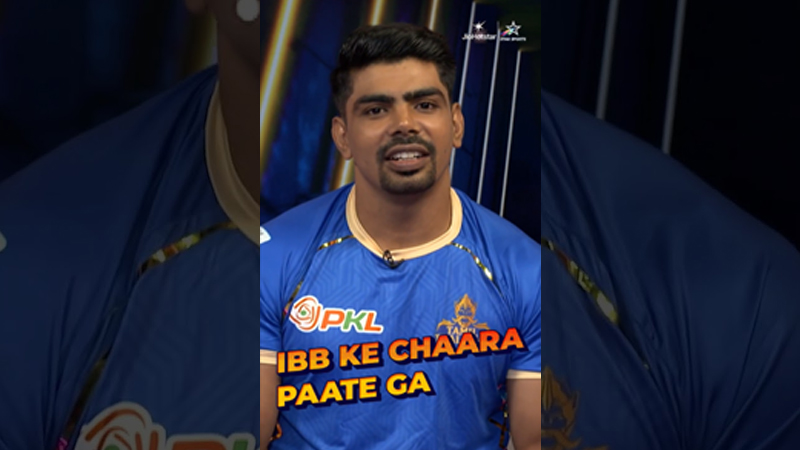
    For the first time, the league goes truly multilingual. Alongside English, Hindi, Tamil, Telugu, Kannada and Marathi, viewers can now hear raids in Haryanvi and Bhojpuri a move that takes kabaddi deeper into its northern heartlands. Bhojpuri has already been a smash hit with cricket audiences, while Haryanvi adds a hyperlocal connect.

    And the voices leading the charge are just as starry. Ravi Kishan headlines the Bhojpuri feed, while Srinivas Reddy takes Telugu. Champions K. Prapanjan (Tamil), Mohit Chhillar (Haryanvi), Vishal Mane (Marathi), former India women’s captain Mamatha Poojary (Kannada) and raider Rishank Devadiga add insider flair. Add to that the likes of Sunil Taneja, Vrajesh Hirjee, Padamjeet Sehrawat, NC Kaushik and Chaitanya Sant, and the mat suddenly sounds richer than ever.

    The tech side gets a glow-up too. Fans can now experience two dugout views, a split screen revival tracker, and the big debut, the ‘Referee Cam’, which flips between live play and a bodycam perspective, plunging viewers into the heart of a raid.

    “Season 12 is about making the game more accessible and more engaging than ever,” said JioStar head of audience engagement Siddharth Sharma,  at . “By presenting the league in eight languages and adding immersive tools like referee cam, we’re creating a richer, more inclusive kabaddi story.”

    On the mat, the action is just as fierce. Tie-breakers will now settle drawn matches in the league phase, ensuring no game ends flat. A brand-new play-in phase has been added: the top two teams sail straight into the playoffs, 3rd and 4th contest a mini-qualifier, while 5th to 8th fight it out for the remaining slots.

    With every raid live on Star Sports Network and JioHotstar, Season 12 promises to be kabaddi like never before faster, louder, and more local, with the referee’s whistle now literally in your ear.

  • Lovnish Bhatia joins Worldwide Media as vice president – digital product

    Lovnish Bhatia joins Worldwide Media as vice president – digital product

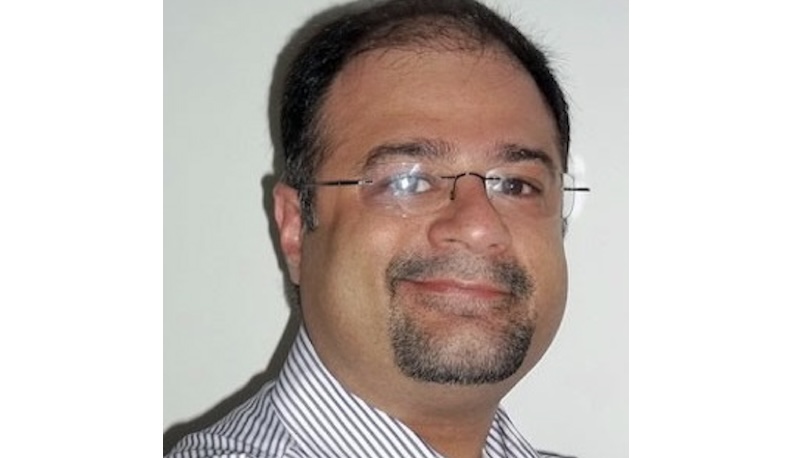
    MUMBAI: Worldwide Media, a subsidiary of the Times Group, has named Lovnish Bhatia as vice president – digital product. Based in Mumbai, he will spearhead the publisher’s digital strategy, mobile platforms and product innovation.

    Bhatia brings more than 20 years of experience across digital media, operations and business development. He was most recently head of operations at Wify Technologies, after a brief stint as a new business development consultant.

    Earlier, he served as chief operating officer at Timesaverz, led services at Hettich India, and drove business development for video advertising firm Vdopia, where he was instrumental in securing the ICC World Cup 2011 digital sales mandate for Star India.

    His media career began at Sony Entertainment Television in 2000, followed by digital sales leadership roles at NDTV Media and Viacom18, where he introduced digital syndication and online-only monetisation models.

    With a career spanning technology, advertising, consumer services and media, Bhatia is expected to play a key role in accelerating Worldwide Media’s digital transformation.

  • Saumya Mittal takes charge as McDonald’s chief people officer for Asia

    Saumya Mittal takes charge as McDonald’s chief people officer for Asia

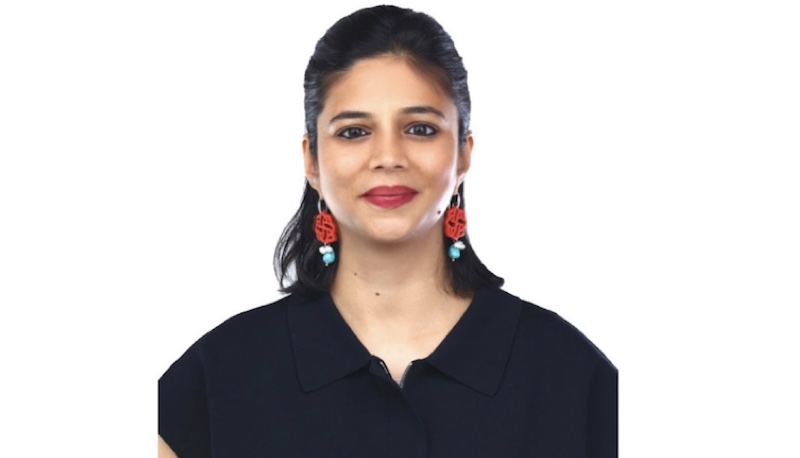
    MUMBAI: McDonald’s Corp has appointed Saumya Mittal as chief people officer for Asia, handing her the keys to one of its most critical growth markets. Mittal, who took charge this month, will oversee the end-to-end people agenda across Asia, partnering with regional leaders to sharpen talent strategy, culture and organisational design.

    She joins from Google, where she spent nearly eight years in senior HR roles, most recently as APAC commercial HR lead, steering transformational programmes across the region. Earlier, she led diversity, equity and inclusion for Google APAC and served as people partner for the region.

    Mittal cut her teeth at PepsiCo, spending a decade across plant HR, IR, talent acquisition, diversity and change management, before rising to head culture, engagement and change. Her early years as management trainee and plant HR manager gave her hands-on grounding in industrial relations and large workforce management.

    Winner of People Matters’ Are You in the List award in 2015, Mittal has also bagged multiple national and international honours during her career at PepsiCo and Google. With 15 years of experience straddling consumer goods and technology, she is expected to play a pivotal role as McDonald’s deepens its bets on Asia’s high-growth markets.

  • Aditya Raj Kaul joins NDTV as senior executive editor for geopolitics and security

    Aditya Raj Kaul joins NDTV as senior executive editor for geopolitics and security

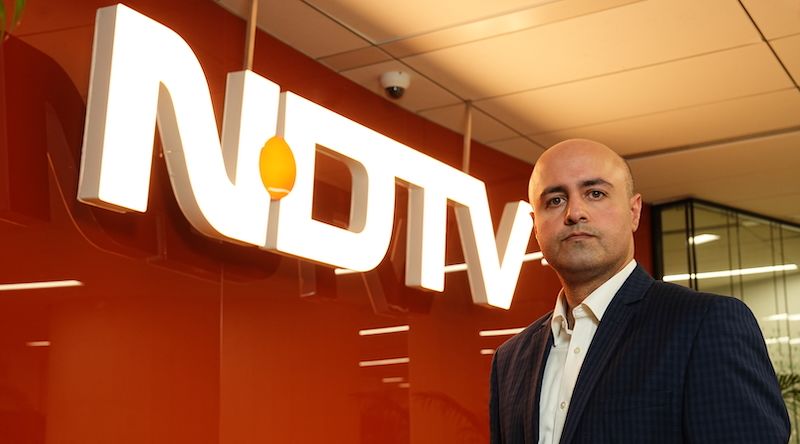
    NEW DELHI: NDTV has named Aditya Raj Kaul senior executive editor for geopolitics, national security and strategic affairs at NDTV 24×7, bolstering its newsroom with one of India’s most seasoned voices on foreign policy and defence.

    Kaul wasted no time settling in. On his very first day, he was filing dispatches from Tianjin, China, where Narendra Modi, Xi Jinping and Vladimir Putin gathered for the Shanghai Cooperation Organisation summit.
    With more than 15 years in frontline journalism, Kaul has reported from some of the world’s most volatile flashpoints — the India-China standoff in Ladakh, the abrogation of Article 370, the rise of ISIS in Iraq and Jordan, major terror strikes in Afghanistan and Pakistan, and India’s first state visit to Israel and Palestine. He was the first journalist on the ground during the 2014 Kashmir floods and has tracked disasters from Uttarakhand to Chhattisgarh’s Maoist belt.

    His international docket includes the G20 in Australia, Brics in China, Asean in Malaysia and Vietnam, and Saarc in Nepal, alongside high-level visits to the US, Germany and Israel. Along the way, he has secured exclusives with leaders such as S. Jaishankar, Amrullah Saleh, Tony Abbott and Benjamin Netanyahu.

    An award-winning documentary maker, Kaul’s films include Airlift on India’s evacuation in Ukraine and Killed by the Taliban on the death of Danish Siddiqui. His work has earned the Golden DigiPub World Award, News Television Award, and the Ram Jethmalani Prize.

    Rahul Kanwal, NDTV’s chief executive and editor-in-chief, hailed him as “among the finest in the field of strategic and international journalism,” adding that his presence in Tianjin on day one “shows his readiness and NDTV’s intent to be at the forefront of global stories.”

    Kaul said he was “honoured to join NDTV at this important juncture,” pledging to bring “clarity and context to events that impact millions.”

  • Festive fever goes long haul as India’s holiday season stretches nine weeks

    Festive fever goes long haul as India’s holiday season stretches nine weeks

    MUMBAI: Turns out Diwali isn’t the full stop anymore, it’s just the comma. Appsflyer’s India Festive Report 2025, based on a hefty 20.5 million installs and over 576 million dollars in ad spend, reveals that the country’s high-stakes festive season has stretched from a week-long Diwali blitz into a nine-week marathon of consumer intent.

    The numbers tell the story. Gaming apps saw post-Diwali install growth of 29 per cent, while Food and Drink apps climbed 16 per cent as celebratory cravings lingered. Travel on Android skyrocketed with a 40 per cent jump in remarketing spend, showing that the festive bug bit long after the firecrackers faded. Meanwhile, Ios Shopping apps logged a 20 per cent rise in session volumes post-Diwali, fuelled by extended discounts and gift redemptions.

    But it wasn’t all smooth sailing. Fraud rates ballooned: Food and Drink apps on Ios hit 60 per cent, a 176 per cent increase while Android Entertainment fraud climbed 74 per cent, exposing how loosened controls around gifting windows can make campaigns vulnerable.

    Appsflyer GM for INSEA and ANZ Sanjay Trisal put it bluntly: “India’s festive season is no longer a one-week race to Diwali. It’s a sustained momentum period. To win, brands must pace budgets, double down on post-Diwali remarketing, and adapt strategies by platform.”

    The report also flagged missed opportunities: gaming led install growth but saw little remarketing activity, limiting retention and monetisation. Shopping apps fared better, with the top ten increasing Share of Paying Users by 32 per cent year-on-year, powered by smoother checkouts and brand trust.

    Meta’s Rishad Chindamada added that mobile is where the action is: “Full-funnel marketing, AI-driven optimisation, and channels like reels and business messaging can take brands from awareness to loyalty in this extended season.”

    For marketers, the playbook is clear:

    ●   Reallocate remarketing to the post-Diwali window, when intent is high but competition thins.

    ●   Time strategies by platform Android for long-tail gains, Ios for sharp, front-loaded pushes.

    ●   Retain beyond Day 7 with reactivation flows between Days 10–14.

    ●   Harden fraud protection during peak gifting surges.

    In short, the festive season is now less of a sprint, more of a Test match and those who play the long game stand to win big.

  • Fast channels surge 14 per cent this year as news and horror fuel boom

    Fast channels surge 14 per cent this year as news and horror fuel boom

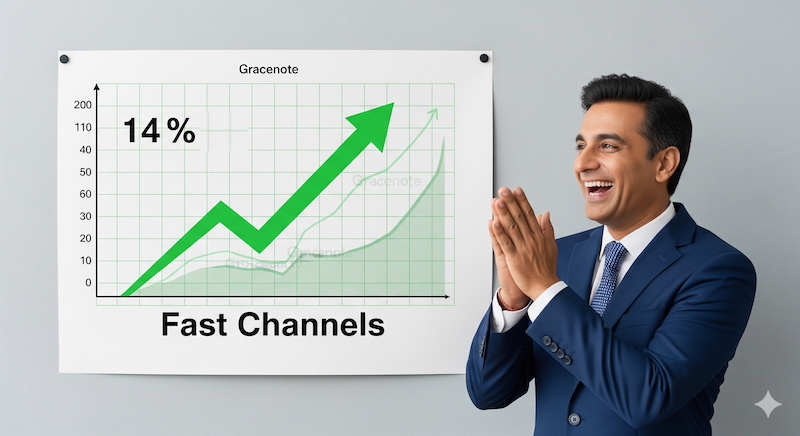
    MUMBAI: Free ad-supported television (Fast) is enjoying a blistering run. The number of Fast channels worldwide has climbed nearly 14 per cent since the start of 2025 and 76 per cent since 2023, according to fresh analysis from Gracenote, the content data arm of Nielsen.

    The firm has expanded its Data Hub to track nearly 1,850 active Fast channels, enabling direct comparisons with subscription video-on-demand (SVOD) catalogues from the likes of Amazon Prime Video, Apple TV+, Disney+, Netflix and Paramount+. The enhanced tool now covers more than 645,000 TV shows, films and sports programmes across SVOD and a further 197,000 across Fast.

    Fast is skewing younger than its subscription rivals. Almost half of its content has been produced in the past five years, compared with only a third for SVOD. Stretching the timeframe to 15 years, Fast jumps to nearly 80 per cent of programming, versus 68.5 per cent for SVOD.

    Television dominates both formats, but especially Fast: 93.1 per cent of its content comprises TV programming by episode count, compared with 88.8 per cent on SVOD platforms.

    Genre trends are diverging. Documentaries make up the largest Fast slice at 16.1 per cent, followed by drama (10.6 per cent) and news (9.9 per cent). Yet it is news and horror that are powering growth, up 37 per cent and 30 per cent respectively. On SVOD, sports led the charge in the past quarter with a 13.2 per cent bump, ahead of films (10 per cent) and TV (9.2 per cent). Sports on Fast dipped 3.7 per cent in the last three months but remain up 14 per cent year to date.

    Among the big streamers, Amazon bulked up most aggressively, expanding its catalogue by 12.6 per cent quarter on quarter. Paramount+ followed with a 6.4 per cent increase. Overall, SVOD offerings grew 9.8 per cent in the same period.

    Gracenote, which covers video content in more than 70 languages and 80 countries, is pitching its Data Hub as a strategic compass for distributors, producers and advertisers eager to map where audiences are headed.

  • Mondelez elevates Nikhil Nicholas to global brand director of Cadbury Dairy Milk

    Mondelez elevates Nikhil Nicholas to global brand director of Cadbury Dairy Milk

    ZURICH: Mondelez International has promoted Nikhil Nicholas to global brand director of Cadbury Dairy Milk, placing him in charge of one of the confectionery giant’s most prized assets. He will be based in Zurich.

    Nicholas, who has spent more than 16 years at Mondelez, was most recently global marketing manager for Cadbury. His career has taken him across Mumbai, Kuala Lumpur and Zurich, spanning sales, innovation and category leadership. He has been closely associated with Cadbury Dairy Milk Silk and chocolate innovation in Asia-Pacific, as well as leading marketing for South East Asia.

    Starting out in customer development and sales roles in India, he steadily climbed through the ranks, moving into brand management in 2013. By 2019, he was senior marketing manager for equity and innovation in South East Asia, before taking on the region’s chocolate marketing lead. In 2023, he shifted to Zurich to handle global duties.

    The promotion cements his role as the custodian of a brand that has defined affordable indulgence for generations and remains central to Mondelez’s global chocolate portfolio.

  • Cable TV lobby urges tax cut to 5 per cent as sector reels under strain

    Cable TV lobby urges tax cut to 5 per cent as sector reels under strain

    NEW DELHI:The All India Digital Cable Federation (AIDCF), the apex body of cable operators, has petitioned information and broadcasting minister Ashwini Vaishnaw and finance minister Ashwini Vaishnaw  to slash goods and services tax on cable television from 18 per cent to 5 per cent.

    The appeal rides on prime minister Narendra Modi’s push for “next-generation GST reforms” and a two-rate structure. The federation argues that cable remains the cheapest mass medium, reaching 64 million households and sustaining 10–12 lakh jobs, yet is under siege from rising costs and unregulated OTT rivals.

    Powered by 852 multi-system operators and 1.6 lakh local cable operators—mostly small entrepreneurs—the sector was even recognised as an “essential service” during the pandemic. But the economics are dire. Broadcaster fees have surged nearly 600 per cent, pushing up subscription costs by 35–40 per cent. With consumers balking at higher tariffs, margins are collapsing.

    “Market dynamics have become unfair for MSMEs in cable TV, as they are bound by tariff regulations while OTTs operate without comparable oversight,” AIDCF wrote.

    The lobby claims a GST cut would restore affordability for households, ease working capital pressures, enable fresh broadband investment under Digital India, and protect lakhs of jobs.

    AIDCF secretary general Manoj P Chhangani urged the government to table the matter at the next GST Council meet: “A reduction will safeguard the viability of MSOs and LCOs and preserve cable’s role in inclusive connectivity.”

    Industry watchers caution that while OTT is growing fast, cable still dominates in small towns and villages. A tax reprieve, they say, could decide whether it remains India’s broadcast backbone—or fades into obsolescence.