
News Broadcasting
Times Now turns 10

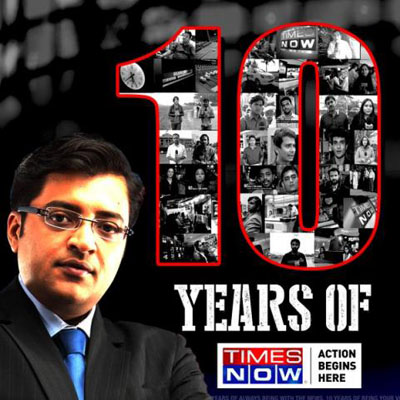
MUMBAI: The leader in the English news channels space in India – Times Now has turned a decade old and over the last ten years, the man at helm has tirelessly led from the top as he made his voice heard across the nation… questioning the system, breaking scams galore with his relentless and unapologetically opinionated approach night after night after night.
‘Love him or hate him, but you just can’t ignore him! He is Arnab Goswami – Times Now & ET Now president – news and editor-in-chief.
Back in 2005, even before the launch of the channel, Goswami had told Indiantelevision.com that the Times Group’s news channel will be looking at changing the rules of the news reporting business. And staying true to his word, that is exactly what Times Now did.

In 2006, when a five-year old boy called Prince fell into a 60 feet deep bore-well, the then five-month old channel covered the news in a manner that had never before been seen in the Indian news space. And it quickly set a trend of sorts. Since the incident had occurred in the hinterland of Kurukshetra and not in a more accessible metro city, not many followed the story initially. But a few hours into Times Now’s coverage of the story, Prince became the only news that mattered across the country for every news broadcaster in India.
Forty-eight excruciating hours later, the Indian Army got Prince out of the bore-well. As the entire country cheered and celebrated the rise of the little boy from the bore-well, it also marked the rise of another star – Bennett, Coleman and Company’s broadcast news channel Times Now. Goswami had arrived on the Indian news broadcast scene armed with his flamboyance and much more.
Recalling the ‘Prince’ coverage at a conference, Goswami said, “Yes, we sensationalised the coverage, and if sensationalising a story forces a change and gets the bore-well filled for no Prince to fall, we are proud of the fact that we sensationalised it. We will do it again.”
Times Now was launched at a time when the English news space was in its early stages of evolution. Dr Prannoy Roy’s NDTV 24×7 was the undisputed leader. But the leader’s two aces – Rajdeep Sardesai and Goswami was now steering their own respective teams.
However, Times Now’s launch was not a flawless one. There were teething problems galore as the channel struggled to find its core competency during the initial months of launch. But it soon found its foothold and decided to focus solely on news. And since then, there’s been no looking back.
Veteran media expert Ravina Raj Kohli says, “Times Now came in with the right format at the right time. In a market where English channels have niche audiences, Times Now has managed to make an impact on audiences who dream in different languages. The sharp and controversial format of The Newshour caught the fancy of the country after 26/11 where Arnab and his team’s relentless reportage and on-air presence showed through and was finally acknowledged.”
And what Goswami and his team did during that nightmare in 2008, which punched Mumbai hard in the gut, was exemplary… to say the least. It was by far the most comprehensive, responsible and sane live reportage on the Mumbai attacks at a time when even some veteran journalists were bungling up. What’s more, throughout the 72-hour long ordeal, Times Now did not air any commercials – a one of a kind unheard of scenario.
“It was nationalism amidst crony capitalism. No ads at a period when the maximum number of people were glued on to the news channel. It was surprising from a business point of view and it could have made a major loss. But what followed after that proved that it was a worthy loss. The Newshour is the largest revenue generating news entity in India today,” said a media planning expert on condition of anonymity.
The Newshour has more than seven brands on board as sponsors and commands top dollar as Times Now charges Rs 45,000 for a 10-second ad slot.
Not only 26/11, Goswami and his team treated every major story incessantly, which brought in the audience that never left again. Times Now only came second once to India Today Television, and for the rest of the time has comfortably been perched at the top.
Speaking on the impact of Times Now’s news breaks, a veteran freelance journalist said, “The Commonwealth Games Scams, which saw Suresh Kalmadi go behind bars still remains the best for me. I still remember Vinod Mehta telling me that Arnab has touched a raw nerve. He told me: ‘I called Arnab and told him what have you done that led to this earthquake? Keep following it.’ The Purulia arms drop documentary was also a great one, which revealed Pappu Yadav’s involvement. The irony is that no action was taken. But the documentary informed the audience about what happened. Yes, it’s an unusual breed of journalism, but I think that’s what was needed and the success of the channel proves it.”
Kohli is of the opinion that the success, however, is not a one-man effort. “Times Now launched all glossy and glowing, backed by strong print media presence, but it has paid its dues. The fragmented English news channel space wasn’t an easy one to break through, so being inventive and being heard was the need of the hour. Rebuilding news habits was a big task. Success on air doesn’t happen overnight and it doesn’t happen singularly. Credit must also go to the management of the channel entrusted with building the brand along with the business, to have created a model that allows credible journalistic expression to balance industry demands and public pressure,” she added.
The channel, in it’s ten-year success run, has never been out of criticism. There are Arnab memes all over the internet and people absolutely love to hate him. But the man remains unperturbed and even without having a handle on the microblogging site Twitter, he almost rules it.
Not the one to go back on its point of view, Times Now remained unapologetic even after Twitter was flooded with #ShameonTimesNow after the channel’s “Shame in Sydney” coverage on the Indian cricket team’s lacklustre performance down under. When later questioned on the negative outrage, Goswami said, “We felt it’s a shame the way team India lost and hence we did the story. I still feel it was a shameful defeat and hence we have no regret at all.”
Throwing light on the reasons behind the channel’s successful dominance, Kohli said, “Single minded promotion of its channel driver face and brand, despite all the HR issues that go along with such decisions, good on-air presentation and off-air follow through are the reasons why the channel has achieved this awareness. It is not without flaws, but its good points far outweigh these drawbacks. Whatever the pseudo-intellectual critique of the channel, the point is, it works in sync with new Indian DNA. There’s no denying that.”
She further added, “A hungry, bi-lingual, aggressive thinking audience has discovered Times Now’s devil may care attitude towards the establishment. And has loved it. Whatever anyone says about the channel, it’s a hard one to ignore. Its reach and perception is such that people who need to be heard cannot afford to alienate themselves from the channel. And audiences who criticise its piercing impact and style of journalism, can’t afford not to watch it. I’d say sustaining that negative-positive impact is the biggest challenge for the channel. It defines the brand.”
Chrome media CEO Pankaj Krishna feels that Goswami and his channel have redefined many aspects for others to follow. Terming the channel as a leader in all matrices, he said, “The presentation format itself might be a huge reason for debate and controversy… but Times Now has redefined the 9 pm slot with Arnab’s flagship show. Today pretty much every channel follows the same format – one anchor and the screen split into four windows featuring guests! All said and done, Times Now was a leader on the TAM panel, is a leader on Chrome DM distribution panel, and is now a leader on the BARC panel.”
And that just about sums it all up.
Over the last 10 years, Times Now has taken all challenges head on and come out triumphant. With cable TV digitisation in full swing across India coupled with the booming digital landscape giving linear television a run for its money, the next 10 years will change many a dynamics in the news television broadcast business as rules will be rewritten faster than ever. And in order to stay relevant, broadcasters will have to follow the cardinal rule to adapt to the change.
It now remains to be seen how Times Now and Goswami suit up for the upcoming challenges, which will not only come from competitors but also from broadcast landscape. At a time like this, how The Newshour man makes himself available on-demand, will be interesting to watch.
Rediffusion Y&R president Dhunji S Wadia sums it up aptly, “In this short span, Times Now has created a unique brand for itself, which is bold, outspoken and gives an outlet for venting outrage on everyday happenings. But mostly, it brings a smile on the viewer’s face. Here’s wishing the very best going forward.”
Here’s raising a toast to the next 10 years in broadcast journalism for Times Now and its team! Lead on!

KERALA: A forensic audit commissioned by the Broadcast Audience Research Council (BARC) India has emerged as the centrepiece of the government’s response to fresh allegations of television rating point manipulation involving a regional news channel in Kerala, with both the audit findings and a parallel police investigation still awaited.
Replying to a query in the Lok Sabha, minister of state for information and broadcasting L Murugan, said Barc had appointed an independent agency to conduct a forensic probe into the conduct of senior personnel allegedly linked to the case.
The move followed media reports claiming that a Barc employee had accepted bribes to manipulate viewership data in favour of a regional television news channel.
“The report from BARC is still awaited,” Murugan told Parliament, signalling that the forensic exercise remains ongoing.
Industry specialists say forensic audits are crucial in alleged TRP fraud cases, as they examine internal controls, data access trails, panel household integrity, staff communications and financial transactions. The outcome could determine whether the alleged manipulation was an isolated breach or a deeper systemic weakness in India’s television measurement framework.
Running alongside the audit, the Kerala Police has formed a special investigation team to probe the allegations. The ministry has sought a preliminary report from the state’s director general of police, including details of action taken on the first information report. That report, too, is yet to be submitted.
The episode has revived long-standing concerns over the vulnerability of India’s TRP system, particularly in regional news markets where competition for ratings is fierce and advertising revenues hinge on weekly viewership rankings.
India’s sole television audience measurement body Barc, has faced scrutiny before, most notably during the nationwide TRP controversy involving news channels in 2020. While tighter compliance norms were introduced in the aftermath, the latest allegations suggest enforcement challenges may persist.
On regulatory consequences, the government said any punitive action against television channels, including suspension or cancellation of uplinking and downlinking permissions, would be governed by the Policy Guidelines for Uplinking and Downlinking of Television Channels issued in November 2022, and would depend on investigation outcomes and due process.
The ministry also pointed to ongoing efforts to overhaul the ratings ecosystem. Television measurement continues to be regulated under the Policy Guidelines for Television Rating Agencies, 2014. Draft amendments were released for public consultation in July 2025, followed by a revised version in November 2025, aimed at tightening audit mechanisms and improving transparency and representativeness.
In November 2025, Barc said it had taken note of allegations aired by Malayalam news channel Twenty-Four, which linked an internal employee to irregularities in audience measurement. The council said it had engaged a “reputed independent agency” to conduct a comprehensive forensic audit, underscoring the seriousness of the claims.
The ratings system sits at the heart of India’s broadcast advertising economy, shaping billions of rupees in annual ad spends. With trust in audience data once again under strain, advertisers, broadcasters and regulators are closely watching the outcome of the investigations.
Barc has urged industry stakeholders and media organisations to exercise restraint while the probe is underway, calling for an end to “unverified or speculatory claims” and reiterating its commitment to integrity and accountability.
Until the forensic audit and police findings are submitted and reviewed, the government said it would refrain from drawing conclusions.
News Broadcasting
Rajat Sharma defamation row: Delhi court summons Congress leaders Ragini Nayak, Pawan Khera and Jairam Ramesh
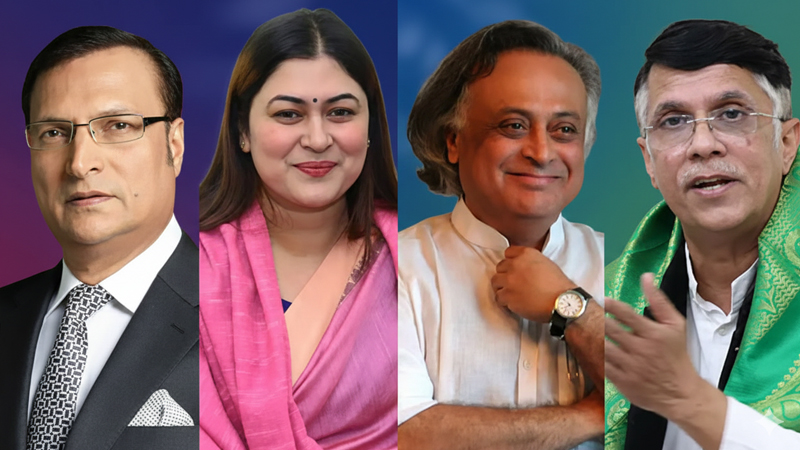
NEW DELHI: A Delhi court has ordered the summoning of senior Congress leaders Ragini Nayak, Pawan Khera and Jairam Ramesh in a criminal case filed by veteran journalist Rajat Sharma, sharpening a legal battle over alleged defamation and doctored digital content.
The order was passed on Monday by Devanshi Janmeja, judicial magistrate first class at Saket Courts, after the court found prima facie grounds to proceed under multiple sections of the Indian Penal Code, including forgery, creation of false electronic records and defamation.
Sharma, chairman and editor-in-chief of India TV, had approached the court over allegations made in June 2024 that he had used derogatory language against Congress spokesperson Ragini Nayak during a live television debate. He denied the charge, claiming it was fuelled by a manipulated video circulated online.
According to the complaint, a clipped version of the broadcast carrying superimposed captions, which were not part of the original programme, was first shared on social media platform X by Nayak and later amplified through retweets and public statements by Khera and Ramesh. Sharma said the viral spread caused serious reputational harm and personal distress.
The court took note of forensic science laboratory findings that pointed to visible post-production alterations in the video, including added titles and captions. It also cited witness testimonies from those present during the live broadcast, who stated that no abusive or objectionable language had been used.
In a related civil matter, the Delhi High Court had earlier observed a prima facie absence of abusive remarks and directed the removal of the disputed social media posts.
With criminal proceedings now set in motion, the case adds to mounting scrutiny around political messaging, digital manipulation and accountability on social media platforms.
News Broadcasting
Mukesh Ambani, Larry Fink come together for CNBC-TV18 exclusive
Reliance and BlackRock chiefs map the future of investing as global capital eyes India

MUMBAI: India’s capital story takes centre stage today as Mukesh Ambani and Larry Fink sit down for a rare joint television conversation, bringing together two of the most powerful voices in global business at a moment of economic churn and opportunity.
The Reliance Industries chief and the BlackRock boss will speak with Shereen Bhan, managing editor of CNBC-TV18, in an exclusive interaction airing from 3:00 pm on February 4. The timing is deliberate. Geopolitics are tense, technology is disruptive and capital is choosier. India, meanwhile, is pitching itself as a long-term bet.
The pairing is symbolic. Reliance straddles energy transition, digital infrastructure and consumer growth in the world’s fastest-expanding major economy. BlackRock, the world’s largest asset manager, oversees more than $14 tn in assets and sits at the nerve centre of global capital flows. When the two talk, markets tend to listen.
Fink’s appearance marks his third India visit, a signal of the country’s rising strategic weight for the Wall Street-listed firm, which carries a market value above $177 bn. His earlier 2023 trips included an October stop in New Delhi, where he met both Ambani and Narendra Modi.
India is now central to BlackRock’s expansion plans, notably through its joint venture with Jio Financial Services. Announced in July 2023, the 50:50 venture, JioBlackRock, commits up to $150 mn each from the partners to build a digital-first asset-management platform aimed at India’s swelling investor class.
The backdrop is robust. BlackRock ended 2025 with record assets under management of $14.04 tn, helped by $698 bn in net inflows, including $342 bn in the fourth quarter alone. Scale gives Fink both heft and a long lens on where money is moving.
He has been openly bullish on India. At the Saudi-US Investment Summit in Riyadh last year, Fink argued that the “fog of global uncertainty is lifting”, with capital returning to dynamic markets such as India, drawn by reforms, demographics and durable return potential.
Expect the conversation to range beyond balance sheets, into technology’s role in finance, access to capital and the mechanics of sustainable growth in a fracturing world order. For investors and policymakers alike, it is a snapshot of how big money is thinking about India.
At a time when capital is cautious and growth is contested, India wants to be the exception. When Ambani and Fink share a stage, it is less a chat and more a signal. The world’s money is still looking for its next big story, and India intends to be it.



MIB sets OTT accessibility rules, mandates captions and audio description

Boney Kapoor acquires remake rights of Tamil political satire Thalaivar Thambi Thalaimaiyil

Netflix India names Rekha Rane director of films and series marketing

Zabeen signs off from TV9 after shaping the network’s public voice

Dhawan steps up to bat for Delhi’s grassroots sports push

Orient Beverages pops the fizz with steady Q3 gains and rising profits

Cheekatilo shines in the dark with record debut on Prime Video

These ’90s fashion trends are making a comeback in 2017

Swiggy Instamart’s GOV surges 103 per cent year on year to Rs 7,938 crore
The final 6 ‘Game of Thrones’ episodes might feel like a full season
According to Dior Couture, this taboo fashion accessory is back
The old and New Edition cast comes together to perform
Phillies’ Aaron Altherr makes mind-boggling barehanded play
Uber and Lyft are finally available in all of New York State
MIB sets OTT accessibility rules, mandates captions and audio description
Boney Kapoor acquires remake rights of Tamil political satire Thalaivar Thambi Thalaimaiyil
Netflix India names Rekha Rane director of films and series marketing
Zabeen signs off from TV9 after shaping the network’s public voice
Dhawan steps up to bat for Delhi’s grassroots sports push
Orient Beverages pops the fizz with steady Q3 gains and rising profits
Cheekatilo shines in the dark with record debut on Prime Video
-
 e-commerce1 month ago
Swiggy Instamart’s GOV surges 103 per cent year on year to Rs 7,938 crore
-
 iWorld1 year ago
Kuku TV transforms India’s OTT space with vertical microdrama boom
-

 News Headline2 months ago
From selfies to big bucks, India’s influencer economy explodes in 2025
-
 News Headline1 year ago
TRAI puts a ‘stop’ to unsolicited calls and messages
-
 Comedy2 years ago
Taarak Mehta Ka Ooltah Chashmah celebrates 4,000 episodes
-
 News Headline1 year ago
Abhishek Bachchan joins as co-owner of European T20 Premier League
-
 MAM2 years ago
OpenAI joins C2PA steering committee
-
 News Headline2 years ago
Odisha to host Ultimate Kho Kho Season 2 from December 24


