
DTH
Loss signal as Dish TV Q1 net loss widens and revenue falls 27.6 percent

MUMBAI: Dish TV is still buffering and this time, the picture is far from rosy. The DTH operator reported a consolidated net loss of Rs 94.53 crore for the quarter ended 30 June 2025, a sharp plunge from the mere Rs 1.56 crore loss logged in the same period last year. Revenue from operations shrank 27.6 per cent year-on-year to Rs 329.36 crore, down from Rs 455.29 crore, while total income stood at Rs 334.11 crore, aided by Rs 4.75 crore in other income.
Costs, however, went in the opposite direction. Total expenses climbed to Rs 425.92 crore, led by operating costs of Rs 142.10 crore, employee benefits of Rs 42.16 crore, and finance costs of Rs 64.12 crore. Depreciation and amortisation weighed in at Rs 105.28 crore.
The company’s balance sheet remains under heavy strain, with accumulated losses now exceeding equity share capital, pushing net worth into the negative. Adding to the pressure is a long-running license fee battle with the Ministry of Information and Broadcasting (MIB) Dish TV has set aside Rs 4,680.24 crore for the dispute, even as the MIB slapped a fresh Rs 8,735.67 crore demand (including interest) in April, which the operator is contesting in court.
For FY25, Dish TV’s annual loss narrowed to Rs 487 crore from a massive Rs 1,966 crore in FY24, but total revenue slid 15.6 per cent to Rs 1,567.6 crore, hit by falling Pay TV subscriber numbers and stagnant ARPU. EBITDA came in at Rs 529.1 crore, with margins easing to 33.75 per cent from last year’s 40.6 per cent.
While exceptional items of Rs 335.4 crore, a pre-tax loss of Rs 152.3 crore, and mounting competition from DTH rivals, cable, telecom, and OTT players dimmed the outlook, the company is leaning on its digital play. Watcho, its OTT arm, crossed the 10 million paid subscriber mark, thanks to premium content aggregation from Jiocinema, Zee5, Sonyliv and others, the launch of Watcho Fliqs for creator-led IP, and smart set-top boxes like the Dish Smrt Hub.
The strategy now is clear: retain quality subscribers, push regional content, and keep hybrid offerings in the mix because in today’s entertainment market, staying in the game might just be about playing on every screen available.













MUMBAI: Tata Play is doubling down on regional loyalty. India’s leading DTH player has launched Tata Play Odia Manoranjan, a new value-added service that corrals Odia entertainment into a single, ad-free destination, available on television and the Tata Play mobile app.
Powered by Sidharth TV, one of Odisha’s most popular Odia-language GECs, the platform serves up a hefty catalogue: over 180 movies, 100+ Jatras, around 20 television shows and a library of more than 12,000 songs spanning devotional, folk, film and non-film genres. From vintage favourites to contemporary titles, the mix is pitched squarely at Odia-speaking households, with particular pull in tier-3 and tier-4 markets.
Subscribers get 24×7, full-screen SD viewing without ad breaks on channel number 1755, with live TV and VOD access across screens. The price point is deliberately sharp: Rs 2 a day.
Pallavi Puri, chief commercial and content officer at Tata Play, framed the move as a bet on language and culture. “India’s strongest viewing loyalties are rooted in language and lived culture. Tata Play Odia Manoranjan brings together the many expressions of Odia entertainment—from films and Jatras to devotional programming and music—into one clearly defined destination. With this launch, Tata Play further elevates its regional content offering by giving Odia audiences a single, definitive home for their stories and traditions.”
For Sidharth TV Network, the partnership is about reach without compromise. Sitaram Agrawalla, owner and chairman, said: “For decades, Odia families have trusted our entertainment platforms for stories that feel like home, and for moments that bring us together. Tata Play Odia Manoranjan builds on this trust by placing a diverse range of Odia films, theatre, devotional music and shows into a single, accessible space. This collaboration isn’t just about wider distribution—it’s about honouring the preferences of Odia viewers with a seamless, ad-free viewing experience that reflects their language, culture and the way they choose to engage with content.”
The new service slots into Tata Play’s expanding portfolio of entertainment and infotainment platform services across genres including entertainment, kids, learning, regional and devotion, catering to all age groups.
In short: one language, one screen, zero ads—and a clear signal that regional is where the real viewing power lies.
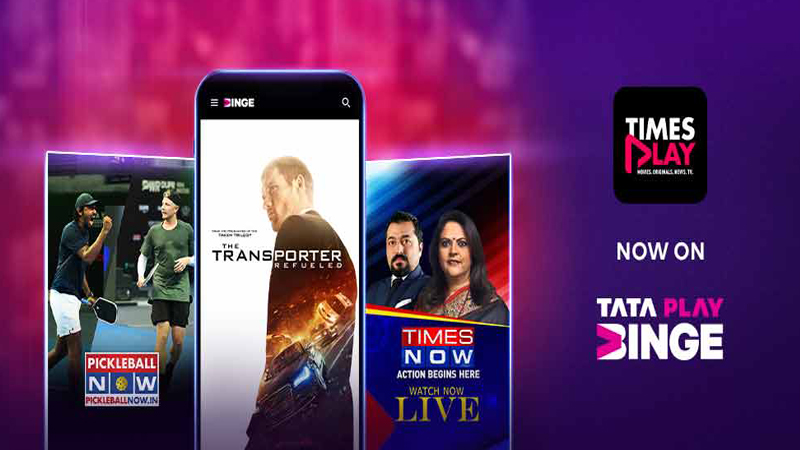
MUMBAI: If streaming had galaxies, Tata Play Binge just opened a wormhole. In its latest move to become India’s most sprawling entertainment universe, the platform has now folded Times Play, Times Network’s digital-first OTT service, into its all-in-one subscription bouquet bringing Hollywood hits, snackable shorts, live news, lifestyle, entertainment, Pickleball and 11 live TV channels under a single roof.
The new addition means subscribers no longer need to hop between apps in Olympic-level finger gymnastics, Binge now pulls Times Network’s entire digital catalogue into one screen, one login, one bill. And in the era of attention overload, that’s practically a public service.
Times Play brings with it a distinctive blend of premium Hollywood cinema, web series, short-format videos, and Times Network’s formidable news muscle. Viewers can flip seamlessly between Romedy Now, Movies Now, MNX, MN+, Zoom, Times Now, Times Now Navbharat, ET Now, ET Now Swadesh, and even Pickleball Now, mirroring the growing Indian appetite for niche sporting entertainment.
On the long-form front, hits like Reunion, India’s Story, True Story of Angeline Jolie, Orphan First Kill, The November Man, Barely Lethal, Southpaw, The Hurt Locker, Transporter Refueled, and The Holiday sit alongside Times Network factual and current-affairs staples including Frankly Speaking, Sawaal Public Ka, and News Ki Paathshaala.
Describing the partnership, Tata Play chief commercial and content officer Pallavi Puri, said the aim remained unchanged to make content discovery effortless and reduce the modern curse of app overload. She noted that integrating Times Play enriches Binge’s already deep catalogue with a broader mix of premium films, originals and news programming “without juggling multiple apps or subscriptions”.
Times Network echoed the sentiment, calling the collaboration a natural extension of its mission to deliver credible entertainment and journalism at scale. It emphasised Tata Play’s reach, reliability and reputation as a key driver in bringing Times Play’s digital catalogue to diverse Indian households.
With the addition of Times Play, Tata Play Binge now boasts 30 plus OTT platforms on a single interface, a list that includes Prime Video, JioHotstar, Zee5, Apple TV+, Lionsgate, SunNXT, Discovery+, BBC Player, Aha, Fancode, ShemarooMe, Hungama, ManoramaMax, Nammaflix, Tarang Plus, Travel XP, Animax, Fuse+, ShortsTV, Curiosity Stream, and DistroTV, among others.
Notably, Netflix remains available as part of combo packs for DTH subscribers, while Amazon Prime Video can be unlocked as an add-on for Binge users with a Tata Play DTH connection. And for large-screen loyalists, all 30 plus apps can be streamed via LG, Samsung and Android Smart TVs, the Tata Play Binge+ set-top box, Amazon FireTV Stick – Tata Play edition, or through TataPlayBinge.com.
The expansion comes on the heels of recent integrations, including WAVES by Prasar Bharati and BBC Player, reinforcing Tata Play Binge’s ambition to remain India’s most diverse, most unified, and most fuss-free entertainment destination.
With Times Play now in the mix, Binge isn’t just aggregating content, it’s quietly aggregating the future of how India watches.
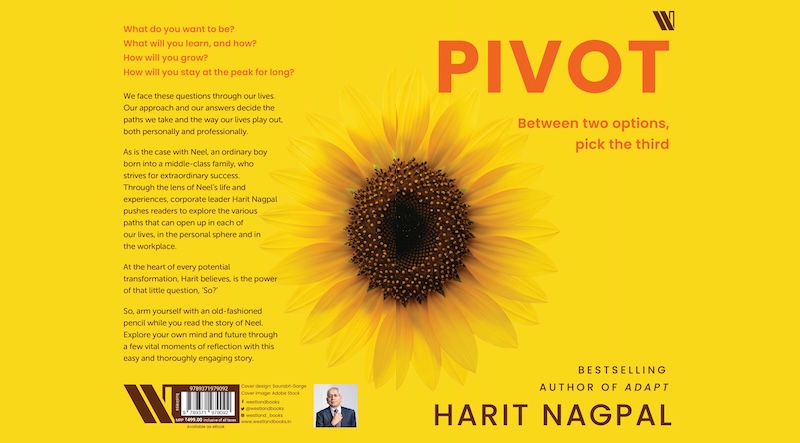
MUMBAI: Harit Nagpal isn’t interested in either/or. The chief executive of Tata Play—India’s largest content distribution platform—has spent four decades navigating cosmetics, cooking oils, colas, clothing, communication and content, and he’s learnt something valuable: the best decisions rarely come from choosing between the options you’re given. They come from inventing the one you weren’t.
His new book, Pivot: Between Two Options, Pick the Third, published by Westland Business, launched on Amazon on 24 November 2025 at Rs 499 (currently discounted 23 per cent to Rs 383). It’s a 164-page distillation of that philosophy, wrapped around the story of Neel, an ordinary middle-class boy whose life becomes a case study in counterintuitive decision-making.
The premise is deceptively simple. When you’re stuck between two choices—whether it’s picking an academic stream, staying in a comfortable job or leaping into uncertainty, handling workplace stress or navigating personal crises—conventional wisdom says weigh the pros and cons and choose. Nagpal says that’s precisely when you should stop, step back, and ask: “So?” That tiny, disruptive question, he argues, can crack open possibilities that binary thinking obscures.
This is Nagpal’s second book. His debut writing effort, Adapt: To thrive, not just survive, established him as a corporate leader willing to put management philosophy into readable prose. And it got him the credentials of a best selling author. Both books are now available as a bundle on Amazon for Rs 739, which positions them as a one-two punch for anyone trying to navigate career and life without succumbing to false choices.
The book doesn’t promise easy answers. What it offers instead is something rarer: the questions for deeper reflection and the space to think through responses that aren’t pre-packaged. In an age of algorithmic recommendations and decision-making outsourced to apps, that might be the most counterintuitive choice of all.
Nagpal’s four-decade career suggests he’s practised what he’s preaching. Moving from consumer goods to media and technology requires exactly the kind of lateral thinking his book champions. Whether Pivot helps readers replicate that trajectory remains to be seen. But in a world increasingly hostile to nuance, a 164-page argument for third options feels quietly radical.

Mukesh Ambani, Larry Fink come together for CNBC-TV18 exclusive

Nielsen launches co-viewing pilot to sharpen TV measurement

Netflix celebrates a decade in India with Shah Rukh Khan-narrated tribute film

Delhivery chairman Deepak Kapoor, independent director Saugata Gupta quit board

Meta appoints Anuvrat Rao as APAC head of commerce partnerships

Brnd.me enters Europe as haircare brands power global expansion

TechnoSport taps quick commerce with launch on Slikk’s 60-minute platform

These ’90s fashion trends are making a comeback in 2017
The final 6 ‘Game of Thrones’ episodes might feel like a full season
According to Dior Couture, this taboo fashion accessory is back
The old and New Edition cast comes together to perform
Phillies’ Aaron Altherr makes mind-boggling barehanded play
Uber and Lyft are finally available in all of New York State
Disney’s live-action Aladdin finally finds its stars
Mukesh Ambani, Larry Fink come together for CNBC-TV18 exclusive
Nielsen launches co-viewing pilot to sharpen TV measurement
Netflix celebrates a decade in India with Shah Rukh Khan-narrated tribute film
Delhivery chairman Deepak Kapoor, independent director Saugata Gupta quit board
Meta appoints Anuvrat Rao as APAC head of commerce partnerships
Brnd.me enters Europe as haircare brands power global expansion
TechnoSport taps quick commerce with launch on Slikk’s 60-minute platform
-
 iWorld5 days ago
Netflix celebrates a decade in India with Shah Rukh Khan-narrated tribute film
-
 I&B Ministry3 months ago
India steps up fight against digital piracy
-
 iWorld3 months ago
Tips Music turns up the heat with Tamil party anthem Mayangiren
-
 iWorld12 months ago
BSNL rings in a revival with Rs 4,969 crore revenue
-
 MAM3 months ago
HoABL soars high with dazzling Nagpur sebut
-
 News Broadcasting2 months ago
CNN-News18 dominates Bihar election coverage with record viewership
-
 News Broadcasting21 hours ago
Mukesh Ambani, Larry Fink come together for CNBC-TV18 exclusive
-

 MAM3 months ago
Kapil Sethi joins Network18 as head of technology