
Kids
Is your kid watching too much TV?


MUMBAI: Television viewing among children in India is growing strong, a fact that underlines the ambitious plans by several broadcasters to launch kids’ channels this year. But it is not just children’s channels that the young latch on to. As kids’ viewing habits go from bad to worse, indiantelevision.com talks to experts and parents to check if a middle path can be chosen.
“Our Bablu doesn’t eat food unless we switch on MTV,” wails Bablu’s mother. “Tina watches television all day. I think I am going to cut off the cable connection next year,” complains Tina’s mother.
Parents complain daily about the growing impact of TV on their children.
Kids wake up to TV flashing news, come home from school to watch Jerry bashing up Tom or check out another child thrusting his pelvis in a kids’ talent show. More often then not, the kids eat and sleep to saas and bahu spewing venom on TV.
With long hours at school, tuition’s and ever increasing loads of homework threatening to take over a child’s life, TV is the only recreational activity available and accessible to child. So if a kid is watching more TV than he ideally should, whose fault is it? Lets take a look at the guilty corner…

The parents:
How many times do you come home and reach for the remote? How many times do you switch on the TV so that your child leaves you alone or doesn’t make a fuss while eating.
Swati Salunkhe, director of Growth Centre, which specialises in psychological counseling of young children, says, “Working parents don’t have enough time to interact with their children. When both husband and wife come tired and late, who will have the patience to read out a story or play Scrabble? Most families can’t even afford to enroll their children for swimming, tennis or karate classes or take them bowling.”
Even as they complain about television, parents themselves are completely addicted to it. “Parents are so engrossed in watching TV that they don’t even think what kind of affect a soap opera might have on a child’s mind. And anyway, its is not as if the child learns to switch on the TV set while he is in his mothers womb. Obviously, the parents teach the kid,” comments Salunkhe.
Salunkhe laments that divorces, marriages, love affairs and extramarital affairs shown so frequently at prime family viewing time have made children casual about human relations. Religious channels can increase bias about certain communities. Soaps about black magic, obsessive and compulsive disorders makes them believe that these things are normal. Most of the characters try to get what they want either by hook or crook and that’s the moral the kids imbibe. Too much exposure to bomb blasts, terrorist attacks, cartoons beating up each other, has also desensitized them to violence and aggression.
“Coupled with parent negligence, exposure to such programmes can be detrimental to a child’s personality. Children’s entertainment too is mainly based fantasy or magic based. While the children’s programmes in the past like Vikram Aur Vetaal, Dada Dadi Ki Kahani and Potli Baba Ki, had a fantasy element, they did imparted some learning. Unfortunately such programmes are no longer made. If not juvenile programmes, children have to make do with entertainment meant for adults. What we lack seriously is healthy entertainment for children,” Salunkhe surmises.
The channels:
Lack of meaningful programming aside, the ill effects of television has on the kids health that parents need to take into account.
While poor eyesight and obesity are some of the problems that children these days suffer because of TV, longer exposure to cathode rays from TV also is supposed to affect the right brain.
Since an average Indian child watches TV for at least two hours a day, it leaves very little time to do creative or interactive work.
Kids product aside, even the ads for adult brands now target the kids. The young minds often fail to understand the true value of the products. It is because of such misleading ads that skimpy tops, trendy clothes, ultra slim physique has become a necessity.
TV has made most children smarter but not necessarily intelligent. For example, they can SMS but they don’t know the logic behind it.
Children these days have extremely small attention spans. Since television commercial breaks occur every 12 minutes, research shows that they can’t concentrate beyond 12-15 minutes on an average.
One cannot expect the television to shoulder the responsibility as it is a commercial medium and will continue to function as long as the method is effective. The onus lies completely on the parents. If the consumption stops even the production will too.
So what can the parent do? Cutting off the cable connection is not the solution. In fact, it will only make the child feel inferior to others. He might feel left out from discussions about TV and make him feel more curious about TV programmes.
Here is what experts recommend:
Parents can make television time a learning experience by asking them to enumerate the ads shown during the last commercial break.
Kids should be given small tasks like drawing so that they don’t just stare at the television. Parents have to have a hawks eye over what the kid is watching. If a kid is watching an offensive music video, don’t just ask him to switch channels. Tell him why he has to switch the channel.
Don’t just tell him that television is not good for him. Ask him to explain what he thinks is great about watching television. Let him understand what’s good and bad for him.
Encourage him to questions. May be when he does question you about a TV mom wear make up to bed, you can help in differentiate between real life and a television act.
Don’t be engrossed in the TV yourself.
Point out inconsistencies in reality while you are watching TV. Parents need to make the kids aware about the fantasy element in serials like Shaktimaan, Karishma Ka Karishma. They could take the kid to TV shooting and point out how things are shot.
Most glamour and lifestyle shown on TV makes children think that earning money is simple. Let them see what kind of hard work goes into making a TV serial.
Parents should ask the child what he has learnt from the programme just watched. Whenever possible, the parents should instill right thoughts so that he doesn’t take anything at face value and is encouraged to think and differentiate between right and wrong.
Fix a time to watch TV. Try and not tune in to TV as soon as you enter home or any time other than the schedule.
Plan what programmes you can watch along with your child in that hour. It could be news, cartoons or soaps, all the family should watch it together.
If there is an episode about TV villain kidnapping a child and asking for a ransom of Rs 100 crore, take the opportunity to help kid understand the difference between hundred, thousand, lakh and crore.
In short, take control over the small box before it starts ruling you…












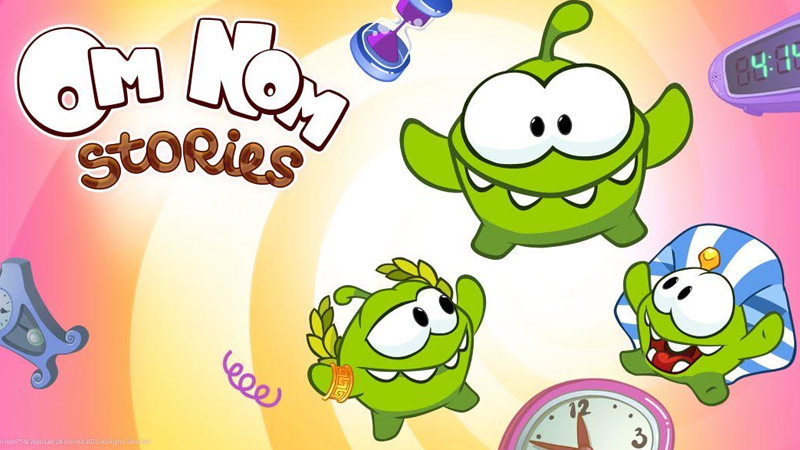
MUMBAI: The little green hero is making a big leap east. Zeptolab has struck a major distribution deal with Warner Bros. Discovery, bringing its hit animated series Om Nom Stories to audiences across the Indian subcontinent.
Under the agreement, Warner Bros. Discovery has acquired the series for exclusive Pay TV broadcast and non-exclusive digital streaming in India, Pakistan, Bangladesh, Bhutan, Nepal and Sri Lanka. The move marks a significant expansion for Zeptolab as it pushes one of its most successful original IPs into one of the world’s fastest-growing entertainment markets.
As part of the deal, all 26 seasons of Om Nom Stories will be rolled out across Cartoon Network, Pogo, Discovery Kids and Discovery+, offering both linear and digital access to the franchise’s slapstick humour and expressive, dialogue-free storytelling.
“We’re incredibly excited to partner with Warner Bros. Discovery to bring Om Nom Stories to the Indian subcontinent,” said Zeptolab executive producer Manaf Hassan, noting that the broadcaster’s reach and legacy make it a strong fit for the series’ growing global fanbase.
Warner Bros. Discovery, meanwhile, sees the acquisition as a natural addition to its children’s portfolio. Warner Bros. Discovery head of factual entertainment, lifestyle and kids for South Asia Sai Abishek, said the series aligns with the network’s focus on cheerful, imaginative and universally appealing content for families across the region.
The timing adds an extra layer of significance. The expansion coincides with Om Nom’s 15th anniversary, underlining the franchise’s staying power and its evolution from a mobile game character into a global animation brand. With this latest bite at the Indian subcontinent, Om Nom’s adventures look set to find a whole new generation of fans.
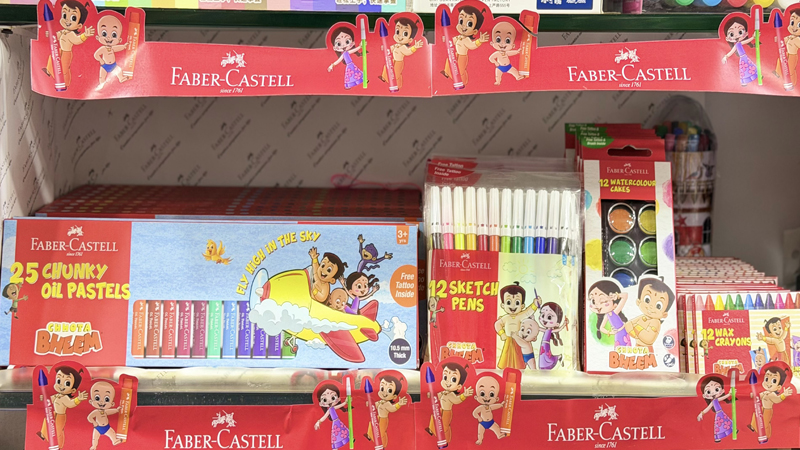
MUMBAI: If childhood memories had a colour palette, Chhota Bheem would likely be right in the middle of it and now, quite literally, in children’s pencil boxes too. Green Gold Animation has announced a landmark licensing partnership with Faber-Castell India, marking the global stationery major’s first-ever licensed character collaboration. The association brings Chhota Bheem to a specially curated range of student art and creative products, blending everyday learning tools with one of India’s most recognisable homegrown characters.
The move is a notable expansion of Chhota Bheem’s footprint beyond screens, reinforcing the character’s status as a multi-generational IP that has steadily grown from a television favourite into a cultural constant. For Green Gold Animation, the partnership signals a sharpened focus on extending its intellectual property into daily touchpoints, where entertainment meets education and habit.
In its first phase, the collaboration will roll out Chhota Bheem-themed products across key student art categories, including watercolour cakes, wax crayons, poster colours, sketch pens, oil pastels and creative bundling kits. The range is aimed squarely at school-going children, tapping into Bheem’s strong emotional connect while encouraging imagination, creativity and hands-on expression.
Green Gold Animation founder and CEO Rajiv Chilaka noted that Chhota Bheem’s journey has long moved beyond episodic storytelling. He said the partnership reflects a deliberate attempt to embed the character into moments of learning and creativity, while building a more purpose-led licensing ecosystem around Indian IP through collaboration with a globally established brand.
From Faber-Castell India’s perspective, the tie-up marks a strategic first. Faber-Castell India director marketing Sonali Shah said the collaboration opens a new chapter by pairing the brand’s long-standing reputation for quality and safety with a character that already commands trust and affection among Indian children. The aim, she added, is to make creativity more engaging and relatable without diluting product standards.
The launch will be backed by a 360-degree promotional push, spanning digital campaigns, social media storytelling, creative usage content and on-ground retail activations across select markets. Both companies have confirmed that this is only the starting point, with additional Chhota Bheem-themed products across new categories planned in the months ahead.
Headquartered in Hyderabad, Green Gold Animation continues to scale its ambition of building globally competitive Indian IPs, with Chhota Bheem leading the charge. This latest collaboration suggests that the brand’s next phase of growth may be less about what children watch and more about what they create.
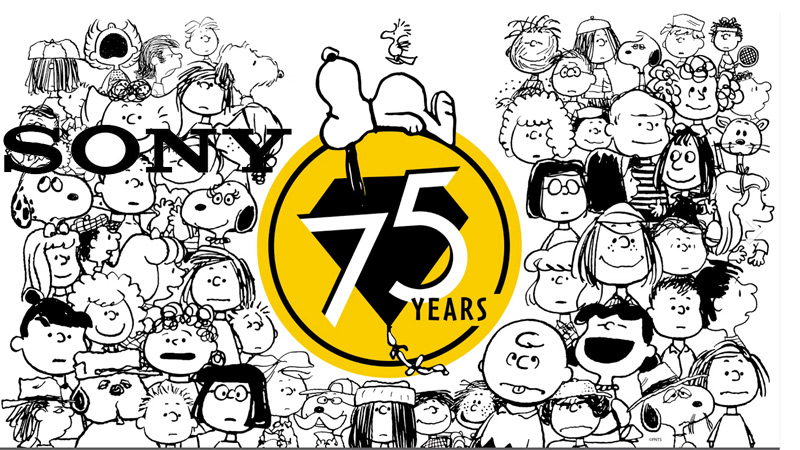
JAPAN: Sony has doubled down on the power of legacy brands, snapping up a majority stake in the Peanuts intellectual property in a late-year deal valued at about $457 million.
Sony Pictures Entertainment and Sony Music Entertainment Japan have acquired the roughly 41 per cent holding in Peanuts Holdings LLC previously owned by Canadian children’s entertainment company WildBrain. The move lifts Sony’s ownership to 80 per cent, with the Schulz family retaining the remaining 20 per cent.
The deal brings one of pop culture’s most durable franchises, home to Charlie Brown, Snoopy and the rest of the Peanuts gang, firmly under the Sony umbrella. The characters were created by Charles M Schulz, whose daily comic strip ran for half a century before ending in 2000.
Sony had already been a long-time partner in the business. The latest transaction consolidates control and sharpens the group’s hand as it looks to keep the characters front and centre across film, television, music and consumer products.
President and group ceo of Sony Music Entertainment Japan, Shunsuke Muramatsu, said the additional stake would allow Sony to further elevate the Peanuts brand by drawing on the group’s global reach and creative expertise, while preserving the legacy of Schulz and his family.
President and ceo of Sony Pictures, Ravi Ahuja, said the combined ownership gives Sony the ability to protect and shape the future of the characters for new generations, expanding their relevance without diluting their charm.
Peanuts long ago escaped the confines of the comic strip, cementing its place in popular culture through perennial television specials such as A Charlie Brown Christmas and It’s the Great Pumpkin, Charlie Brown. More recently, WildBrain kept the franchise active with animated series including Snoopy in Space and The Snoopy Show.
Now, with Sony firmly in control, the message is unmistakable. In an industry obsessed with the next big thing, nostalgia still sells and Sony is betting big on a doghouse that refuses to age.



MIB sets OTT accessibility rules, mandates captions and audio description

Boney Kapoor acquires remake rights of Tamil political satire Thalaivar Thambi Thalaimaiyil

Netflix India names Rekha Rane director of films and series marketing

Zabeen signs off from TV9 after shaping the network’s public voice

Dhawan steps up to bat for Delhi’s grassroots sports push

Orient Beverages pops the fizz with steady Q3 gains and rising profits

Cheekatilo shines in the dark with record debut on Prime Video

Swiggy Instamart’s GOV surges 103 per cent year on year to Rs 7,938 crore

These ’90s fashion trends are making a comeback in 2017
The final 6 ‘Game of Thrones’ episodes might feel like a full season
According to Dior Couture, this taboo fashion accessory is back
The old and New Edition cast comes together to perform
Phillies’ Aaron Altherr makes mind-boggling barehanded play
Uber and Lyft are finally available in all of New York State
MIB sets OTT accessibility rules, mandates captions and audio description
Boney Kapoor acquires remake rights of Tamil political satire Thalaivar Thambi Thalaimaiyil
Netflix India names Rekha Rane director of films and series marketing
Zabeen signs off from TV9 after shaping the network’s public voice
Dhawan steps up to bat for Delhi’s grassroots sports push
Orient Beverages pops the fizz with steady Q3 gains and rising profits
Cheekatilo shines in the dark with record debut on Prime Video
-
 e-commerce1 month ago
Swiggy Instamart’s GOV surges 103 per cent year on year to Rs 7,938 crore
-
 iWorld1 year ago
Kuku TV transforms India’s OTT space with vertical microdrama boom
-

 News Headline2 months ago
From selfies to big bucks, India’s influencer economy explodes in 2025
-
 News Headline1 year ago
TRAI puts a ‘stop’ to unsolicited calls and messages
-
 MAM2 years ago
OpenAI joins C2PA steering committee
-
 Comedy2 years ago
Taarak Mehta Ka Ooltah Chashmah celebrates 4,000 episodes
-
 News Headline1 year ago
Abhishek Bachchan joins as co-owner of European T20 Premier League
-
 News Headline2 years ago
Odisha to host Ultimate Kho Kho Season 2 from December 24


