
Jobs
India’s care economy could create 60 million jobs by 2030


NATIONAL: India is sitting on one of its largest untapped growth engines: care work. Long treated as a private household responsibility, the care economy already employs an estimated 36 million people, yet remains undervalued, informal and largely invisible in economic planning.
A new report argues that care must be reimagined as a core economic sector, capable of anchoring India’s next phase of growth. With targeted investment in skilling, certification, formalisation and demand creation, the sector could generate over 60 million jobs by 2030 and create market value of $300 billion.
The study redefines the care economy for India by mapping 13 distinct care personas, spanning childcare, eldercare, disability support, rehabilitation, mental health, wellness, beauty, domestic services and care enterprise management. This broader definition captures the fragmented but vast reality of paid care in India, much of which remains statistically invisible and politically neglected.
Contrary to entrenched assumptions, the report finds that care jobs are not inherently low-value or precarious. Where roles are formalised and linked to organised service delivery, care work can offer stable, predictable and often comparatively well-paid employment, particularly for women and young workers. The constraint, it argues, is not demand but design.
Care demand is geographically dispersed, cutting across metros, tier-2 and tier-3 cities, peri-urban regions and rural India. This makes it one of the few sectors where growth is naturally decentralised, capable of creating quality jobs where people already live and reducing distress migration.
Despite rising demand driven by ageing, chronic disease and changing family structures, the sector continues to grow by default rather than by design. Workers bear the risks of informality and income volatility, enterprises struggle to scale without regulatory clarity, and households face uneven quality and high costs.
The report calls for explicit fiscal and institutional intent in the Union Budget, including dedicated allocations for care services, skilling and worker protection. It proposes a National Care Services Mission, aligned with the vision of Viksit Bharat, to treat care as productive economic infrastructure rather than welfare expenditure.
A proposed Nurture framework outlines how mission-led governance, skill pathways, regulation, technology, social protection and enterprise growth could convert an invisible workforce into a structured industry. The report concludes that the question for policymakers is no longer whether care should be prioritised, but whether India is ready to build it deliberately.












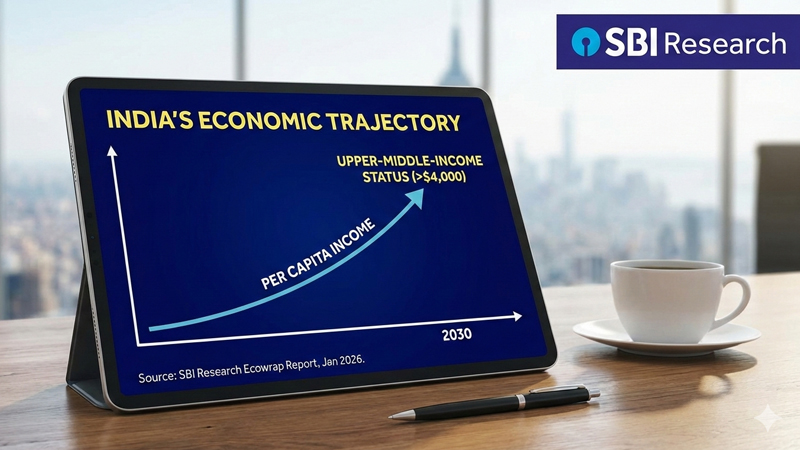
NEW DELHI: India is accelerating up the global income curve, with the country set to become an upper middle-income economy by 2030, in step with its rise as the world’s third-largest economy by 2028, according to a new SBI Research report.
After taking six decades to climb out of low-income status, India’s growth engine has shifted gears. Per capita GNI, which stood at just $90 in 1962, crossed $2,000 in 2019 and is projected to touch $4,000 by 2030, putting the country within striking distance of the World Bank’s upper middle-income threshold of around $4,500, the report said.
The pace is telling. India reached $1 trillion in GDP in 60 years, added the next trillion in seven, the third in another seven, and the fourth in just four. At this clip, the $5 trillion mark is barely two years away. Nominal GDP growth in dollar terms of around 11.5 per cent, seen consistently before and after the pandemic, makes the climb achievable, SBI Research noted.
India’s growth credentials are also improving in relative terms. Over the decade ended 2024, the country ranked in the 95th percentile of global real GDP growth, up from the 92nd percentile over a 25-year horizon, placing it firmly in the upper tier of the global growth distribution.
The comparison with peers is stark. China and Indonesia have already made the leap to upper middle-income status, while countries such as Guyana have vaulted all the way to high income. India, which transitioned to lower middle-income only in 2007, is now compressing decades of growth into years, the report said.
Looking further out, India could hit high-income status by 2047 if per capita GNI grows at 7.5 to 9 per cent annually. The task is demanding but not implausible given performance over the past two decades. Manufacturing expansion, reforms and sustained investment will determine how quickly the gap closes.
For now, the direction is clear. India is no longer inching up the ladder. It is climbing faster, with momentum firmly on its side.

The gig economy has emerged as a transformative force in India, fundamentally altering the way people work, how businesses operate, and the structure of employment itself. Characterized by short-term contracts, freelance work, and flexible working hours, the gig economy provides an alternative to traditional full-time employment, and it is reshaping the Indian workforce at an unprecedented scale.
With the proliferation of digital platforms like Uber, Zomato, Swiggy, and Upwork, the gig economy is rapidly expanding, offering a range of opportunities across various industries. While it presents significant advantages like flexibility and income potential for workers, it also raises concerns about job security, benefits, and long-term financial stability. As India positions itself as a major player in the global economy, understanding the impact of the gig economy on its workforce is crucial for the country’s socio-economic development.
Rise of the gig economy in India
India, with its large and young labor force, has witnessed an exponential rise in gig work over the past decade. According to a report by the Boston Consulting Group, around 15 million people were engaged in gig work in India as of 2022. This number is expected to grow substantially as more individuals opt for freelance and contract-based work over conventional employment.
Several factors have contributed to the growth of the gig economy in India. The rapid penetration of smartphones and internet connectivity has made it easier for people to access digital platforms that connect gig workers with employers. Moreover, changing attitudes toward work, especially among millennials and Gen Z, have led to a preference for flexibility, autonomy, and the ability to work on multiple projects rather than committing to a single employer.
Additionally, the COVID-19 pandemic accelerated the gig economy’s growth, as many traditional businesses were forced to adapt to remote work and embrace a more flexible workforce. Companies, especially in sectors like food delivery, e-commerce, and IT services, turned to gig workers to meet demand surges, further driving the shift towards non-traditional employment.
Benefits of the gig economy for workers
One of the primary attractions of the gig economy is the flexibility it offers. Workers have the freedom to choose when, where, and how much they want to work, which is especially appealing to those who value work-life balance. This model also provides opportunities for individuals to explore diverse skill sets, take on multiple roles, and earn income from different sources, all without being tied to a full-time job.
For many people, the gig economy serves as a means to earn supplemental income, whether they are students, homemakers, or professionals looking for extra work. In regions with limited full-time job opportunities, gig work allows individuals to tap into the global market and secure freelance projects, reducing regional employment disparities.
Furthermore, the gig economy has been instrumental in promoting entrepreneurship, especially among the youth. Many young workers are now able to start their own businesses, offer specialised services, or work as consultants, thanks to the ease with which they can connect with clients through digital platforms.
Challenges for gig workers
Despite its advantages, the gig economy presents several challenges, particularly around income stability and job security. Gig workers often lack access to essential benefits such as health insurance, pensions, and paid leave, which are standard in traditional employment. The absence of a formal employment contract can leave gig workers vulnerable to exploitation, with low pay, irregular hours, and limited bargaining power.
Income volatility is another significant concern. While some gig workers can earn a substantial income, many face unpredictable earnings due to fluctuations in demand or competition with other freelancers. This uncertainty can make it difficult for workers to plan for long-term financial goals or manage their expenses effectively.
Additionally, the lack of social security benefits like provident fund contributions or access to unemployment insurance means that gig workers are left unprotected in times of crisis. This was evident during the COVID-19 pandemic, where many gig workers lost their income due to restrictions on movement, with limited government support to fall back on.
Impact on the broader workforce
The gig economy’s rise is also influencing traditional employment models in India. Companies are increasingly adopting hybrid workforce models, where they rely on a mix of full-time employees and gig workers to achieve greater operational flexibility. While this may lead to cost savings for businesses, it also raises concerns about the future of full-time jobs and the growing casualisation of labor.
On a larger scale, the gig economy is contributing to changes in labor policies and regulations in India. The government has recognized the need to provide gig workers with some level of social security and has introduced schemes like the Code on Social Security, 2020, which includes provisions for gig and platform workers. However, the effective implementation of such policies remains a challenge.
Conclusion
The gig economy offers both opportunities and challenges for the Indian workforce. While it provides workers with flexibility, autonomy, and access to new income streams, it also raises concerns about job security, benefits, and income stability. As the gig economy continues to expand, it will be essential for policymakers, businesses, and workers to find a balance that ensures both flexibility and protection for gig workers. By addressing these challenges, India can harness the potential of the gig economy while safeguarding the rights and well-being of its workforce.
The article has been authored by Judge India president and Judge Group, global delivery, Abhishek Agarwal.

Mumbai: Monday mornings often carry a heavy weight, especially for salaried and general working class people. They rise early and navigate through the chaotic crowd to catch a train, spend the day at the office and return home in the evening, often with little time left for relaxation or enjoyment. The cycle repeats day after day, leaving little room for anything beyond the grind of work.
Many people feel that after years of education, studying for 13 to 15 years and landing a job that pays only a meagre salary feels like a scam. Adding more insult to injury is the expectation to give 100% in a pernicious work culture that often normalises late nights and overwork. As working conditions worsen, employees find themselves grappling with alienation and a sense of nihilism, as their efforts contribute to tasks that offer little real satisfaction.
In our digital age, social media has become a platform for venting frustrations about corporate life. Office memes and comments on these posts reveal a collective discontent, with many individuals sharing their experiences of challenging manager-worker relationships and the anxiety surrounding salary increments. The normalisation of poor working conditions elicits both laughter and anger, reflecting the heartbreak of doing mundane tasks that feel devoid of meaning.
The recent tragic case of Anna Sebastian Perayil, an employee at Ernst & Young, highlights the serious toll of work-related stress, raising important questions about workplace culture. Companies claiming to be the “best places to work” have faced scrutiny, as a Gallup report from 2024 found that only 14 per cent of surveyed Indian employees reported thriving in their roles, compared to 34 per cent globally. Employment conditions in India remain troubling, marked by stagnant wages, increasing self-employment among women, and a higher proportion of unpaid family labour among youth.
Marching Sheep founder Sonica Aron says, “Work related stress and burnout are a symptom and it’s time we address the root cause. High tolerance for toxic work culture, poor managerial capability, carewashing are issues that need to be addressed systematically. And these are issues not specific to any one industry or geography, they pervade the entire corporate culture. Companies forget that it is people who drive performance, productivity, innovation and growth, and not taking care of people is not an option.”
Sonica rightfully mentioned that identifying the root cause is a highly trivial aspect since topics such as these only highlights the problems, the data, statistics which is indeed pretty much important, but doesn’t really emphasis on why such a situation is in the first place. In this article, we will explore the root causes of these dismal working conditions.
The push for better working environments seems logical, but it deludes us into thinking that companies genuinely care about their employees’ well-being. In reality, the premature deaths of workers under harsh conditions can be seen as beneficial for corporations. If the capitalist society is truly rewarding for employees, the working class would not be facing the dire situations they currently endure.
From a materialist perspective, the production and reproduction of life are the ultimate determinants of history. Under capitalism, companies extract profit from this life until it no longer produces value. From the moment we enter this system, we face vulnerabilities related to housing, food and health. Without selling our labour, we risk falling into crises.
For instance, a factory owner can only profit if they pay labourers less than the true value of their work. The surplus value (extra money created by the workers/employees during their working hours) generated is retained by the owner, who reinvests it in the business to increase efficiency and further exploit workers. As a result, employees receive less than what is necessary for a decent quality of life, leading to exhaustion and health issues. This decline renders them less useful to their employers, who view them as replaceable resources.
A disturbing implication of this system is that the sooner a worker is unable to perform, the quicker they can be replaced. Companies show little interest in enhancing the lifespan or well-being of their employees, as this would require investing in their needs rather than maximising profits. Thus, the argument for better working conditions contradicts the very foundations of this system.
This is the reason why we are unable to witness any empathy shown by the companies when such unfortunate incidents happen. The case of Anna Sebastian Perayil at Ernst & Young is not an isolated incident; such tragedies are becoming increasingly common and is a global phenomenon. Even those who glorify “hustle culture” are often kept in a delusion that primarily benefits companies. In these critical times, workers should advocate for stricter labour laws to reduce working hours, form unions, and improve their overall conditions. It’s essential to challenge the exploitative dynamics at play and fight for a workplace that values human life and dignity over mere profit.

Netflix celebrates a decade in India with Shah Rukh Khan-narrated tribute film

Delhivery chairman Deepak Kapoor, independent director Saugata Gupta quit board

Meta appoints Anuvrat Rao as APAC head of commerce partnerships

Brnd.me enters Europe as haircare brands power global expansion

TechnoSport taps quick commerce with launch on Slikk’s 60-minute platform

Jitendra Singh joins Reliance Industries as senior vice president, special projects

Tinder brings real-world dating experiences to North East India

These ’90s fashion trends are making a comeback in 2017
The final 6 ‘Game of Thrones’ episodes might feel like a full season
According to Dior Couture, this taboo fashion accessory is back
The old and New Edition cast comes together to perform
Phillies’ Aaron Altherr makes mind-boggling barehanded play
Uber and Lyft are finally available in all of New York State
Disney’s live-action Aladdin finally finds its stars
Netflix celebrates a decade in India with Shah Rukh Khan-narrated tribute film
Delhivery chairman Deepak Kapoor, independent director Saugata Gupta quit board
Meta appoints Anuvrat Rao as APAC head of commerce partnerships
Brnd.me enters Europe as haircare brands power global expansion
TechnoSport taps quick commerce with launch on Slikk’s 60-minute platform
Jitendra Singh joins Reliance Industries as senior vice president, special projects
Tinder brings real-world dating experiences to North East India
-
 iWorld3 months ago
Tips Music turns up the heat with Tamil party anthem Mayangiren
-
 iWorld12 months ago
BSNL rings in a revival with Rs 4,969 crore revenue
-
 I&B Ministry3 months ago
India steps up fight against digital piracy
-
 MAM3 months ago
HoABL soars high with dazzling Nagpur sebut
-

 News Broadcasting2 months ago
CNN-News18 dominates Bihar election coverage with record viewership
-

 MAM2 months ago
Best Lightweight Sunscreens for Daily Use in India
-

 AD Agencies1 month ago
Divya Parkhi steps into client lead role at WPP Media
-

 GECs4 weeks ago
SPNI set to undertake leadership realignment as part of long-term transformation