
Applications
HSEMI AI debuts on Republic Day with a human plus machine approach

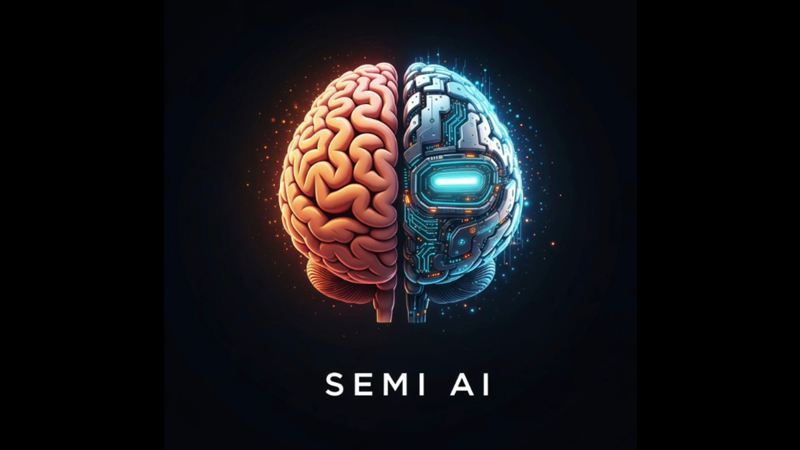
MUMBAI: Brains met bytes on Republic Day as SEMI AI quietly stepped into the spotlight. Marking India’s 77th Republic Day, the tech platform announced its soft launch, positioning itself as the world’s first “half-machine, half-human” AI system, a hybrid designed to marry the speed of algorithms with the nuance of human judgement. The aim: decisions that are not just faster, but fairer, more ethical and deeply aware of context.
At the heart of SEMI AI is an intelligent routing engine. Incoming queries are analysed to determine what can be resolved by machine learning models and what demands human insight. Routine tasks are handled instantly by AI, while complex issues involving ethics, culture or judgement are escalated to domain experts within SEMI AI’s human network. Each interaction feeds a loop where human decisions refine the system, and the system, in turn, improves scale and efficiency.
SEMI AI founder and CEO Saurabh Bhambri described the timing as symbolic, calling SEMI AI “Made in India, by Indians, and for Indians”, and dedicating the platform to citizens on Republic Day. SEMI AI co-founder and CTO Bijay Singh Rajput added that the model could help citizens and institutions take smarter decisions, while also giving India a distinctive voice in the global AI conversation.
The platform is designed for use across sectors where purely algorithmic answers often fall short. In healthcare, it can support diagnostics under doctor supervision. In finance, it blends automated risk assessment with human validation. In education, it enables personalised learning guided by teachers, while in public services it helps resolve citizen queries, escalating only the most complex cases.
By blending code with conscience, SEMI AI is pitching itself as an alternative to black-box automation. Its Republic Day debut underlines a broader ambition: to show that India’s next wave of AI innovation can scale globally without losing sight of human values.
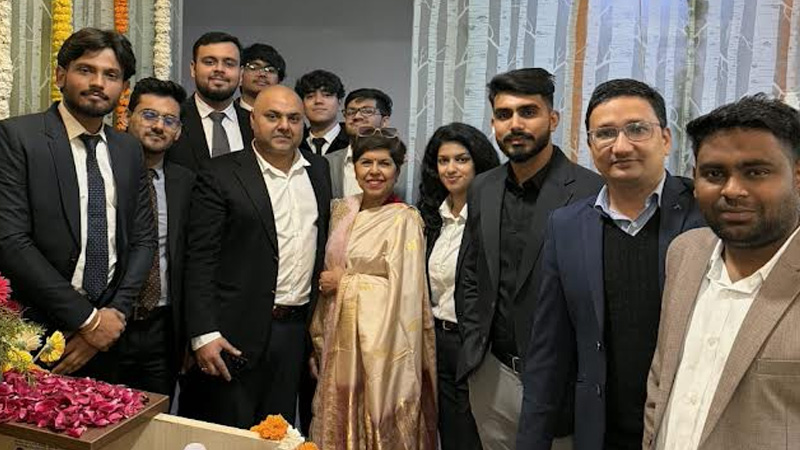
MUMBAI: Bharathcloud is bringing its cloud closer to power. The Hyderabad-based sovereign AI cloud services provider has opened its Delhi office, marking its formal entry into North India and setting the stage for its next phase of growth.
The expansion comes as India’s digital transformation fuels rising demand for AI-ready cloud infrastructure, driven by wider adoption of artificial intelligence, machine learning, the Internet of Things and data-heavy applications. With the new office, Bharathcloud plans to onboard more than 100 employees in 2026, strengthening its workforce to support customers across government, enterprises, MSMEs and social sectors.
The Delhi presence is expected to sharpen the company’s engagement with organisations seeking secure, scalable and cost-efficient cloud platforms that comply with India’s data sovereignty requirements. It also positions Bharathcloud closer to policy, public sector and enterprise decision-makers in the region.
Founded in Hyderabad, Bharathcloud offers AI-ready cloud infrastructure including Kubernetes-as-a-Service, zero-trust security architecture and multi-level data protection frameworks. Its platform supports AI and ML workloads, blockchain application migration from hyperscalers and distributed data management, with an emphasis on reliability, low latency and operational continuity.
“With the Delhi expansion, we are positioning Bharathcloud to engage more closely with AI-driven enterprises and technology hubs in North India,” said Bharathcloud co-founder Rahul Takallapally. He added that the move would help nurture local cloud and AI talent while accelerating the adoption of secure and resilient AI infrastructure across sectors.
The company currently operates in Hyderabad, Bengaluru, Mumbai, Kolkata, Lucknow and Chennai, employing over 200 people and serving more than 1,500 clients across manufacturing, healthcare, financial services, IT and media. Aligned with national initiatives such as Digital India and Make in India, Bharathcloud continues to focus on building indigenous AI-cloud infrastructure to support data localisation and the country’s growing appetite for next-generation digital solutions.
With its Delhi office now live, the company is signalling a clear intent: to make sovereign, AI-ready cloud infrastructure not just an alternative, but a mainstream choice for India’s north as well as its tech capitals.
CALIFORNIA: Meta Platforms is going all in. The Instagram and Facebook owner has sharply raised its capital expenditure for 2026 to between $115 billion and $135 billion, nearly double last year’s spend, signalling CEO Mark Zuckerberg’s aggressive push toward artificial superintelligence. Investors cheered, sending shares higher, buoyed by robust advertising growth.
Speaking to analysts, Zuckerberg called 2026 a “pivotal year” for Meta, highlighting the focus on delivering highly personalised AI capabilities while reshaping internal operations.
The spend surge is driven by infrastructure costs, higher depreciation from AI data centres, and rising operating expenses linked to compute-intensive workloads. Meta has secured capacity deals with external providers including Alphabet, CoreWeave and Nebius, though capacity constraints are expected through much of the year, according to chief financial officer susan li.
Meta’s fourth-quarter performance underpinned confidence in the strategy. Advertising revenue, still the core engine, jumped 24 per cent year on year to $58.14 billion, up from $46.78 billion a year earlier. Strong ad cash flows helped the company beat earnings expectations and issue a first-quarter revenue forecast of $53.5–$56.5 billion, well above analyst estimates.
Despite the ad boom, capital expenditure surged 49 per cent, contributing to a decline in operating margin as infrastructure costs accelerated. Meta has been able to fund its AI ambitions largely through advertising, which benefits from AI-driven improvements in targeting and campaign automation. New monetisation channels on WhatsApp and Threads, and competition in short-form video via Instagram Reels, have further strengthened the ad engine.
Meta also projected total expenses for 2026 between $162 billion and $169 billion, reflecting infrastructure costs and rising employee compensation as the company hires aggressively for AI roles in a tight talent market.
“2026 will redefine how Meta works as AI reshapes teams and productivity,” zuckerberg said, underscoring the company’s commitment to superintelligence, a theoretical stage where machines outperform humans across a broad range of tasks.
Market watchers said investors appear comfortable with Meta’s high-stakes strategy, noting that generative AI returns may take time, but the company’s advertising cash flows are strong enough to absorb heavy spending. The outlook contrasts with Microsoft, which also ramped up capital expenditure but saw shares fall amid modest cloud growth.
Meta is charging full throttle into 2026, betting big on AI while keeping the ad engine roaring — and the world is watching.

SWEDEN: Spotify paid out more than $11bn to the global music industry in 2025, cementing its position as the single largest annual payer to music creators in history and setting the stage for a renewed push to help artists break through in an increasingly crowded market.
“I’m proud to share that, last year alone, Spotify paid out more than $11bn to the music industry,” said Charlie Hellman, head of music at Spotify, in a note published on the Spotify for Artists blog. The figure marks a year-on-year increase of over 10% from 2024, significantly outpacing growth across other industry income streams.
Independent artists and labels accounted for half of all royalties paid out during the year, reinforcing the platform’s growing role as a revenue engine beyond major labels.
“Big, industry-wide numbers can feel abstract,” Hellman said, “but that growth is showing up in tangible ways.” He pointed to a structural shift in music economics, noting that there are now more artists earning over $100,000 a year from Spotify alone than were ever stocked on record-store shelves at the height of the CD era.
Despite what Hellman described as “rampant misinformation about how streaming is working today”, Spotify now contributes roughly 30 per cent of recorded music revenue worldwide. In 2025, Spotify’s payouts grew by more than 10%, while other industry income sources expanded by closer to 4%, making the platform the primary driver of industry revenue growth.
That growth, Hellman said, is ultimately fan-led. More than 750 million people globally now pay for music streaming across all platforms each month. As audiences expanded, Spotify also raised subscription prices. With nearly two-thirds—almost 70%—of its revenue paid back to rightsholders, rising platform revenues translated directly into higher payouts for artists.
“The other third is our fuel,” Hellman said, referring to Spotify’s retained revenue. That capital is reinvested into product innovation designed to convert more listeners into paying subscribers and deepen fan engagement.
The challenge, however, is visibility. With more than 100,000 new songs released every day, emerging artists are competing not only with each other but with the entire recorded history of music. Spotify’s priority for 2026, Hellman said, is helping new artists “cut through the noise and form real connections with fans”.
A key pillar of that strategy is artist storytelling. As artificial intelligence floods the internet with content, Spotify is betting that human context will become more valuable, not less. The platform is expanding features that explain who artists are, what inspires them, and how songs come together.
An upcoming feature, SongDNA, will allow fans to explore the creative networks behind tracks—such as Addison Rae’s collaboration with Luka Kloser and Elvira Anderfjärd—and trace those links into wider catalogues, including Kloser’s work with Ed Sheeran and Anderfjärd’s with Alec Benjamin.
Video is another focus area, with Spotify leaning into authenticity over polish. Live takes, rehearsals and behind-the-scenes studio moments are being positioned as fan-building tools. For pop group Katseye, early backstage Clips on their Countdown Page helped drive momentum ahead of the release of Beautiful Chaos.
Trust and identity protection form the second pillar. Spotify is preparing new systems for artist verification, song credits and identity protection to counter impersonation, scams and low-quality AI-generated content designed to siphon royalties.
“AI is being exploited by bad actors,” Hellman said, adding that protecting authentic creativity is critical to maintaining trust among listeners and rightsholders.
Human editorial curation remains central to Spotify’s discovery engine. While algorithms personalise listening, editorial playlists offer cultural signals that can change careers. Leon Thomas, for example, landed on playlists such as RADAR and RNB X after pitching through Spotify for Artists, reaching listeners in more than 180 countries.
In 2026, Spotify plans to introduce new editorial programmes aimed at sustaining momentum for emerging artists, alongside greater visibility for the editors themselves through video and storytelling.
Live music is the final frontier. Spotify has already helped generate more than $1bn in ticket sales through its partners by matching artists with their most engaged fans. New tools launching in 2026 are designed to convert streams into sold-out rooms.
“You’ve built communities, taken risks, and kept going even when the path felt uncertain,” Hellman said. “It’s our job to make sure Spotify works as hard as you do.”
With unprecedented competition colliding with unprecedented opportunity, Spotify is placing a clear bet: scale alone is not enough. The next phase of streaming, it argues, will be won by those who help artists turn attention into careers.
And in 2026, Spotify wants to be the loudest ally in the room.

Netflix celebrates a decade in India with Shah Rukh Khan-narrated tribute film

Delhivery chairman Deepak Kapoor, independent director Saugata Gupta quit board

Meta appoints Anuvrat Rao as APAC head of commerce partnerships

Brnd.me enters Europe as haircare brands power global expansion

TechnoSport taps quick commerce with launch on Slikk’s 60-minute platform

Jitendra Singh joins Reliance Industries as senior vice president, special projects

Tinder brings real-world dating experiences to North East India

These ’90s fashion trends are making a comeback in 2017
The final 6 ‘Game of Thrones’ episodes might feel like a full season
According to Dior Couture, this taboo fashion accessory is back
The old and New Edition cast comes together to perform
Phillies’ Aaron Altherr makes mind-boggling barehanded play
Uber and Lyft are finally available in all of New York State
Disney’s live-action Aladdin finally finds its stars
Netflix celebrates a decade in India with Shah Rukh Khan-narrated tribute film
Delhivery chairman Deepak Kapoor, independent director Saugata Gupta quit board
Meta appoints Anuvrat Rao as APAC head of commerce partnerships
Brnd.me enters Europe as haircare brands power global expansion
TechnoSport taps quick commerce with launch on Slikk’s 60-minute platform
Jitendra Singh joins Reliance Industries as senior vice president, special projects
Tinder brings real-world dating experiences to North East India
-
 iWorld3 months ago
Tips Music turns up the heat with Tamil party anthem Mayangiren
-
 iWorld12 months ago
BSNL rings in a revival with Rs 4,969 crore revenue
-
 I&B Ministry3 months ago
India steps up fight against digital piracy
-
 MAM3 months ago
HoABL soars high with dazzling Nagpur sebut
-
 iWorld2 days ago
Netflix celebrates a decade in India with Shah Rukh Khan-narrated tribute film
-
 News Broadcasting6 months ago
Wion marks Independence Day with global showcase of India’s spirit
-
 iWorld3 months ago
The Night Manager returns with new secrets, new spies and old scars
-

 I&B Ministry2 months ago
Centre drafts OTT rules to boost access for hearing disabled