Lights flashed, cameras rolled, news was created and records made. With no sure route to success, the tussle for bragging rights in the Hindi news space aggravated, with ever more bizarre stories being thrown up. In stark contrast, investigative, true journalism could not collect much by way of worthwhile brownie points on the ratings graph-o-meter. 2007 has indeed been an active year for news channels; sting operations, saas bahu stories, khatarnak baba, Nag Nagin Ki Shaadi, and the like ruling the roast.
IBN7 managing editor Ashutosh says that this year has clearly shown how ratings and TRPs can affect content.
NDTV Group director Narayan Rao says, “This was a year when the question was asked as to where the advertisers were putting their money: trash channels or genuine ones. From the limited perspective of a news channel, particularly Hindi news, I can see that a large number of them have gone the tabloid way: the sex-and-violence route.”
Indiantelevision.com’s analysis of Hindi news channels using Tam data (HSM, C&S 15+, all day parts) during the one-year period beginning January 2007 throws up some interesting insights into the genre while the battle among the players intensifies.
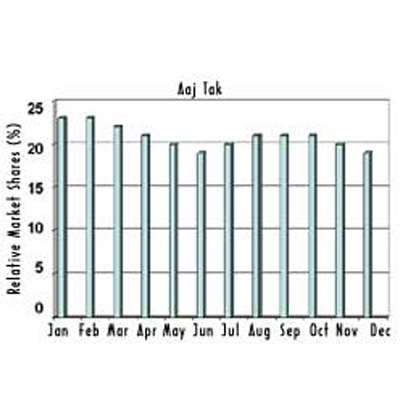
Refusing to budge from the top position for the ‘golden’ year of Hindi News channels is India Today Group’s Aaj Tak, with an annual average of 20.83 per cent market share. Being the forerunner, it has been consistent in its performance as far as relative market share. Beginning the year with 23 per cent in January, it reached its lowest in the month of June and December with a market share of 19 per cent in both the months. In June it was neck to neck with Star News, but in the month of December it had to finally give way as Star News took over pole position.
Aaj Tak’s sister concern Tez has also maintained its consistency with an almost constant share of 5 per cent of the market for eight months.
Aaj Tak news director QW Naqvi says, “As for our channels, it is extremely satisfying that we have retained the number one position despite a virtual dogfight in the TV news market. We are proud to present balanced news content. Though this is a remarkable achievement for Aaj Tak, we are aware of the challenges ahead. A number of new channels coming in the fray and with a growing audience base, it will be our effort to retain our number one position – both in terms of content perfection and market share.”
A huge attrition seen by Aaj Tak during the year however did not have any direct effect on the score card. Its top rung journalists have made tracks, either to upcoming Hindi news channels or already established ones. Aaj Tak lost its executive editor Punya Prasun Bajpai who switched sides to Samay (then Sahara Samay) as editor-in-chief. Bajpai took along with him a host of other Aaj Tak journalists including anchor and deputy editor Sanjay Bragta and crime bureau chief Nazim Naqvi.
Aaj Tak executive editor and Mumbai bureau chief Shishir Joshi quit to join Mid Day Multimedia as group directorial editor. Aaj Tak also lost Ram Kripal and Rahul Kulshetra to Triveni Group. While Kripal joined as group editor for their upcoming news channels, Kulshetra will head technical operations.
With an annual average of 18.08 per cent is News Corp backed Media Content and Communication Services (MCCS)’s Star News, which stands next to Aaj Tak in terms of market share. Star News began the year with 17 per cent market share in January. By mid-year it had picked up 19 per cent. It carved a share of 20 per cent each in the months of September, and October but could not surpass Aaj Tak in the numbers game. December, however, was a good month for Star News as it broke Aaj Tak’s monopoly by getting to the top place with 20 per cent of the market share in its kitty.
Next in the rung is India TV with an annual average of 13.75 per cent. India TV had 11 per cent in January, but slipped down to 9 per cent in February. From May, India TV joined the race in high spirits with its highest grab of 16 per cent. What followed in the later months was consistence in terms of performance in market share, dabbling between 15 to 16 per cent in the last two quarters of the year.
Leave a Reply