News Headline
Guest Column: As digital spreads wings, bolstering security is paramount


The dream of moving towards a cashless society has never been closer than it is today in India. With the recent decision of demonetization, the public is being actively urged to move online for their transactions, big or small. Aiding the public in this move has been a slew of ads, demos, tutorials and YouTube videos galore, followed by a huge migration to online shopping, boosting the digital economy of the nation. However, as a landscape changes, so does how we navigate it. And, as the market rises to meet this new demand, new and relevant questions arise — questions about the security parameters and overall security strength of e-commerce platforms.
Immediately after the demonetization announcement that caught the entire nation off-guard, there was a noticeable drop in sales on e-commerce portals. But now things are stabilizing and the stats are looking up. In the wake of demonetization, India’s mobile wallet industry is expected to soar from US$ 22.41 million in 2015-2016 to US$ 4.37 billion in 2022. This means a huge jump in the value of mobile wallet transactions from US$ 3 billion to US$ 800.35 billion during the same period, according to a July forecast by Assocham-RNCOS titled Indian M-wallet Market: Forecast 2022. Every second, three more Indians experience the internet for the first time and by 2030, more than 1 billion of them will be online.
Besides making this the most exciting time to be a part of the ecommerce sector, these advances are also expected to make businesses efficient in the long run. Digital payments are now seen as the future and are believed to be a way of life soon. However, with this clickable economy and with commerce involved, there is also a valid risk of cybercrimes.
Security in OTT e-subscriptions
In fact, let’s first look at the OTT platforms like Amazon Prime, Netflix, Hotstar and others, which are witnessing an increased demand for paid content. What it means is an increased set of security features to manage subscriptions and paid-content access.

The three key areas of security for OTT content are authentication, geo-blocking and control of account sharing. Netflix as a provider uses message security layer instead of using HTTPS protocol. Being tied to SSL and TLS, HTTPS suffers from fundamental security issues unknown at the time of their design. Examples include padding attacks and the use of MAC-then-Encrypt, which is less secure than Encrypt-then-MAC.
MSL is a modern cryptographic protocol that takes into account the latest cryptography technologies and knowledge. It supports the following basic security properties:
-Integrity protection: Messages in transit are protected from tampering.
-Encryption: Message data is protected from inspection.
-Authentication: Messages can be trusted to come from a specific device and user.
-Non-replayable: Messages containing non-idempotent data can be non-replayable.
MSL has pluggable authentication and may leverage any number of device- and user-authentication types for the initial message. The initial message will provide authentication, integrity protection, and encryption if the device authentication type supports it. Future messages will make use of session keys established as a result of the initial communication.
With MSL Netflix has eliminated many of the problems they faced with HTTPS and platform integration. Its flexible and extensible design means it will be able to adapt as Netflix expands and as the cryptographic landscape changes.
Securing trust in e-commerce
This demonetization era calls for the strengthening of cyber security mechanisms. Anyone with an email address and a social media account is at threat and can be a target. The most common kinds of cyber-crimes associated with e-commerce are to do with data privacy and protection, and include bogus deals and purchases, trademark and copyright infringement, payment frauds, disputes in B2B and B2C transactions, FEMA violations, issues of web content ownership, contract violation, hacking, phishing, cyber stalking and cyber-squatting.
Nearly 45 per cent of transactions are done via mobile, giving scope for several cons. According to a joint study by Assocham and PwC released in August 2016, cyber-crimes in India have surged around 350 per cent between 2011 and 2014.
India has germinated into a fertile ground for e-commerce, but consumers are exposed to security threats too. Fraud in the e-commerce sector leads not only to financial loss, but also a loss of reputation and simultaneously, a severe loss in business. Once a loyal customer, the individual switches to a competitor for his needs in case of breach of trust. Consumer trust in such a complex and interactive environment has become the need of the hour.
Addressing the risk of fraud
At HGS Interactive, our teams are proactive in addressing the risk of fraud that ecommerce companies can face by taking a hard look at their business models and vulnerability to fraud so that their customers can buy their products with confidence.
We understand that effective fraud risk management is a continuous process of reviewing and addressing the significant risks of fraud. Network security, confidentiality and authentication are three essential components of an e-commerce website. Several companies such as PayTM use 128-bit encryption technologies for storing information, which makes it tough to crack a password. Front-end payment card validation wherein MOD 10 checks, BIN checks, authorization responses, customer profile checks, security questions, login analysis, basic site rules such as number of orders placed through one account, value of orders or back-end manual order reviews must be put into place.
Digital signatures and dynamic IP protection are exemplary methodologies and should be implemented on all ecommerce websites. A secure and reliable web hosting service is a prerequisite to guarantee optimum performance of an ecommerce website, all through the year.
HGS Interactive recently worked for Nakshatra, which is one of India’s most reputed diamond jewelery brands and is from the pioneer Gitanjali Group. We ensured we hosted their web app on a safe hosted service provider to whom we mandated extremely strong privacy and data security policies enforced actively. Whether it is for a top jewelery brand or numerous other clients across sectors, high-end and world class web and digital security is of paramount importance. Financial information is typically stored by payment gateways primarily for small and medium businesses, while larger platforms prefer to have their own security parameters and store the data themselves, as it provides more control and security over this extremely sensitive data.
Hosting providers like Amazon Web Services and DigitalOcean provide full access to their security profiles, but skill and expertise is required to manage and stay ahead of the curve and avoid being hacked. Credit data is stored in an encrypted format and never as pure text, so it is protected as long as the encryption is strong.
Encryption equals protection
I strongly believe that encryption of data equals protection. Encryption lets you scramble information using a mathematical formula, which is tough to break without a “key”. You can implement technologies like SSL (Secure Sockets Layer) and SHTML (Secure-HTML), with web forms to secure your ecommerce website. Encryption can also be incorporated in your email package through a technology known as S/MIME (Secure/Multipurpose Internet Mail Extensions). It is mandatory to have these in place during transactions to prevent vulnerable attacks from networks.
Firewalls are another essential aspect in stopping attackers before they can breach your network and gain access to your critical information. Major certifications reaffirm credibility, while a full-featured secure environment is expected to boast security measures like virtual private cloud, encrypted data storage, identity and access management, and Multi-Factor Authentication (MFA) to provide users with peace of mind.
To summarize, customers expect a safe experience when shopping on any ecommerce website. And as a responsible business, protecting their personal and financial information is not only the paramount responsibility of any business, but it is also considerably easier and far less costly than recovering from a breach. It is crucial to ensure the security of the existing infrastructure and upgrade present systems and oversee the smooth transition to the more advanced digitization of India.
Also Read
Irdeto joins Frog by Wyplay community to offer integrated security solutions
 The author, Sachin Karweer, is Business Head, HGS Interactive, a Hinduja Group company that creates new paradigms for digital consumer experience. The views expressed here are personal and Indiantelevision.com need not necessarily subscribe to them The author, Sachin Karweer, is Business Head, HGS Interactive, a Hinduja Group company that creates new paradigms for digital consumer experience. The views expressed here are personal and Indiantelevision.com need not necessarily subscribe to them |






NEW DELHI: Hamdard Laboratories gathered a cross-section of India’s achievers in New Delhi on Friday, handing out the Hakeem Abdul Hameed Excellence Awards to figures who have left their mark across healthcare, education, sport, public service and the arts.
The ceremony, attended by minister of state for defence Sanjay Seth and senior officials from the ministry of Ayush, celebrated individuals whose work blends professional success with a sense of public purpose. It was as much a roll call of achievement as it was a reminder that influence is not measured only in profits or podiums, but in people reached and lives improved.
Among the headline awardees was Alakh Pandey, founder and chief executive of PhysicsWallah, recognised for turning affordable digital learning into a mass movement. On the sporting front, Arjuna Awardee and kabaddi player Sakshi Puniya was honoured for her contribution to the game and for pushing women’s participation onto bigger stages.
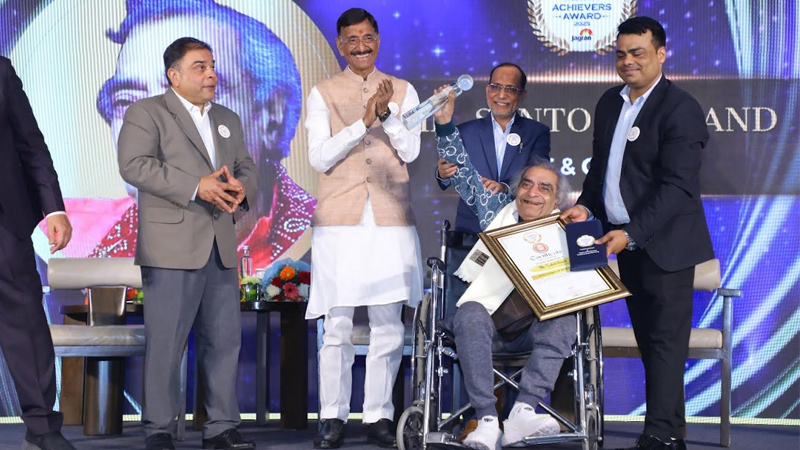
The cultural spotlight fell on veteran lyricist and poet Santosh Anand, whose songs have echoed across generations of Hindi cinema. At 97, Anand accepted the honour with characteristic humility, reflecting on a life shaped by perseverance and hope.
Healthcare honours spanned both modern and traditional systems. Manoj N. Nesari was recognised for strengthening Ayurveda’s place in national and global health frameworks. Padma shri Mohammed Abdul Waheed was honoured for his research-backed work in Unani medicine, while padma shri Mohsin Wali received recognition for his long-standing contribution to patient-centred care.
Education and social development also featured prominently. Padma shri Zahir Ishaq Kazi was honoured for decades of work in education, while former Meghalaya superintendent of Police T. C. Chacko was recognised for public service. Goonj founder Anshu Gupta received an award for his dignity-centred rural development initiatives, and the Hunar Shakti Foundation was honoured for empowering women and young girls through skill development.
The Lifetime Achievement Award went to former IAS officer Shailaja Chandra for her long career in public healthcare and governance, particularly in the traditional systems under Ayush.
Speaking at the event, Hamdard chairman Abdul Majeed said the awards were a tribute to those who combine excellence with empathy. “These awardees reflect Hakeem Sahib’s belief that healthcare, education and public service must ultimately serve humanity,” he said.
Minister Seth struck a forward-looking note, saying India’s young population gives the country a unique opportunity to become a global destination for learning, health and wellness by 2047.
The ceremony also featured the trailer launch of Unani Ki Kahaani, an upcoming documentary starring actor Jim Sarbh, set to premiere on Discovery on 11 February.
Instituted in memory of Unani scholar and educationist Hakeem Abdul Hameed, the awards have grown into a national platform that celebrates those building a more inclusive and resilient India. For one evening at least, the spotlight was not just on success, but on service with substance.

MUMBAI: For decades, creative storytelling has been the cornerstone of brand communication. The “big idea” amplified through catchy jingles, striking visuals, and memorable hooks was once the gold standard for relevance and recall. Creativity defined presence, and the loudest, boldest campaigns often won attention.
But the marketing landscape today looks very different.
Audiences are more exposed, more discerning, and far less patient. They are inundated with messages across platforms, formats, and creators, often encountering hundreds of brand touchpoints in a single day. In this environment, creativity alone especially when untethered from real consumer truths is no longer enough to move behaviour. Great ideas are abundant. Meaningful impact is not.
This is where insights matter.
The difference may seem subtle, but it is fundamental. An idea represents what a brand wants to say. An insight reflects what the audience is already thinking, feeling, or experiencing. The most effective campaigns emerge not from cleverness alone, but from the intersection of these two forces.
From creativity to relevance
As the marketing ecosystem becomes increasingly saturated, consumers are growing immune to inflated claims and surface-level storytelling. Even beautifully crafted campaigns can fail if they are disconnected from lived realities. The gap between a brand’s internal enthusiasm and the audience’s actual sentiment can be the difference between attention and indifference.
Insights help bridge this gap. They force brands to pause, listen, and observe to understand emotions, behaviours, cultural contexts, and contradictions. Instead of trying to be remembered through louder branding, insight-led campaigns allow audiences to see their own experiences reflected back at them. When a campaign articulates a problem that feels personal, relevance is created. Trust follows.
Insight is interpretation, not information
It’s important to distinguish between data and insight. Data tells us what is happening. Insight explains why it is happening. While data is measurable and structured, insights are interpretive and dynamic, shaped by real-time sentiment and human behaviour.
Modern consumers are full of contradictions. They demand authenticity while remaining deeply aspirational. They want brands to take a stand but expect nuance, not instruction. They seek transparency, yet are drawn to curated narratives. These tensions are not obstacles, they are opportunities. When understood correctly, they can shape communication that feels timely, credible, and human.
Some of the most effective campaigns today are born not in isolated brainstorm rooms, but through listening to audiences, creators, editors, online communities, and cultural signals. Insights often exist in blurred patterns, but once identified, they can redefine how a brand connects.
A recent campaign we executed for Domino’s illustrates this shift clearly. The brief wasn’t to make a pizza look bigger or louder. Instead, it was rooted in a simple behavioural truth: in Tier 2 and Tier 3 markets, sharing food is an emotional act tied to family, celebration, and value perception. The “Big Big 6-in-1 Pizza” became a canvas for this insight. The campaign leaned into regional voices and real sharing moments, allowing people to show how they experienced the product rather than being told why they should buy it. Influencers and celebrities amplified genuine usage, not scripted endorsements. The impact from engagement to footfall to sales came not from a clever idea, but from understanding how people relate to food in their everyday lives.
Shifting the starting point
Today’s consumer landscape demands a shift in perspective from “What should the brand say?” to “What does the audience need to hear right now?” This marks a move away from inward-led marketing toward communication shaped by behaviour, emotion, and cultural relevance.
Brands leading today are keen observers. They notice when perfection stops resonating. They sense when luxury shifts from aspiration to excess. They recognise when influencer content begins to feel repetitive and trust erodes.
Virality, too, is often misunderstood. It is not a strategy to chase, but an outcome. Campaigns rooted in insight do not aim to go viral; they aim to resonate. When content reflects something familiar, a shared truth, emotion, or tension, it travels organically because people see themselves in it.
Ideas attract attention. Insights build connection.
The evolving role of PR
For PR professionals, this shift has redefined success. Coverage volume alone no longer tells the full story. The more meaningful questions today are: Did the communication influence behaviour? Did it align with cultural conversations? Did it address a real consumer pain point?
Insight-first thinking allows these questions to be answered at the planning stage, rather than corrected midway through execution.
In a world where formats and platforms will continue to evolve, what remains constant is the power of authentic communication. The strongest campaigns today do not begin with a brainstorm, but with observation, interpretation, and empathy. That is not just better marketing, it is more responsible, resilient, and meaningful brand-building.

MUMBAI: Zepto has elevated Ahmad Muneeb to vice president – HR centre of excellence, placing him at the helm of the company’s total rewards, executive compensation and organisational effectiveness as the quick-commerce firm powers through a high-growth phase.
The move follows his stint as senior director of the HR COE, where he played a central role in preparing the company for IPO readiness while scaling its people analytics capabilities. During this period, Muneeb helped align complex performance management structures with more streamlined and scalable employee experience frameworks.
In his new role, he will steer the design of total rewards strategies, executive compensation planning and organisational design, while also overseeing performance management, employee experience initiatives and people analytics programmes.
Before joining Zepto, Muneeb spent nearly three years at Meesho, where he held multiple rewards and HR business partner roles. Earlier in his career, he worked as a senior rewards consultant at Mercer, advising high-tech clients on compensation benchmarking, pay structures and talent-focused reward frameworks.
He began his hr journey at Cognizant, where he supported compensation programmes for nearly two lakh employees across India and worked on m&a compensation alignment and skill-based pay initiatives. Prior to moving into HR, Muneeb started his career as a software engineer at Netcracker, bringing a technical grounding to his people strategy work.
With a mix of consulting rigour, start-up agility and enterprise-scale experience, Muneeb’s elevation signals Zepto’s continued focus on building robust people systems as it races towards its next phase of growth.


MIB sets OTT accessibility rules, mandates captions and audio description

Boney Kapoor acquires remake rights of Tamil political satire Thalaivar Thambi Thalaimaiyil

Netflix India names Rekha Rane director of films and series marketing

Zabeen signs off from TV9 after shaping the network’s public voice

Dhawan steps up to bat for Delhi’s grassroots sports push

Orient Beverages pops the fizz with steady Q3 gains and rising profits

Cheekatilo shines in the dark with record debut on Prime Video

These ’90s fashion trends are making a comeback in 2017
The final 6 ‘Game of Thrones’ episodes might feel like a full season
According to Dior Couture, this taboo fashion accessory is back

Swiggy Instamart’s GOV surges 103 per cent year on year to Rs 7,938 crore
The old and New Edition cast comes together to perform
Phillies’ Aaron Altherr makes mind-boggling barehanded play
Uber and Lyft are finally available in all of New York State
MIB sets OTT accessibility rules, mandates captions and audio description
Boney Kapoor acquires remake rights of Tamil political satire Thalaivar Thambi Thalaimaiyil
Netflix India names Rekha Rane director of films and series marketing
Zabeen signs off from TV9 after shaping the network’s public voice
Dhawan steps up to bat for Delhi’s grassroots sports push
Orient Beverages pops the fizz with steady Q3 gains and rising profits
Cheekatilo shines in the dark with record debut on Prime Video
-
 e-commerce3 weeks ago
Swiggy Instamart’s GOV surges 103 per cent year on year to Rs 7,938 crore
-

 News Headline2 months ago
From selfies to big bucks, India’s influencer economy explodes in 2025
-

 News Broadcasting2 weeks ago
Mukesh Ambani, Larry Fink come together for CNBC-TV18 exclusive
-
 iWorld5 months ago
Billions still offline despite mobile internet surge: GSMA
-

 News Headline2 months ago
2025: The year Indian sports saw chaos, comebacks, and breakthroughs
-

 News Headline2 months ago
Game on again as 2025 powers up a record year and sets the stage for 2030
-
 MAM2 years ago
Costa Coffee becomes official coffee partner of Olympic Games Paris 2024
-

 Applications2 months ago
28 per cent of divorced daters in India are open to remarriage: Rebounce