

Broadband
FCC gets Indian origin Ajit Pai as its chairman

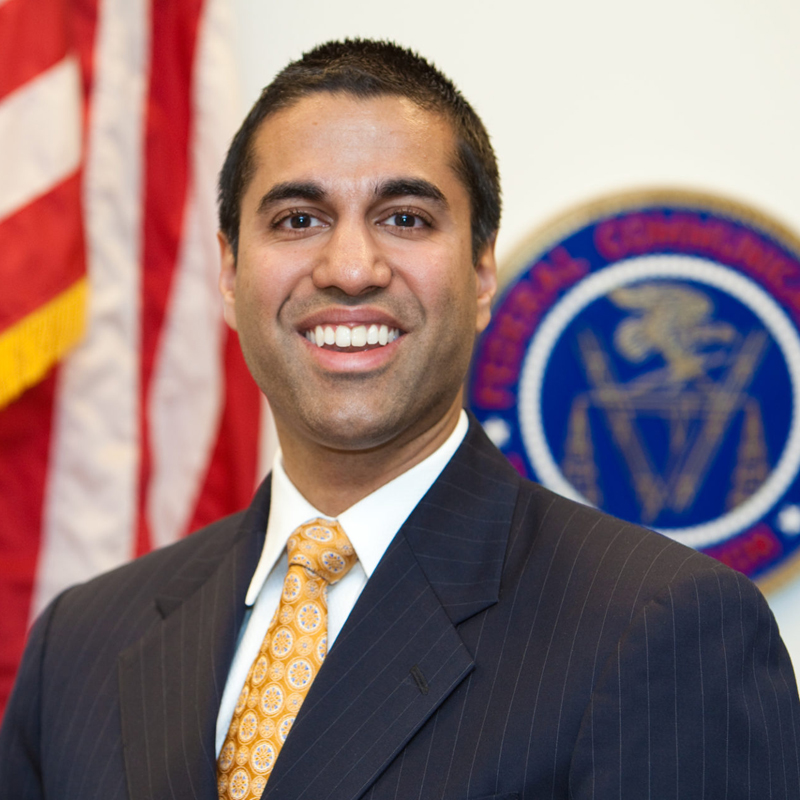
MUMBAI: Indians are familiar with Ajit Pai who addressed Ficci Frames as a keynote speaker just three years ago. But Pai is the point man designated by US president Donald Trump as the 34th chairman of the Federal Communications Commission (FCC) who will be drawing up communications policy in one of the most highly networked and communications heavy nations on earth.
Pai, a senior republican on the FCC, was appointed as a commissioner in 2012 by the then President Barack Obama and later confirmed by the senate. He replaces outgoing chairman Tom Wheeler.
“I look forward to working with the new administration, my colleagues at the Commission, members of Congress and the American public to bring the benefits of the digital age to all Americans,” Pai said in a statement.
Ajit Pai had credited his family for his successful rise as communications regulator during his Ficci Frames speech: Said he: “I was born and brought up in the United States, but my family’s roots are here in India. My mother grew up in Bangalore, and my father was raised in Hyderabad. In 1971, they came to the United States with just a radio and ten dollars in their pockets. Now, forty-three years later, here I am, in the country of my forefathers, speaking to you as the first Indian-American to serve on the FCC. The credit for this goes to my parents, who, like many immigrants, sacrificed to give me opportunities not available to them as children. It goes to my grandparents, who instilled in my parents the value of hard work and the vision to dream big.”
According to the FCC website Pai’s rules on communication regulations are as follows:
* Consumers benefit most from competition, not preemptive regulation. Free markets have delivered more value to American consumers than highly regulated ones.
* No regulatory system should indulge arbitrage; regulators should be skeptical of pleas to regulate rivals, dispense favors, or otherwise afford special treatment.
* Particularly given how rapidly the communications sector is changing, the FCC should do everything it can to ensure that its rules reflect the realities of the current marketplace and basic principles of economics.
* As a creature of Congress, the FCC must respect the law as set forth by the legislature.
* The FCC is at its best when it proceeds on the basis of consensus; good communications policy knows no partisan affiliation.
Pai as the commissioner had proposed a:
* Comprehensive plan to promote broadband deployment to all Americans. The federal government must make it easier to for broadband providers to retire increasingly obsolete copper lines in favor of next-generation technologies like fiber.”
• It must enable rural residents to have the same choice for stand-alone broadband typically found in cities.
• It must create a roadmap for state and local governments so that companies that want to compete in the broadband market don’t have to jump through unnecessary regulatory hoops in order to lay fiber to consumers.
• It must promote common-sense policies like “Dig Once” and reform pole attachment rules to reduce the costs of building digital networks.
• It must streamline the process for deploying wireless infrastructure, from big towers to small cells.
• It must free up more licensed spectrum for use by wireless carriers and more unlicensed spectrum for things like Wi-Fi.
• And it must preserve Internet freedom here and abroad, so that the online world can flourish free from heavy-handed government intervention.
Additionally, Pai ai was the first member of the FCC in over two decades to call for revitalizing the AM radio band; the basic reforms he proposed were adopted in 2015. He also urged the FCC to create a task force to study the “Internet Protocol Transition” and report on obsolete rules that could be repealed; that task force was created.
He is likely to undo the net neutrality regime that the FCC had been pursuing under outgoing chairman Wheeler.









PUNE: Airtel has appointed Rabi Shankar Mishra as chief executive officer, based in Pune, marking a sharp leadership shift as the telco sharpens its focus on growth, execution and market momentum.
Mishra moves into the role after leading Airtel’s Guwahati operations, where he built a reputation for tight execution and cross-functional leadership. In Pune, he will drive business strategy, operational excellence and expansion, drawing on deep expertise across sales, scale and complex, multi-market operations.
Before joining Airtel, Mishra held senior leadership roles across global consumer giants. He served as sales director at the Hershey company, vice president at Diageo, and held multiple associate vice president and associate director roles at Mondelēz International and Cadbury India Ltd, overseeing large, high-value businesses and teams across regions.
His earlier career at Pepsico India and Cavinkare laid a strong foundation in sales, customer development and route-to-market strategy across fast-moving consumer businesses.
With a rare blend of FMCG rigour and telecom scale, Mishra arrives in Pune to push Airtel harder, faster and deeper into its next phase of growth.

MUMBAI: Global broadband subscribers surged past 1.52 billion in the first quarter of 2025, marking a 1.21 per cent quarterly rise as South and East Asia drove expansion, according to Point Topic data. Yet the picture remains patchy, with 22 countries—up from 14 in the previous quarter—seeing subscriber numbers fall as consumers shift to mobile broadband or grapple with economic headwinds and market saturation.
India topped the largest 20 fixed broadband markets with a blistering 4.7 per cent quarterly growth rate, whilst Britain stood out as an outlier, suffering a 0.3 per cent decline as fibre rollout failed to offset broader connection losses.
Fibre-to-the-home and building connections now command 72.34 per cent of global fixed broadband subscriptions, cementing the technology’s dominance. Other fixed technologies saw their market shares shrink, bar satellite and fixed wireless access, which bucked the trend with spectacular annual growth of 47.4 per cent and 29.9 per cent respectively.
The satellite boom was largely driven by Starlink breaching the 5 million customer mark, though growth has slowed due to capacity constraints and pricing pressures. Competition is set to intensify as Amazon’s Project Kuiper prepares for launch by year-end, with Britain expected among the first markets to go live following Ofcom approvals. Residential plans currently start at around £75 monthly.
Fixed wireless access is reshaping rural connectivity, particularly in America and India, with aggressive investments from Reliance, Bharti, T-Mobile, Verizon and AT&T driving adoption.
Industry consolidation is accelerating, with potential mega-deals including Charter’s merger with Cox in America and a possible carve-up of France’s SFR among Orange, Bouygues and Iliad. Meanwhile, sub-Saharan Africa represents untapped potential, attracting significant infrastructure investment targeting broadband expansion.

MUMBAI: Act Fibernet has struck a streaming sweet spot. The wired internet major has teamed up with Amazon Prime to offer its users a fresh set of broadband plans bundled with Prime Lite — a compact yet power-packed version of Amazon’s popular subscription service.
Designed for digital-first consumers who want speed and spectacle in equal measure, the new ACT plans include high-speed fibre connectivity along with Prime Lite benefits: HD access to Prime Video’s catalogue of originals, films, and TV shows on one device, unlimited Same-Day/Next-Day deliveries, early bird access to marquee sales like Prime Day, and exclusive shopping deals.
Act’s subscribers, both new and existing, can access the bundle by signing up for six-month (or longer) plans. Once onboard, Prime Lite perks remain active for as long as the eligible Act subscription is live.
Act VP, head of brands, content and partnerships, Naveen Nahar, said, “At Act Fibernet, our brand promise is simple — Feel the Advantage. It’s about going beyond the fast internet to deliver real, everyday value to our customers. With the launch of Amazon Prime Lite on our platform, we’re giving our users the best of entertainment, shopping, and convenience — all in one seamless experience. Whether its world class shows, free express deliveries, or early access to deals, this partnership ensures our customers don’t just stay connected, they stay ahead.”
“At Prime Video, we remain committed to offering easy and convenient access to our much-loved Originals, movies, series, and more to customers across India,” said Prime Video India director & head, SVOD Business, Shilangi Mukherji said, “This strategic collaboration with Act Fibernet not only simplifies access to Prime Video’s extensive content selection but also delivers other shopping & shipping benefits of Prime Lite, like unlimited free ‘Same-day/Next-Day’ delivery across millions of products, early access to exclusive deals, and much more.”
With this move, Act is no longer just a broadband provider — it’s a bundled convenience powerhouse. For subscribers, it’s all the streaming, scrolling, and shopping — at the speed of light.
Below is a list of cities and their corresponding starting rates for Prime Lite with ACT Plans:


Mukesh Ambani, Larry Fink come together for CNBC-TV18 exclusive

Nielsen launches co-viewing pilot to sharpen TV measurement

Netflix celebrates a decade in India with Shah Rukh Khan-narrated tribute film

Delhivery chairman Deepak Kapoor, independent director Saugata Gupta quit board

Meta appoints Anuvrat Rao as APAC head of commerce partnerships

Brnd.me enters Europe as haircare brands power global expansion

TechnoSport taps quick commerce with launch on Slikk’s 60-minute platform

These ’90s fashion trends are making a comeback in 2017
The final 6 ‘Game of Thrones’ episodes might feel like a full season
According to Dior Couture, this taboo fashion accessory is back
The old and New Edition cast comes together to perform
Phillies’ Aaron Altherr makes mind-boggling barehanded play
Uber and Lyft are finally available in all of New York State
Disney’s live-action Aladdin finally finds its stars
Mukesh Ambani, Larry Fink come together for CNBC-TV18 exclusive
Nielsen launches co-viewing pilot to sharpen TV measurement
Netflix celebrates a decade in India with Shah Rukh Khan-narrated tribute film
Delhivery chairman Deepak Kapoor, independent director Saugata Gupta quit board
Meta appoints Anuvrat Rao as APAC head of commerce partnerships
Brnd.me enters Europe as haircare brands power global expansion
TechnoSport taps quick commerce with launch on Slikk’s 60-minute platform
-
 News Broadcasting2 days ago
Mukesh Ambani, Larry Fink come together for CNBC-TV18 exclusive
-
 iWorld6 days ago
Netflix celebrates a decade in India with Shah Rukh Khan-narrated tribute film
-
 I&B Ministry3 months ago
India steps up fight against digital piracy
-
 iWorld3 months ago
Tips Music turns up the heat with Tamil party anthem Mayangiren
-
 MAM2 days ago
Nielsen launches co-viewing pilot to sharpen TV measurement
-
 iWorld12 months ago
BSNL rings in a revival with Rs 4,969 crore revenue
-
 MAM3 months ago
HoABL soars high with dazzling Nagpur sebut
-

 News Broadcasting2 months ago
CNN-News18 dominates Bihar election coverage with record viewership
