
DTH
Direct To Home Television A Practical Perspective

Direct to home (DTH) television service, more popularly known as direct broadcast satellite service, is coming to India after a government ordained delay of three years.
In March 2001, government allowed Ku-band direct to home television broadcasting by issuing a notification and laying down the ground rules for companies wanting to enter DTH in India.
The initial excitement in media companies and even the public dissipated when details of the notification became available.
Abroad, DTH acts as a strong alternative to cable TV. In the US it has broken the monopoly of local cable companies and offers two viable options in lieu of cable. It enables the customer to receive a minimum of 200 to 300 channels on a fairly economical basis.
The other advantage of DTH is the availability of satellite broadcast in rural and semi-urban areas where cable is difficult to install.

Due to digital compression techniques, many more niche channels are available than can be provided by cable operators.
The services are more reliable vis-?-vis repeated breakdowns that can occur in cable transmissions as against satellite broadcast.
DTH also offers digital quality signals which do not degrade the picture or sound quality. It also offers interactive channels and program guides with customers having the choice to block out programming which they consider undesirable.
One of the great advantages of the cable industry has been the ability to provide local channels, but this handicap has been overcome by many DTH providers using other local channels or local feeds.
In the US, there are at present two major DTH providers. DirecTV provides a series of 225 basic channels and premium services.
DirecTV has understood the requirements of the present day customer and provides various segments of programming like gearing the services towards sports and other premium services. DirecTV also now supplies local channels and regional channel programming like Spanish. It offers a pay per view movie service with up to 55 choices of movies.
DirecTV subscribers can also receive high speed internet access through Direct PC and Direct Duo Services.
Revenues for fiscal 2000 for DirecTV have been estimated at $ 4.8 billion. DirecTV expects to add another two million customers to total 11 million by fiscal 2001.
Its competitor, Echostar is fast catching up with DirecTV. This also provides an equal number of basic channels and premium services. It has also pioneered dual focus dish to provide local channels.
Echostar is also improving its fiscal performance. For the 3rd quarter of 2000, it earned revenues of $ 698 million but booked a loss for the 3rd quarter of $ 130 million.
While the number of Echostar dish network subscribers is growing strongly, the enhanced revenue from additional customers is offset by increased marketing expenses due to stiff competition from the strong US cable industry.
In Europe, the general view has been that Europe could take up to five years to catch up with the US. On the other hand, in the area of mobile devices and interactive television, Europe is leading the US and the rest of the world. Europe has seen a great move towards digital television and interactive television. Similarly Europe leads the US with over 25 million DTH customers.
Europe is served among others by the Eutelsat 5 satellite Hotbird network to provide more than 530 Television channels and 400 digital radio channels to approximately 24 million homes in Europe, North Africa and the Middle East.
Europe has developed the ability to do satellite television differently from the US. Out of the 530 Television channels, more than 200 are free to air. Television channel providers are allowed either to jointly commercialise the transponder capacity or utilise the Sky-Plex package to provide DTH signals to various homes.
Eutelsat is paying increasing attention to data casting and micro broadcasting to specifically targeted markets. Recently, Eutelsat has announced proposed launch of a new satellite to provide 850 Television channels by the last quarter of 2001. This satellite will provide Ka band technology.
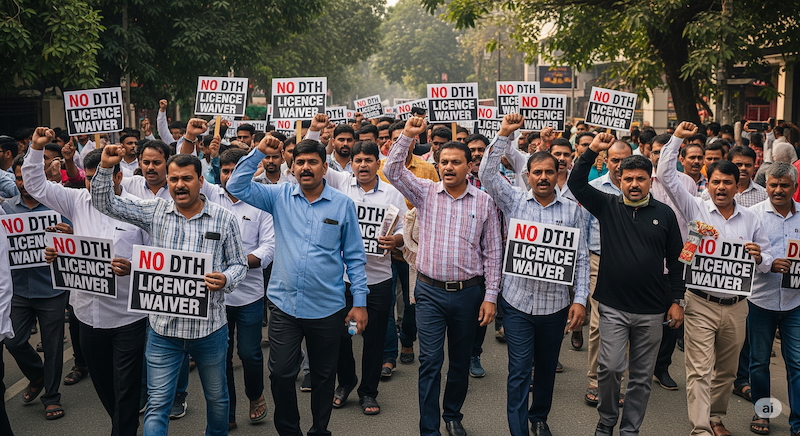
The Indian scenario is potentially exciting with a series of decisions taken by the Government to regulate the Indian DTH scene. But the initial excitement in Nov. 2000 has largely been transformed by a realistic look at the guidelines for DTH service in India.
The key features of the guidelines are:
* The total foreign investment cannot exceed 49 per cent.
* No broadcast or cable company can own more than 20 per cent.
* The applicant company will have to pay an entry fee of Rs 100 million, pay 10 per cent annual revenue and execute a bank guarantee of RS 400 million for the duration of the 10 years license.
* Violation of license conditions can include revocation of license and / or penalty of up to RS 500 million.
* The licensee will have to set up an Indian earth station in 12 months and provide access to various content providers on a non-discriminatory basis.
* The set top boxes required to receive the encrypted signals will have to be open standard boxes.
* The DTH license cannot be used for other modes of communication including voice fax, data Internet unless specific licenses for these value added services have been obtained from the competent authority.
On the face of it, the DTH regulations are quite in tune with media policy of the ruling alliance. However, there are many pitfalls in the policy some of which are outlined below.
1. A modest entry fee of RS 100 million and a bank guarantee of RS 400 million has been mandated with no restriction on the number of DTH operators in the country. However, the DTH operator will have to pass on 10 per cent of revenues as annual fees to the government. It is assumed that this is gross revenue without deduction of expenses and is not 10 per cent of net profit which would have been more equitable.
2. The period of license is for 10 years and non exclusive. However, there is no provision for automatic renewal of the license after 10 years based on performance of the DTH operator.
3. No broadcasters or cable television company is allowed to own more than 20 per cent of DTH. This has supposedly been done to prevent emergence of vertically integrated monopoly. This is despite the worldwide move towards convergence and even the provisions of the convergence bill!
4. The DTH operator shall have to follow the advertising and programme code of Doordarshan and maintain a video record for 90 days of advertisements and programmes. A DTH operator who does not own content will, like the present cable operators, be solely responsible for the implementation of advertising and programme code. No liability has been put on the content providers at all.
5. Apart from open architecture for STBs, the government has mandated that DTH operators should not discriminate between various channels wanting to get on the network. This is a welcome development as it will enable content providers to be available on all competing DTH platforms.
6. I&B Ministry will be the licensing authority until one is set up. There is no mention in this notification about the Broadcast Regulatory Authority as mandated by the Supreme Court in Cricket Association of Bengal Judgement in 1995.
7. The DTH operator is bound to carry all Prasar Bharati channels on most favourable terms offered to any other channel. No mention is made about the present requirements under the Cable Act to carry a minimum three Doordarshan channels on prime band, despite the fact that carriage of all Prasar Bharati channels may not be commercially desirable. Of course, it will not be easy to convince any government to leave it to the DTH operator to carry only specific Prasar Bharati channels.
8. The DTH operator is allowed to carry value added services such as fax, voice or broadband as long as it gets clearance from the right competent authority. While the government is willing to allow data, fax and broadband service from the DTH operator, the stipulations of getting clearance from the right competent authority without creating a single window approach will in effect delay provision of value added services by the DTH operator and is against the provisions of the convergence bill planned to be introduced in Parliament in May 2001.
The only positive announcement after the government notification so far has been from Videsh Sanchar Nigam Limited which plans to set up a neutral (?) DTH facility using its large number of earth stations to give opportunity to broadcasters wishing to join a common platform.
Europestar has also announced that it is willing to take up an appropriate stake within the 20 per cent guidelines in any consortium of DTH players and would contribute its satellite capacity of 30 transponders with eight dedicated to India.
The Star India digital platform group President has been quoted in the last week to say that the DTH guidelines are ‘extremely stringent’ and the risks are much ‘higher’ than possible rewards. He has been quoted on a website (indiantelevision.com) as stating that Star is preparing a business plan and will decide upon the entry into the DTH arena only if it is “commercially viable”. This is to be contrasted against an interview given by the Star CEO (Peter Mukerjea) in November 2000 that Star would like to launch DTH and then justify its case to the Government.
Another interesting development which has taken place on 26th March, 2001 is the launch of a new Telugu Channel titled Manna Television on a Ku-Band satellite transponder of ISRO. This will commence telecast on a pilot basis of long distance education programmes and help State Government departments of Andhra Pradesh with weather and seasonal updates.
In November 2000, when the government announced plans to allow DTH in India, there was a general view expressed by the media pundits that the 35 million strong cable television industry in India would be seriously affected. The cable television industry on the other hand has been gearing up for value added and digital cable services for the past two years and installing fiber optic at the trunk lines with a view to be able to provide cost effective broadband and narrowband value added services to the Indian customers at a very cost effective price.
Many Indian MSOs have begun to supply cable modems to provide a dial free high bandwidth access to the Internet and also customise broadband content using interactive digital mode to give customer quality service at very little additional cost.
The broadband providers using cable platform are already providing on line news, movie trailors, music videos and teleshopping. In other words, the oncoming DTH revolution could well turn out to be a damp squib provided cable companies gear up for the challenges of the future.
On the other hand, in the US, the incremental growth in the television subscribers is much faster in the DTH mode than the cable mode. It is estimated that there are already approximately 15 million DTH homes in the US as compared to 60 million cable homes.
In the foreseeable future of the next five years, the total number of DTH homes in India will not exceed five million. But what if DTH companies were to provide all the new forms of value added services by obtaining the concerned licensing?
I believe that the DTH operator who has the economic capacity to obtain all the value added services licenses will probably build a new business model wherein as much as 25 per cent of the revenues could flow from value added services.
An important aspect is the subscriber cost to avail of DTH services. The pizza sized dish and digital decoder will cost at least RS 20,000/- and the average subscriber fee will be a minimum of RS 2,500/- a month. This puts DTH out of reach of 90 per cent customers of cable television.
Further, if Indian manufacturers take on the challenge of fabricating set top boxes which are cheaper than the imported version then it is possible that DTH will be a commercially viable option in the near future.
In conclusion: Unless VSNL and Prasar Bharati combine with private content providers the launch of DTH network appears to be



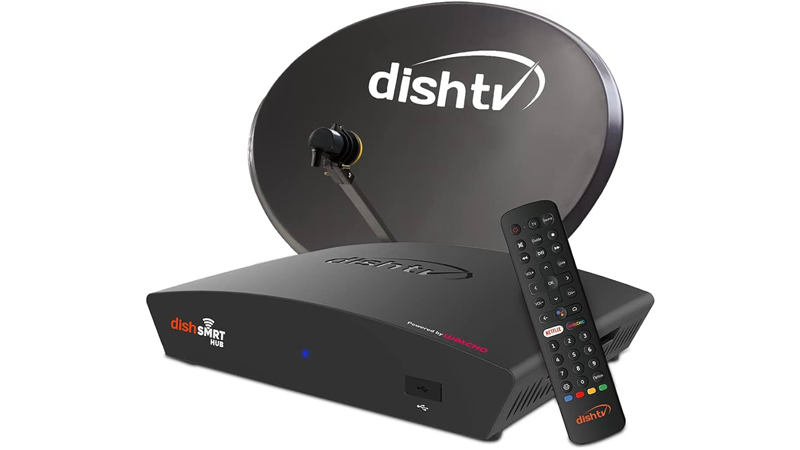
NOIDA: When the remote stops working, you don’t throw it away, you change the batteries. Dish TV is trying something similar. Faced with falling subscription revenues and a fast-shrinking DTH universe, India’s once-dominant satellite broadcaster is flipping channels, betting on smart TVs, OTT aggregation and a hybrid future even as the numbers flash red.
For the quarter ended 31 December, 2025, Dish TV India reported operating revenues of Rs 2,991 million, down 19.8 per cent year-on-year from Rs 3,730 million. Subscription revenues, still the backbone of the business, fell sharply by 32.2 per cent to Rs 2,245 million, reflecting industry-wide cord-cutting and persistent churn. The pain shows up clearly below the line.
Ebitda swung to a loss of Rs 415 million, compared with a profit of Rs 1,227 million a year earlier. Total expenditure climbed 36.1 per cent to Rs 3,406 million, pushing costs to nearly 114 per cent of operating revenues. The quarter closed with a loss before tax of Rs 2,762 million, weighed down further by exceptional items of Rs 700 million. Yet the company insists this is not a business stuck buffering, but one deliberately loading a new format.
Dish TV is repositioning itself from a pure DTH operator into what it calls a connected-home entertainment platform, stitching together live television, OTT apps and smart devices. The centrepiece of that strategy is the nationwide rollout of VZY smart TVs, offering a unified DTH-plus-OTT experience.
Amazon Prime Video has now been integrated across Dish TV’s ecosystem, including Watcho and VZY. Watcho, the company’s in-house OTT super app, has crossed millions of downloads and paid subscribers, aggregating more than 25 content apps.
Fliqs, its creator-driven content platform, is being pitched as a home for premium regional and international programming. Brand visibility has also been boosted through splashy partnerships with Bigg Boss Hindi and Bigg Boss Kannada: high-decibel bets in a crowded attention economy.
“Indian home entertainment is undergoing a structural shift,” said CEO and executive director Manoj Dobhal arguing that Dish TV’s hybrid model improves convenience while keeping customers within a single ecosystem. The revenue mix shows early signs of diversification, even if it is not yet compensating for falling subscriptions.
Marketing and promotional fees rose 27.3 per cent to Rs 399 million, while advertisement income, still small, nearly doubled to Rs 48 million. Other operating income surged 267.6 per cent to Rs 298 million, softening the overall revenue decline.
On costs, the company is tightening the screws. It has renegotiated transponder contracts, rationalised call-centre and general expenses, and improved asset discipline by boosting set-top box recovery beyond 30 days, reducing swap frequency and replacement capex.
New customer activations are being driven through a no-subsidy Rs 999 set-top box, a move management says materially improves unit economics and cash flow. Still, risks remain stubbornly in view. Churn continues to shadow the business, and scaling Watcho while balancing content spend will demand execution discipline.
Cost cuts, the company admits, must not erode service quality: a delicate act in a market where customer loyalty is already thin. For now, Dish TV’s numbers tell a story of strain.
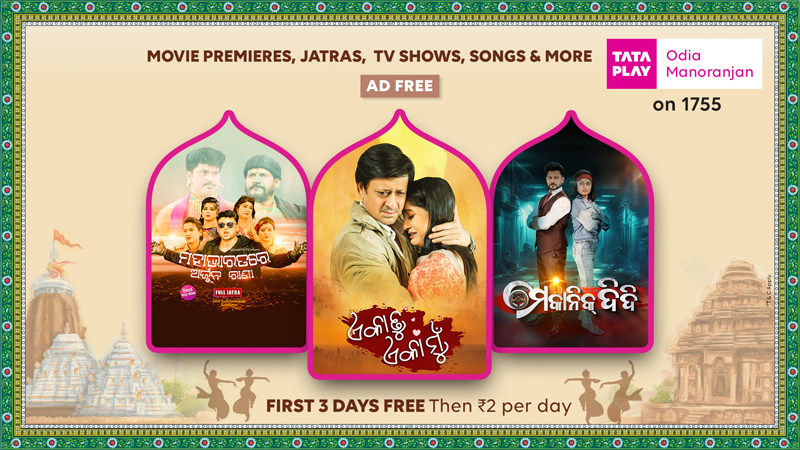
MUMBAI: Tata Play is doubling down on regional loyalty. India’s leading DTH player has launched Tata Play Odia Manoranjan, a new value-added service that corrals Odia entertainment into a single, ad-free destination, available on television and the Tata Play mobile app.
Powered by Sidharth TV, one of Odisha’s most popular Odia-language GECs, the platform serves up a hefty catalogue: over 180 movies, 100+ Jatras, around 20 television shows and a library of more than 12,000 songs spanning devotional, folk, film and non-film genres. From vintage favourites to contemporary titles, the mix is pitched squarely at Odia-speaking households, with particular pull in tier-3 and tier-4 markets.
Subscribers get 24×7, full-screen SD viewing without ad breaks on channel number 1755, with live TV and VOD access across screens. The price point is deliberately sharp: Rs 2 a day.
Pallavi Puri, chief commercial and content officer at Tata Play, framed the move as a bet on language and culture. “India’s strongest viewing loyalties are rooted in language and lived culture. Tata Play Odia Manoranjan brings together the many expressions of Odia entertainment—from films and Jatras to devotional programming and music—into one clearly defined destination. With this launch, Tata Play further elevates its regional content offering by giving Odia audiences a single, definitive home for their stories and traditions.”
For Sidharth TV Network, the partnership is about reach without compromise. Sitaram Agrawalla, owner and chairman, said: “For decades, Odia families have trusted our entertainment platforms for stories that feel like home, and for moments that bring us together. Tata Play Odia Manoranjan builds on this trust by placing a diverse range of Odia films, theatre, devotional music and shows into a single, accessible space. This collaboration isn’t just about wider distribution—it’s about honouring the preferences of Odia viewers with a seamless, ad-free viewing experience that reflects their language, culture and the way they choose to engage with content.”
The new service slots into Tata Play’s expanding portfolio of entertainment and infotainment platform services across genres including entertainment, kids, learning, regional and devotion, catering to all age groups.
In short: one language, one screen, zero ads—and a clear signal that regional is where the real viewing power lies.
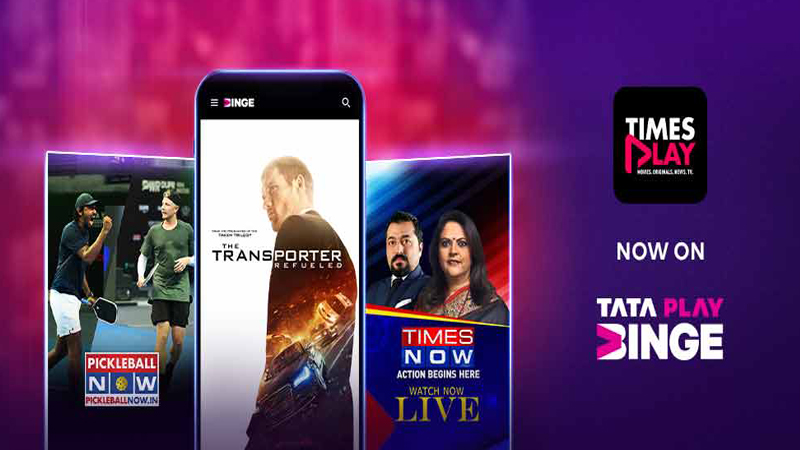
MUMBAI: If streaming had galaxies, Tata Play Binge just opened a wormhole. In its latest move to become India’s most sprawling entertainment universe, the platform has now folded Times Play, Times Network’s digital-first OTT service, into its all-in-one subscription bouquet bringing Hollywood hits, snackable shorts, live news, lifestyle, entertainment, Pickleball and 11 live TV channels under a single roof.
The new addition means subscribers no longer need to hop between apps in Olympic-level finger gymnastics, Binge now pulls Times Network’s entire digital catalogue into one screen, one login, one bill. And in the era of attention overload, that’s practically a public service.
Times Play brings with it a distinctive blend of premium Hollywood cinema, web series, short-format videos, and Times Network’s formidable news muscle. Viewers can flip seamlessly between Romedy Now, Movies Now, MNX, MN+, Zoom, Times Now, Times Now Navbharat, ET Now, ET Now Swadesh, and even Pickleball Now, mirroring the growing Indian appetite for niche sporting entertainment.
On the long-form front, hits like Reunion, India’s Story, True Story of Angeline Jolie, Orphan First Kill, The November Man, Barely Lethal, Southpaw, The Hurt Locker, Transporter Refueled, and The Holiday sit alongside Times Network factual and current-affairs staples including Frankly Speaking, Sawaal Public Ka, and News Ki Paathshaala.
Describing the partnership, Tata Play chief commercial and content officer Pallavi Puri, said the aim remained unchanged to make content discovery effortless and reduce the modern curse of app overload. She noted that integrating Times Play enriches Binge’s already deep catalogue with a broader mix of premium films, originals and news programming “without juggling multiple apps or subscriptions”.
Times Network echoed the sentiment, calling the collaboration a natural extension of its mission to deliver credible entertainment and journalism at scale. It emphasised Tata Play’s reach, reliability and reputation as a key driver in bringing Times Play’s digital catalogue to diverse Indian households.
With the addition of Times Play, Tata Play Binge now boasts 30 plus OTT platforms on a single interface, a list that includes Prime Video, JioHotstar, Zee5, Apple TV+, Lionsgate, SunNXT, Discovery+, BBC Player, Aha, Fancode, ShemarooMe, Hungama, ManoramaMax, Nammaflix, Tarang Plus, Travel XP, Animax, Fuse+, ShortsTV, Curiosity Stream, and DistroTV, among others.
Notably, Netflix remains available as part of combo packs for DTH subscribers, while Amazon Prime Video can be unlocked as an add-on for Binge users with a Tata Play DTH connection. And for large-screen loyalists, all 30 plus apps can be streamed via LG, Samsung and Android Smart TVs, the Tata Play Binge+ set-top box, Amazon FireTV Stick – Tata Play edition, or through TataPlayBinge.com.
The expansion comes on the heels of recent integrations, including WAVES by Prasar Bharati and BBC Player, reinforcing Tata Play Binge’s ambition to remain India’s most diverse, most unified, and most fuss-free entertainment destination.
With Times Play now in the mix, Binge isn’t just aggregating content, it’s quietly aggregating the future of how India watches.



MIB sets OTT accessibility rules, mandates captions and audio description

Boney Kapoor acquires remake rights of Tamil political satire Thalaivar Thambi Thalaimaiyil

Netflix India names Rekha Rane director of films and series marketing

Zabeen signs off from TV9 after shaping the network’s public voice

Dhawan steps up to bat for Delhi’s grassroots sports push

Orient Beverages pops the fizz with steady Q3 gains and rising profits

Cheekatilo shines in the dark with record debut on Prime Video

Swiggy Instamart’s GOV surges 103 per cent year on year to Rs 7,938 crore

These ’90s fashion trends are making a comeback in 2017
The final 6 ‘Game of Thrones’ episodes might feel like a full season
According to Dior Couture, this taboo fashion accessory is back
The old and New Edition cast comes together to perform
Phillies’ Aaron Altherr makes mind-boggling barehanded play

Kuku TV transforms India’s OTT space with vertical microdrama boom
MIB sets OTT accessibility rules, mandates captions and audio description
Boney Kapoor acquires remake rights of Tamil political satire Thalaivar Thambi Thalaimaiyil
Netflix India names Rekha Rane director of films and series marketing
Zabeen signs off from TV9 after shaping the network’s public voice
Dhawan steps up to bat for Delhi’s grassroots sports push
Orient Beverages pops the fizz with steady Q3 gains and rising profits
Cheekatilo shines in the dark with record debut on Prime Video
-
 e-commerce1 month ago
Swiggy Instamart’s GOV surges 103 per cent year on year to Rs 7,938 crore
-
iWorld1 year ago
Kuku TV transforms India’s OTT space with vertical microdrama boom
-
 News Headline1 year ago
TRAI puts a ‘stop’ to unsolicited calls and messages
-

 News Headline2 months ago
From selfies to big bucks, India’s influencer economy explodes in 2025
-
 Comedy2 years ago
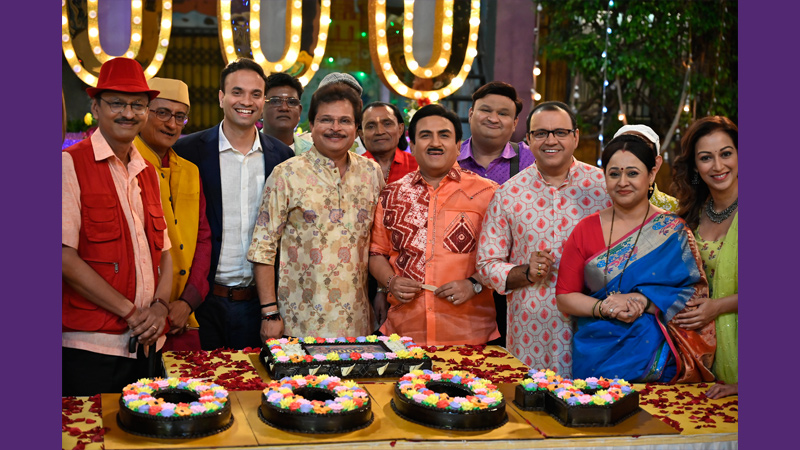
Taarak Mehta Ka Ooltah Chashmah celebrates 4,000 episodes
-
 MAM2 years ago
OpenAI joins C2PA steering committee
-
 News Headline1 year ago
Abhishek Bachchan joins as co-owner of European T20 Premier League
-
 News Headline2 years ago
Odisha to host Ultimate Kho Kho Season 2 from December 24


