
Hindi
Cut to the craft as Hirani and Joshi reveal how films truly take shape

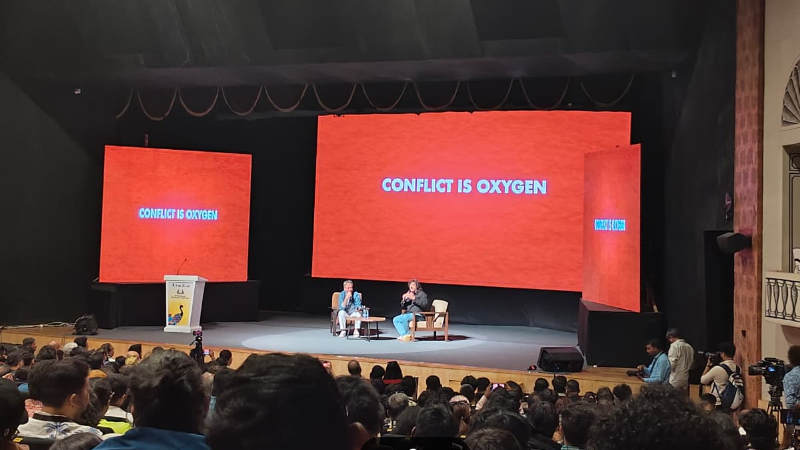
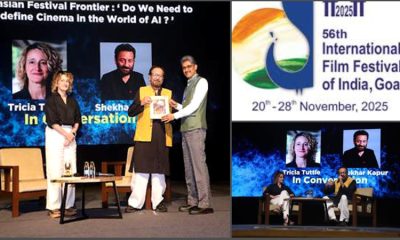
MUMBAI: Goa may be known for sunsets and susegad, but at the 56th International Film Festival of India (IFFI), the brightest moment arrived not from a red-carpet premiere but from a classroom. Filmmaker Rajkumar Hirani and screenwriter-director Abhijat Joshi took the stage for a masterclass titled Film is Made on Two Tables, and for two hours, the auditorium morphed into a crash course on storytelling, rhythm and the secret life of cinema. No drama, no theatrics, just two craftsmen unpacking decades of craft with the clarity of a lens pointed at truth.
Hirani opened with a deceptively simple hammer-blow: “A film begins only when a character wants something. If there is no want, the audience also doesn’t want it.” In his world, a story is not about plot but propulsion. Munna Bhai wants to become a doctor. PK wants to go home. Rancho wants real education. Virus wants to always be right. Chatur wants to win at any cost. These wants aren’t decorative; they collide like tectonic plates, creating the earthquakes that make stories breathe.
Joshi followed with what became the philosophical spine of the masterclass: “Conflict is oxygen.” In life, conflict is inconvenient. In cinema, it’s nourishment. And the conflicts that truly burn, he said, aren’t good versus evil, they’re clashing truths. He recalled Javed Akhtar explaining why Deewaar has such ferocious tension: every argument is unimpeachable, and the opposing argument is just as strong. “That argument exists somewhere in the universe,” Akhtar had said. “We just have to find it.”
From there, Hirani introduced the session’s core metaphor, the two tables where films are truly made. The first is the writing table, where worlds are conceived, character arcs sharpened and emotional engines built. The second is the editing table, where the film acquires rhythm, balance and breath. Writing is the birth. Editing is the heartbeat.
For Hirani, editing is practically spiritual. “Editing is like meditation for me,” he said, not surprising from a man who famously edits for hours, oblivious to clocks. Joshi, who has worked with the legendary Walter Murch, went further: “He is the greatest editor in the history of cinema.” A statement that earned a wave of applause, partly for its sincerity and partly for how plainly it explained the coherence of the Hirani–Joshi universe.
One of the sharpest sections of the session focused on exposition, the graveyard where many scripts go to die. Joshi unpacked the Billy Wilder rule: exposition should feel like the whistle of a pressure cooker tension first, information later. Hirani illustrated it with the opening of 3 Idiots. In the first draft, Farhan simply got a phone call. Functional but flat. Shifting the scene to an aeroplane instantly transformed it into a moment of panic, urgency and hilarity revealing how much Rancho means to Farhan without spelling anything out.
Then came a masterclass in turning exposition into theatre. Hirani explained the scene in Lage Raho Munna Bhai where Munna discovers Gandhiji is a hallucination. This could have been a dull psychological reveal. Instead, they added a countdown: “I’ll prove in 60 seconds that you’re hallucinating.” The audience leans in, the truth detonates, and exposition becomes revelation.
Theme, Joshi stressed, is the soul of a film. “The moment you find your theme, the film gains its soul.” He explained how Munna Bhai MBBS is fundamentally about compassion in healthcare, 3 Idiots about chasing excellence, and PK about questioning faith. To illustrate how theme can change a filmmaker’s life, he shared a deeply emotional memory: two decades ago, he sent Hirani an early scene that didn’t work. Hirani was kind but unimpressed. The second scene Joshi sent, rooted in a story about a French freedom fighter shouting “Bullets cannot kill ideas!”, moved Hirani so much that he called Joshi in Ohio, a call Joshi described as “the most important moment of my life.”
The duo also revealed how deeply their writing draws from real-life anecdotes that linger in memory. An electric shock device installed in an Ahmedabad neighbourhood to prevent public urination became a memorable gag in 3 Idiots. A woman scratching her back with a rolling pin while making rotis inspired the unforgettable black-and-white comedy sequence. A line overheard by Salim Khan, “If I had a match, I’d burn the world” became Jackie Shroff’s introduction in one of his films. For Hirani and Joshi, if a story stays in memory for 30 years, it deserves to be in a film.
Then came the sequence that had editors in the room grinning, the making of Pal Pal in PK. The song was never shot. Not even storyboarded. Hirani assembled it entirely from unused footage, filmed Vidya Balan’s lip-sync in two hours, and stitched together a full-length song in the editing room. It was, as Joshi put it, “a miracle unfolding before my eyes.”
Hirani also revealed how the song Bande Mein Tha Dum in Lage Raho Munna Bhai became the spiritual glue of the film. Because Gandhiji could not appear in every scene, the song became his presence, a thematic ghost haunting the narrative. This was an editing-room decision, not a writing-room one. Proof, again, that the second table is where the film truly matures.
Despite all the craft talk, the masterclass often drifted into tenderness. Joshi spoke about the generosity behind their collaboration. Hirani spoke about their hunger to improve drafts. Both spoke about criticism as a gift. “If someone points out a flaw and we agree, that’s gold. We get greedy for that,” Hirani said, a rare humility in an industry that often resists rewrites.
By the time the session wrapped, the audience had witnessed something rare: not just lessons in writing and editing, but a window into two minds who believe cinema is not made on set, but in the spaces where ideas are shaped and reshaped between the writing table and the editing table. Everything else, cameras, chaos, glamour is only the world in motion. The film, the real film, is created in the quiet hum of these two desks.








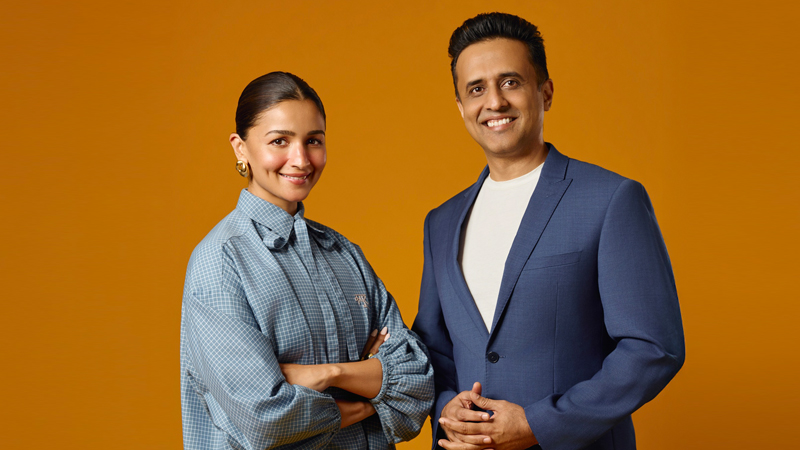
MUMBAI: Prime Video has found its next feel-good original, and it comes with a healthy dose of heart, humour and youthful chaos. The streaming platform has announced Don’t Be Shy, a coming-of-age romantic comedy produced by Alia Bhatt and Shaheen Bhatt under their banner, Eternal Sunshine Productions.
Written and directed by Sreeti Mukerji, the film follows Shyamili ‘Shy’ Das, a 20-year-old who believes her life is neatly mapped out until it suddenly is not. What follows is a relatable tumble through friendship, love and the awkward art of growing up, when plans unravel and certainty gives way to self-discovery.
The project is co-produced by Grishma Shah and Vikesh Bhutani, with music composed by Ram Sampath, adding to the film’s promise of warmth and energy. Prime Video describes the story as light-hearted yet emotionally grounded, with a strong female-led narrative at its core.
Prime Video India director and head of originals Nikhil Madhok, said the platform was delighted to collaborate with Eternal Sunshine on a story that blends sincerity with humour. He noted that the film’s fresh writing, earnest characters and infectious music make it an easy, engaging watch for audiences well beyond its young adult setting.
For Alia Bhatt, Don’t Be Shy reflects the kind of storytelling Eternal Sunshine set out to champion. She said the film stood out for its honesty, its coming-of-age perspective and Mukerji’s passion, which she felt was deeply woven into the narrative. Bhatt also praised Prime Video for supporting distinctive voices and bold creative choices.
With its breezy tone and familiar emotional beats, Don’t Be Shy aims to charm viewers whether they are rom-com regulars or simply in the mood for a warm, unpretentious story about life refusing to stick to the plan.

MUMBAI: Tips Films struggled to find its rhythm in the final quarter of 2025, as a spike in production costs and a new regulatory burden pushed the Mumbai-based outfit deeper into the red. According to results released on Tuesday, January 27, 2026, the company posted a net loss of Rs 286.87 lakh for the quarter ended 31 December, despite a modest bump in total income to Rs 456.29 lakh.
The bottom line was hit by the introduction of India’s New Labour Codes, which forced a Rs 37.37 lakh catch-up payment for employee benefits. Production costs also proved a heavy lift, gobbling up Rs 318.48 lakh during the period. On a nine-month basis, the picture looks even bleaker; the company has racked up losses of Rs 1,237.61 lakh, a sharp reversal from the Rs 1,269.17 lakh profit it managed in the same period last year.
Investors will be looking for a script change as the company enters the final stretch of the financial year, with basic earnings per share now languishing at minus Rs 6.64. For now, Tips Films remains a single-segment player, pinning its hopes entirely on the volatile world of film production and distribution.
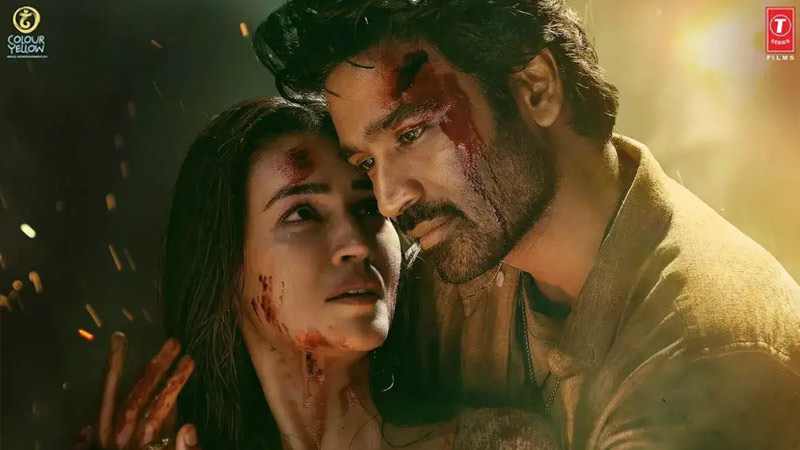
MUMBAI: Eros International Media Ltd has moved the Bombay high court against filmmaker Aanand L Rai and his production banner Colour Yellow Media Entertainment LLP, alleging unauthorised exploitation of the intellectual property of its 2013 blockbuster Raanjhanaa in the promotion and release of the 2025 film Tere Ishk Mein.
The studio is seeking damages of Rs 84 crore, claiming losses arising from what it describes as unlawful capitalisation on Raanjhanaa’s goodwill. According to a report in The Times of India, Eros has filed a commercial intellectual property suit along with an interim application, alleging trademark infringement, copyright infringement and passing off.
Eros contends that Tere Ishk Mein was deliberately marketed as a “spiritual sequel” to Raanjhanaa without authorisation. The suit names Aanand L Rai, Colour Yellow Media Entertainment LLP and Colour Yellow Productions, along with Super Cassettes Industries (T-Series), writer Himanshu Sharma and Netflix Entertainment Services India LLP, turning the dispute into a multi-party legal battle.
In its filing, Eros asserts that it is the producer and exclusive owner of all intellectual property rights in Raanjhanaa, including copyright, registered trademark rights, character rights in Kundan Shankar and Murari, and remake, prequel and sequel rights. The company alleges these rights were exploited while promoting Tere Ishk Mein, which released theatrically on November 28, 2025.
The legal action was triggered by a teaser released online in July 2025, which Eros claims used phrases such as “From the world of Raanjhanaa” and hashtags including #WorldOfRaanjhanaa. The interim application further alleges unauthorised use of footage, background score and music from Raanjhanaa, despite Eros no longer holding the film’s music rights.
Directed by Aanand L Rai, Tere Ishk Mein stars Dhanush, Kriti Sanon, Priyanshu Painyuli, Prakash Raj and Tota Roy Chowdhury. Neither Eros nor the defendants have issued an official statement so far.

Netflix celebrates a decade in India with Shah Rukh Khan-narrated tribute film

Delhivery chairman Deepak Kapoor, independent director Saugata Gupta quit board

Meta appoints Anuvrat Rao as APAC head of commerce partnerships

Brnd.me enters Europe as haircare brands power global expansion

TechnoSport taps quick commerce with launch on Slikk’s 60-minute platform

Jitendra Singh joins Reliance Industries as senior vice president, special projects

Tinder brings real-world dating experiences to North East India

These ’90s fashion trends are making a comeback in 2017
The final 6 ‘Game of Thrones’ episodes might feel like a full season
According to Dior Couture, this taboo fashion accessory is back
The old and New Edition cast comes together to perform
Phillies’ Aaron Altherr makes mind-boggling barehanded play
Uber and Lyft are finally available in all of New York State
Disney’s live-action Aladdin finally finds its stars
Netflix celebrates a decade in India with Shah Rukh Khan-narrated tribute film
Delhivery chairman Deepak Kapoor, independent director Saugata Gupta quit board
Meta appoints Anuvrat Rao as APAC head of commerce partnerships
Brnd.me enters Europe as haircare brands power global expansion
TechnoSport taps quick commerce with launch on Slikk’s 60-minute platform
Jitendra Singh joins Reliance Industries as senior vice president, special projects
Tinder brings real-world dating experiences to North East India
-
 iWorld3 months ago
Tips Music turns up the heat with Tamil party anthem Mayangiren
-
 iWorld12 months ago
BSNL rings in a revival with Rs 4,969 crore revenue
-
 I&B Ministry3 months ago
India steps up fight against digital piracy
-
 MAM3 months ago
HoABL soars high with dazzling Nagpur sebut
-

 News Headline4 weeks ago
Preeti Sahni set to join TV9 Network in senior leadership role
-

 News Broadcasting5 days ago
Palki Sharma leaves Firstpost: Reports
-
 iWorld3 days ago
Netflix celebrates a decade in India with Shah Rukh Khan-narrated tribute film
-
 News Broadcasting6 months ago
Wion marks Independence Day with global showcase of India’s spirit