
Hindi
Critic in the Mix experts unpack clicks clout and cinema’s changing compass

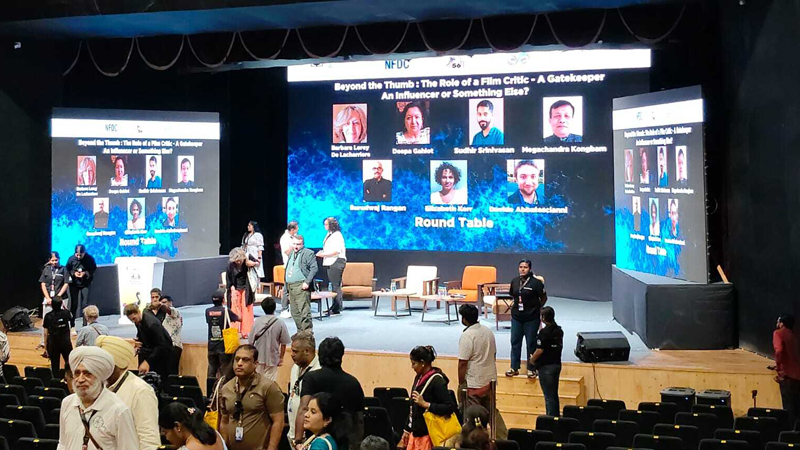
MUMBAI: If film criticism ever needed a reality check, Goa delivered one with the force of a director’s clapboard. At the 56th International Film Festival of India, a masterclass titled Beyond the Thumb – The Role of a Film Critic: A Gate Keeper, An Influencer or Something Else? turned into a sharp, spirited dissection of what it means to judge films in an era where everyone with a phone camera believes they’ve earned the right to declare something “the best ever” or “WTF”.
The session brought together Barbara Lorey de Lacharrière, Deepa Gahlot, Meghachandra Kongbam, Elizabeth Kerr, Baradwaj Rangan and Sudhir Srinivasan, with Davide Abbatescianni moderating, a line-up that offered more nuance than any star-rating system can handle.
Meghachandra Kongbam began by stressing the need to build appreciation, not noise. “Everyone is a critic now,” he noted, observing how unfiltered commentary often masquerades as informed judgement. He argued that workshops and education must become central to Indian film discourse because without understanding the language of cinema, the loudest voices risk drowning out the most meaningful ones.
From there, Baradwaj Rangan set the conversation ablaze with a subject few critics willingly tackle branding. In India, he said, employability often depends on the voice you’ve built and the trust you’ve earned. Like television anchors who draw followings not just for news, but personality, critics too accrue an identity over time. And that need not be a dirty word. “If your voice remains consistent,” he said, “and your criticism honest, the brand that forms around you is simply a by-product not a compromise.”
Sudhir Srinivasan agreed, arguing that identity isn’t vanity; it’s circulation. “Big organisations have machinery,” he said. “Individuals only have their voice.” And with that voice, he added, comes the responsibility of provoking thought rather than smothering it. For him, the ideal critic unsettles complacency not by imposing taste, but by sparking a dialogue in the reader’s mind.
When the conversation shifted to the generational churn in film criticism, Rangan was blunt: the fundamentals haven’t changed. Most serious critics still assess the same thing whether the film achieves what it sets out to do. But the content ecosystem around them has mutated wildly. Sensationalist thumbnails, exaggerated titles, and hyperbolic instant reactions have replaced measured reflection. “Everything is hysteria,” he said, adding that younger audiences often engage not with the review itself but with their own imagined version of it. The space for disagreement has shrunk; the appetite for argument has grown.
Elizabeth Kerr took the baton with humour and clarity. Transparency, she argued, is the critic’s North Star. Not objectivity because that does not exist but openness about one’s own perspective. To her, the most valuable review is one that reveals not just what the critic sees in the film, but where the critic stands while seeing it. Whether it is a queer romance from Hong Kong or a village drama from India, the critic’s task is not to mirror identity but to understand universality. “You don’t have to be those characters,” she said. “You just have to be open enough for the film to speak to you.”
Deepa Gahlot echoed this, adding that every film good or bad contains something worth noticing. The artistry of even a flawed work deserves acknowledgement. The role of the critic, she insisted, is not to moralise, nor to decide whether a film should exist, nor to judge its “usefulness”. Instead, it is to examine how well it expresses what it intends to. Violence, for instance, cannot be condemned in a vacuum; in Kill Bill, inventiveness is the point. The critic’s job is to evaluate craftsmanship, not to act as a cultural gatekeeper guarding society’s moral code.
Srinivasan returned to this theme with a warning against monocular criticism, especially criticism shaped solely through ideological lenses. He noted that films are increasingly being dismissed for a single “wrong” element, while their technical, emotional, or structural achievements are ignored. Specialists who write from feminist, caste, political or sociological perspectives play a vital role, he clarified but when such lenses dominate all discourse, they risk reducing cinema to a single checkbox.
Rangan, drawing from years of navigating audiences who demand a yes/no verdict, emphasised what he calls “subjective objectivity,” the attempt to root one’s personal taste within a rational framework. Ultimately, he said, readers must find their tribe: critics who watch films the way they do, who share their cinematic instincts. “This is a subjective profession,” he reminded. “Find the voices that resonate with your view of cinema.”
Barbara Lorey de Lacharrière’s reflections offered a gentle counterpoint. Critics, she said, are not arbiters but interpreters conduits between filmmaker and audience. What matters is sincerity: the filmmaker’s sincerity in telling a story, and the critic’s sincerity in receiving and reflecting it. A critic may dislike a film, she reminded the room, but they must always try to understand the desire that created it.
The masterclass closed the way great conversations do not with answers, but with apertures. No one, it turned out, believed in the old labels anymore. The critic is not a gatekeeper, not merely an influencer, and certainly not a subscriber-counting entertainer. Instead, as the panel collectively shaped it, the critic is a thinker, a translator, an irritant, a companion, a challenger, and sometimes, simply, a mirror held up to the cinema and its moment.
In an age where the loudest thumb rules the algorithm, this reminder felt like a breath of fresh air: criticism is not about noise, but nuance. And nuance, as Goa discovered, still has an audience.











MUMBAI: Prime Video has found its next feel-good original, and it comes with a healthy dose of heart, humour and youthful chaos. The streaming platform has announced Don’t Be Shy, a coming-of-age romantic comedy produced by Alia Bhatt and Shaheen Bhatt under their banner, Eternal Sunshine Productions.
Written and directed by Sreeti Mukerji, the film follows Shyamili ‘Shy’ Das, a 20-year-old who believes her life is neatly mapped out until it suddenly is not. What follows is a relatable tumble through friendship, love and the awkward art of growing up, when plans unravel and certainty gives way to self-discovery.
The project is co-produced by Grishma Shah and Vikesh Bhutani, with music composed by Ram Sampath, adding to the film’s promise of warmth and energy. Prime Video describes the story as light-hearted yet emotionally grounded, with a strong female-led narrative at its core.
Prime Video India director and head of originals Nikhil Madhok, said the platform was delighted to collaborate with Eternal Sunshine on a story that blends sincerity with humour. He noted that the film’s fresh writing, earnest characters and infectious music make it an easy, engaging watch for audiences well beyond its young adult setting.
For Alia Bhatt, Don’t Be Shy reflects the kind of storytelling Eternal Sunshine set out to champion. She said the film stood out for its honesty, its coming-of-age perspective and Mukerji’s passion, which she felt was deeply woven into the narrative. Bhatt also praised Prime Video for supporting distinctive voices and bold creative choices.
With its breezy tone and familiar emotional beats, Don’t Be Shy aims to charm viewers whether they are rom-com regulars or simply in the mood for a warm, unpretentious story about life refusing to stick to the plan.

MUMBAI: Tips Films struggled to find its rhythm in the final quarter of 2025, as a spike in production costs and a new regulatory burden pushed the Mumbai-based outfit deeper into the red. According to results released on Tuesday, January 27, 2026, the company posted a net loss of Rs 286.87 lakh for the quarter ended 31 December, despite a modest bump in total income to Rs 456.29 lakh.
The bottom line was hit by the introduction of India’s New Labour Codes, which forced a Rs 37.37 lakh catch-up payment for employee benefits. Production costs also proved a heavy lift, gobbling up Rs 318.48 lakh during the period. On a nine-month basis, the picture looks even bleaker; the company has racked up losses of Rs 1,237.61 lakh, a sharp reversal from the Rs 1,269.17 lakh profit it managed in the same period last year.
Investors will be looking for a script change as the company enters the final stretch of the financial year, with basic earnings per share now languishing at minus Rs 6.64. For now, Tips Films remains a single-segment player, pinning its hopes entirely on the volatile world of film production and distribution.
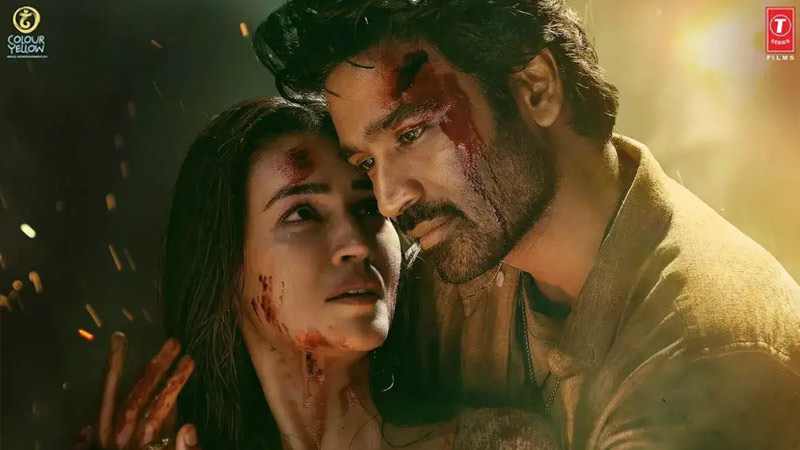
MUMBAI: Eros International Media Ltd has moved the Bombay high court against filmmaker Aanand L Rai and his production banner Colour Yellow Media Entertainment LLP, alleging unauthorised exploitation of the intellectual property of its 2013 blockbuster Raanjhanaa in the promotion and release of the 2025 film Tere Ishk Mein.
The studio is seeking damages of Rs 84 crore, claiming losses arising from what it describes as unlawful capitalisation on Raanjhanaa’s goodwill. According to a report in The Times of India, Eros has filed a commercial intellectual property suit along with an interim application, alleging trademark infringement, copyright infringement and passing off.
Eros contends that Tere Ishk Mein was deliberately marketed as a “spiritual sequel” to Raanjhanaa without authorisation. The suit names Aanand L Rai, Colour Yellow Media Entertainment LLP and Colour Yellow Productions, along with Super Cassettes Industries (T-Series), writer Himanshu Sharma and Netflix Entertainment Services India LLP, turning the dispute into a multi-party legal battle.
In its filing, Eros asserts that it is the producer and exclusive owner of all intellectual property rights in Raanjhanaa, including copyright, registered trademark rights, character rights in Kundan Shankar and Murari, and remake, prequel and sequel rights. The company alleges these rights were exploited while promoting Tere Ishk Mein, which released theatrically on November 28, 2025.
The legal action was triggered by a teaser released online in July 2025, which Eros claims used phrases such as “From the world of Raanjhanaa” and hashtags including #WorldOfRaanjhanaa. The interim application further alleges unauthorised use of footage, background score and music from Raanjhanaa, despite Eros no longer holding the film’s music rights.
Directed by Aanand L Rai, Tere Ishk Mein stars Dhanush, Kriti Sanon, Priyanshu Painyuli, Prakash Raj and Tota Roy Chowdhury. Neither Eros nor the defendants have issued an official statement so far.

Netflix celebrates a decade in India with Shah Rukh Khan-narrated tribute film

Delhivery chairman Deepak Kapoor, independent director Saugata Gupta quit board

Meta appoints Anuvrat Rao as APAC head of commerce partnerships

Brnd.me enters Europe as haircare brands power global expansion

TechnoSport taps quick commerce with launch on Slikk’s 60-minute platform

Jitendra Singh joins Reliance Industries as senior vice president, special projects

Tinder brings real-world dating experiences to North East India

These ’90s fashion trends are making a comeback in 2017
The final 6 ‘Game of Thrones’ episodes might feel like a full season
According to Dior Couture, this taboo fashion accessory is back
The old and New Edition cast comes together to perform
Phillies’ Aaron Altherr makes mind-boggling barehanded play
Uber and Lyft are finally available in all of New York State
Disney’s live-action Aladdin finally finds its stars
Netflix celebrates a decade in India with Shah Rukh Khan-narrated tribute film
Delhivery chairman Deepak Kapoor, independent director Saugata Gupta quit board
Meta appoints Anuvrat Rao as APAC head of commerce partnerships
Brnd.me enters Europe as haircare brands power global expansion
TechnoSport taps quick commerce with launch on Slikk’s 60-minute platform
Jitendra Singh joins Reliance Industries as senior vice president, special projects
Tinder brings real-world dating experiences to North East India
-
 iWorld3 months ago
Tips Music turns up the heat with Tamil party anthem Mayangiren
-
 iWorld12 months ago
BSNL rings in a revival with Rs 4,969 crore revenue
-
 I&B Ministry3 months ago
India steps up fight against digital piracy
-
 MAM3 months ago
HoABL soars high with dazzling Nagpur sebut
-

 MAM2 months ago
Best Lightweight Sunscreens for Daily Use in India
-

 MAM3 months ago
Kapil Sethi joins Network18 as head of technology
-

 MAM2 months ago
Radio one’s renaissance man gets bigger brief
-

 eNews2 months ago
Luma AI’s Ray3 Modify brings actors and AI into perfect sync