
Cable TV
Conditional access gets the thumbs up in indiantelevision.com poll

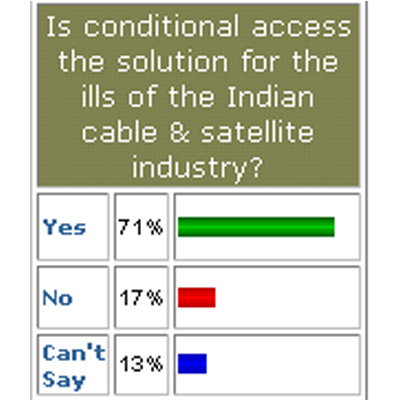
The government seems to have the mandate of the people in the matter of conditional access.
The latest indiantelevision.com poll that queried if conditional access is the solution for the ills facing the Indian cable and satellite industry, had a whopping 71 per cent endorsing CAS. Those who answered in the negative were a mere 17 per cent, while 13 per cent were unable to decide either way.
Information and broadcasting minister Sushma Swaraj does seem to be inclined to push in conditional access, a move that is likely to ring in some cheer for the cable industry. The broadcaster community has not been quite so enthusiastic though .

Star Group CEO James Murdoch, in Mumbai last month, made no bones about his displeasure with the cable op fraternity, which he blamed for the mess the industry is in. According to Murdoch, the whole call by the cable industry for CAS systems to be introduced was no more than a delaying tactics was reacting to what was potentially a major threat to his business interests in India. The government task force’s report on the introduction of conditional access has not been too helpful to the broadcaster either.
Among other recommendations, the report stipulates that CAS should be mandated under the Cable Television Networks (Regulations) Act, 1995, that a set top box be required only for pay channels (premium tier) while FTA channels continue to be receivable by subscribers in the current mode. While the government does not intend to interfere in the pricing of the pay channels or the pricing of set top boxes, leaving both to market forces, it would still retain the right to regulate the price of the ‘basic tier’ of FTA channels, the report says.
The report is also of the view that consumer interest needs to be protected by providing efficient and responsive service through a transparent and accurate billing and collection system to ensure that the revenue accruable to the government is determined in a fair manner. The report envisages that eventually the set top would permit migration by the subscriber across various delivery media – satellite, cable and terrestrial. The user will have the capability to migrate to various delivery media, simply by changing the “network interface module”.
However, even if legislation is to come in the next few months, implementation will take three to five years, according to the industry.
Although the poll result offers a clear inclination towards CAS, there is no doubt that there is a real problem on the cards for the general entertainment pay channels. This is because if the decision is left to consumers, the majority would go in for the basic tier. The resultant picking and choosing among channels will mean that the bottom will fall out of all that has been achieved in the last few years. The leader, Star naturally has the most to lose. However, all pay bouquets will take a hit, although niche channels need not be as worried by the introduction of CAS.
Some or all of these issues are likely to come up for debate at a seminar on CAS scheduled for next week in the capital. The seminar is being organised by the Swiss-based Consumer Action Network, according to Deepa Mistry of the PR firm Euro RSEG.
The government, meanwhile, has not really moved forward on this issue. Whether it is the political uncertainties prevailing that have virtually paralysed the government or whether it is due to some heavy duty behind the scenes lobbying is still to be ascertained.






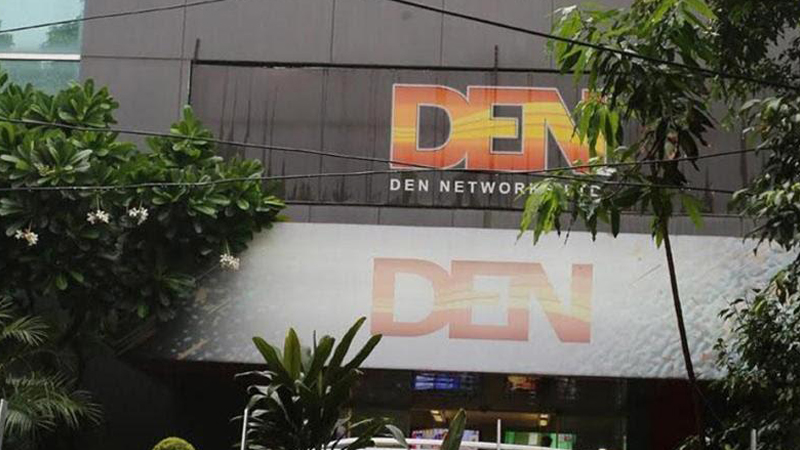
MUMBAI: When margins wobble, liquidity talks and in Q3 FY25-26, cash did most of the talking. Den Networks Limited closed the December quarter with consolidated revenue of Rs.251 crore, marginally higher than the previous quarter but down 4 per cent year-on-year, even as profitability stayed resilient on the back of strong cash reserves and disciplined cost control.
Subscription income softened to Rs.98 crore, slipping 3 per cent sequentially and 14 per cent from last year, while placement and marketing income offered some cheer, rising 15 per cent quarter-on-quarter to Rs.148 crore. Total costs climbed faster than revenue, up 7 per cent QoQ to Rs.238 crore, driven largely by higher content costs and operating expenses. As a result, EBITDA dropped sharply to Rs.13 crore from Rs.19 crore in Q2 and Rs.28 crore a year ago, pulling margins down to 5 per cent.
Yet, the bottom line refused to blink. Profit after tax stood at Rs.40 crore, up 15 per cent sequentially and only marginally lower than last year’s Rs.42 crore. A healthy Rs.57 crore in other income helped cushion operating pressure, keeping profit before tax at Rs.48 crore, broadly stable quarter-on-quarter despite the tougher cost environment.
The real headline-grabber, however, sits on the balance sheet. The company remains debt-free, with cash and cash equivalents swelling to Rs.3,279 crore as of December 31, 2025. Net worth rose to Rs.3,748 crore, while online collections accounted for 97 per cent of total receipts, underscoring strong cash discipline across operations, including subsidiaries.
In short, while Q3 showed signs of operating strain, the financial backbone remains solid. With zero gross debt, steady profits and a formidable cash war chest, the company enters the next quarter with flexibility firmly on its side proving that in uncertain markets, balance sheet strength can be the best growth strategy.
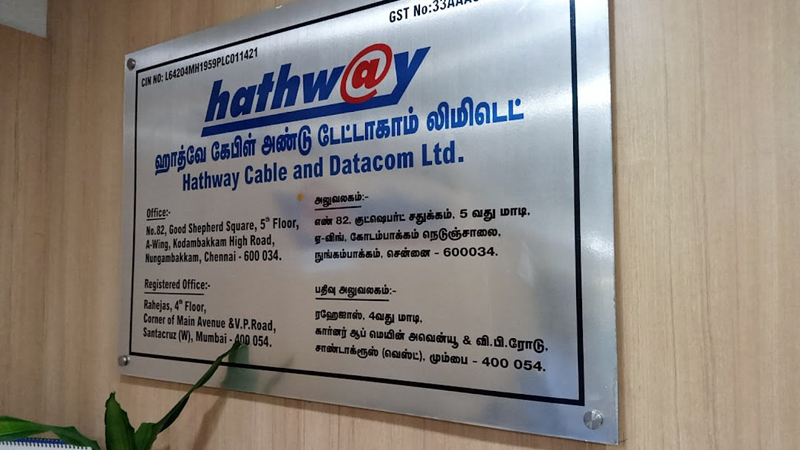
MUMBAI: In a quarter where staying connected mattered more than moving fast, Hathway Cable and Datacom kept its signal steady. The cable and broadband major reported a net profit of Rs 21.7 crore for the December 2025 quarter, marking a clear improvement from Rs 13.6 crore a year earlier, even as pressures persisted in parts of its operating portfolio.
For the quarter ended December 31, 2025, revenue from operations stood largely flat at Rs 536.6 crore, compared with Rs 511.2 crore in the same period last year. Including other income of Rs 21.1 crore, total income rose to Rs 557.7 crore, reflecting incremental gains despite a competitive media and connectivity landscape.
Profitability improved on the back of disciplined cost control and higher contribution from associates. Profit before tax increased to Rs 28.2 crore, up from Rs 19.1 crore in Q3 FY25, aided by Rs 3.9 crore in share of profit from associates and joint ventures. After tax, earnings for the quarter climbed nearly 60 per cent year-on-year.
Over the nine months ended December 31, 2025, Hathway reported a net profit of Rs 71 crore, compared with Rs 57.7 crore in the corresponding period last year. Total income for the nine months came in at Rs 1,677.3 crore, up from Rs 1,599.8 crore, while profit before tax rose to Rs 94.7 crore from Rs 84.2 crore.
A closer look at the segments shows a familiar split story. The cable television business remained under pressure, reporting a segment loss of Rs 11.4 crore for the quarter, though this narrowed sharply from the Rs 16.6 crore loss seen a year ago. In contrast, the broadband business returned to the black, delivering a modest but positive contribution of Rs 4.2 crore, helped by associate income. Dealing in securities continued to be a bright spot, generating Rs 14.7 crore in quarterly profits.
Costs stayed broadly contained. Pay channel costs, the single largest expense, rose to Rs 287.4 crore, while depreciation and amortisation stood at Rs 74 crore. Finance costs remained negligible at Rs 0.2 crore, keeping leverage risks in check.
Hathway’s earnings per share for the quarter improved to Rs 0.12, up from Rs 0.08 a year ago. The company maintained a strong balance sheet, with total assets of Rs 5,302.4 crore and total liabilities of Rs 848.9 crore as of December 31, 2025.
While structural challenges persist in the traditional cable business, the numbers suggest Hathway is slowly recalibrating its mix trimming losses where needed, leaning on associate income, and keeping the broadband engine ticking. For now, the company may not be racing ahead, but it is clearly staying tuned in to profitability.
MUMBAI: In telecom, even the strongest signals face interference and Tejas Networks Limited’s latest numbers show just how noisy the airwaves remain. The Tata Group-backed networking firm reported unaudited standalone revenue of Rs 305.72 crore for the quarter ended December 31, 2025, up sequentially from Rs 261.37 crore in the September quarter, but sharply lower compared with the Rs 2,642.05 crore clocked in the year-ago period. The topline recovery, however, was overshadowed by a pre-tax loss of Rs 303.20 crore, widening from a Rs 473.03 crore loss in the previous quarter, and reversing a Rs 211.06 crore profit reported in the December 2024 quarter.
After tax, the company posted a loss of Rs 196.89 crore for Q3 FY26, compared with a loss of Rs 307.17 crore in Q2 FY26 and a profit of Rs 165.42 crore a year earlier. For the nine months ended December 31, 2025, Tejas Networks reported revenue of Rs 769.02 crore and a loss after tax of Rs 697.97 crore, a sharp swing from a Rs 512.67 crore profit in the corresponding nine-month period last year. The numbers reflect a year marked by execution challenges rather than demand collapse.
Costs remained the dominant spoiler. Total expenses for the December quarter stood at Rs 616.50 crore, driven by elevated material costs, employee expenses and provisioning. The company also flagged several one-offs and adjustments: a Rs 9.85 crore provision linked to the implementation of new labour codes, ₹24.35 crore in warranty provisions, and reversals related to inventory obsolescence. Earlier quarters had already absorbed heavy charges tied to contract manufacturing losses, design changes and write-downs, the hangover from which continues to weigh on profitability.
Tejas reiterated that it operates as a single reportable segment focused on telecom and data networking products and services, offering little insulation from sector-wide volatility. While revenue momentum has stabilised sequentially, the contrast with the previous financial year remains stark. For context, the company closed FY25 with audited standalone revenue of Rs 8,915.73 crore and a profit after tax of Rs 450.66 crore, underscoring how sharply the operating environment has shifted in FY26.
The results were reviewed by the audit committee and approved by the board on January 9, 2026, but they leave investors with a familiar question: when does recovery turn structural rather than episodic? For now, Tejas Networks appears to be in reset mode, balancing execution clean-up with cost discipline. In a sector where margins can be as fragile as fibre strands, the next few quarters will matter as much as the signals the company sends to the market.



MIB sets OTT accessibility rules, mandates captions and audio description

Boney Kapoor acquires remake rights of Tamil political satire Thalaivar Thambi Thalaimaiyil

Netflix India names Rekha Rane director of films and series marketing

Zabeen signs off from TV9 after shaping the network’s public voice

Dhawan steps up to bat for Delhi’s grassroots sports push

Orient Beverages pops the fizz with steady Q3 gains and rising profits

Cheekatilo shines in the dark with record debut on Prime Video

Swiggy Instamart’s GOV surges 103 per cent year on year to Rs 7,938 crore

These ’90s fashion trends are making a comeback in 2017
The final 6 ‘Game of Thrones’ episodes might feel like a full season
According to Dior Couture, this taboo fashion accessory is back

ATN International brings ATN Bangla to Canada
The old and New Edition cast comes together to perform
Phillies’ Aaron Altherr makes mind-boggling barehanded play
MIB sets OTT accessibility rules, mandates captions and audio description
Boney Kapoor acquires remake rights of Tamil political satire Thalaivar Thambi Thalaimaiyil
Netflix India names Rekha Rane director of films and series marketing
Zabeen signs off from TV9 after shaping the network’s public voice
Dhawan steps up to bat for Delhi’s grassroots sports push
Orient Beverages pops the fizz with steady Q3 gains and rising profits
Cheekatilo shines in the dark with record debut on Prime Video
-
 e-commerce1 month ago
Swiggy Instamart’s GOV surges 103 per cent year on year to Rs 7,938 crore
-
 iWorld1 year ago
Kuku TV transforms India’s OTT space with vertical microdrama boom
-
 News Headline1 year ago
TRAI puts a ‘stop’ to unsolicited calls and messages
-

 News Headline2 months ago
From selfies to big bucks, India’s influencer economy explodes in 2025
-
 Comedy2 years ago
Taarak Mehta Ka Ooltah Chashmah celebrates 4,000 episodes
-
 MAM2 years ago
OpenAI joins C2PA steering committee
-
 News Headline2 years ago
Odisha to host Ultimate Kho Kho Season 2 from December 24
-
 News Headline1 year ago
Abhishek Bachchan joins as co-owner of European T20 Premier League


