
Cable TV
Cable operator’s arrest exposes India’s unencrypted piracy racket

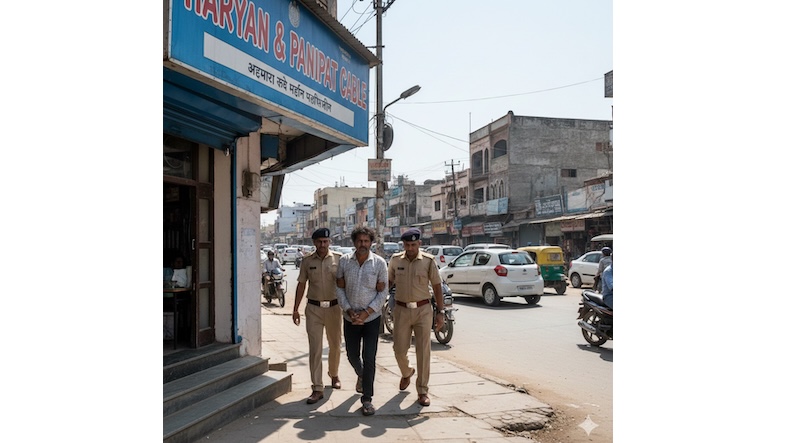
NEW DELHI: Haryana police have collared a cable operator in Sonipat for beaming unauthorised television signals—a bust that lays bare the booming black market in unencrypted feeds across northern India.
Anurag Narwal, known locally as Nura, was arrested in Gohana for illegally broadcasting JioStar channels without permission, according to storyboard18.com. The first information report charges him under the Copyright Act, 1957, for criminal infringement and possession of illicit broadcast kits.
Gohana police station inspector Arun Kumar confirmed the clamping of handcuffs on the guilty party. “The accused was arrested and was released on bail. We are investigating the matter further,” he said.
During a raid on premises in Kathmandi, Gohana, officers seized two optical transmitters and two optical receivers from the upper floor of a commercial shop. The gear had allegedly been used to distribute pirated signals.
The investigation has revealed that Narwal was sourcing the unauthorised feed from a multi-system operator in Panipat. Police are now probing whether other local cable operators were tapping into the same distribution chain—suggesting an unregulated network pumping unencrypted signals across multiple districts.
The absence of watermarking on these feeds has made tracing the source fiendishly difficult. Unlike encrypted satellite feeds or internet-delivered streams that carry forensic markers, unencrypted fibre-fed signals leave no traceable fingerprint once they are illicitly redistributed.
A senior executive at a leading entertainment broadcaster, speaking anonymously, called it a growing crisis. “The biggest loophole today is unencrypted distribution. When feeds are shared without watermarking, it becomes nearly impossible to trace who extracted it, who retransmitted it, and where the leak originated. It’s a blind spot that pirates have learned to exploit very effectively.”
The sector has poured money into anti-piracy technology, but broadcasters say these efforts crumble when multi-system operators and local cable operators run parallel networks outside the encrypted ecosystem. “We keep closing the gaps at our end, but unencrypted feeds undo everything,” another broadcaster said.
The ministry of information and broadcasting has launched a nationwide consultation with industry stakeholders to tighten anti-piracy mechanisms. In a notice dated 7 November 2025, the ministry said it is reviewing enforcement and monitoring frameworks to tackle piracy affecting films, television broadcasts and over-the-top content.
Industry players say the Haryana case makes the argument for mandatory watermarking unanswerable. Without it, they warn, illegal signal-sharing will keep multiplying—and crackdowns will remain a game of whack-a-mole that bleeds broadcasters and legitimate operators dry.
(The picture featured at the beginning of this report was generated by using gemini.ai and is representational in nature and in no way claims to be a picture of the accused or his or anyone else’s cable TV network by name. No offence to any one is intended)












MUMBAI: When margins wobble, liquidity talks and in Q3 FY25-26, cash did most of the talking. Den Networks Limited closed the December quarter with consolidated revenue of Rs.251 crore, marginally higher than the previous quarter but down 4 per cent year-on-year, even as profitability stayed resilient on the back of strong cash reserves and disciplined cost control.
Subscription income softened to Rs.98 crore, slipping 3 per cent sequentially and 14 per cent from last year, while placement and marketing income offered some cheer, rising 15 per cent quarter-on-quarter to Rs.148 crore. Total costs climbed faster than revenue, up 7 per cent QoQ to Rs.238 crore, driven largely by higher content costs and operating expenses. As a result, EBITDA dropped sharply to Rs.13 crore from Rs.19 crore in Q2 and Rs.28 crore a year ago, pulling margins down to 5 per cent.
Yet, the bottom line refused to blink. Profit after tax stood at Rs.40 crore, up 15 per cent sequentially and only marginally lower than last year’s Rs.42 crore. A healthy Rs.57 crore in other income helped cushion operating pressure, keeping profit before tax at Rs.48 crore, broadly stable quarter-on-quarter despite the tougher cost environment.
The real headline-grabber, however, sits on the balance sheet. The company remains debt-free, with cash and cash equivalents swelling to Rs.3,279 crore as of December 31, 2025. Net worth rose to Rs.3,748 crore, while online collections accounted for 97 per cent of total receipts, underscoring strong cash discipline across operations, including subsidiaries.
In short, while Q3 showed signs of operating strain, the financial backbone remains solid. With zero gross debt, steady profits and a formidable cash war chest, the company enters the next quarter with flexibility firmly on its side proving that in uncertain markets, balance sheet strength can be the best growth strategy.
MUMBAI: In a quarter where staying connected mattered more than moving fast, Hathway Cable and Datacom kept its signal steady. The cable and broadband major reported a net profit of Rs 21.7 crore for the December 2025 quarter, marking a clear improvement from Rs 13.6 crore a year earlier, even as pressures persisted in parts of its operating portfolio.
For the quarter ended December 31, 2025, revenue from operations stood largely flat at Rs 536.6 crore, compared with Rs 511.2 crore in the same period last year. Including other income of Rs 21.1 crore, total income rose to Rs 557.7 crore, reflecting incremental gains despite a competitive media and connectivity landscape.
Profitability improved on the back of disciplined cost control and higher contribution from associates. Profit before tax increased to Rs 28.2 crore, up from Rs 19.1 crore in Q3 FY25, aided by Rs 3.9 crore in share of profit from associates and joint ventures. After tax, earnings for the quarter climbed nearly 60 per cent year-on-year.
Over the nine months ended December 31, 2025, Hathway reported a net profit of Rs 71 crore, compared with Rs 57.7 crore in the corresponding period last year. Total income for the nine months came in at Rs 1,677.3 crore, up from Rs 1,599.8 crore, while profit before tax rose to Rs 94.7 crore from Rs 84.2 crore.
A closer look at the segments shows a familiar split story. The cable television business remained under pressure, reporting a segment loss of Rs 11.4 crore for the quarter, though this narrowed sharply from the Rs 16.6 crore loss seen a year ago. In contrast, the broadband business returned to the black, delivering a modest but positive contribution of Rs 4.2 crore, helped by associate income. Dealing in securities continued to be a bright spot, generating Rs 14.7 crore in quarterly profits.
Costs stayed broadly contained. Pay channel costs, the single largest expense, rose to Rs 287.4 crore, while depreciation and amortisation stood at Rs 74 crore. Finance costs remained negligible at Rs 0.2 crore, keeping leverage risks in check.
Hathway’s earnings per share for the quarter improved to Rs 0.12, up from Rs 0.08 a year ago. The company maintained a strong balance sheet, with total assets of Rs 5,302.4 crore and total liabilities of Rs 848.9 crore as of December 31, 2025.
While structural challenges persist in the traditional cable business, the numbers suggest Hathway is slowly recalibrating its mix trimming losses where needed, leaning on associate income, and keeping the broadband engine ticking. For now, the company may not be racing ahead, but it is clearly staying tuned in to profitability.
MUMBAI: In telecom, even the strongest signals face interference and Tejas Networks Limited’s latest numbers show just how noisy the airwaves remain. The Tata Group-backed networking firm reported unaudited standalone revenue of Rs 305.72 crore for the quarter ended December 31, 2025, up sequentially from Rs 261.37 crore in the September quarter, but sharply lower compared with the Rs 2,642.05 crore clocked in the year-ago period. The topline recovery, however, was overshadowed by a pre-tax loss of Rs 303.20 crore, widening from a Rs 473.03 crore loss in the previous quarter, and reversing a Rs 211.06 crore profit reported in the December 2024 quarter.
After tax, the company posted a loss of Rs 196.89 crore for Q3 FY26, compared with a loss of Rs 307.17 crore in Q2 FY26 and a profit of Rs 165.42 crore a year earlier. For the nine months ended December 31, 2025, Tejas Networks reported revenue of Rs 769.02 crore and a loss after tax of Rs 697.97 crore, a sharp swing from a Rs 512.67 crore profit in the corresponding nine-month period last year. The numbers reflect a year marked by execution challenges rather than demand collapse.
Costs remained the dominant spoiler. Total expenses for the December quarter stood at Rs 616.50 crore, driven by elevated material costs, employee expenses and provisioning. The company also flagged several one-offs and adjustments: a Rs 9.85 crore provision linked to the implementation of new labour codes, ₹24.35 crore in warranty provisions, and reversals related to inventory obsolescence. Earlier quarters had already absorbed heavy charges tied to contract manufacturing losses, design changes and write-downs, the hangover from which continues to weigh on profitability.
Tejas reiterated that it operates as a single reportable segment focused on telecom and data networking products and services, offering little insulation from sector-wide volatility. While revenue momentum has stabilised sequentially, the contrast with the previous financial year remains stark. For context, the company closed FY25 with audited standalone revenue of Rs 8,915.73 crore and a profit after tax of Rs 450.66 crore, underscoring how sharply the operating environment has shifted in FY26.
The results were reviewed by the audit committee and approved by the board on January 9, 2026, but they leave investors with a familiar question: when does recovery turn structural rather than episodic? For now, Tejas Networks appears to be in reset mode, balancing execution clean-up with cost discipline. In a sector where margins can be as fragile as fibre strands, the next few quarters will matter as much as the signals the company sends to the market.

Netflix celebrates a decade in India with Shah Rukh Khan-narrated tribute film

Delhivery chairman Deepak Kapoor, independent director Saugata Gupta quit board

Meta appoints Anuvrat Rao as APAC head of commerce partnerships

Brnd.me enters Europe as haircare brands power global expansion

TechnoSport taps quick commerce with launch on Slikk’s 60-minute platform

Jitendra Singh joins Reliance Industries as senior vice president, special projects

Tinder brings real-world dating experiences to North East India

These ’90s fashion trends are making a comeback in 2017
The final 6 ‘Game of Thrones’ episodes might feel like a full season
According to Dior Couture, this taboo fashion accessory is back
The old and New Edition cast comes together to perform
Phillies’ Aaron Altherr makes mind-boggling barehanded play
Uber and Lyft are finally available in all of New York State
Disney’s live-action Aladdin finally finds its stars
Netflix celebrates a decade in India with Shah Rukh Khan-narrated tribute film
Delhivery chairman Deepak Kapoor, independent director Saugata Gupta quit board
Meta appoints Anuvrat Rao as APAC head of commerce partnerships
Brnd.me enters Europe as haircare brands power global expansion
TechnoSport taps quick commerce with launch on Slikk’s 60-minute platform
Jitendra Singh joins Reliance Industries as senior vice president, special projects
Tinder brings real-world dating experiences to North East India
-
 iWorld3 months ago
Tips Music turns up the heat with Tamil party anthem Mayangiren
-
 iWorld12 months ago
BSNL rings in a revival with Rs 4,969 crore revenue
-
 I&B Ministry3 months ago
India steps up fight against digital piracy
-
 MAM3 months ago
HoABL soars high with dazzling Nagpur sebut
-
 News Broadcasting6 months ago
Wion marks Independence Day with global showcase of India’s spirit
-
 iWorld2 days ago
Netflix celebrates a decade in India with Shah Rukh Khan-narrated tribute film
-
 iWorld3 months ago
The Night Manager returns with new secrets, new spies and old scars
-
 iWorld6 months ago
Naseeruddin Shah steps into J.R.D. Tata’s shoes in Amazon MX Player’s Made in India – A Titan Story