
Budget
Awaaz to air special programmes on budget 2006

MUMBAI: The consumer channel Awaaz has lined up its budget-programming, that questions the relevance of the budget for the Indian consumer. Awaaz will make a trip criss-crossing the country and voicing the opinions of Indian consumers on their expectations of Budget 2006. The channel has lined up a series of special programmes from 10 February.
Awaaz Budget will specifically focus on innovative programme concepts which have been translated into programmes segregated into three categories: Budget Yatra, Ghar Ghar Ki Kahani and Budget Panchayat.
Budget Yatra: The Awaaz team will travel across the country from 15 to 25 February, stopping at metros, mini metros, small towns, etc. to hold special one-on-ones and small group discussions with the local community in the country. The expectations of individuals and the nation will be voiced on the channel in the form of three to four minute segments which will be aired in key Bulletins like Aaj ka Karobaar and Awaaz Samachar.
Ghar Ghar Ki Kahani: The team will visit Indian families from 12 different cities to analyze their expectations and understand how the budget is likely to affect them. Post the budget verdict, the Awaaz team will revisit these families to gauge their reactions to the verdict. Starting 10 February, this 2-3 minute special will air one story everyday running across the channel during the entire budget predicament.
Budget Panchayat: Budget Panchayat will be a series of four specials, which will feature experts, analysts and industry leaders who will provide both macro as well as the micro view of what to expect from the budget and the implications of the budget on various aspects of every Indians life, like tax, personal finance, stocks and shares and macro economic issues.

Post the declaration of the budget, six focused one hour on-air Panchayats will discuss the policy implications of the budget and the way forward while focusing on the share market, personal finance, tax, sasta mehenga (housewives), traders and overall budget and the impact of macro economic issues on consumers.
Awaaz will also present Extreme Budget – a spoof on the budget desires and wishes of the corporate bigwigs from 16 February played eight times a day in three different versions. Shot in a typical newsroom environment, Extreme Budget will provide viewers a hilarious outlook on budget expectations.
Special segments on Awaaz Samachar will air the budget expectations of the common man (Common Man Poll) and India Inc (CEO Poll) conducted by Synovate.
Other pre-budget specials lined up on Awaaz are: Mera Budget, a 30 second segment playing throughout the day on Awaaz, will speak to personalities like Rahul Bajaj, Priyanka Chopra as well as the common man on the street, revealing their expectations of the budget.
Economic Survey, a 30 minute show on the eve of the Budget will analyze each sector extensively and present a list of expectations and recommendations for each sector with a special focus on the wish list of the consumer from these sectors.
Factoids on The Budget, a 30 second graphic segment will play throughout the day, gauging the expectations from the budget in 2006.
The SME Focus – Awaaz will also run two pre-budget half hour discussions on the SME expectations and concerns and their ability to create a significant impact on the economic development of the country. The Railway Budget will be a 30 minute Panchayat during prime time on the railway budget, the policy implications and the reactions of the various related parties.
Budget Day Programming
On budget day, Awaaz will air live coverage of the finance minister’s speech simultaneously translated to Hindi. An analysis with details on the implications and Impact on various constituencies throughout the day will also feature through –
• Regular news bulletins
• Awaaz Samachar
• Segments with consumer and CEOs
• Discussions with political leaders
• Tax impact analysis with tax experts
• Consumer speak
Post Budget Programming: Post the Budget, Talking Tax – two Half hour shows on 1 March will decipher what the budget means for the consumer, featuring tax experts who will discuss the implications of the direct and indirect tax recommendations of Budget 2006 in a simple and easy to understand language.





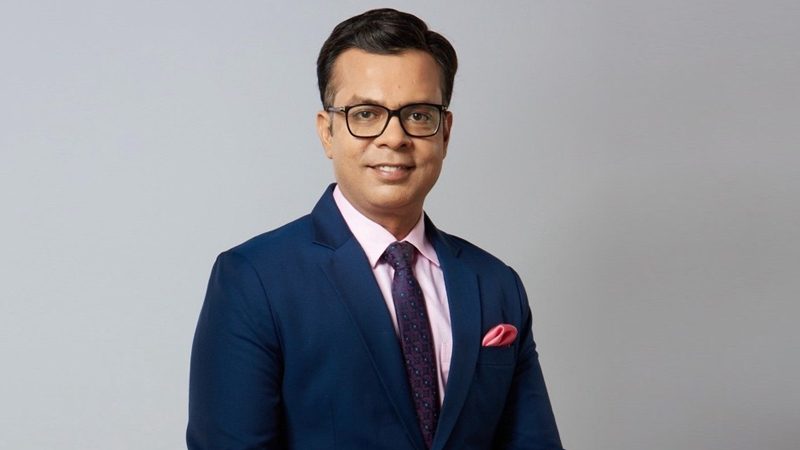
MUMBAI: Anuj Singhal, managing editor at CNBC- AWAAZ and CNBC BAJAR, operates at the sharp end of India’s business news ecosystem. With over two decades in business journalism, he has earned credibility for decoding policy, markets and macro trends for millions of Hindi-speaking investors. Equal parts newsroom leader and market analyst, he shapes editorial direction while anchoring flagship shows that break down the economy, politics and corporate India in real time.
Known for cutting through jargon and hype, Singhal blends data, discipline and clarity — a mix that has made him one of the most trusted voices in Hindi business news.
In this interaction, he discusses the Union Budget, trade deals, newsroom strategy and what truly moves markets and ratings.
• What was the single most market-moving announcement in this Budget, and why?
The most market-moving element was the clear commitment to fiscal consolidation without compromising capex. The glide path on fiscal deficit reassured bond markets and foreign investors, while sustained public investment kept growth expectations intact. That balance removed a big overhang for both equities and debt.
• Do you see this Budget as growth-oriented, fiscally cautious, or politically calibrated?
This Budget is growth-led but fiscally disciplined. It avoids overt populism, stays within macro guardrails, and prioritises medium-term competitiveness over short-term optics. Politically, it is restrained; economically, it is deliberate. The message is clear: stability over spectacle.
• How is CNBC-AWAAZ programming different, especially in decoding trade deal impact?
CNBC-AWAAZ goes beyond headline reaction. We translate policy into portfolio impact — sector by sector, stock by stock.
On trade agreements, our focus is on:
-Earnings visibility
-Export competitiveness
-Currency implications
-Margin sustainability
We don’t treat trade deals as political milestones. We decode them as profit-and-loss events for corporate India and map them to FY earnings trajectories.
• Which sectors look like clear winners and laggards over the next 12–18 months?
The next 12–18 months favour sectors aligned with structural spending and supply-side strengthening.
– Clear beneficiaries:
Capital goods and infrastructure
Manufacturing linked to export chains and PLI ecosystems
Power, defence, and logistics
– Relative laggards:
Consumption segments dependent on immediate demand revival
Businesses facing margin pressure from global volatility or pricing power erosion
This is not a momentum-driven market environment. It is execution-driven. Balance-sheet strength and order visibility will matter more than narrative.
• One headline to sum up this Budget 2026 for India Inc?
“Steady Hands, Long-Term Vision: A Budget That Rewards Discipline Over Drama”.
• What editorial filters do you apply before calling something ‘market-positive’ or ‘negative’?
We apply three structured filters:
– First: Earnings translation — does this materially change earnings visibility or cash flow outlook?
– Second: Time horizon — is the impact immediate, cyclical, or structural?
– Third: Valuation context — good news priced in or not.
If a policy doesn’t move earnings or risk perception, we don’t oversell it.
• How has business news consumption changed around big policy events?**
There has been a clear behavioural shift. They’re less interested in what was said, more in what it means for their money. There’s also a clear shift toward second-screen consumption, with digital platforms complementing live TV. The audience seeks sharper accountability. Viewers no longer accept broad optimism or pessimism — they want frameworks, numbers, and sector mapping.
• CNBC-AWAAZ decisively outperformed on Budget Day. What editorial and distribution choices mattered most?
Three deliberate strategic choices:
– Preparation depth:
We build scenarios months in advance — deficit ranges, sectoral incentives, tax calibrations — so we’re ready with analysis the moment numbers are announced.
– Language of impact:
We translate macro policy into investor-friendly Hindi without diluting complexity. That bridges accessibility and sophistication.
– Integrated distribution:
Television, YouTube, and digital platforms operate as one editorial grid, not parallel silos. This ensures continuity of narrative.We stayed analytical while others stayed reactive.
• How different is your YouTube audience from your TV audience?
The behavioural differences are subtle but important. TV audiences prioritise authority, structured debate, and context. YouTube audiences want speed, clarity, and actionable insights — often sharper, sometimes more opinionated. However, both share one expectation: accuracy. The format evolves; the trust benchmark does not.
• How do you retain viewers after the budget speech ends?
By shifting from announcements to implications.Retention comes from shifting the narrative from announcement to implication. We break down sectoral breakouts, stock-level impact, and what to do next. The speech is just the trigger; analysis is the destination.
• Is Budget Day your biggest traffic day?
It is one of the biggest — but more importantly, it is among the deepest in engagement. Viewers spend longer durations, revisit segments, and seek follow-up programming. That indicates behavioural trust, not just traffic.
• What’s the first thing you personally track on Budget Day — the speech or the markets?
The markets. They’re the fastest truth-teller. The speech explains intent; markets reveal interpretation.
• Your personal Budget-day ritual?
Early morning prep, minimal distractions, and once the speech begins, complete immersion. For me, Budget Day is less about reaction and more about reading between the lines.
• What drove your Budget-day ratings dominance, and how are Budget and trade deals shaping markets now?
Our dominance came from credibility, consistency, and clarity.
As for markets, both the Budget and recent trade deals are reinforcing a narrative of policy stability and global integration, which supports valuations even amid global volatility.
For Singhal, the market is the final judge. Policies can promise and speeches can persuade, but prices reveal what investors truly believe. As India’s investor class grows more informed and more demanding, business journalism is shifting from commentary to calibration. The premium is on clarity, context and credibility. In a landscape flooded with noise, the real edge lies in interpretation. In the end, the markets listen to numbers, not narratives , and Singhal’s craft is helping viewers tell the difference.
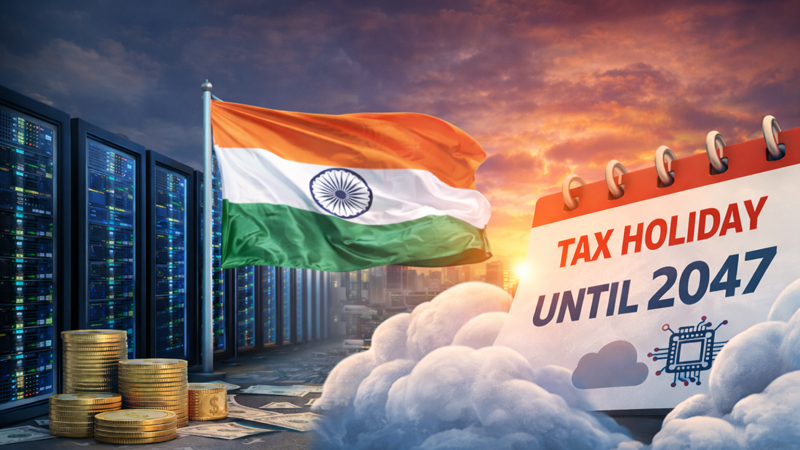
NEW DELHI: India has rolled out a long-dated tax break to tempt the world’s cloud and AI giants to plant their servers on Indian soil. The lure is simple and bold: base your data centres in India and your overseas cloud income can escape Indian tax until 2047.
A tax holiday, in essence, is a temporary exemption from certain taxes, used by governments to draw investment into priority sectors. It lowers early costs, improves returns and reduces risk for capital-heavy projects. In this case, the target is data centres, the backbone of artificial intelligence and digital services.
Under Budget 2026 proposals, foreign cloud companies can earn revenue from customers outside India without paying Indian tax, so long as those services are delivered through India-based data centres. Revenue from Indian users is excluded. That business must be routed through locally incorporated reseller entities and taxed in India.
An official statement said the proposal aims to “enable critical infrastructure and boost investment in data centres”, offering a tax holiday up to 2047 for foreign firms serving global markets via Indian facilities, while domestic sales are “taxed appropriately”.
The budget also offers a 15 per cent cost-plus safe harbour for Indian data centre operators serving related foreign companies, trimming transfer-pricing disputes and giving multinationals clearer guardrails on profit allocation.
The context is a global capacity crunch. AI workloads are soaring, power and land are tight in the United States and parts of Europe, and data centres are becoming strategic assets. India is pitching scale, skills and policy stability.
The money is already moving. Google has outlined a $15 billion investment in AI hubs and data centres after a $10 billion commitment in 2020. Microsoft plans $17.5 billion in AI and cloud expansion by 2029. Amazon has pledged another $35 billion by 2030, taking its planned India investment to about $75 billion.
Domestic groups are not sitting idle. Digital Connexion, backed by Reliance Industries, Brookfield Asset Management and Digital Realty Trust, plans an $11 billion, 1-gigawatt AI-focused campus in Andhra Pradesh. Adani Group has mapped out up to $5 billion alongside Google for AI data centre projects.
The push stretches beyond servers. A second phase of the India Semiconductor Mission targets equipment, materials and domestic chip intellectual property. Funding for the Electronics Components Manufacturing Scheme has risen to Rs 400 billion. Foreign equipment suppliers to bonded-zone electronics makers get a five-year tax break, while rare-earth corridors are planned to secure supply chains.
The strategy is blunt. Offer tax certainty, pull in capital, build digital muscle. If it works, the world’s data may increasingly be stored, processed and streamed from India. The holiday runs to 2047. The race to host the AI age has begun.
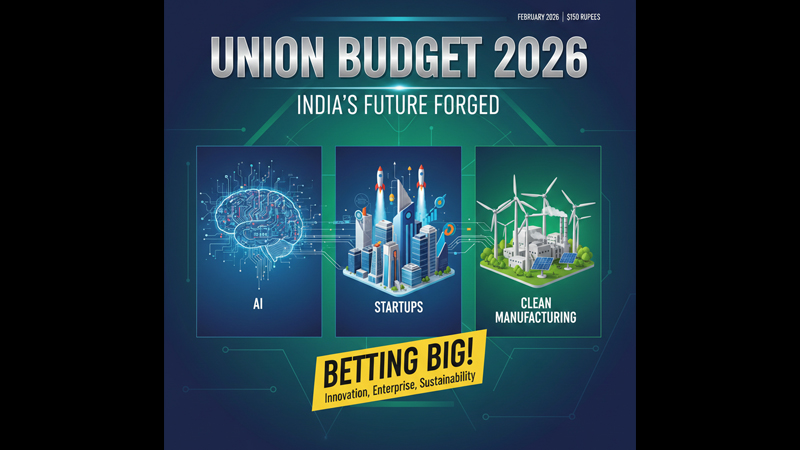
NEW DELHI: Union Budget 2026 marked a decisive shift towards building indigenous deep-tech capacity, decentralised startup growth and industrial efficiency, as finance minister Nirmala Sitharaman unveiled an “intelligence-first” strategy to power India’s next phase of economic expansion.
The budget prioritised operationalising the Anusandhan National Research Fund, rolling out capacity-building AI missions and scaling the Genesis programme, alongside a Rs 10,000 crore SME growth fund aimed at broadening access to capital beyond metro cities.
Technology founders across AI, consumer platforms and manufacturing welcomed the focus on patient capital for research and digital public infrastructure, saying it would strengthen domestic intellectual property and bridge the innovation gap between urban India and Bharat.
In renewable manufacturing, the government announced a historic rise in capital expenditure to Rs 12.2 lakh crore and rationalised duties on solar inputs to correct inverted duty structures. Industry leaders said the measures would cut logistics costs, boost domestic value addition and enhance the global competitiveness of Indian solar brands as new freight corridors reshape industrial supply chains.



MIB sets OTT accessibility rules, mandates captions and audio description

Boney Kapoor acquires remake rights of Tamil political satire Thalaivar Thambi Thalaimaiyil

Netflix India names Rekha Rane director of films and series marketing

Zabeen signs off from TV9 after shaping the network’s public voice

Dhawan steps up to bat for Delhi’s grassroots sports push

Orient Beverages pops the fizz with steady Q3 gains and rising profits

Cheekatilo shines in the dark with record debut on Prime Video

Swiggy Instamart’s GOV surges 103 per cent year on year to Rs 7,938 crore

These ’90s fashion trends are making a comeback in 2017
The final 6 ‘Game of Thrones’ episodes might feel like a full season
According to Dior Couture, this taboo fashion accessory is back
The old and New Edition cast comes together to perform
Phillies’ Aaron Altherr makes mind-boggling barehanded play

ATN International brings ATN Bangla to Canada
MIB sets OTT accessibility rules, mandates captions and audio description
Boney Kapoor acquires remake rights of Tamil political satire Thalaivar Thambi Thalaimaiyil
Netflix India names Rekha Rane director of films and series marketing
Zabeen signs off from TV9 after shaping the network’s public voice
Dhawan steps up to bat for Delhi’s grassroots sports push
Orient Beverages pops the fizz with steady Q3 gains and rising profits
Cheekatilo shines in the dark with record debut on Prime Video
-
 e-commerce1 month ago
Swiggy Instamart’s GOV surges 103 per cent year on year to Rs 7,938 crore
-
 iWorld1 year ago
Kuku TV transforms India’s OTT space with vertical microdrama boom
-
 News Headline1 year ago
TRAI puts a ‘stop’ to unsolicited calls and messages
-

 News Headline2 months ago
From selfies to big bucks, India’s influencer economy explodes in 2025
-
 Comedy2 years ago
Taarak Mehta Ka Ooltah Chashmah celebrates 4,000 episodes
-
 MAM2 years ago
OpenAI joins C2PA steering committee
-
 News Headline2 years ago
Odisha to host Ultimate Kho Kho Season 2 from December 24
-
 News Headline1 year ago
Abhishek Bachchan joins as co-owner of European T20 Premier League


