
I&B Ministry
AIDCF clarifications on certain issues raised by broadcasters

Mumbai: The All India Digital Cable Federation (AIDCF) has clarified some issues raised by broadcasters.
The new regulatory framework (NTO 1.0) announced by Trai in 2017 promised consumer choice and lower prices for channels on cable TV and DTH platforms.The framework came into effect in February 2019 after an extended 2-year legal battle between the Trai and the broadcasters.
“The broadcasters announced MRP for the consumers for the first time ever which was raised by as much as 400 per cent in some cases. Most of the popular channels were announced at an MRP of Rs.19/. Annexure 2 showing details of some popular channels,” said the press release by AIDCF.
The press release further made these points
Broadcasters also announced bundles of channels that had both popular and unpopular channels in the same bundles (bouquets) However, the broadcasters effectively killed consumer choice by pricing these bouquets at heavily discounted prices as compared to the a-la-carte prices.

Consumers as well as the cable TV and DTH platforms had effectively no choice but to subscribe to the bouquets. For eg. The smallest bouquet offered by Sony was for Rs 31/ for the consumer which included 9 channels including both Sony Entertainment, Sony Sab, Sony Max, Max 2, Sony Pal, Sony Yay, Sony Wah and Sony Marathi/Sony Aath (Bengali). The a-la-carte price for just two channels Sony Entertainment and Sony Sab at Rs 19 each amounted to more than the bouquet price which included the same two channels.
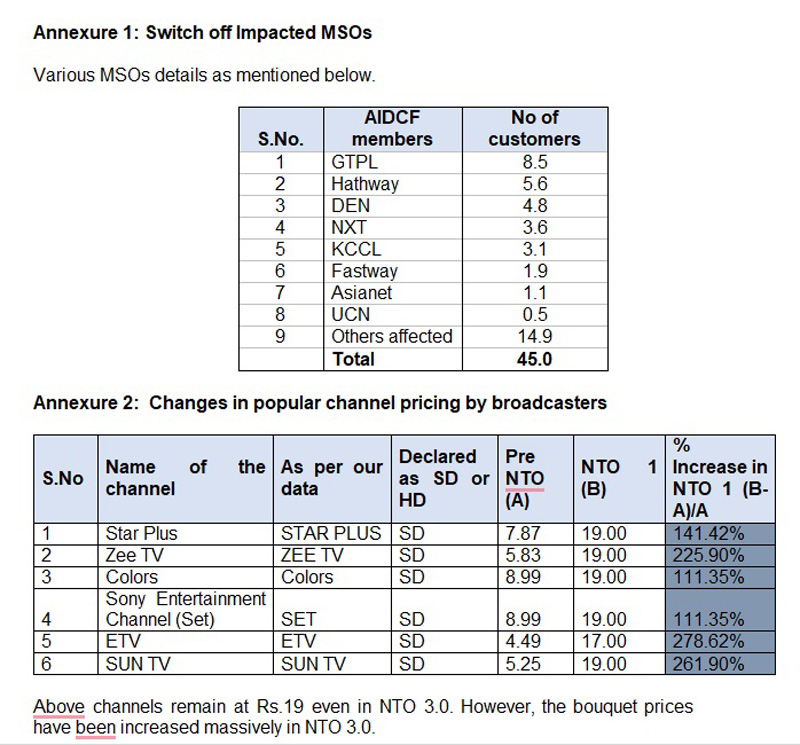
The situation was similar across all broadcasters
The cost of NTO 1 was:
Loss of more than 30 million (3.00 crore) subscribers from the cable tv service providers
Increase of subscription revenue by more than 200 per cent for broadcasters and resultant massive increase in profits for them (Annexure 3 showing result of a publicly listed broadcaster before and after NTO). Even free-to-air channels of these broadcasters were converted into pay channels at minimal prices so that they could be pushed into bouquets and thereby to consumer homes.
Within a period of less than 6 months, Trai felt the need to undergo another consultation process to correct the anomalies in the structures and perverse pricing of channels and bouquets announced by broadcasters.
Consultation was followed by the amendments to the regulations (NTO 2.0) issued on 1 Jan 2020.
Broad highlights of the amendments:
Reduction of MRP from Rs 19 to Rs 12 for inclusion of a channel in a bouquet by a broadcaster
logic was given to prevent perverse pricing of bouquets compared to a-la-carte prices so that consumers could effectively choose what they want to see.
NCF announced in initial regulations was amended and a cap of a maximum of Rs.130 was introduced for 200 channels and a maximum of Rs 160 for more than 200 channels to ensure consumers were not burdened.
Discount on multi-tv homes was introduced. The cable tv platforms implemented the reduction in prices immediately so as to ease the consumers’ burden.
The broadcasters, however, again went to court against the amendments related to pricing of channels as well as the logic of pricing of channels in bouquets. The case went on till 2021 which the broadcasters lost in the High Court at Mumbai
The High Court decided the case after almost two years while upholding the structure proposed by Trai and their right to do so.
The Trai approached all the stakeholders to try and come to a solution to the impasse and held a couple of meetings. These meetings were inconclusive since the cable platforms (under AIDCF) were against any price increase for the customers while the broadcasters wanted the price for channels to be restored to Rs.19 for the channel to be included in bouquets.
The Trai brought out a minutes of meeting dated 23 December 2021 which was purportedly agreed by all stakeholders including broadcasters, DTH, cable TV platforms and Trai.
AIDCF had written to Trai and disagreed to the minutes and raised other issues too. However, Trai overlooked the communications for unknown reasons
Trai announced a consultation again in 2022 with the purpose of bringing relevant amendments.
The consultation process culminated with the issuance of the amendments (NTO 3.0) on 22 November .2022. Price of individual channels allowed to be priced at a maximum of Rs.19/- again for inclusion in a bouquet. A new provision allowing broadcasters to discount their bouquets by a maximum of 45 per cent as compared to a-la-carte prices. This effectively keeps the consumer choice limited since the situation is similar to initial regulations (NTO 1.0) and the consumer does not have the option to choose.
Cost of NTO 3.0 and its impact
Broadcasters have significantly increased their channel prices and bouquet prices by approximately 18 per cent – 35 per cent which will definitely affect the consumer price (details given Annexure 4)
Average price increase across different areas of the country is expected to be in the range of Rs 30 to Rs 100 per month depending on the channels/bouquets opted by the consumer. The above price increase will result in a cost of close to Rs 5,000 crore to Rs 8,000 crore per annum to consumers which will largely benefit the broadcasters.
AIDCF and MSOs have immediately filed a case in Hon. High court of Kerala requesting stay on this Trai amendment
Various LCO associations have also filed their requested to put a stay on this Trai amendment
Broadcasters in meanwhile, despite the matter being sub judice, sent legal notices to AIDCF members to sign the agreement within 48 hrs. of issuance of notice or to face disconnection of signal immediately
Disney-Star, Sony and Zee switched off their channels on 18 February morning.Only three broadcasters have taken action. Other broadcasters who have not affected switch-off include Colors, Times, Discovery, Sun TV, ETV, etc.
Nearly 45 million households are affected (details appended in Annexure 1) who are unable to see the channels from these broadcasters. Now, broadcasters are urging consumers to go through the inconvenience of changing their service provider for their own limited benefit.
I&B Ministry
MIB sets OTT accessibility rules, mandates captions and audio description
Platforms get three years to add features for hearing and visually impaired
NEW DELHI: The government has asked OTT platforms to make their shows easier to watch and hear. A new set of accessibility guidelines from the Ministry of Information and Broadcasting requires streaming services to add features for viewers with hearing and visual impairments.
The move follows the Rights of Persons with Disabilities Act, 2016, and is meant to bring streaming closer to the promise of equal access. In simple terms, if a film or series is coming to an OTT platform, it should not arrive empty-handed. It should come with captions for those who cannot hear well and audio descriptions for those who cannot see clearly.
The guidelines ask platforms to provide at least one accessibility feature each for hearing-impaired and visually-impaired viewers. That could be closed captions, open captions, Indian Sign Language interpretation, or audio description. The aim is to make content understandable without turning the viewing experience into a technical chore.
There is, however, a long runway. Platforms have up to thirty six months from the date of the guidelines to ensure that all newly released content carries these accessibility features. Older titles in their libraries are not under strict timelines, but companies are encouraged to add features gradually.
The rules also go beyond the show itself. User interfaces, whether on mobile apps, smart TVs or websites, must be designed to work with assistive technologies. Accessibility labels such as CC for captions, AD for audio description and ISL for sign language must be displayed clearly so viewers know what to expect before pressing play.
Some content types get a free pass. Live events, music, podcasts, and short form content like ads are exempt because of practical challenges in real time captioning and description.
OTT publishers will also need to file accessibility conformance reports. The first report is due three years from now, followed by quarterly updates. Complaints from viewers will follow a three tier system, starting with the platform itself, moving to self-regulatory bodies, and finally reaching a government monitoring committee if needed.
For the streaming industry, the message is clear. Accessibility is no longer a nice extra tucked away in settings. It is fast becoming part of the main feature, and in a country where streaming audiences run into the hundreds of millions, that could make a very big difference to who gets to enjoy the show.
NEW DELHI: If 2025 was India’s year to make waves, the ministry of information and broadcasting (I&B) was its chief surfboard maker. Prime minister Narendra Modi’s call to “create in India, create for the world” wasn’t just ministerial hot air—it triggered a tsunami of creative dealmaking that swept from Melbourne to Madrid, generating Rs 4,334 crores in potential business discussions and putting Indian creators on every continent’s radar.
The centrepiece was Waves 2025, the World Audio Visual and Entertainment Summit, which drew over 90 countries, 10,000 delegates, and roughly 1 lakh punters through its doors. Modi himself dropped by to glad-hand young creators, describing the event as a “wave of culture, creativity and universal connectivity”—and for once, the hyperbole wasn’t entirely unwarranted.
The summit’s CreatoSphere platform, which sounds like something from a sci-fi novel but is actually a hub for film, VFX, animation, gaming, and digital media, launched the Create in India Challenges. Season one attracted over 1 lakh entries from more than 60 countries across 33 categories. Winners weren’t just handed certificates and sent packing—they performed at Melbourne, exhibited at Tokyo Game Show, and pitched at Toronto International Film Festival. I&B minister Ashwini Vaishnav handed out gongs to 150 creators, cementing the government’s commitment to nurturing what it calls the “creative economy.”
WaveX, the startup arm, proved equally industrious. It coaxed over 200 startups into its embrace, enabled 30 to pitch to Microsoft, Amazon, and Lumikai, and somehow got two of its charges—VYGR News and VIVA Technologies—onto Shark Tank India, where they presumably dodged the usual mauling. The initiative’s KalaaSetu and BhashaSetu challenges, focused on AI-driven video generation and real-time translation respectively, attracted over 100 startups and picked ten for collaboration with government media units.
Waves Bazaar, the “craft-to-commerce” global e-marketplace, went on a roadshow between August and December, hitting 12 international events across four continents and four domestic jamborees. The numbers are eye-watering: over 9,000 B2B meetings, 10 memoranda of understanding signed, three more proposed, and the launch of creative corridors with Japan, Korea, and Australia. The ministry claims Rs 4,334 crores in potential deals—potential being the operative word, though in India’s booming content market, optimism often precedes reality by only a few quarters.
On the bricks-and-mortar front, the Indian Institute of Creative Technology opened its temporary Mumbai campus in July with Rs 391.15 crores in budgetary support. The public-private partnership with Ficci and CII has enrolled over 100 students across 18 courses, incubated eight startups, and signed memoranda with Google, Meta, Nvidia, Microsoft, Apple, Adobe, and WPP—a who’s who of tech giants keen to tap India’s creative reserves. A permanent 10 acre campus at Film City, Goregaon, complete with an immersive AR/VR/XR studio, is in the works.
Elsewhere, the ministry set up a Live Events Development Cell to position India’s concert economy as a growth driver. A single-window clearance system is being built on the India Cine Hub platform to expedite permissions for fire, traffic, and municipal approvals—addressing the red-tape nightmares that have long plagued event organisers. Meanwhile, an inter-ministerial committee is tackling digital piracy, that perennial thorn in the creative economy’s side.
State broadcaster Doordarshan snagged the Election Commission’s media award for voter awareness during the 2024 Lok Sabha elections, presented by the president on National Voters’ Day. Community radio added 22 new stations, bringing the total to 551, with workshops and a national sammelan held during Waves to strengthen local broadcasting.
The 56th International Film Festival of India in Goa screened over 240 films from 81 countries, threw in the country’s first AI Film Festival, and staged a grand parade through Panaji that turned the event into a street-level celebration. The accompanying Waves Film Bazaar drew over 2,500 delegates from 40-plus countries and showcased 320 projects—making it one of South Asia’s largest film markets.
The Central Board of Film Certification modernised too, launching a multilingual certification module that allows multiple language versions under a single application, and mandating 50 per cent women’s participation on examining and revising committees. Digital signatures replaced wet ink, and certificates became downloadable—small victories in the fight against bureaucratic inertia.
India’s I&B ministry ended 2025 having turned content creation into something resembling an industrial policy. Whether Rs 4,334 crores in “potential” business materialises remains to be seen, but the ministry has built the infrastructure, corralled the startups, and put Indian creators on international stages. As Modi might say, the wave has been ridden. Now comes the hard part: keeping the momentum going when the cameras stop rolling.
MUMBAI: The Centre has inched closer to making India’s streaming universe easier to watch, hear and enjoy for everyone. The Ministry of Information and Broadcasting has released draft guidelines that aim to standardise accessibility on OTT platforms, ensuring that viewers with hearing and visual impairments are no longer left out of the country’s digital entertainment boom.
Issued on 7 October and now open for public consultation, the draft rules arrive with constitutional and global backing. Minister of State for Information and Broadcasting L. Murugan told the Rajya Sabha that the framework draws from Article 14, the UN Convention on the Rights of Persons with Disabilities and the Rights of Persons with Disabilities Act, 2016. It also mirrors the Code of Ethics under the IT Rules, 2021.
At the heart of the proposal is a two-phase rollout of mandatory accessibility tools such as same-language closed captions and audio descriptions. The ministry said penalties and enforcement steps will be shaped after the consultation, but compliance will be tracked through progressive targets for OTT content libraries.
Parliament was also reminded that the broadcast sector has walked this path before. In 2019, the government notified accessibility standards for television programming, starting with Prasar Bharati and eventually extending them to private broadcasters.
With OTT viewership climbing across urban and small-town India, the draft rules attempt to bring streaming giants in step with a wider vision of inclusive media. The government hopes the move will help millions of Indians with disabilities press play without barriers.


MIB sets OTT accessibility rules, mandates captions and audio description

Boney Kapoor acquires remake rights of Tamil political satire Thalaivar Thambi Thalaimaiyil

Netflix India names Rekha Rane director of films and series marketing

Zabeen signs off from TV9 after shaping the network’s public voice

Dhawan steps up to bat for Delhi’s grassroots sports push

Orient Beverages pops the fizz with steady Q3 gains and rising profits

Cheekatilo shines in the dark with record debut on Prime Video

These ’90s fashion trends are making a comeback in 2017
The final 6 ‘Game of Thrones’ episodes might feel like a full season
According to Dior Couture, this taboo fashion accessory is back
The old and New Edition cast comes together to perform
Phillies’ Aaron Altherr makes mind-boggling barehanded play
Uber and Lyft are finally available in all of New York State
Disney’s live-action Aladdin finally finds its stars
MIB sets OTT accessibility rules, mandates captions and audio description
Boney Kapoor acquires remake rights of Tamil political satire Thalaivar Thambi Thalaimaiyil
Netflix India names Rekha Rane director of films and series marketing
Zabeen signs off from TV9 after shaping the network’s public voice
Dhawan steps up to bat for Delhi’s grassroots sports push
Orient Beverages pops the fizz with steady Q3 gains and rising profits
Cheekatilo shines in the dark with record debut on Prime Video
-

 News Broadcasting1 week ago
Mukesh Ambani, Larry Fink come together for CNBC-TV18 exclusive
-

 News Headline1 month ago
From selfies to big bucks, India’s influencer economy explodes in 2025
-
 iWorld5 months ago
Billions still offline despite mobile internet surge: GSMA
-

 Applications2 months ago
28 per cent of divorced daters in India are open to remarriage: Rebounce
-

 iWorld2 weeks ago
Netflix celebrates a decade in India with Shah Rukh Khan-narrated tribute film
-
 Hollywood1 week ago
The man who dubbed Harry Potter for the world is stunned by Mumbai traffic
-
 News Headline2 months ago
Game on again as 2025 powers up a record year and sets the stage for 2030
-
 I&B Ministry3 months ago
India steps up fight against digital piracy
