
Hindi
AI Lights Camera Action as IFFI Masterclass Maps Cinema’s Next Frontier

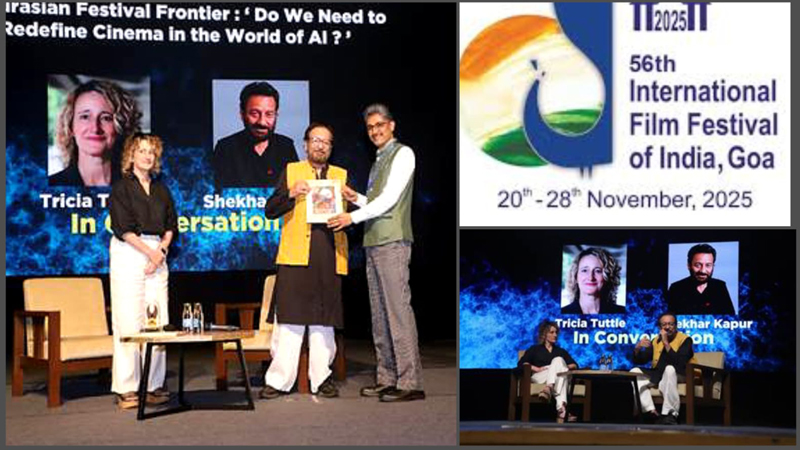
MUMBAI: Moviemaking may once have begun with a camera, but at IFFI this week, the consensus seemed clear: in the age of artificial intelligence, all you really need is curiosity and a prompt. At the 56th International Film Festival of India in Goa, the masterclass The New AI Cinema: A Discourse on Generative AI and LLMs quickly turned into one of the festival’s most electric sessions, a spirited, sometimes philosophical, often provocative debate about how AI is reshaping the craft, the industry and even the idea of storytelling itself.
Helmed by filmmaker V. Muralitharan, auteur Shekhar Kapur, and writer-director Shankar Ramakrishnan, the session moved far beyond technical demos. Instead, it cracked open the cultural, artistic and ethical tensions simmering beneath cinema’s AI revolution.
Muralitharan opened with a glimpse into AI’s unexpected role in education. He described sitting with an academic panel studying the human nervous system — a complicated animation traditionally achievable only with expensive modelling tools, now fully AI-generated. Neural networks visualising actual neural networks: the irony wasn’t lost on anyone.
He argued that the same technology could resurrect history, lost characters, forgotten struggles, major events and accidents, all recreated with precision as long as research materials were robust. “Our project is only just taking shape,” he said, hinting at a future where historical cinema no longer depends on scarce archives.
Muralitharan also offered a deeply personal confession. After a decade in corporate managerial roles, his hands-on artistic skills had faded. He felt the gap acutely. But AI, he said, had restored his ability to “make my films and tell my stories” without needing to relearn complex software.
Initially guided by engineers, he soon realised that modern tools “are like talking to a person”. Simple English prompts could now generate shots, scenes or entire sequences. “There is no technical expertise needed today,” he said. Creativity, not coding, had become the entry barrier and even that barrier was getting lower.
Kapur agreed. “It’s become very democratic,” he added, before launching into an unexpected tale of how AI fed his obsession with the relationship between physics, poetry and schizophrenia.
Kapur recounted spending three months on ChatGPT exploring the idea that Van Gogh, declared schizophrenic, may have intuitively painted the true nature of fluid dynamics — something physicists still struggle to mathematically resolve.
If art can reveal truths that science can’t express, Kapur argued, then AI becomes a tool not for shortcuts but for deeper inquiry. “I found relationships I had never learnt before,” he said, describing the chatbot as an engine of personal education.
While some debated continuity flaws in AI-generated shots like three dogs inexplicably shrinking to one, Muralitharan insisted the tools evolve weekly. Literally. “What I saw two weeks back is not the tool today,” he said, describing how character consistency across ages had recently become achievable.
Their seven-minute demonstration film featured a protagonist across three life stages, generated consistently something impossible even months earlier.
To create long continuous sequences, they generated eight-second blocks, each feeding the next. It took three or four cycles to create a smooth 20-second time-lapse with crowds, movement and controlled camera speed. Soon, he said, tools will generate arbitrarily long shots, though “they must be meaningful”.
One of the biggest misconceptions in public discourse, the speakers stressed, is confusing AI with VFX.
“AI is far, far more sophisticated,” Muralitharan said. VFX still requires cameras, green screens and physical shoots. AI requires nothing but data, imagination and prompts.
Yet the two are now merging. Most VFX pipelines already secretly incorporate AI for set design, costumes and environmental generation. Kapur admitted he had recently seen a commercial where even he couldn’t distinguish the real Hrithik Roshan from his AI double.
Kapur then pulled back the curtain on why OTT platforms and theatrical distributors wield such power: the barrier to entry is high because budgets are high. AI, he said, will bulldoze that barrier.
“A. R. Rahman and I are setting up an AI film school in Dharavi,” he announced, explaining that kids with no equipment, no training and no industry access will soon make films purely through AI tools.
“When budgets crash, gatekeepers lose control,” Kapur said. OTT platforms will acquire AI-made films, “they won’t have a choice.”
When asked whether AI can replicate great performances, Kapur answered with characteristic bluntness: AI can replace a superhero suit but not Shabana Azmi’s eyes.
“AI eyes have a dead look,” he explained, offering a scientific nugget: a human pupil performs around 1,000 micro-movements per minute movements so subtle even scientists rarely acknowledge them. AI, he said, cannot recreate that expressiveness anytime soon.
Close-ups of great actors will remain the human domain at least for now.
On intellectual property, Muralitharan emphasised responsibility. If a filmmaker wants to use someone’s image, they must seek consent and sign contracts. AI may be a mirror and a provocateur, he said, but it doesn’t erase ethics.
Kapur added that artistic inspiration has always been a form of borrowing. “We study every painter in art school,” he said. “Of course we’re influenced.” The problem isn’t influence, it’s inertia. “How much you depend on AI depends on how lazy you are,” he added, earning laughs.
Kapur warned that AI will transform how organisations, hierarchies and power structures function. Traditional pyramids thrive on inertia and AI “sucks inertia out of systems”. As roles blur, “you won’t know who leads and who follows anymore”. The shift, he said, will redefine how we live, work and learn.
One of the conversation’s most poetic turns came when Muralitharan spoke about his fascination with lost Indian cinema. Many early films, including the 1928 silent Tamil film Vigadha Kumaran, survive only in photographs. AI, he said, could reconstruct these films not perfectly, but evocatively enough to restore what history has forgotten.
Kapur acknowledged AI’s early Western bias but said India is quickly training its own sub-models. Today, he said, AI-generated characters increasingly “look very Indian”, and models are learning Indian language structures. The days of a tiger with white stripes, a famously wrong early AI output are fading.
The speakers did not shy away from AI’s energy demands. Kapur cited data showing AI prompts consume up to 10 times the energy of a Google search. Even small prompt choices matter. “Remove the word please,” he said. “It saves power.”
But he pointed to emerging quantum chip research, where chips compute “maybe” rather than binary “yes/no”, cutting heat and energy drastically. “It will change everything,” he predicted.
In a moment of déjà vu, a crew member reminded Kapur that 20 years ago he had predicted that digital filmmaking would enter every home. “It happened,” Kapur said. And now AI is doing it again but faster, deeper, and in ways that will reshape not just cinema, but society itself.









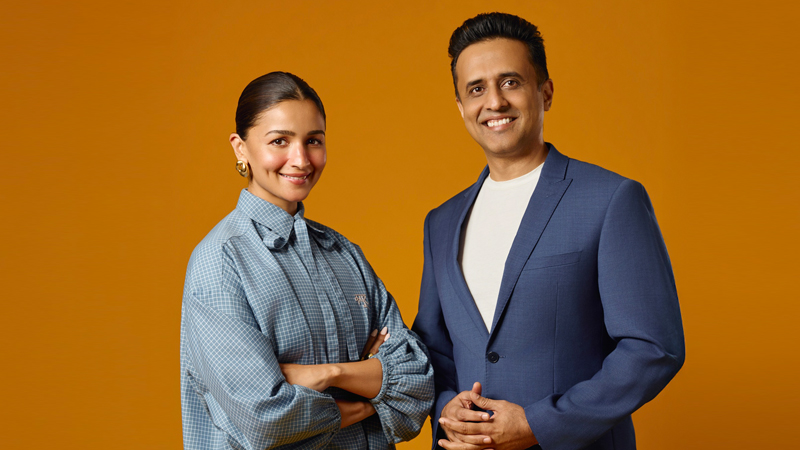
MUMBAI: Prime Video has found its next feel-good original, and it comes with a healthy dose of heart, humour and youthful chaos. The streaming platform has announced Don’t Be Shy, a coming-of-age romantic comedy produced by Alia Bhatt and Shaheen Bhatt under their banner, Eternal Sunshine Productions.
Written and directed by Sreeti Mukerji, the film follows Shyamili ‘Shy’ Das, a 20-year-old who believes her life is neatly mapped out until it suddenly is not. What follows is a relatable tumble through friendship, love and the awkward art of growing up, when plans unravel and certainty gives way to self-discovery.
The project is co-produced by Grishma Shah and Vikesh Bhutani, with music composed by Ram Sampath, adding to the film’s promise of warmth and energy. Prime Video describes the story as light-hearted yet emotionally grounded, with a strong female-led narrative at its core.
Prime Video India director and head of originals Nikhil Madhok, said the platform was delighted to collaborate with Eternal Sunshine on a story that blends sincerity with humour. He noted that the film’s fresh writing, earnest characters and infectious music make it an easy, engaging watch for audiences well beyond its young adult setting.
For Alia Bhatt, Don’t Be Shy reflects the kind of storytelling Eternal Sunshine set out to champion. She said the film stood out for its honesty, its coming-of-age perspective and Mukerji’s passion, which she felt was deeply woven into the narrative. Bhatt also praised Prime Video for supporting distinctive voices and bold creative choices.
With its breezy tone and familiar emotional beats, Don’t Be Shy aims to charm viewers whether they are rom-com regulars or simply in the mood for a warm, unpretentious story about life refusing to stick to the plan.

MUMBAI: Tips Films struggled to find its rhythm in the final quarter of 2025, as a spike in production costs and a new regulatory burden pushed the Mumbai-based outfit deeper into the red. According to results released on Tuesday, January 27, 2026, the company posted a net loss of Rs 286.87 lakh for the quarter ended 31 December, despite a modest bump in total income to Rs 456.29 lakh.
The bottom line was hit by the introduction of India’s New Labour Codes, which forced a Rs 37.37 lakh catch-up payment for employee benefits. Production costs also proved a heavy lift, gobbling up Rs 318.48 lakh during the period. On a nine-month basis, the picture looks even bleaker; the company has racked up losses of Rs 1,237.61 lakh, a sharp reversal from the Rs 1,269.17 lakh profit it managed in the same period last year.
Investors will be looking for a script change as the company enters the final stretch of the financial year, with basic earnings per share now languishing at minus Rs 6.64. For now, Tips Films remains a single-segment player, pinning its hopes entirely on the volatile world of film production and distribution.
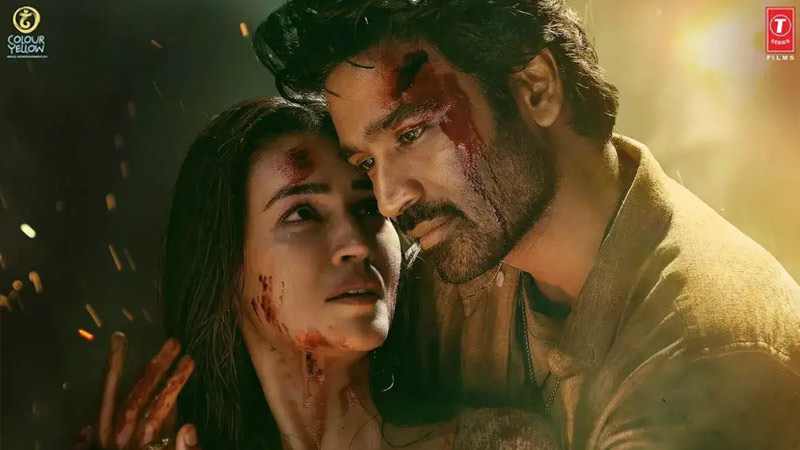
MUMBAI: Eros International Media Ltd has moved the Bombay high court against filmmaker Aanand L Rai and his production banner Colour Yellow Media Entertainment LLP, alleging unauthorised exploitation of the intellectual property of its 2013 blockbuster Raanjhanaa in the promotion and release of the 2025 film Tere Ishk Mein.
The studio is seeking damages of Rs 84 crore, claiming losses arising from what it describes as unlawful capitalisation on Raanjhanaa’s goodwill. According to a report in The Times of India, Eros has filed a commercial intellectual property suit along with an interim application, alleging trademark infringement, copyright infringement and passing off.
Eros contends that Tere Ishk Mein was deliberately marketed as a “spiritual sequel” to Raanjhanaa without authorisation. The suit names Aanand L Rai, Colour Yellow Media Entertainment LLP and Colour Yellow Productions, along with Super Cassettes Industries (T-Series), writer Himanshu Sharma and Netflix Entertainment Services India LLP, turning the dispute into a multi-party legal battle.
In its filing, Eros asserts that it is the producer and exclusive owner of all intellectual property rights in Raanjhanaa, including copyright, registered trademark rights, character rights in Kundan Shankar and Murari, and remake, prequel and sequel rights. The company alleges these rights were exploited while promoting Tere Ishk Mein, which released theatrically on November 28, 2025.
The legal action was triggered by a teaser released online in July 2025, which Eros claims used phrases such as “From the world of Raanjhanaa” and hashtags including #WorldOfRaanjhanaa. The interim application further alleges unauthorised use of footage, background score and music from Raanjhanaa, despite Eros no longer holding the film’s music rights.
Directed by Aanand L Rai, Tere Ishk Mein stars Dhanush, Kriti Sanon, Priyanshu Painyuli, Prakash Raj and Tota Roy Chowdhury. Neither Eros nor the defendants have issued an official statement so far.

Netflix celebrates a decade in India with Shah Rukh Khan-narrated tribute film

Delhivery chairman Deepak Kapoor, independent director Saugata Gupta quit board

Meta appoints Anuvrat Rao as APAC head of commerce partnerships

Brnd.me enters Europe as haircare brands power global expansion

TechnoSport taps quick commerce with launch on Slikk’s 60-minute platform

Jitendra Singh joins Reliance Industries as senior vice president, special projects

Tinder brings real-world dating experiences to North East India

These ’90s fashion trends are making a comeback in 2017
The final 6 ‘Game of Thrones’ episodes might feel like a full season
According to Dior Couture, this taboo fashion accessory is back
The old and New Edition cast comes together to perform
Phillies’ Aaron Altherr makes mind-boggling barehanded play
Uber and Lyft are finally available in all of New York State
Disney’s live-action Aladdin finally finds its stars
Netflix celebrates a decade in India with Shah Rukh Khan-narrated tribute film
Delhivery chairman Deepak Kapoor, independent director Saugata Gupta quit board
Meta appoints Anuvrat Rao as APAC head of commerce partnerships
Brnd.me enters Europe as haircare brands power global expansion
TechnoSport taps quick commerce with launch on Slikk’s 60-minute platform
Jitendra Singh joins Reliance Industries as senior vice president, special projects
Tinder brings real-world dating experiences to North East India
-
 iWorld3 months ago
Tips Music turns up the heat with Tamil party anthem Mayangiren
-
 iWorld12 months ago
BSNL rings in a revival with Rs 4,969 crore revenue
-
 I&B Ministry3 months ago
India steps up fight against digital piracy
-
 MAM3 months ago
HoABL soars high with dazzling Nagpur sebut
-

 News Headline4 weeks ago
Preeti Sahni set to join TV9 Network in senior leadership role
-
 News Broadcasting5 days ago
Palki Sharma leaves Firstpost: Reports
-
 iWorld3 days ago
Netflix celebrates a decade in India with Shah Rukh Khan-narrated tribute film
-
 News Broadcasting6 months ago
Wion marks Independence Day with global showcase of India’s spirit