
Hindi
Rustom for ‘Independence Day’; Mohenjo Daro, a poor film

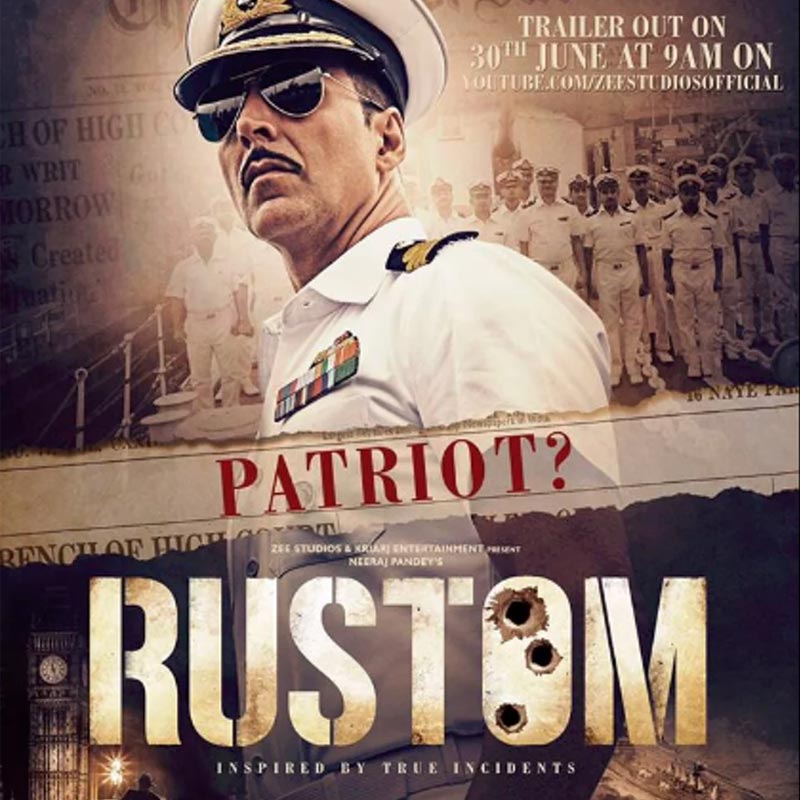
MUMBAI: Of late, Akshay Kumar starrers have become much-awaited. His transition from action to comedies were taken as they came; without much expectations. But, while an interesting story as the mainstay of a film is becoming rarer in Hindi films, Akshay’s films have strong tales to tell lately. And some of his recent films like Oh My God!, Special 26, Airlift, Holiday: A Soldier Is Never On Leave etc have relied on interesting stories mainly providing no scope for his kind of action and romance let alone comedy.
If one cared to, there are many real life human-interest stories to find in the country and the media if the filmmakers tried to look beyond crime and mafia stories. In fact, Akshay’s recent films, Special 26 and Airlift were also inspired from such real life events.
Though the film runs a disclaimer to the contrary, Rustom is based on the real life 1959 incident of a senior naval officer of the Indian Navy murdering the paramour of his English wife and the sensation that the court proceedings that followed created. Even as the murder looked like a simple adultery-incited rush of blood, the real life as well as the reel life hint at deeper conspiracy related to the defense system in the country towards which the film deals with towards the end.
Akshay is Rustom Pavri, an officer of Parsi origin with the Indian Navy, much respected as well as admired by his colleagues as well as friends. He has been sent to UK on a long assignment the purpose of which is to check on an aircraft carrier the Indian Navy plans to acquire.
Akshay’s stay in UK has been curtailed and his arrival back in Bombay happens before schedule. When back, to his surprise, his wife, Ileana D’Cruz, has been away for a couple of days. She, it seems, has been cheating on Akshay and is shacking up with one of Akshay’s close friends, Arjan Bajwa, on a regular basis in his absence. Arjan is a suave imported-car dealer and, thanks to his clientele, has unhindered access to high society dos and the wives of his clients.

Devastated by the revelation, Akshay walks into Arjan’s apartment and fires three bullets at him killing him instantly. He then walks into a police station and surrenders to the station in charge, Pawan Malhotra.
The murder by a naval officer of a high society Sindhi businessman makes banner headlines in the newspapers among which there is a tabloid owned by a fellow Parsi, Kumud Mishra, who sees this as an opportunity to salvage his almost defunct publication as well as to run a crusade to create a sympathy wave in favour of Akshay because he is a Parsi. With Esha Gupta taking on cudgels to avenge the death of her brother, Arjan, this literally turns into a war between Parsi and Sindhi communities. So much so even the public prosecutor appointed is a Sindhi.
As the court proceedings begin, Akshay refuses to appoint a lawyer, deciding to defend his own cause. It was the era of jury system where a bunch of court-appointed individuals from society sat in judgment while the judge only conducted the proceedings. Akshay works on winning over the sympathy of the jury members while the tabloid supporting him paints him as a true patriot. The judge too picks on the public prosecutor, Sachin Khedekar, from time to time creating more sympathy for Akshay. The court proceedings are meant to cater to the gallery as it regales both, the ‘crowd’ gathered in the court as well as the viewer.
Written by Vipul K Rawal, himself an erstwhile naval officer, the film has the tricky task of blending a real life saga with fiction as well as to decide where one ends the other takes over. It also applies to execution as recreating 1950s/60s era Bombay has never been convincing on screen. Here, as a compromise, some scenes have been shot in London around its Victorian architecture buildings. What works for the makers is that most of the film is shot in a court room. While the scripting is more like a stage play, the film sags in the first half as the narration moves from scene to scene at fast pace. This may seem to quicken the pace of the film but gives no time for the viewer to digest what just went past. The director shows ample confidence as a first timer. Songs have no place in the story and whatever is there is functional. Editing needed to be much sharper. Dialogue is good at places.
As for the performances, this is an Akshay Kumar vehicle all the way. He looks dignified and the uniform of a naval officer only adds to his persona. He does not have to act after that. Ileana carries a singular look throughout the film, weather she is romancing with Arjan or is facing the betrayed Akshay or in court scenes. Esha Gupta’s role is about sneering and jeering alternately. Sachin Khedekar, Anang Desai and Kumud Mishra play up to the masses. Pawan Malhotra and Usha Nadkarni are good in support. Arjan Bajwa is okay in a brief role.
Rustom has had a decent opening and the Monday, 15th August, Independence Holiday should add to its kitty to see it through safely.
Producers: Arun Bhatia, Nittin Keni, Aksah Chawla, Virender Arora, Ishwar Kapoor, Arjun N Kapoor, Shital Bhatia.
Director: Tinu Suresh Desai.
Cast: Akshay Kumar, Ileana D’Cruz, Arjan Bajwa, Esha Gupta, Usha Nadkarni, Sachin Khedekar, Lakshman Khangan, Kumud Mishra, Pawan Malhotra.
Mohenjo Daro…Bad idea!
Ashutosh Gowariker is said to have been inspired by the sites of the ruins of Dholavira, an excavated city from an ancient civilization in Kutch, Gujarat. That made him think of Mohenjo Daro, (now in Sindh, Pakistan) where the biggest city of an ancient Indus Valley Civilization was excavated in 1922 and, then, declared a Heritage Site by the UNESCO in as late as 1980.
All that is known about the find is its name, Mohenjo Daro (Mound of the Dead, when translated in English), there is nothing more on record or known to the archeologists who worked on the sites. While some assumptions may have been made about the culture as it existed then and the lifestyle of the people, there are no myths, legends or folklore related to Mohenjo Daro available anywhere or with anybody. In such a situation, a great imagination is needed to build a story around this civilization.
Here goes the story: we have Hrithik Roshan is a tiller of neel (indigo) in a small town in pre-historic land mass, later called Hindustan. Like all small town lads, he aspires to go to the big city, Mohenjo Daro, on the banks of Indus River. These days, all those who come to big cities become dons or their goons. In the good old days, they became saviours of the masses. Hrithik arrives in the new city and is impressed by its sights, its architecture and the scope for enterprise since people from other worlds also come here to trade.
The city is throbbing with people all around so much so that there is even a traffic cop to control these people and direct those like cops nowadays direct traffic in big cities! As he learns the tricks of the trade, Hrithik realizes that such big cities have two strata to society: the mass and the elite. Here too the city is divided between them demarcated by Lower City and Upper City settlements.
Like all such cities, Mohenjo Daro too has its share of evil in the form of Kabir Bedi, who rules the place with an iron hand, and his son, Arunoday Singh. Seeing their tyranny and having his first brush with Singh, Hrithik soon decides to leave the place and return to his own village. But, that is when he spots Pooja Hegde and it is love at first sight. For her sake, he now wants to stay put. In the process, he gets involved with events in the city and sees how injustice is being meted out to people by Bedi and Singh.
Hrithik has competition when it comes to Pooja as Singh wants her for himself and that has been decided at her birth by the prophesy makers of the city. Determined to stay back and fight with Singh and Bedi for the girl as well as the people, Hrithik’s resolve is only strengthened when he learns that his father, Sharad Kelkar, was one of the ministers in the darbar of Bedi but was murdered for opposing him.
As the film, which started bad, goes on to becoming worse, there are more treacheries by Bedi and Singh and some song and dance and some fights including an arena fight a la old Hollywood films, between Hrithik and two monstrous cannibal men. Hrithik overcomes all odds and vanquishes the evildoers. Don’t know why maneaters fight with Hrithik instead of just eating him up and be done with it? This was probably their idea of cooking their meal!
Talking about the imagination needed for a story to fit into the Mohenjo Daro civilization, there is none. In fact, whatever has been conjured up in the name of a great saga is childish to put it mildly. For instance, Hrithik is named Sarman and Singh is Munja; Sarman Munja was the name of a don in the city of Porbandar in Gujarat after whose death his wife, Santokba, went on to become India’s first all-powerful woman don who also has a film to her name. Kelkar is a good guy so Surjan while his brother who fails to stand by him is Durjan! It can’t get any more juvenile!
The story as such can fit into any B grade film of today if you replace the locale but keep the characters and the story same.
A poor story idea and a poorer script make for a directionless film: here we have props that loom totally out of place in the viewer’s perception of Mohenjo Daro. There are regular ration shops, costumes few can identify with! There is also word Haramkhor in Bedi’s vocabulary. The romance does not convince and there is no music to back it save for one song, Tu hia…. Dialogue lacks spirit. Cinematography is fair. Choreography is good. Special effect are routine. Editing is not evident in this film.
Performances are routine with Hrithik Roshan carrying on with same expressions from Koi… Mil Gaya. Pooja Hegde looks charming but can’t perform. Kabir Bedi is okay. Arunoday Singh is the victim of a routine role. Of the rest, only Manish Choudhary shows some conviction with what he is doing.
Mohenjo Daro is a poor film in all respects. If cost is considered, worse still.
Producers: Siddharth Roy Kapoor, Sunita Gowarikar.
Director: Ashutosh Gowariker.
Cast: Hrithik Roshan, Pooja Hegde, Kabir Bedi, Arunoday Singh, Suhasini Mulay, Nitish Bharadwaj, Kishori Shahane, Sharad Kelkar, Manish Choudhary, Narendra Jha, Casey Frank, Diganta Hazarika.



Hindi
Boney Kapoor acquires remake rights of Tamil political satire Thalaivar Thambi Thalaimaiyil
Strong word-of-mouth turns Pongal satire into remake pick
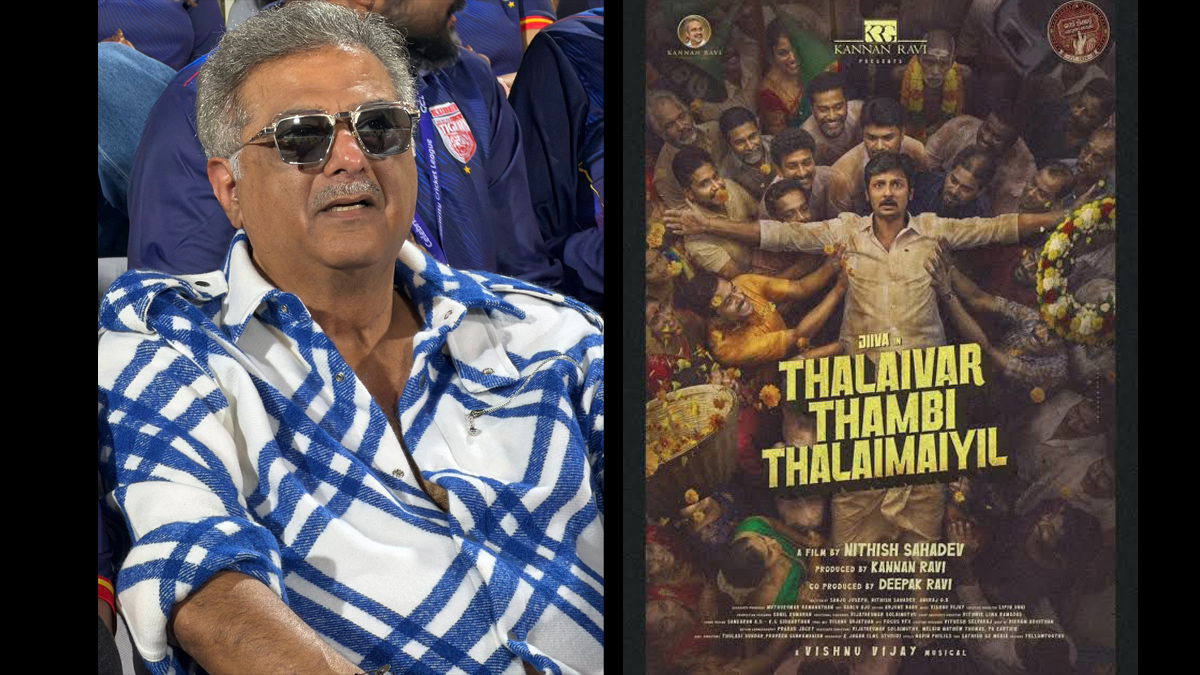
MUMBAI: A Pongal release, a village satire and a theatre visit in Coimbatore have turned into Boney Kapoor’s latest acquisition. The producer has secured the remake rights to the Tamil political satire Thalaivar Thambi Thalaimaiyil (TTT), a film that has been enjoying a strong theatrical run powered by word-of-mouth and praise for its sharp, rooted writing.
Set in a rural milieu, the story follows a panchayat leader thrown into disarray when a wedding and a funeral land on the same day. What unfolds is a swirl of satire and humour that skewers local politics, power games, bruised egos and family tensions, all anchored in the textures of everyday village life.
Kapoor first encountered the film earlier this year while in Coimbatore for the Celebrity Cricket League. With time to spare, he caught a screening at a local theatre. That viewing proved decisive. According to sources, the narrative style, performances and the film’s balance of political commentary and comedy caught his attention.
Interest quickly turned into intent. Kapoor reached out to the producers soon after to explore a remake. Talks gathered pace over the following weeks and came to a head last Friday at the film’s success party in Chennai, where Kapoor joined the celebrations and continued negotiations with the makers.
By the end of the evening, the deal was sealed, with Kapoor formally acquiring the remake rights.
For an industry constantly mining regional cinema for the next crossover story, the move is telling. A small-town satire with local flavour has found a national backer. And if Kapoor’s instincts hold, a tale born in one village may soon echo far beyond it.
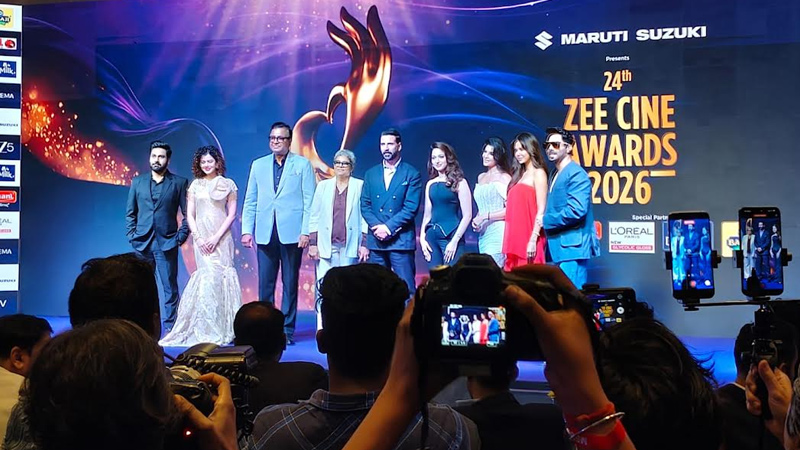
MUMBAI: When the applause gets louder than the dialogue, you know the fans have taken over. That was the unmistakable mood as Zee formally announced the Zee Cine Awards 2026, flipping the script to celebrate not just cinema’s stars, but the people who cheer them on the loudest.
The 24th edition of the awards marks a fresh chapter in Zee’s long-standing relationship with Hindi cinema, anchored in its fan-first philosophy, Fantertainment. This year’s theme, ‘Yeh Pal Hai Fans Ka’, reinforces a simple idea: cinema’s most powerful moments are shaped as much by audiences as by actors on screen. Presented by Maruti Suzuki, the awards aim to turn fandom into the main event.
The announcement, held in Mumbai, was anything but a routine press conference. Bollywood stars Akshay Kumar, Tamannaah Bhatia, Jacqueline Fernandez, Sonam Bajwa, Aparshakti Khurana, composer Mithoon and singer Palak Muchhal joined fans to kick off the celebrations, turning the launch into a high-voltage, participative spectacle.
Staying true to the theme, fans didn’t just watch the announcement, they drove it. Akshay Kumar took the lead, pulling fellow stars on stage and energising the room, before the unveiling of a live LED Fan Meter. Powered purely by audience cheers, the rising meter culminated in the reveal of the Zee Cine Awards 2026 ground event date, announced in unison with fans, blurring the line between performer and spectator.
The momentum continued as Tamannaah Bhatia, Jacqueline Fernandez, Sonam Bajwa and Aparshakti Khurana recreated iconic hook steps, joined by Mithoon and Palak Muchhal for music-led interactions. Games, spontaneous performances and playful banter kept the focus firmly on shared moments, underscoring the evolving bond between cinema and its audience.
Beyond the launch, the awards will roll out as a multi-platform journey across television, digital, print and fan-led experiences. The aim is sustained engagement from the first announcement to awards night cementing fandom as a cultural force rather than a footnote.
Commenting on the milestone edition Zee head of advertisement revenue, broadcast & digital Laxmi Shetty said the 24th Zee Cine Awards continue to draw strength from the network’s omni-channel ecosystem, reflecting how audiences consume content today across TV, digital and social platforms. She noted that long-standing brand associations, including Maruti Suzuki’s three-year partnership and support from brands such as Hell Energy, underline the platform’s scale, trust and cultural relevance.
As Zee Cine Awards 2026 gathers pace, one thing is clear: this year, the loudest cheers won’t just echo in the auditorium, they’ll shape the show itself.

MUMBAI: Prime Video has found its next feel-good original, and it comes with a healthy dose of heart, humour and youthful chaos. The streaming platform has announced Don’t Be Shy, a coming-of-age romantic comedy produced by Alia Bhatt and Shaheen Bhatt under their banner, Eternal Sunshine Productions.
Written and directed by Sreeti Mukerji, the film follows Shyamili ‘Shy’ Das, a 20-year-old who believes her life is neatly mapped out until it suddenly is not. What follows is a relatable tumble through friendship, love and the awkward art of growing up, when plans unravel and certainty gives way to self-discovery.
The project is co-produced by Grishma Shah and Vikesh Bhutani, with music composed by Ram Sampath, adding to the film’s promise of warmth and energy. Prime Video describes the story as light-hearted yet emotionally grounded, with a strong female-led narrative at its core.
Prime Video India director and head of originals Nikhil Madhok, said the platform was delighted to collaborate with Eternal Sunshine on a story that blends sincerity with humour. He noted that the film’s fresh writing, earnest characters and infectious music make it an easy, engaging watch for audiences well beyond its young adult setting.
For Alia Bhatt, Don’t Be Shy reflects the kind of storytelling Eternal Sunshine set out to champion. She said the film stood out for its honesty, its coming-of-age perspective and Mukerji’s passion, which she felt was deeply woven into the narrative. Bhatt also praised Prime Video for supporting distinctive voices and bold creative choices.
With its breezy tone and familiar emotional beats, Don’t Be Shy aims to charm viewers whether they are rom-com regulars or simply in the mood for a warm, unpretentious story about life refusing to stick to the plan.


MIB sets OTT accessibility rules, mandates captions and audio description

Boney Kapoor acquires remake rights of Tamil political satire Thalaivar Thambi Thalaimaiyil

Netflix India names Rekha Rane director of films and series marketing

Zabeen signs off from TV9 after shaping the network’s public voice

Dhawan steps up to bat for Delhi’s grassroots sports push

Orient Beverages pops the fizz with steady Q3 gains and rising profits

Cheekatilo shines in the dark with record debut on Prime Video

These ’90s fashion trends are making a comeback in 2017
The final 6 ‘Game of Thrones’ episodes might feel like a full season
According to Dior Couture, this taboo fashion accessory is back
The old and New Edition cast comes together to perform
Phillies’ Aaron Altherr makes mind-boggling barehanded play
Uber and Lyft are finally available in all of New York State
Disney’s live-action Aladdin finally finds its stars
MIB sets OTT accessibility rules, mandates captions and audio description
Boney Kapoor acquires remake rights of Tamil political satire Thalaivar Thambi Thalaimaiyil
Netflix India names Rekha Rane director of films and series marketing
Zabeen signs off from TV9 after shaping the network’s public voice
Dhawan steps up to bat for Delhi’s grassroots sports push
Orient Beverages pops the fizz with steady Q3 gains and rising profits
Cheekatilo shines in the dark with record debut on Prime Video
-

 News Broadcasting2 weeks ago
Mukesh Ambani, Larry Fink come together for CNBC-TV18 exclusive
-

 News Headline1 month ago
From selfies to big bucks, India’s influencer economy explodes in 2025
-
 iWorld5 months ago
Billions still offline despite mobile internet surge: GSMA
-

 Applications2 months ago
28 per cent of divorced daters in India are open to remarriage: Rebounce
-

 News Headline1 month ago
2025: The year Indian sports saw chaos, comebacks, and breakthroughs
-

 e-commerce2 weeks ago
Swiggy Instamart’s GOV surges 103 per cent year on year to Rs 7,938 crore
-

 News Headline1 week ago
JioStar announces biggest ever talent line-up for an ICC event
-

 iWorld2 weeks ago
Netflix celebrates a decade in India with Shah Rukh Khan-narrated tribute film
