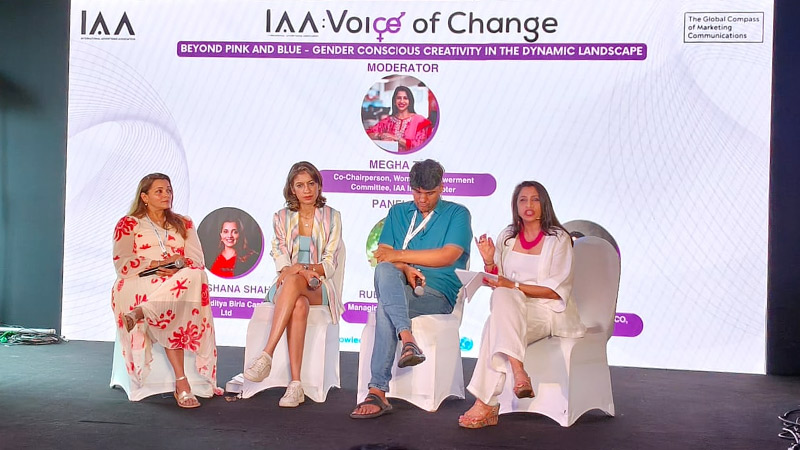
MUMBAI: Stirring the pot, not the soup, panel shreds the gender script in adland, Forget ‘pink for girls’ and ‘blue for boys’ at the GoaFest 2025 panel Beyond Pink and Blue, industry leaders dismantled the creative clichés still haunting adland like ghosts of campaigns past. From financial services to fashion, panelists shared both their victories and roadblocks in trying to make marketing more inclusive, authentic, and frankly, less boring.
Moderated by Megha Tata, the discussion brought together voices from across the spectrum like Aditya Birla Capital CMO Darshana Shah, Neil Patel Digital MD Rubeena Singh, Talented co-founder and CCO P.G. Aditya, and Makemytrip CMO Raj Rishi Singh.
Darshana Shah laid bare the startling findings of a study supported by UNICEF and the Gina Davis Institute: of over 1,000 TV and digital ads analysed using AI, women appeared as often as men but were largely stuck in kitchens or beauty aisles. Men, unsurprisingly, got to handle the chequebooks and cars.
Even more worrying was how these stereotypes are being hardcoded into generative AI tools. Shah recalled prompting image generators for a 40-year-old Indian woman, only to be served stocky brown-skinned figures wearing bindis with yoga pants. “Even when you say ‘no saree,’ the AI insists on putting her in one,” she quipped, pointing out how algorithms are learning from outdated media input.
As she explained, “We’re teaching AI stereotypes faster than we’re unlearning them ourselves.”
Despite leading marketing in a “quintessentially male-targeted” financial services firm, Shah has spearheaded campaigns like Motherhood on Hold, addressing the rising trend of women delaying childbirth due to financial independence. A staggering 45% of Indian women now make that choice, a reality rarely reflected in advertising.
Still, progress hits walls. Shah shared how she turned down a bold campaign idea around gender-transition challenges in financial documentation simply because the infrastructure and regulation weren’t ready. “We can’t just talk inclusivity if the backend systems still say ‘no’ to identity updates,” she said candidly.
P.G. Aditiya offered a refreshingly blunt perspective: “Old tropes are not just sexist, they’re creatively lazy.” Behind Talented’s much-lauded work for brands like Tanishq and Urban Company, he credited not just client bravery, but female creators leading the charge from strategy to direction.
He urged agencies to reframe inclusivity not just as ‘good business’ but ‘good storytelling’. Referencing the Bechdel Test (which Shawshank Redemption famously flunks), he said creatives should challenge the tired setups: men watching TV while women cook. “If your ad only works with that setup, your idea probably isn’t strong enough,” he said.
Digital may be dynamic, but it’s not immune to legacy mindsets. Rubeena Singh observed that while Gen Z consumers fluidly reject binary gender norms, media decision-makers largely male and over 45, still cling to archaic assumptions.
From fertility brands that shy away from including men in IVF discussions, to women’s safety campaigns unwilling to speak to male allies, Singh said, “We’ve won some battles, but most briefs still come in wearing blinders.”
And when briefs do break bias? “It’s usually the younger teams pushing it,” she said, advocating for greater representation at all levels—especially in client rooms where bold ideas often get neutered.
Across the board, the panel agreed: change starts with who’s in the room. Shah now insists on reviewing director lists for gender diversity before any campaign shoot. “If we want diverse stories, we need diverse storytellers,” she said.
The path to gender-conscious creativity may not be smooth, but panels like this prove the appetite for transformation is alive and well. As one speaker put it, “Doing the right thing is also often the more interesting creative path.”
Now that’s a plot twist adland could use.
Leave a Reply