
AD Agencies
An ‘Infectious’ association


MUMBAI: For colleagues at the then Saatchi & Saatchi who saw them fighting with each other, it came as a surprise when Ramanuj Shastry and Nisha Singhania quit within days of each other, to start an enterprise of their own.
Singhania makes no bones about it. “We still have a lot of fights. Of course, it’s all related to work, but we aren’t the kinds who will just nod our heads to what the other person has to say,” she admits. How do they resolve these conflicts? “We try and convince the other. At the end of the day, it is all about logic and creativity,” she answers.
What began as an association when the duo first met in Rediffusion Y&R blossomed into an up-and-coming agency christened ‘Infectious’. Ask them why such a title and Singhania says it has to do with their belief that their work should be infectious. “We wanted to solve clients’ business problems, rather than focus only on creating communication like large agencies. Our work is to engage people and for that to happen, the work had to be communicable. We wanted to start an epidemic of good with ideas that spread,” she adds.
The freedom to do the kind of work the two of them wanted to was the mainstay of this self-funded agency. “We wanted to ‘do’ as well as ‘say’. For instance, when Camlin asked us to create a print ad for Children’s Day, we ‘did’ an activity instead. We created a ‘join the dots’ ad, which kids had to colour and parents were urged to upload on their Facebook page. It was a very successful engagement and within 24 hours, took the likes on the Kokuyo Camlin FB page from 150 to 15,000,” says Shastry. The activity went on to be nominated by Facebook Studio for best use of the social networking website by any brand.
According to Singhania and Shastry, what sets their agency apart is the quality of ideas, lesser turnaround time, and personal involvement in every business. The client list is a mixed bag of biggies like HCL, DNA and Camlin and start-ups like Pied Piper and Braces & Smiles. For some clients, the agency handles all their marketing requirements while for others, it looks after specific projects.

For an organic set up, Infectious was lucky to have bagged two clients even before it launched. However, Singhania and Shastry are candid about the fact that clients are usually more comfortable giving business to larger agencies. Besides, it did take them a while before winning the confidence of heavyweights like HCL and DNA.
 |
Infectious is headquartered out of Mumbai with a presence in Chennai, Delhi and Kolkata and has a young, energetic, hand-picked team of 15 running it. “We have worked in various agencies, so when people heard that we were starting something of our own; we got a lot of calls, especially from the youngsters. And since we have worked with them, so we knew what we could expect from them. We are blessed to have hand-picked talent,” says Singhania.
In addition to having a young team, the agency saw no harm in advertising itself. “Very few advertising agencies ever advertise about themselves. What is the harm in doing so? The logo adaption is our way of having fun. Digitally, one can do so much to engage with people, let alone clients,” says Shastry. Though he quickly adds that at its core, the business is still about ideas and digital is only a medium. Speaking of elections, he says that most political parties engaged and optimized their reach via the digital medium. Even Infectious created a special campaign along with DNA to urge people to go out and vote.
What do the next five years look like for Infectious? “Five years is a very long time. We are a ‘work in progress’ agency, with plans for the next 100 days,” say Shastry and Singhania at once.
What about network agencies snapping up independent agencies? The duo feels that in most cases, it is a win-win situation where network agencies bring in resources and scale while independent agencies bring in local expertise.
And with Goafest coming up, the agency which is all for awards as long as they are for real work, the future holds only great promises.
One wouldn’t be wrong in saying that like Monday mornings and coffee (chai, in some cases), Singhania and Shastry are a perfect combo.












MUMBAI: Innocean has renewed its global media partnership with Havas Media Network following an internal review across Hyundai Motor Group brands.
The renewed mandate spans Hyundai, Kia and Genesis across Europe, the Middle East, Asia Pacific and Latin America. The work will be coordinated with Innocean’s international teams in Seoul, Frankfurt, Dubai, New Delhi and Jakarta.
The refreshed alliance is designed with a sharper focus on data and technology, aiming to connect the dots across customer acquisition, conversion and retention as the Group’s global audience continues to diversify.
Innocean head of global business Steve Jun, said the extension reflects a shared push for stronger, data-led media performance across key markets. He added that the partnership would focus on creating more connected and effective customer experiences for Hyundai Motor Group brands.
Havas Media Network global CEO Peter Mears, described the relationship as one built on innovation and global scale. He said the next phase would lean on the network’s Converged.AI platform to deliver seamless, data-driven media experiences and drive business outcomes for the automotive brands.
The renewed partnership officially commenced in January 2026.

INDIA: India’s advertising industry is entering a new phase of structural transformation, with digital media now the central growth engine, according to the Dentsu digital advertising report 2026.
Total advertising spends closed 2025 at Rs 1.21 lakh crore, up 8.3 per cent year on year, and are projected to reach Rs 1.40 lakh crore by 2027, implying a compound annual growth rate of over 7 per cent.
Digital advertising accounted for Rs 71,621 crore in 2025, representing 59 per cent of total spends. By 2027, digital’s share is expected to rise to around 70 per cent, with spends nearing Rs 98,034 crore.
The report stresses that this is no longer a temporary shift but a permanent rebalancing of advertising priorities, driven by mobile-first consumption, short-form video, creator ecosystems, embedded commerce and AI-led optimisation.
Retail media has emerged as the fastest-growing segment, with ad spends on e-retail platforms reaching Rs 17,601 crore in 2025: a surge of nearly 56 per cent year on year. Retail platforms are evolving into full-funnel media ecosystems, linking storytelling directly with purchase outcomes through first-party data.
Within digital formats, social media leads with a 29 per cent share, closely followed by online video at 28 per cent, while paid search contributes 23 per cent. Online video is expected to overtake social as the largest digital format over the next two years.
Programmatic buying now accounts for 42 per cent of digital spends, exceeding Rs 30,000 crore, and is increasingly becoming the default media operating layer across video, connected TV and retail platforms.
FMCG remains the largest advertising category at 30 per cent of total spends, followed by e-commerce at 18 per cent, which also recorded the fastest growth.
Dentsu South Asia chief executive Harsha Razdan said the most meaningful industry shift has been in how consumers consciously allocate attention.
Dentsu South Asia president and chief strategy officer Narayan Devanathan, added that the next growth phase will belong to organisations that successfully integrate creativity, data, media and technology.
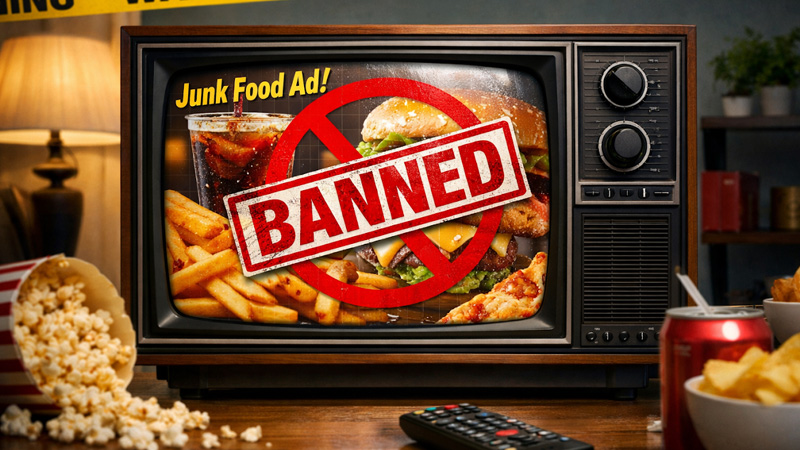
DELHI: India is staring down a junk food epidemic, and the government wants to fight back with an advertising ban. The Economic Survey, tabled in the Lok Sabha on Thursday, has pitched a radical proposal: prohibit ultra-processed food advertisements from 6am to 11pm across all media platforms.
The timing is hardly coincidental. India has become one of the world’s fastest-growing markets for ultra-processed foods: those calorie-laden concoctions of burgers, noodles, pizza and soft drinks that increasingly dominate Indian diets. The consequences are written in the waistlines of a growing number of Indians.
Excess weight among children under five has jumped from 2.1 per cent in 2015-16 to 3.4 per cent in 2019-21, the survey notes. More troubling still, over 3.3 crore children in India were obese in 2020, with projections suggesting that figure will balloon to 8.3 crore children by 2035.
The numbers for adults paint an equally grim picture. According to the 2019-21 National Family Health Survey, 24 per cent of Indian women and 23 per cent of Indian men are overweight or obese. Among women aged 15-49 years, 6.4 per cent are obese, whilst among men, 4 per cent are overweight, the survey said.
The pre-budget document doesn’t mince words about the scale of the challenge. To tackle ultra-processed foods, it advocates front-of-pack nutrition labelling for high-fat, sugar and salt foods, with warnings that restrict marketing to children and ensure trade agreements don’t undermine public health policy.
The survey also suggests restrictions on marketing infant and toddler milk and beverages, whilst flagging growing obesity among children.
The proposed marketing ban would run from 0600 hours to 2300 hours across all media, with mandatory enforcement of restrictions on marketing infant and toddler milk and beverages.
India isn’t treading new ground here. The survey points to Chile, which has integrated such laws, along with Norway and the UK, where advertisement restrictions are already in place for ultra-processed foods.
Britain recently banned junk food advertising before 9pm on television and online to reduce children’s exposure and curb childhood obesity. Further action on other marketing activities, including school and college sponsorship of events by ultra-processed food manufacturers, can be designed, the survey said.
Yet India’s regulatory landscape remains muddled. Rule 7 of the Advertisement Code prohibits misleading, unverified, or unhealthy advertisements but doesn’t define “misleading” with measurable or nutrient-based criteria, leaving interpretation subjective and inconsistent.
Similarly, the Central Consumer Protection Authority guidelines for prevention of misleading advertisements (2022) mandate that advertisements must not exaggerate health benefits or exploit children.
Yet they lack clear nutrient thresholds or a framework for identifying misleading claims in food marketing, the survey said, adding that this regulatory ambiguity allows companies marketing ultra-processed foods to continue making vague health, energy, or nutrition cues without violating any clearly defined standard, highlighting a critical policy gap that needs reform.
The stakes couldn’t be higher. India is one of the fastest-growing markets for ultra-processed food sales, contributing to chronic diseases worldwide and widening health inequalities.
The survey lays bare the commercial triumph of junk food in India. Sales of ultra-processed foods grew more than 150 per cent between 2009 and 2023. Retail sales surged from $0.9 billion in 2006 to nearly $38 billion in 2019, a 40-fold rise. It is during the same period that obesity has nearly doubled in both men and women, the survey said.
The document advocates a multi-pronged approach to tackle the rising consumption of ultra-processed foods (popularly known as junk foods), which includes burgers, noodles, pizza, soft drinks, and the like, warning it is contributing to chronic diseases worldwide and widening health inequalities.
Improving diets cannot depend solely on consumer behaviour change, the survey argues. It will require coordinated policies across food systems that regulate ultra-processed food production, promote healthier and more sustainable diets and marketing.
The gauntlet has been thrown. Whether India’s policymakers have the stomach to take on the junk food industry remains to be seen.


Hamdard honours changemakers at Abdul Hameed awards

Why the Best Campaigns Today Start With Insights, Not Ideas

Ahmad Muneeb elevated to VP – HR centre of excellence at Zepto

Fans Take Centre Stage as Zee Cine Awards Turns the Spotlight Around

GUEST COLUMN: How content leaders decide what gets greenlit

The man who dubbed Lord of the Rings in 50 languages is stunned by Mumbai traffic

Dell names Aishwarya Sudhakar director of marketing intelligence

These ’90s fashion trends are making a comeback in 2017
The final 6 ‘Game of Thrones’ episodes might feel like a full season
According to Dior Couture, this taboo fashion accessory is back
The old and New Edition cast comes together to perform
Phillies’ Aaron Altherr makes mind-boggling barehanded play
Uber and Lyft are finally available in all of New York State
Disney’s live-action Aladdin finally finds its stars
Hamdard honours changemakers at Abdul Hameed awards
Why the Best Campaigns Today Start With Insights, Not Ideas
Ahmad Muneeb elevated to VP – HR centre of excellence at Zepto
Fans Take Centre Stage as Zee Cine Awards Turns the Spotlight Around
GUEST COLUMN: How content leaders decide what gets greenlit
The man who dubbed Lord of the Rings in 50 languages is stunned by Mumbai traffic
Dell names Aishwarya Sudhakar director of marketing intelligence
-

 News Broadcasting4 days ago
Mukesh Ambani, Larry Fink come together for CNBC-TV18 exclusive
-

 iWorld1 week ago
Netflix celebrates a decade in India with Shah Rukh Khan-narrated tribute film
-
 MAM3 months ago
HoABL soars high with dazzling Nagpur sebut
-

 MAM4 days ago
Nielsen launches co-viewing pilot to sharpen TV measurement
-
 iWorld12 months ago
BSNL rings in a revival with Rs 4,969 crore revenue
-
 I&B Ministry3 months ago
India steps up fight against digital piracy
-
 iWorld3 months ago
Tips Music turns up the heat with Tamil party anthem Mayangiren
-

 Film Production1 week ago
UFO Moviez rides high on strong Q3 earnings
