
DTH
Dish TV: Scaling up on numbers & value proposition

Zee Telefilms chairman Subhash Chandra is on a roll. The resurgence of flagship Hindi entertainment channel Zee TV has come after years of slippage since Kaun Banega Crorepati catapulted Star plus into leadership position.
But this is not just about Zee TV‘s prime time assault on Star Plus; it is also about how Chandra has streamlined his media empire to give it the right focus, resources and value. His announcement on 29 March: Zee Telefilms will be de-merged into four separate entities. While cable business will come under Wire and Wireless India Ltd (WWIL), Dish TV will handle the DTH operations. News and regional channels are being consolidated in Zee News Ltd. Under the umbrella of Zee Telefilms will be the newly launched Zee Sports.
The “sum total of the parts” concept ignited the scrip which, once hovering around Rs 130-150 in mid-2005, has breached the 200-mark and closed today at Rs 222.
In the second of a four-part series, Indiantelevision.com takes an in-depth look into the de-merged DTH business of Zee Telefilms.
The battle for supremacy between News Corp chairman Rupert Murdoch and Subhash Chandra will be extended to the DTH arena this year. The commercial launch of Tata Sky, a 80:20 joint venture between Tata Group and Star (now expected to happen only some time in August-September), will see a hell of a scramble for subscribers with focus on pricing, quality of service, value-added services and marketing.

Chandra‘s gameplan is to build a sizeable early lead before the fight for share in the market takes shape. Having launched Dish TV over two years back, he has already snapped up 1.15 million DTH subscribers. And he expects to mop up an additional one million by the end of this fiscal.
 Even before Tata Sky can settle down and get its products out of the door, Chandra is in a hurry to launch an array of value-added services. Movie-on-demand is already available and soon to launch is gaming and interactivity. The idea is to fill up the product portfolio as quickly as possible.
Working on the content side, he has recently stitched a deal with SET-Discovery to offer a bouquet of 12 channels on his platform. Star‘s channels should also come on board, perhaps closer to launch of Tata Sky. Armed with full content, Dish TV will be able to aggressively target more urban and upscale subscribers in the course of the year.
The DTH operations has already consumed a net expense of Rs 3.8 billion. A further investment of Rs 2.5 billion has been lined up over a two-year period, mainly to subsidise the set-top boxes (STBs). “But we are sitting on a dynamic model and if Tata Sky and us are aggressively competing on pricing, there is a possibility of the subsidy amount further increasing. It is a factor of what strategies we adopt to develop our subscriber base,” says Essel Group CEO of corporate strategy Rajiv Garg.
Placing his bets on both cable and DTH, Chandra ensured that he started operations much before Murdoch could jump over the regulatory hurdles. The strategy was in place: mobilise the cable dark and rural subscribers, offer them a basic bandwidth of channels, tie up content as they come, drive in volumes and command clout.
The start was slow. Then came the “dish-har-chhat-par” (a dish on every rooftop) pricing scheme of Rs 3,990 (almost halving the hardware prices and subscription fees for a year) last April and the market in specific territories just opened up.
 Targeting DD Direct‘s customers, Dish TV also announced a “Dish Freedom Package” plan in January. This offers viewers 40 channels in digital quality without charging any monthly subscription fee, but they had to make a one-time investment of Rs 2,690 in a digi box. Clearly, the strategy was to get into a different segment of customers and slowly entice them to upgrade to the other packages.
Dish TV‘s subscriber base grew and by the end of FY06 it touched close to one million. Almost 70 per cent of the consumers came from the cable dry and smaller towns, but it suited Chandra to an extent by giving him a headstart over Murdoch. As he also has presence in cable TV, his muscle in the distribution business has grown.
A fallout of this model, though: low ARPUs (average revenue per user). While revenue from DTH operations stood at Rs 818 million for FY06, net loss was at Rs 790 million on the back of subsidies and marketing expenses. The ARPU by the end of the year was hovering around Rs 190.
The task this year will, thus, be to drive up the ARPUs to at least Rs 250. The content tie up with Sony and later Star will help achieve this. After the deal with SET-Discovery, Dish TV has increased the price of its basic tier by Rs 38. “By providing the first year subscription for free, Dish TV‘s financials don‘t reflect the paying capacity of the subscribers. But if consumers decide to continue with the service after this period, the incremental subscription revenues from the DTH venture would be sizeable. The problem will arise if they decide to drop out at the time of renewal,” says an analyst.
Dish TV is also banking on value-added services (VAS) to realise more from subscribers. Says Garg, “Beginning 1 September, VAS will be accounted for separately from the ARPUs. We expect VAS to average Rs 40 per subscriber. Since this will be for a stretch of seven months, the average during the fiscal will work out to Rs 22-23,” says Garg.
Dish TV‘s revenue projections look healthy. For FY07, the target is fixed at Rs 3.2 billion on a subscriber base of 2.4 million and an ARPU of Rs 250. And in FY08, the turnover is expected to touch Rs 8 billion as subscribers rise to 3.15 million and ARPU to Rs 310.
An analyst at a trading firm is optimistic about Dish TV‘s growth. “Even after the launch of Tata Sky, the DTH market is large enough to provide space for growth to the two service providers,” he says.
Dish TV, however, will continue to be in a net loss situation this fiscal. According to a report on Zee by a brokering firm, Dish TV‘s net loss will be Rs 368.4 million while subscribers are expected to grow to 2.07 million and revenue to Rs 3.29 billion on an ARPU of Rs 250. But the picture changes completely in FY08 and the operations become profitable, says the firm.
The situation, though, is completely fluid and a lot will depend on how Tata Sky prices its services. DTH takeoff will also have to factor in the responses from the cable TV industry and the entry of other DTH operators like Anil Ambani‘s Reliance with its Blue magic offering and Kalanithi Maran‘s Sun Group with Sun Direct.
So far, Chandra has been clever not to alienate the cable TV operators but play safe on both the platforms. Tata Sky, on the other hand, has drawn hostility from the operators with its MDU (multi-dwelling unit) technology in high-rise residential buildings.
Prices could plummet if competition intensifies, putting profitability under threat. Tata Sky, in fact, has indicated a monthly subscription price of Rs 250 for all the Hindi channels and an upper-end fee of Rs 550, according to a dealer. It is also expected to subsidise heavily the hardware costs. “The pricing is very tentative at this stage and executives from Tata Sky will have a meeting with the dealers closer to date of launch,” he adds. Tata Sky CEO Vikram Kaushik was not available for comment.
For an infant business venture, DTH operators may not worry about profitability at such an early stage. Their main concern will be to allow the market to expand, acquire customers, keep them locked over a longer period, and then make them pay more for various services. Volumes is what all of them will be hunting for.
Dish TV‘s pricing strategy so far has reflected this line of thinking. It has promoted the DTH service packages with a lock-in period bundled along with the initial subscription. Says Garg, “The bulk of the subscription selling has been on the business of this bundle which includes a subsidy element. Subscription revenue, thus, starts typically one year after the creation of the subscriber relationship. So you would see these one million subscribers in FY06 gradually come into the subscription fold during this year.”
Chandra, meanwhile, is sprucing up the distribution network. Dish TV recently tied up with HCL Infosystems for a five-year partnership to utilise the IT major‘s distribution and service support across the country. While Dish TV will immediately double its distribution reach with this tie-up, the alliance will enable HCL Infosystems to offer digital entertainment services as part of its digital lifestyle portfolio.
“Scopus‘ product line will help us achieve very high satellite utilisation and bring down costs on a per channel basis. We plan to implement this better compression technology within a month. We will be able to increase our capacity to 150 channels,” says Essel Group director of technology Amitabh Kumar.  Dish TV has also addressed another problem: how to increase offerings by accommodating more channels per transponder. It has recently tied up with Scopus Video Networks, a provider of digital video networking products. Having taken seven transponders on NSS-6, Dish TV can pack up to 150 channels using this compression technology.
For pursuing plans of offering 200 channels, Dish TV has booked more transponders on NSS. Even when DD Direct Plus, Doordarshan‘s free DTH service, migrates from NSS-6 to Insat 4B, Dish TV will face no space crunch. “We can bunch all the DD channels into one transponder. We have also requested for more transponders on NSS-6 which will be available during the course of the year for us,” says Kumar. Dish TV currently offers 110 channels in addition to the 33 channels of DD Direct Plus which are also available to its consumers.
So ahead of the skirmish, Chandra has strengthened his armoury. Sure enough, the war for DTH subscribers is about to begin and escalate.
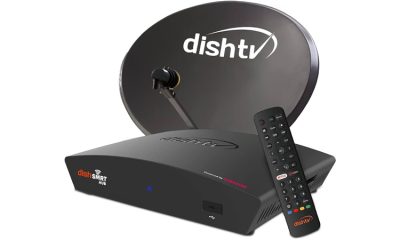










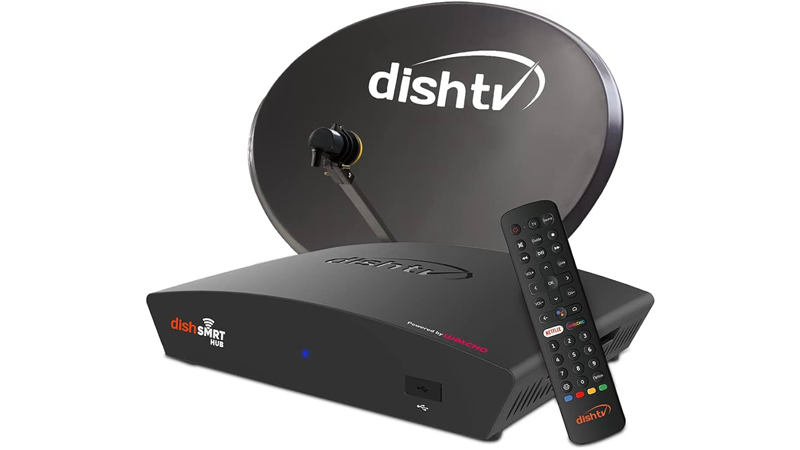
NOIDA: When the remote stops working, you don’t throw it away, you change the batteries. Dish TV is trying something similar. Faced with falling subscription revenues and a fast-shrinking DTH universe, India’s once-dominant satellite broadcaster is flipping channels, betting on smart TVs, OTT aggregation and a hybrid future even as the numbers flash red.
For the quarter ended 31 December, 2025, Dish TV India reported operating revenues of Rs 2,991 million, down 19.8 per cent year-on-year from Rs 3,730 million. Subscription revenues, still the backbone of the business, fell sharply by 32.2 per cent to Rs 2,245 million, reflecting industry-wide cord-cutting and persistent churn. The pain shows up clearly below the line.
Ebitda swung to a loss of Rs 415 million, compared with a profit of Rs 1,227 million a year earlier. Total expenditure climbed 36.1 per cent to Rs 3,406 million, pushing costs to nearly 114 per cent of operating revenues. The quarter closed with a loss before tax of Rs 2,762 million, weighed down further by exceptional items of Rs 700 million. Yet the company insists this is not a business stuck buffering, but one deliberately loading a new format.
Dish TV is repositioning itself from a pure DTH operator into what it calls a connected-home entertainment platform, stitching together live television, OTT apps and smart devices. The centrepiece of that strategy is the nationwide rollout of VZY smart TVs, offering a unified DTH-plus-OTT experience.
Amazon Prime Video has now been integrated across Dish TV’s ecosystem, including Watcho and VZY. Watcho, the company’s in-house OTT super app, has crossed millions of downloads and paid subscribers, aggregating more than 25 content apps.
Fliqs, its creator-driven content platform, is being pitched as a home for premium regional and international programming. Brand visibility has also been boosted through splashy partnerships with Bigg Boss Hindi and Bigg Boss Kannada: high-decibel bets in a crowded attention economy.
“Indian home entertainment is undergoing a structural shift,” said CEO and executive director Manoj Dobhal arguing that Dish TV’s hybrid model improves convenience while keeping customers within a single ecosystem. The revenue mix shows early signs of diversification, even if it is not yet compensating for falling subscriptions.
Marketing and promotional fees rose 27.3 per cent to Rs 399 million, while advertisement income, still small, nearly doubled to Rs 48 million. Other operating income surged 267.6 per cent to Rs 298 million, softening the overall revenue decline.
On costs, the company is tightening the screws. It has renegotiated transponder contracts, rationalised call-centre and general expenses, and improved asset discipline by boosting set-top box recovery beyond 30 days, reducing swap frequency and replacement capex.
New customer activations are being driven through a no-subsidy Rs 999 set-top box, a move management says materially improves unit economics and cash flow. Still, risks remain stubbornly in view. Churn continues to shadow the business, and scaling Watcho while balancing content spend will demand execution discipline.
Cost cuts, the company admits, must not erode service quality: a delicate act in a market where customer loyalty is already thin. For now, Dish TV’s numbers tell a story of strain.

MUMBAI: Tata Play is doubling down on regional loyalty. India’s leading DTH player has launched Tata Play Odia Manoranjan, a new value-added service that corrals Odia entertainment into a single, ad-free destination, available on television and the Tata Play mobile app.
Powered by Sidharth TV, one of Odisha’s most popular Odia-language GECs, the platform serves up a hefty catalogue: over 180 movies, 100+ Jatras, around 20 television shows and a library of more than 12,000 songs spanning devotional, folk, film and non-film genres. From vintage favourites to contemporary titles, the mix is pitched squarely at Odia-speaking households, with particular pull in tier-3 and tier-4 markets.
Subscribers get 24×7, full-screen SD viewing without ad breaks on channel number 1755, with live TV and VOD access across screens. The price point is deliberately sharp: Rs 2 a day.
Pallavi Puri, chief commercial and content officer at Tata Play, framed the move as a bet on language and culture. “India’s strongest viewing loyalties are rooted in language and lived culture. Tata Play Odia Manoranjan brings together the many expressions of Odia entertainment—from films and Jatras to devotional programming and music—into one clearly defined destination. With this launch, Tata Play further elevates its regional content offering by giving Odia audiences a single, definitive home for their stories and traditions.”
For Sidharth TV Network, the partnership is about reach without compromise. Sitaram Agrawalla, owner and chairman, said: “For decades, Odia families have trusted our entertainment platforms for stories that feel like home, and for moments that bring us together. Tata Play Odia Manoranjan builds on this trust by placing a diverse range of Odia films, theatre, devotional music and shows into a single, accessible space. This collaboration isn’t just about wider distribution—it’s about honouring the preferences of Odia viewers with a seamless, ad-free viewing experience that reflects their language, culture and the way they choose to engage with content.”
The new service slots into Tata Play’s expanding portfolio of entertainment and infotainment platform services across genres including entertainment, kids, learning, regional and devotion, catering to all age groups.
In short: one language, one screen, zero ads—and a clear signal that regional is where the real viewing power lies.
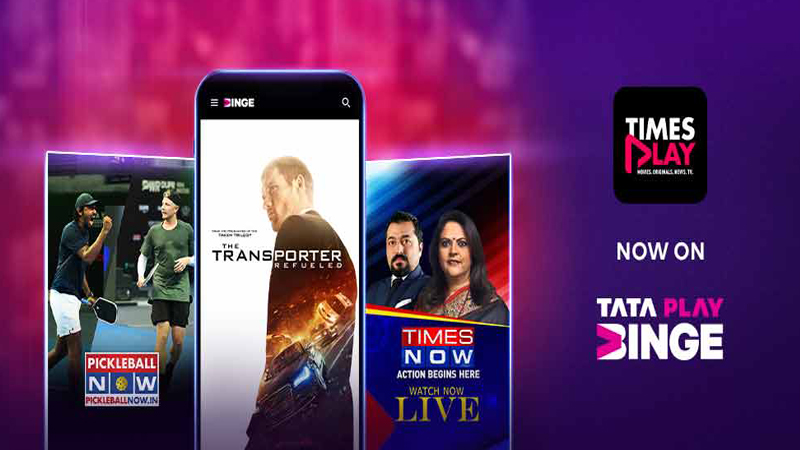
MUMBAI: If streaming had galaxies, Tata Play Binge just opened a wormhole. In its latest move to become India’s most sprawling entertainment universe, the platform has now folded Times Play, Times Network’s digital-first OTT service, into its all-in-one subscription bouquet bringing Hollywood hits, snackable shorts, live news, lifestyle, entertainment, Pickleball and 11 live TV channels under a single roof.
The new addition means subscribers no longer need to hop between apps in Olympic-level finger gymnastics, Binge now pulls Times Network’s entire digital catalogue into one screen, one login, one bill. And in the era of attention overload, that’s practically a public service.
Times Play brings with it a distinctive blend of premium Hollywood cinema, web series, short-format videos, and Times Network’s formidable news muscle. Viewers can flip seamlessly between Romedy Now, Movies Now, MNX, MN+, Zoom, Times Now, Times Now Navbharat, ET Now, ET Now Swadesh, and even Pickleball Now, mirroring the growing Indian appetite for niche sporting entertainment.
On the long-form front, hits like Reunion, India’s Story, True Story of Angeline Jolie, Orphan First Kill, The November Man, Barely Lethal, Southpaw, The Hurt Locker, Transporter Refueled, and The Holiday sit alongside Times Network factual and current-affairs staples including Frankly Speaking, Sawaal Public Ka, and News Ki Paathshaala.
Describing the partnership, Tata Play chief commercial and content officer Pallavi Puri, said the aim remained unchanged to make content discovery effortless and reduce the modern curse of app overload. She noted that integrating Times Play enriches Binge’s already deep catalogue with a broader mix of premium films, originals and news programming “without juggling multiple apps or subscriptions”.
Times Network echoed the sentiment, calling the collaboration a natural extension of its mission to deliver credible entertainment and journalism at scale. It emphasised Tata Play’s reach, reliability and reputation as a key driver in bringing Times Play’s digital catalogue to diverse Indian households.
With the addition of Times Play, Tata Play Binge now boasts 30 plus OTT platforms on a single interface, a list that includes Prime Video, JioHotstar, Zee5, Apple TV+, Lionsgate, SunNXT, Discovery+, BBC Player, Aha, Fancode, ShemarooMe, Hungama, ManoramaMax, Nammaflix, Tarang Plus, Travel XP, Animax, Fuse+, ShortsTV, Curiosity Stream, and DistroTV, among others.
Notably, Netflix remains available as part of combo packs for DTH subscribers, while Amazon Prime Video can be unlocked as an add-on for Binge users with a Tata Play DTH connection. And for large-screen loyalists, all 30 plus apps can be streamed via LG, Samsung and Android Smart TVs, the Tata Play Binge+ set-top box, Amazon FireTV Stick – Tata Play edition, or through TataPlayBinge.com.
The expansion comes on the heels of recent integrations, including WAVES by Prasar Bharati and BBC Player, reinforcing Tata Play Binge’s ambition to remain India’s most diverse, most unified, and most fuss-free entertainment destination.
With Times Play now in the mix, Binge isn’t just aggregating content, it’s quietly aggregating the future of how India watches.


MIB sets OTT accessibility rules, mandates captions and audio description

Boney Kapoor acquires remake rights of Tamil political satire Thalaivar Thambi Thalaimaiyil

Netflix India names Rekha Rane director of films and series marketing

Zabeen signs off from TV9 after shaping the network’s public voice

Dhawan steps up to bat for Delhi’s grassroots sports push

Orient Beverages pops the fizz with steady Q3 gains and rising profits

Cheekatilo shines in the dark with record debut on Prime Video

These ’90s fashion trends are making a comeback in 2017
The final 6 ‘Game of Thrones’ episodes might feel like a full season
According to Dior Couture, this taboo fashion accessory is back
The old and New Edition cast comes together to perform
Phillies’ Aaron Altherr makes mind-boggling barehanded play
Uber and Lyft are finally available in all of New York State
Disney’s live-action Aladdin finally finds its stars
MIB sets OTT accessibility rules, mandates captions and audio description
Boney Kapoor acquires remake rights of Tamil political satire Thalaivar Thambi Thalaimaiyil
Netflix India names Rekha Rane director of films and series marketing
Zabeen signs off from TV9 after shaping the network’s public voice
Dhawan steps up to bat for Delhi’s grassroots sports push
Orient Beverages pops the fizz with steady Q3 gains and rising profits
Cheekatilo shines in the dark with record debut on Prime Video
-

 News Broadcasting6 days ago
Mukesh Ambani, Larry Fink come together for CNBC-TV18 exclusive
-
 I&B Ministry3 months ago
India steps up fight against digital piracy
-

 iWorld1 week ago
Netflix celebrates a decade in India with Shah Rukh Khan-narrated tribute film
-
 MAM3 months ago
HoABL soars high with dazzling Nagpur sebut
-
 iWorld12 months ago
BSNL rings in a revival with Rs 4,969 crore revenue
-

 MAM6 days ago
Nielsen launches co-viewing pilot to sharpen TV measurement
-
 iWorld3 months ago
Tips Music turns up the heat with Tamil party anthem Mayangiren
-

 Film Production2 weeks ago
UFO Moviez rides high on strong Q3 earnings
