
DTH
DIRECT TO HOME (DTH) – AN INSIGHT TO THE INDIAN SCENARIO

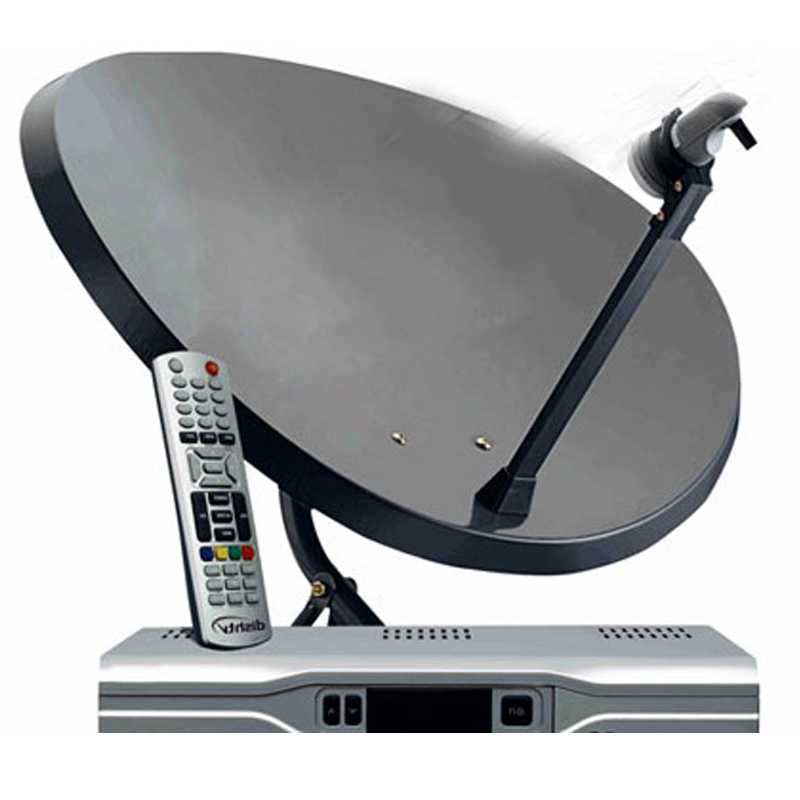
The only constant in today’s Media industry is change. Given the growth and significance of this industry in the global economy, this change puts industry players in a permanent position of assessing new products, services and enabling technologies. Customers worldwide have become extremely choosy on what they want and it has become a challenge for the media players to not only meet such demands but also constantly innovate to stay alive in an extremely competitive environment. The likelihood of investing in a white elephant or “missing the train” of a successful product opportunity is surely as great as identifying the right product at the right time. Direct to Home (DTH) broadcasting has been one such area of high investment with a dual purpose of effecting good revenues in the long run and providing top class services as well.
Direct-To-home (DTH) TV distribution is one in which a large number of channels are digitally compressed, encrypted and beamed from very high power satellites. The programs can be directly transmitted to homes, using very small dish antennae and card operated Integrated Receiver Decoders (IRDS). It normally provides a basic service consisting of a certain number of channels at a particular cost. DTH can provide a lot of other high revenue generating, value-added services like Internet Access, Video Conferencing, Video On Demand, Home security/Shopping/Banking, E-mail, Pay Per View, Near Video On Demand and Data Broadcasts.
The Market dynamics of DTH could be broadly classified as Broadcast policies and regulations, Market potential, Major players involved in DTH consortia, Costs, Revenues, Value added services, Evolving technologies and Superior content and connectivity. The DTH end-to-end service value-chain is complex, technologically sophisticated and includes almost all aspects of broadcasting, such as satellite ownership/bulk leasing of transponders, large scale broadcasting studios/up-link earth-station, acquisition/production/arrangement of many programming channels, user-friendly creation of an Electronic Programme Guide, sourcing/distribution/technical support of subscribers reception equipment, elaborate marketing of DTH services, comprehensive subscription billing systems and revenue collection, etc. These diverse requirements coupled with considerable financial risks involved, means that a consortium of companies into these services is the best likely solution for this venture.
Certain Business Projections have been drawn for DTH service providers in India based on three parameters namely- Subscriber base, Project cost and Revenues. These parameters have been projected for the total market size for DTH in India.
Subscriber Estimates– Firstly, since cable has penetrated the Indian market in a big way with roughly 35 million C&S homes, a parallel can been drawn with the U.S market pattern where cable was the first mover, present now in approximately 160 million households compared to a mere 10 million DTH homes. Due to this critical penetration achieved by CATV in India it is imperative that in its first few years of operations, DTH will be focused on a niche market. This niche would basically constitute the rich segment from urban as well as rural areas due to the primary reason of high initial costs for DTH and the associated psychology of people. The second reason could be the better service and value added services (VAS) like pay per view (PPV), NVOD and Internet being offered on DTH. Two approaches have been drawn for the subscriber projections. One is based on the disposable income of the population and the second based on cannibalization of CATV, multiple TV households and VAS, the projections from the two being approximately the same.


Project Cost Estimates- Broad business assumptions here are that, a DTH platform would carry about 70 odd channels with additional services like PPV, NVOD and Internet. The principal costs would involve programming costs, satellite transponder costs, Conditional Access systems, Customer Premise Equipment costs and Marketing costs associated with DTH. It is found that the cost of financing the Customer Premises Equipment is massive and therefore it is viable to finance the set top box (STB) and dish antennae, the cost of which can be recovered from the customers on a monthly basis. However, it is assumed that the customer will pay for the installation charges. It is also interesting to note that financing the STB and dish antennae accounts for more than 75% of the project cost and is extremely price sensitive. Therefore a slight change in these equipment costs would significantly change the project cost. Drawing a parallel with cable costs here, it is seen that initially cable connections were costly. In fact one had to pay deposits too. However with the popularity of cable the costs reduced drastically. The same is expected to happen with DTH equipment whose costs are assumed to decrease by 10% on an annual basis.

Project Revenue Estimates- The major business assumptions here are that, since a large chunk of the project cost deals with financing the equipment for DTH, so too will the earnings from recovering this cost from the subscribers form the major component of revenues earned. Therefore a decrease in the cost of equipment would actually help in faster recovery of the expenses incurred. The other broad channels of revenues are base subscription, bouquet subscription, and NVOD, PPV and Internet usage.

Opportunities for DTH in India look great. There exists a tremendous potential for direct to home broadcast in this market and it is projected that by 2005 there would be around 2.5 million DTH subscribers in India. This figure is likely to increase due to the increase in TV and Cable households and also the growing multiple TV households, which would form a large percentage of the total subscriber base. Since India’s population crossed the one billion mark, it is no surprise that satellite operators and programmers world-wide have set their sights on the world’s largest open market for DTH satellite TV services. The growing popularity of TV as a communication medium has resulted in the TV media sectors undergoing a rapid transformation. Also when DTH transmissions start in India the market will open for the following types of equipment -Ku-band dish antennae and Integrated Receiver Decoders (IRD). In a couple of years with Multipoint Microwave Distribution System and Net Television the whole digital domain is going to open up very fast. DTH can help in narrower targeting of satellite delivered services, rather than a single regional service, allowing programming to be more directly geared to the interests, language and culture of the particular audience, as well as providing a vehicle that integrates and offers locally produced and local language material.
Drawing a parallel with the American DTH market, certain conclusions are drawn. Cable has been an early mover in India like in the U.S and with DTH operations starting as early as ‘ 92 the American DTH market is 10 million homes big as of today compared to 160 million cable homes. Similarly, with cable penetrating 35 million homes in India, given the time and resources, the DTH market size would stand at approximately 5 million homes by 2007 assuming operations start by 2002. The American TV household is roughly about 90% of the total U.S population with a figure of 2.24 TV’s per household. This number has grown tremendously over the last 15 years and fast approaching saturation. This is boom time however, for the Indian TV market with numbers expected to touch 100 million six years hence from the present figure of 70 million odd. This combined with the growing multiple TV households shall triple the DTH subscriber base in 2004 from the 0.5 million expected in 2002(starting year of operation). Finally, the two main operators for DTH in the U.S, DirecTV and Echostar account for 95% of the total DTH subscriber base there and have proved to been extremely profitable. This has thrown a similar picture for the Indian scenario where not more than two DTH service providers could coexist profitably.
In conclusion, it has now been over a decade since DTH satellite broadcasting began to show promise as a new technology capable of widespread distribution of programs and services. In those early days, the prime concern of many governments was that the spread of DTH satellite would result in mass Americanization and a decline in the cultural values and ideas of their people. The solution that has to be found is to maintain some form of national control, ranging from outright ban on ownership of satellite signal receiving equipment, to introducing licensing regimes, prescribing guidelines for program content and placing limits on foreign ownership of broadcasting licenses or ventures. The present DTH policy drawn addresses some of these issues which effectively strikes a balance between the economic benefits of introducing new services, the consumer demand for change and the government’s overriding interest in maintaining control over broadcasting. It remains to be seen how India will strike a final balance in the structuring of its laws and regulatory scheme to maximize the benefits of the new technologies, whilst ensuring that the national and public interests in the control and content of those services are protected.
*The article is authored by Monideep Chattopadhay, a student of the ICFAI Business School, Bangalore.
*All arguments and views expressed herein are the authors’ personal views.





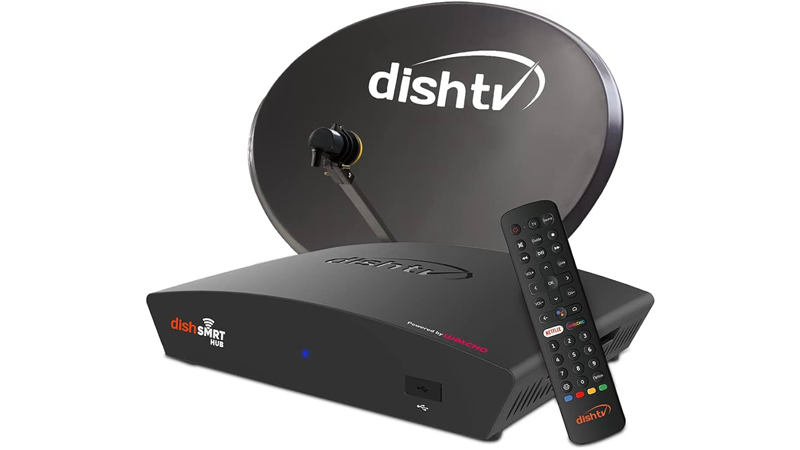
NOIDA: When the remote stops working, you don’t throw it away, you change the batteries. Dish TV is trying something similar. Faced with falling subscription revenues and a fast-shrinking DTH universe, India’s once-dominant satellite broadcaster is flipping channels, betting on smart TVs, OTT aggregation and a hybrid future even as the numbers flash red.
For the quarter ended 31 December, 2025, Dish TV India reported operating revenues of Rs 2,991 million, down 19.8 per cent year-on-year from Rs 3,730 million. Subscription revenues, still the backbone of the business, fell sharply by 32.2 per cent to Rs 2,245 million, reflecting industry-wide cord-cutting and persistent churn. The pain shows up clearly below the line.
Ebitda swung to a loss of Rs 415 million, compared with a profit of Rs 1,227 million a year earlier. Total expenditure climbed 36.1 per cent to Rs 3,406 million, pushing costs to nearly 114 per cent of operating revenues. The quarter closed with a loss before tax of Rs 2,762 million, weighed down further by exceptional items of Rs 700 million. Yet the company insists this is not a business stuck buffering, but one deliberately loading a new format.
Dish TV is repositioning itself from a pure DTH operator into what it calls a connected-home entertainment platform, stitching together live television, OTT apps and smart devices. The centrepiece of that strategy is the nationwide rollout of VZY smart TVs, offering a unified DTH-plus-OTT experience.
Amazon Prime Video has now been integrated across Dish TV’s ecosystem, including Watcho and VZY. Watcho, the company’s in-house OTT super app, has crossed millions of downloads and paid subscribers, aggregating more than 25 content apps.
Fliqs, its creator-driven content platform, is being pitched as a home for premium regional and international programming. Brand visibility has also been boosted through splashy partnerships with Bigg Boss Hindi and Bigg Boss Kannada: high-decibel bets in a crowded attention economy.
“Indian home entertainment is undergoing a structural shift,” said CEO and executive director Manoj Dobhal arguing that Dish TV’s hybrid model improves convenience while keeping customers within a single ecosystem. The revenue mix shows early signs of diversification, even if it is not yet compensating for falling subscriptions.
Marketing and promotional fees rose 27.3 per cent to Rs 399 million, while advertisement income, still small, nearly doubled to Rs 48 million. Other operating income surged 267.6 per cent to Rs 298 million, softening the overall revenue decline.
On costs, the company is tightening the screws. It has renegotiated transponder contracts, rationalised call-centre and general expenses, and improved asset discipline by boosting set-top box recovery beyond 30 days, reducing swap frequency and replacement capex.
New customer activations are being driven through a no-subsidy Rs 999 set-top box, a move management says materially improves unit economics and cash flow. Still, risks remain stubbornly in view. Churn continues to shadow the business, and scaling Watcho while balancing content spend will demand execution discipline.
Cost cuts, the company admits, must not erode service quality: a delicate act in a market where customer loyalty is already thin. For now, Dish TV’s numbers tell a story of strain.
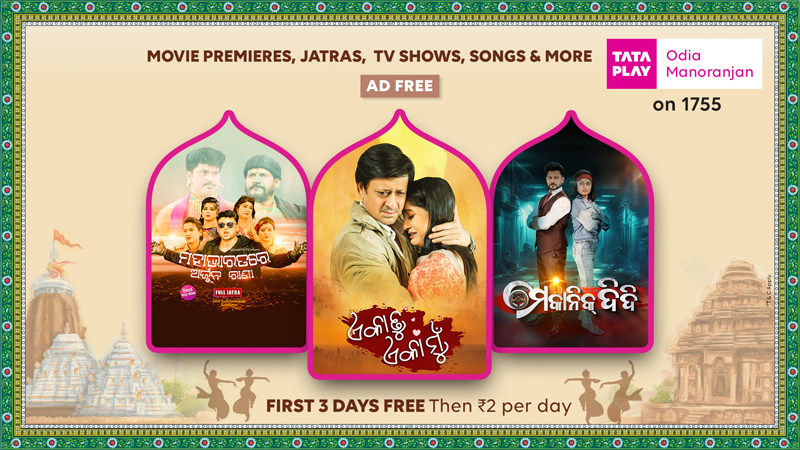
MUMBAI: Tata Play is doubling down on regional loyalty. India’s leading DTH player has launched Tata Play Odia Manoranjan, a new value-added service that corrals Odia entertainment into a single, ad-free destination, available on television and the Tata Play mobile app.
Powered by Sidharth TV, one of Odisha’s most popular Odia-language GECs, the platform serves up a hefty catalogue: over 180 movies, 100+ Jatras, around 20 television shows and a library of more than 12,000 songs spanning devotional, folk, film and non-film genres. From vintage favourites to contemporary titles, the mix is pitched squarely at Odia-speaking households, with particular pull in tier-3 and tier-4 markets.
Subscribers get 24×7, full-screen SD viewing without ad breaks on channel number 1755, with live TV and VOD access across screens. The price point is deliberately sharp: Rs 2 a day.
Pallavi Puri, chief commercial and content officer at Tata Play, framed the move as a bet on language and culture. “India’s strongest viewing loyalties are rooted in language and lived culture. Tata Play Odia Manoranjan brings together the many expressions of Odia entertainment—from films and Jatras to devotional programming and music—into one clearly defined destination. With this launch, Tata Play further elevates its regional content offering by giving Odia audiences a single, definitive home for their stories and traditions.”
For Sidharth TV Network, the partnership is about reach without compromise. Sitaram Agrawalla, owner and chairman, said: “For decades, Odia families have trusted our entertainment platforms for stories that feel like home, and for moments that bring us together. Tata Play Odia Manoranjan builds on this trust by placing a diverse range of Odia films, theatre, devotional music and shows into a single, accessible space. This collaboration isn’t just about wider distribution—it’s about honouring the preferences of Odia viewers with a seamless, ad-free viewing experience that reflects their language, culture and the way they choose to engage with content.”
The new service slots into Tata Play’s expanding portfolio of entertainment and infotainment platform services across genres including entertainment, kids, learning, regional and devotion, catering to all age groups.
In short: one language, one screen, zero ads—and a clear signal that regional is where the real viewing power lies.
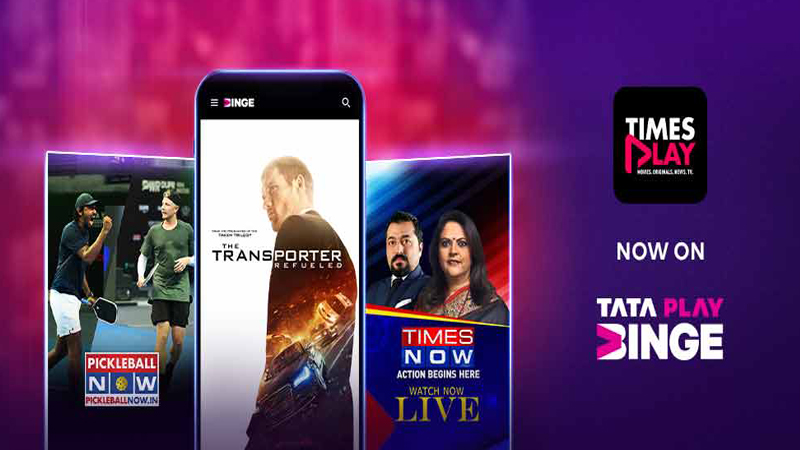
MUMBAI: If streaming had galaxies, Tata Play Binge just opened a wormhole. In its latest move to become India’s most sprawling entertainment universe, the platform has now folded Times Play, Times Network’s digital-first OTT service, into its all-in-one subscription bouquet bringing Hollywood hits, snackable shorts, live news, lifestyle, entertainment, Pickleball and 11 live TV channels under a single roof.
The new addition means subscribers no longer need to hop between apps in Olympic-level finger gymnastics, Binge now pulls Times Network’s entire digital catalogue into one screen, one login, one bill. And in the era of attention overload, that’s practically a public service.
Times Play brings with it a distinctive blend of premium Hollywood cinema, web series, short-format videos, and Times Network’s formidable news muscle. Viewers can flip seamlessly between Romedy Now, Movies Now, MNX, MN+, Zoom, Times Now, Times Now Navbharat, ET Now, ET Now Swadesh, and even Pickleball Now, mirroring the growing Indian appetite for niche sporting entertainment.
On the long-form front, hits like Reunion, India’s Story, True Story of Angeline Jolie, Orphan First Kill, The November Man, Barely Lethal, Southpaw, The Hurt Locker, Transporter Refueled, and The Holiday sit alongside Times Network factual and current-affairs staples including Frankly Speaking, Sawaal Public Ka, and News Ki Paathshaala.
Describing the partnership, Tata Play chief commercial and content officer Pallavi Puri, said the aim remained unchanged to make content discovery effortless and reduce the modern curse of app overload. She noted that integrating Times Play enriches Binge’s already deep catalogue with a broader mix of premium films, originals and news programming “without juggling multiple apps or subscriptions”.
Times Network echoed the sentiment, calling the collaboration a natural extension of its mission to deliver credible entertainment and journalism at scale. It emphasised Tata Play’s reach, reliability and reputation as a key driver in bringing Times Play’s digital catalogue to diverse Indian households.
With the addition of Times Play, Tata Play Binge now boasts 30 plus OTT platforms on a single interface, a list that includes Prime Video, JioHotstar, Zee5, Apple TV+, Lionsgate, SunNXT, Discovery+, BBC Player, Aha, Fancode, ShemarooMe, Hungama, ManoramaMax, Nammaflix, Tarang Plus, Travel XP, Animax, Fuse+, ShortsTV, Curiosity Stream, and DistroTV, among others.
Notably, Netflix remains available as part of combo packs for DTH subscribers, while Amazon Prime Video can be unlocked as an add-on for Binge users with a Tata Play DTH connection. And for large-screen loyalists, all 30 plus apps can be streamed via LG, Samsung and Android Smart TVs, the Tata Play Binge+ set-top box, Amazon FireTV Stick – Tata Play edition, or through TataPlayBinge.com.
The expansion comes on the heels of recent integrations, including WAVES by Prasar Bharati and BBC Player, reinforcing Tata Play Binge’s ambition to remain India’s most diverse, most unified, and most fuss-free entertainment destination.
With Times Play now in the mix, Binge isn’t just aggregating content, it’s quietly aggregating the future of how India watches.



MIB sets OTT accessibility rules, mandates captions and audio description

Boney Kapoor acquires remake rights of Tamil political satire Thalaivar Thambi Thalaimaiyil

Netflix India names Rekha Rane director of films and series marketing

Zabeen signs off from TV9 after shaping the network’s public voice

Dhawan steps up to bat for Delhi’s grassroots sports push

Orient Beverages pops the fizz with steady Q3 gains and rising profits

Cheekatilo shines in the dark with record debut on Prime Video

Swiggy Instamart’s GOV surges 103 per cent year on year to Rs 7,938 crore

These ’90s fashion trends are making a comeback in 2017
The final 6 ‘Game of Thrones’ episodes might feel like a full season
According to Dior Couture, this taboo fashion accessory is back
The old and New Edition cast comes together to perform
Phillies’ Aaron Altherr makes mind-boggling barehanded play
ATN International brings ATN Bangla to Canada
MIB sets OTT accessibility rules, mandates captions and audio description
Boney Kapoor acquires remake rights of Tamil political satire Thalaivar Thambi Thalaimaiyil
Netflix India names Rekha Rane director of films and series marketing
Zabeen signs off from TV9 after shaping the network’s public voice
Dhawan steps up to bat for Delhi’s grassroots sports push
Orient Beverages pops the fizz with steady Q3 gains and rising profits
Cheekatilo shines in the dark with record debut on Prime Video
-
 e-commerce1 month ago
Swiggy Instamart’s GOV surges 103 per cent year on year to Rs 7,938 crore
-
 iWorld1 year ago
Kuku TV transforms India’s OTT space with vertical microdrama boom
-
 News Headline1 year ago
TRAI puts a ‘stop’ to unsolicited calls and messages
-

 News Headline2 months ago
From selfies to big bucks, India’s influencer economy explodes in 2025
-
 Comedy2 years ago
Taarak Mehta Ka Ooltah Chashmah celebrates 4,000 episodes
-
 MAM2 years ago
OpenAI joins C2PA steering committee
-
 News Headline1 year ago
Abhishek Bachchan joins as co-owner of European T20 Premier League
-
 News Headline2 years ago
Odisha to host Ultimate Kho Kho Season 2 from December 24


